
Old vases are among the most sought-after items at any garage or estate sale. But most of the time, people often trade a $1,000 vase for a few bucks, because they don’t know what to check.
If you also don’t know whether your vase is valuable, this guide will show you how to spot them, then walk you through the most collectible vintage vases worth money.
What Counts as a “Vintage” Vase?
Although “antique” and “vintage” are often used synonymously when talking about vases, they mean totally different things in terms of age and worth. A vintage vase is aged 20 to 99 years, while an antique vase is aged 100 years or above.
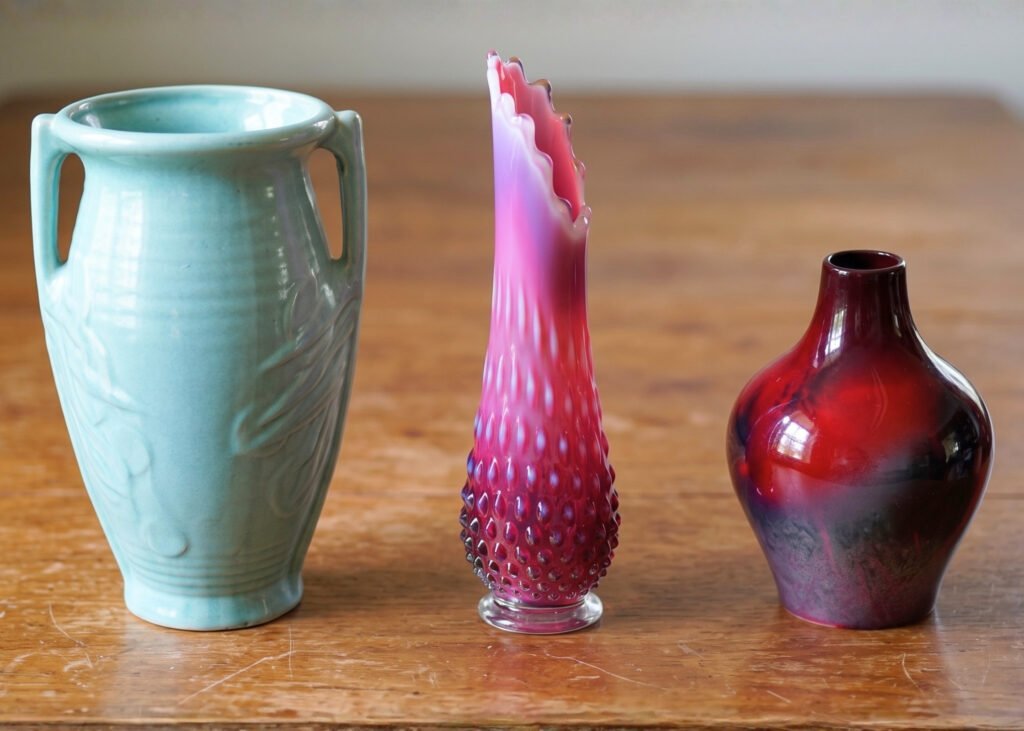
The most popular vases for today’s collectors belong to the vintage category: mid-century Fenton hobnail, 1960s Scheurich fat lava, or an antique McCoy planter that your aunt purchased new back in 1955. Old enough to be desirable, young enough to still turn up at estate sales
How to Identify a Vintage Vase (Easy Checks)
To identify whether an old-looking vase is really a vintage find, you need to check the following four things. Get through them, and you’ll usually know what you’re holding.
The Maker’s Mark First
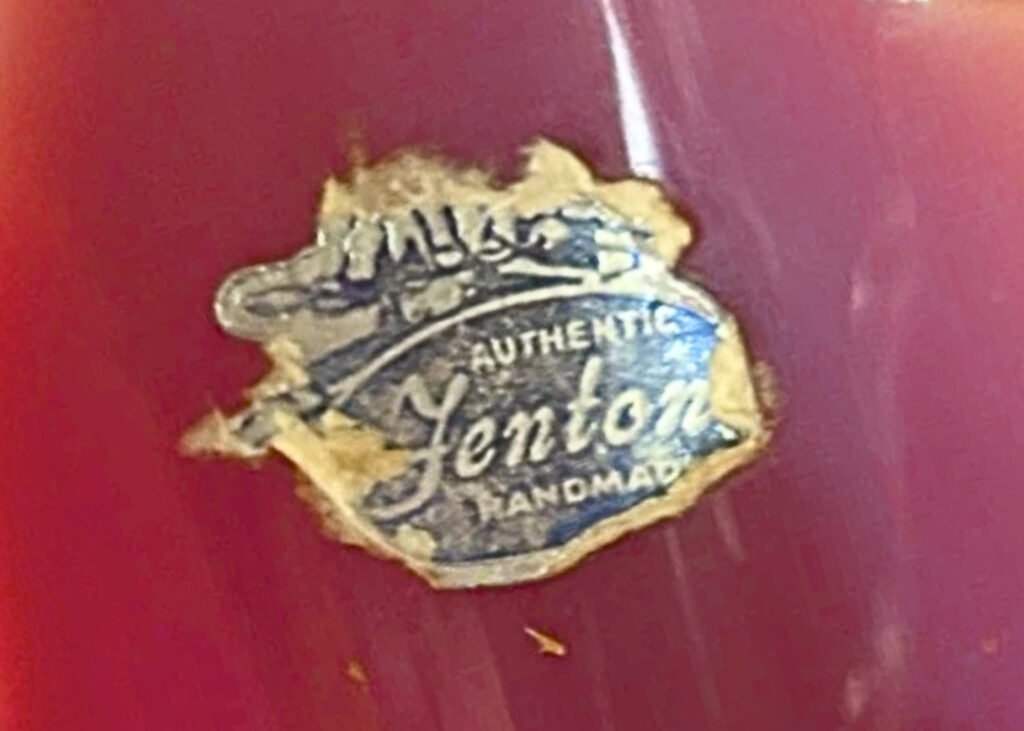
The base is where you’ll find most of the story. So, flip the vase over and look for any sort of impressed stamps (pressed into the clay before firing), painted backstamps, or a paper foil label.
Some of the best makers, like Roseville, used raised script marks that read “Roseville USA” plus a shape and size number, like “121-7” for a shape 121 vase that’s seven inches tall.
Not every mark is honest, though. Reproductions have flooded the market since the 1990s, especially for Roseville, McCoy, and Fenton. So a “perfect” mark that looks freshly stamped on an otherwise beat-up piece is a red flag.
The Country-of-Origin Clue
The country name, if present, is an easy dating tool most people ignore.
For example, Japanese porcelain marked “Nippon” was made between 1891 and 1921, when U.S. customs law required English country names on imports. After 1921, the same factories switched to “Japan.”
Similarly, “Made in Occupied Japan” narrows a piece to 1945 to 1952, and “West Germany” places it between 1949 and 1990.
What to Do When There Are No Markings
Plenty of great vintage vases have no marks at all. Early McCoy pieces before 1920, most Fenton pieces before 1970, and quite a bit of Murano glass were never signed.
In those cases, check the style, weight, glaze, and shape. That’s where reference books and sold eBay listings help you a lot.
The Material and Wear
Run your finger across the base and feel it. Genuine older glass vases often have a pontil mark, which is the rough scar where the piece was cracked off the blowpipe.
Modern reproductions have smooth, machine-finished bases. On pottery, look for even, aged crazing (those tiny hairline glaze cracks). Fake aging tends to look uniform and too dark.
What Makes a Vintage Vase Valuable?
The value of a vintage vase can range from $20 to $2,000 today, with some scarce designs reaching even higher. The overall worth is determined based on the following five factors working together:
- The maker matters most. A name like Lalique or Roseville can multiply a common form by ten.
- Rarity comes next, since limited runs, discontinued colors, and artist-signed pieces always pull higher.
- Next is the condition, because even a hairline crack can cut the value in half.
- Provenance helps, too, so original paper labels or documentation add a real premium.
- And finally, current demand, which constantly shifts. Mid-century modern is hot right now. Brown 1970s pottery is collectible, but not so much.
Note for Collectors: Always compare a vase against sold items on eBay, instead of “listed” items. Sellers list for what they hope to get, but sold prices tell you what people are actually paying for that piece.
11 Most Valuable Vintage Vases That Collectors Chase
Here are some of the highly valuable vases that are actively collected today, plus what makes each one a real find.
1. Lalique “Bacchantes” Frosted Glass Vase
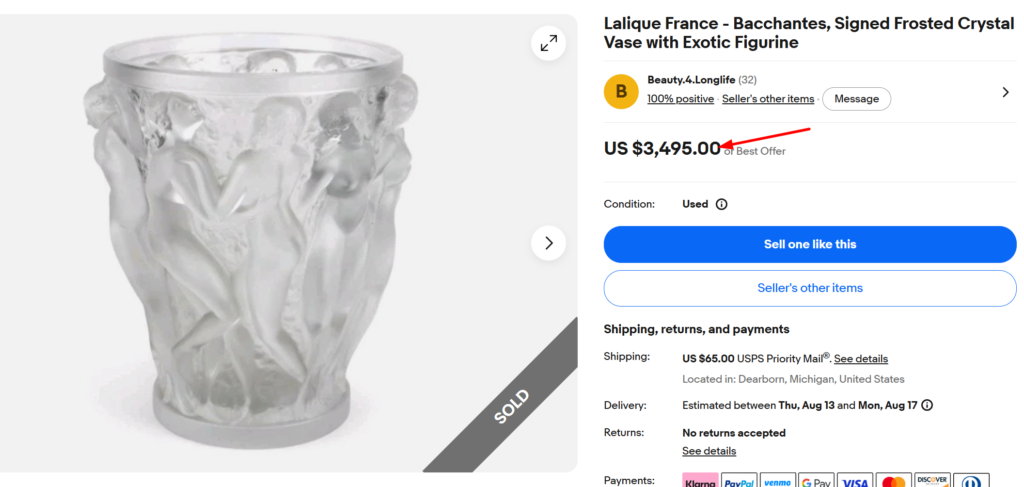
Sold for $3,500
Lalique’s Bacchantes vase is one of the most iconic French crystal designs ever made. The body is covered in frosted nude female figures in high relief, based on René Lalique’s original 1927 model.
Pieces signed “R. Lalique” were made during René’s lifetime, before 1945, and command the highest prices. Post-1945 pieces marked “Lalique France” are still valuable but are worth less.
- Estimated Value: $1,500 to $5,000+
- Production Years: 1927 to present (vintage 1927–1978)
- What to Check: Frosted nude figures, “R. Lalique” or “Lalique France” mark
- Quick Notes: Pre-1945 “R. Lalique” marks are most valuable.
2. Loetz Iridescent Art Glass Vase
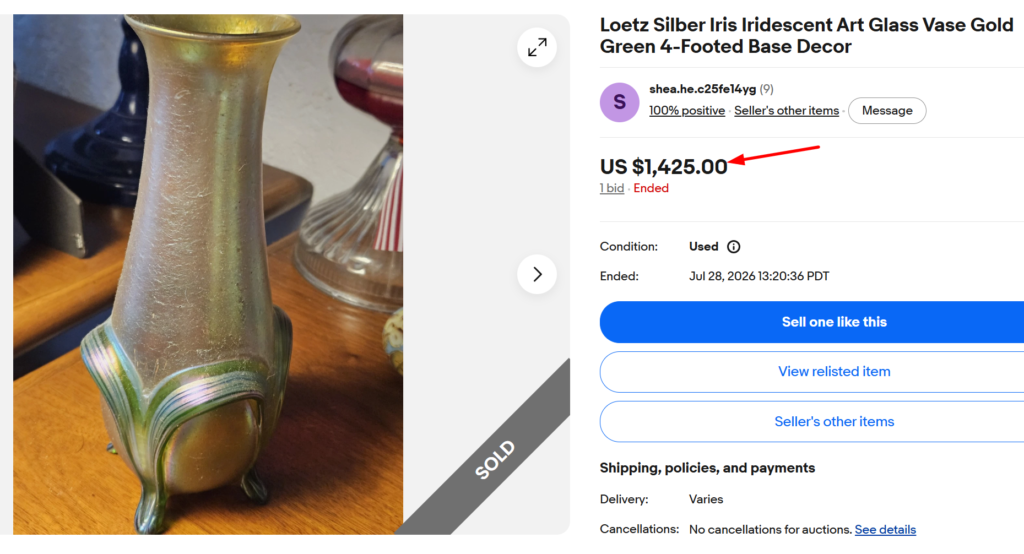
Sold for $1,425
Bohemian glassmaker Loetz produced some of the most collected Art Nouveau iridescent glass. The surface has a metallic, oil-slick shimmer in blues, golds, and purples, sometimes with threaded or pulled decoration.
Most Loetz was never signed, which makes attribution tricky. So, these are often confused with Tiffany. Signed pieces marked “Loetz Austria” are rare and always pull higher.
For unsigned pieces, form, technique, and the ground pontil finish do the identifying work.
- Estimated Value: $400 to $4,000+
- Production Years: 1890s to 1920s
- What to Check: Oil-slick iridescence, threaded decoration, ground pontil
3. Chinese Famille Rose Export Vase
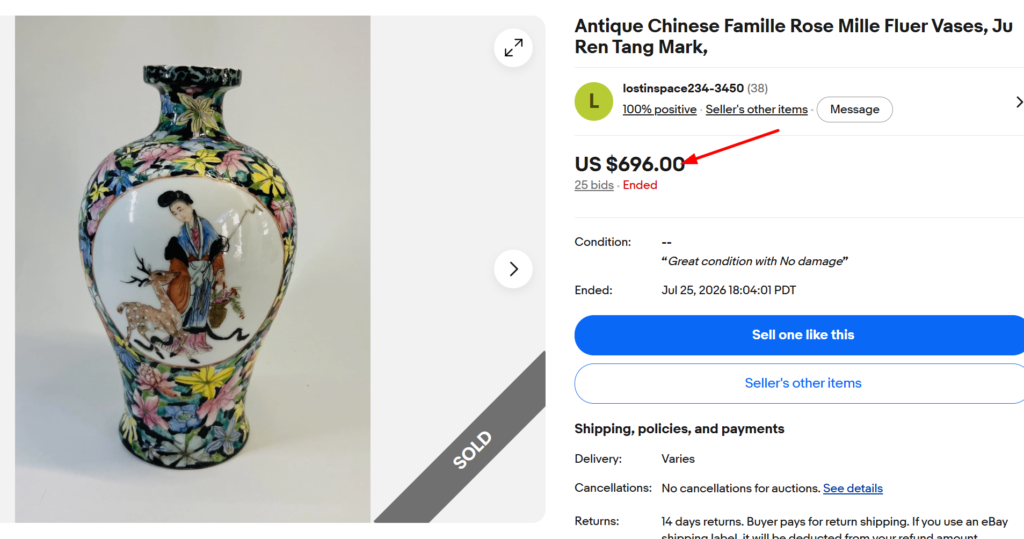
Sold for $700
Famille rose means “pink family,” referring to the enameled palette of pinks, greens, and gilt used on Chinese export porcelain. Vases from the late Qing dynasty through the early Republic period are what most collectors are after.
The reign mark on the base is helpful, but be careful, because later pieces often carry earlier reign marks as tribute (not fakes exactly, just decorative).
Real age shows in the enamel wear, the foot rim finishing, and the weight of the porcelain.
- Estimated Value: $200 to $3,000+
- Production Years: Late 19th to early 20th century
- What to Check: Enameled flowers, pink palette, reign mark on base
4. Roseville Blue Pine Cone Vase
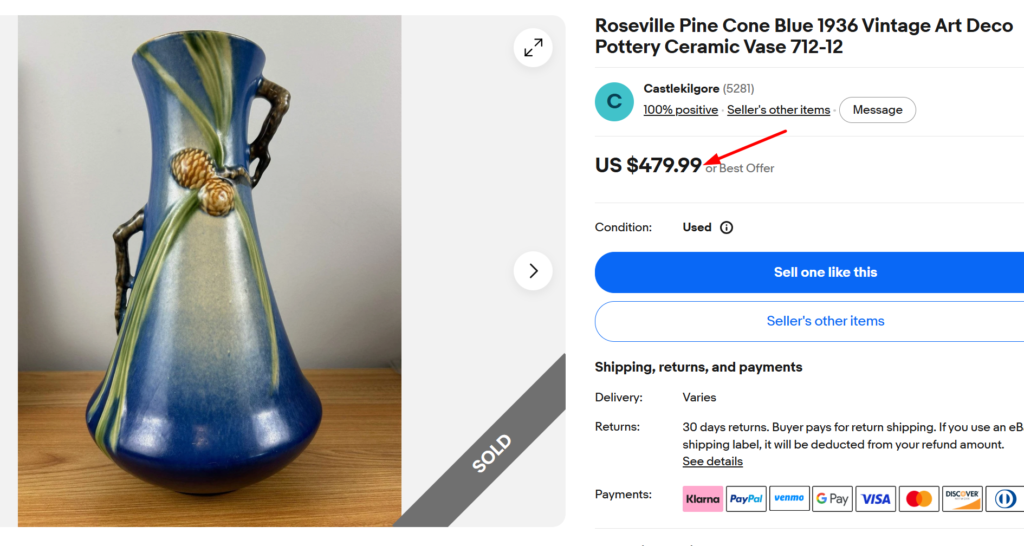
Sold for $480
Roseville’s Pinecone is one of the most recognized American art pottery patterns. The molded pinecones and pine needles wrap around the body, usually against a matte brown, blue, or green ground.
Blue examples always outsell the other two colors, sometimes by double. And larger forms like floor vases, umbrella stands, and jardinieres bring higher numbers than small bud vases.
- Estimated Value: $150 to $600
- Production Years: 1931 to 1953
- What to Check: Raised Pinecone and needle decoration
5. Weller Hudson Vase with Floral Decoration
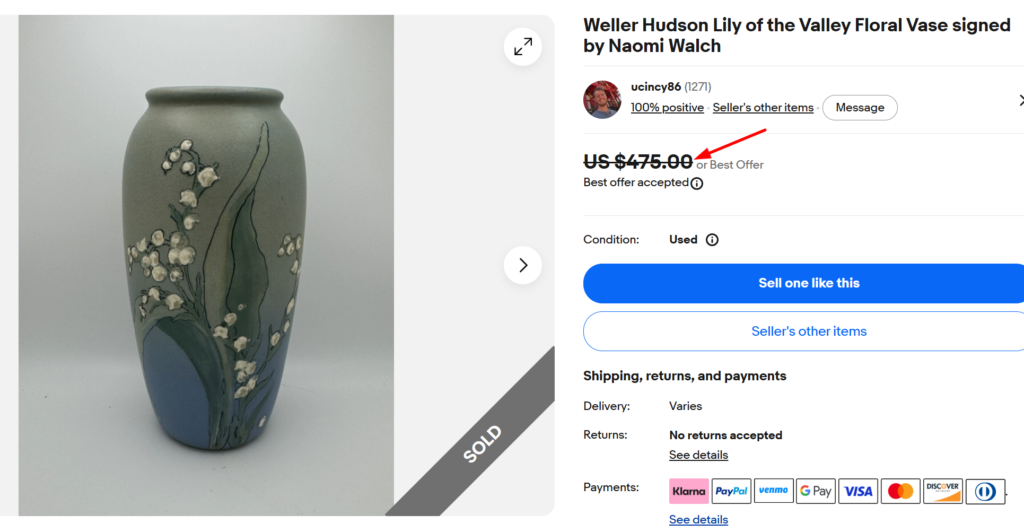
Sold for $475
Weller Hudson is a hand-decorated line with soft floral or wildlife scenes on a matte pastel background. Many pieces are signed on the side by the original decorator, with names like Sara Timberlake or Hester Pillsbury.
An unsigned Hudson vase in average condition still holds decent value. With an artist’s signature and a large, well-decorated form, the price can climb quickly.
- Estimated Value: $200 to $1,500+
- Production Years: 1917 to mid-1930s
- What to Check: Hand-painted florals, matte ground, artist signature
6. McCoy Pottery Double Handle Vase
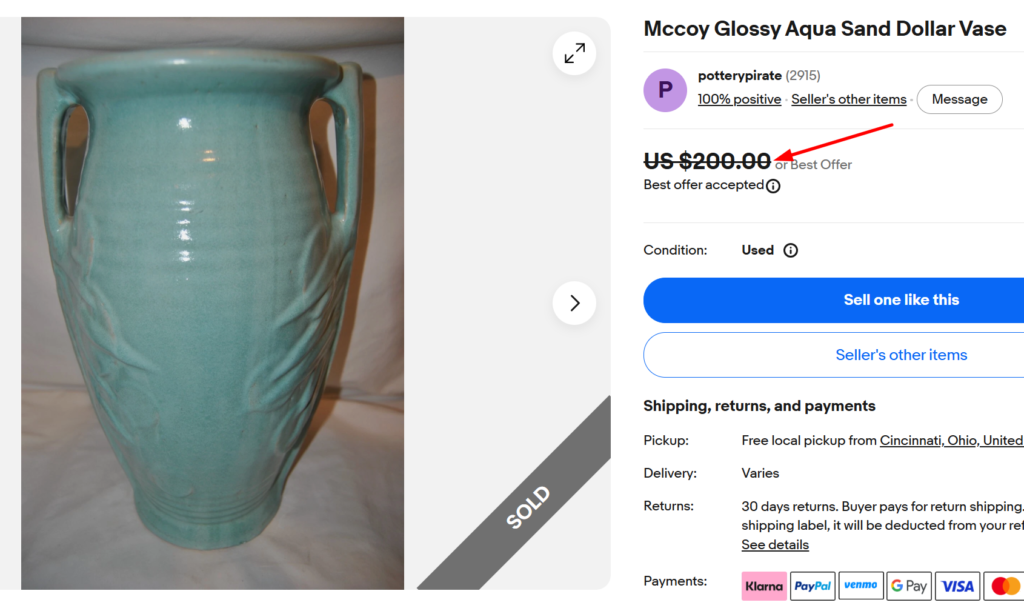
Sold for $200
McCoy built its reputation on soft matte pastels like celadon green, butter yellow, and dusty pink. And the double-handle vase form is one of their most common shapes.
Condition and color are the key value drivers for these pieces. A clean McCoy vase in an unusual color, with the raised McCoy USA mark on the base, is what collectors want.
- Estimated Value: $40 to $150
- Production Years: 1940s to 1950s
- What to Check: Raised “McCoy USA” mark, matte glaze
- ID Notes: Marks on repros look too crisp or feel etched.
7. Fenton Hobnail Cranberry Opalescent Vase
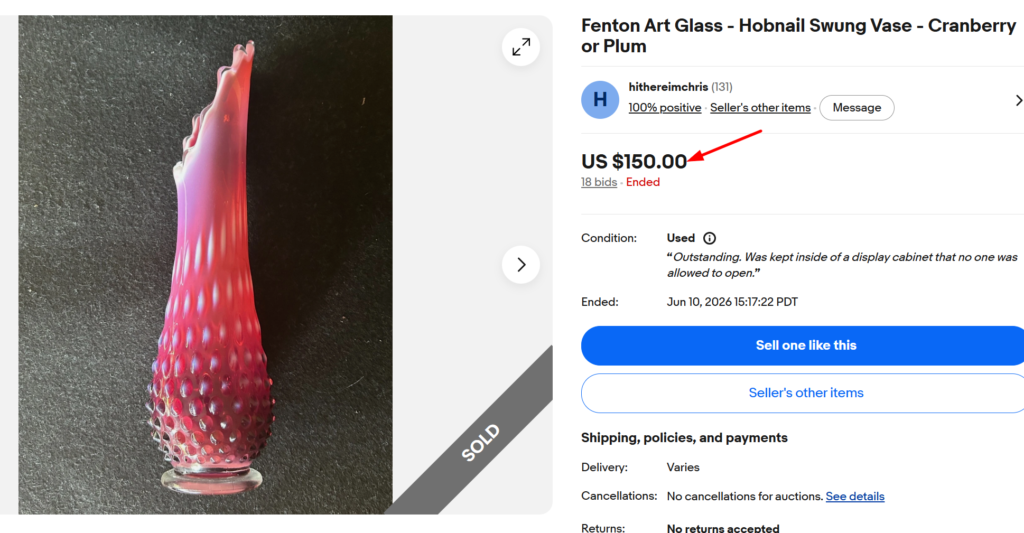
Sold for $150
Fenton’s hobnail line launched in 1939 and became the company’s signature. The pattern is a field of small, raised, round bumps covering the body.
Milk glass hobnail is common and affordable. But cranberry opalescent hobnail, with its pink-to-clear color shift and milky white tips, is the most collectible variant.
Note that pre-1970 Fenton has no molded mark, only paper labels that rarely survive. So, if there’s no label, identification comes down to color, pattern, and the opalescent glow at the edges when you hold it to light.
- Estimated Value: $80 to $400
- Production Years: 1940s to 1960s
- What to Check: Hobnail bumps, milky opalescent edges
8. Murano Sommerso Art Glass Vase
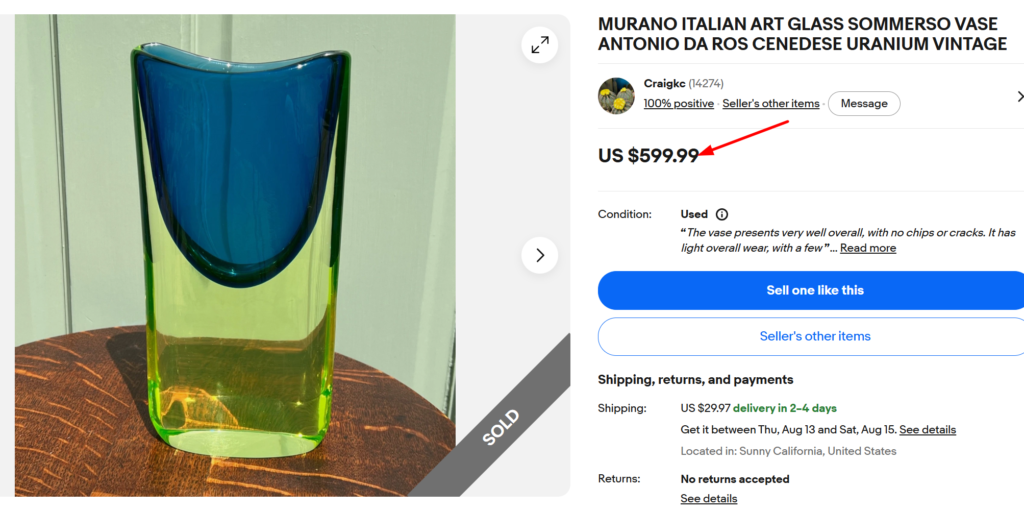
Sold for $600
Murano sommerso means “submerged” in Italian, and the technique layers one color of glass inside another to create a floating effect. The heavy, solid feel and hand-blown asymmetry are dead giveaways.
An unsigned tourist piece with a generic “Made in Murano” label sits in the modest range. But a piece signed by a documented artist like Seguso or Barbini can jump into the thousands.
- Estimated Value: $150 to $2,000+
- Production Years: 1950s to 1970s
- What to Check: Layered colors, heavy base, pontil mark
- Quick Notes: Signed artist pieces are worth the most.
9. Nippon Moriage Dragon Vase
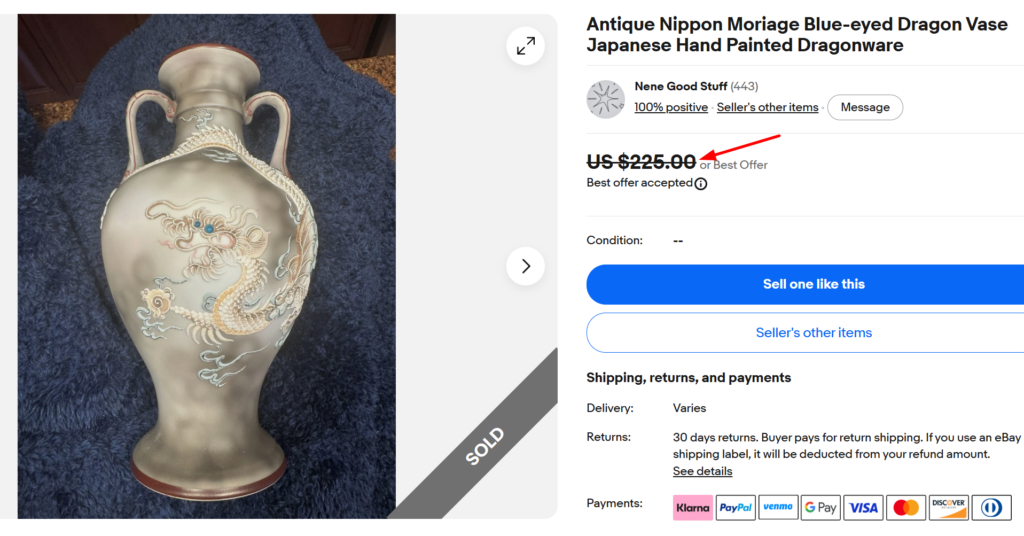
Sold for $225
Moriage is a raised enamel decoration that Japanese artisans built up in layers, often forming dragons, flowers, or landscapes. On a Nippon vase, this hand-applied work shows the real quality.
The green “M in Wreath” backstamp confirms Morimura Brothers production, roughly 1911 to 1921. Just be careful, because reproductions of Nippon marks are everywhere.
Genuine early marks have slight irregularities under a magnifier. Perfect, printed-looking marks usually aren’t.
- Estimated Value: $200 to $800
- Production Years: 1891 to 1921
- What to Check: Raised enamel dragon, green M-in-wreath mark
10. West German Scheurich Fat Lava Vase
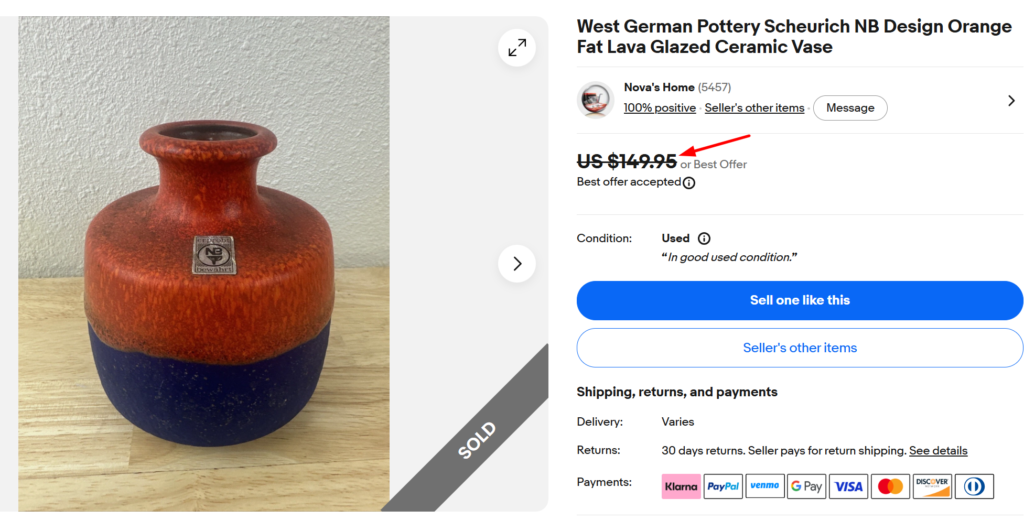
Sold for $150
Fat Lava is the thick, bubbly, textured glaze that West German potters like Scheurich, Bay, and Ruscha perfected in the mid-century. Common colors include orange and brown, and these are affordable. But blue, green, or unusual multi-tone glazes pull real money.
Larger floor vases and pieces with intricate hand-thrown detail are more popular among collectors. Also, check the base for the model number and “W. Germany” or “West Germany” stamps.
- Estimated Value: $60 to $350
- Production Years: 1960s to 1970s
- What to Check: Thick lava glaze, W. Germany mark, mold number
11. Royal Doulton Flambé Vase
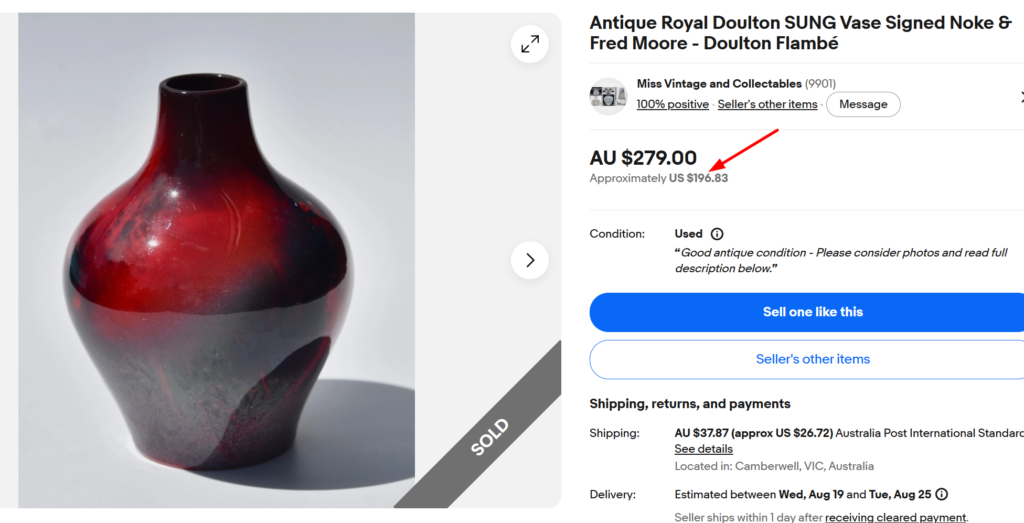
Sold for $200
Royal Doulton’s flambé glaze is a deep, blood-red finish with subtle veining and darker mottling, developed in the early 1900s. The color comes from copper oxide firing in a controlled reduction kiln. That’s why no two pieces look exactly alike.
Standard flambé pieces are collectible but affordable. Special variants like Sung (with mottled blues and purples) and Chang (with thick, cascading glazes) are most valuable.
To confirm authenticity, check the Royal Doulton lion mark plus “Flambé” on the base.
- Estimated Value: $200 to $1,200+
- Production Years: 1902 to present (vintage pre-1970 preferred)
- What to Check: Deep red glaze, veined effect, Doulton lion mark
- Quick Notes: Sung and Chang variants pull the highest prices.
A vintage vase you see in an estate sale or in your attic can be worth real money today when you know what signs to check. Once you know Roseville, McCoy, Fenton, and Loetz designs, you’ll know whether you have a rare find.