
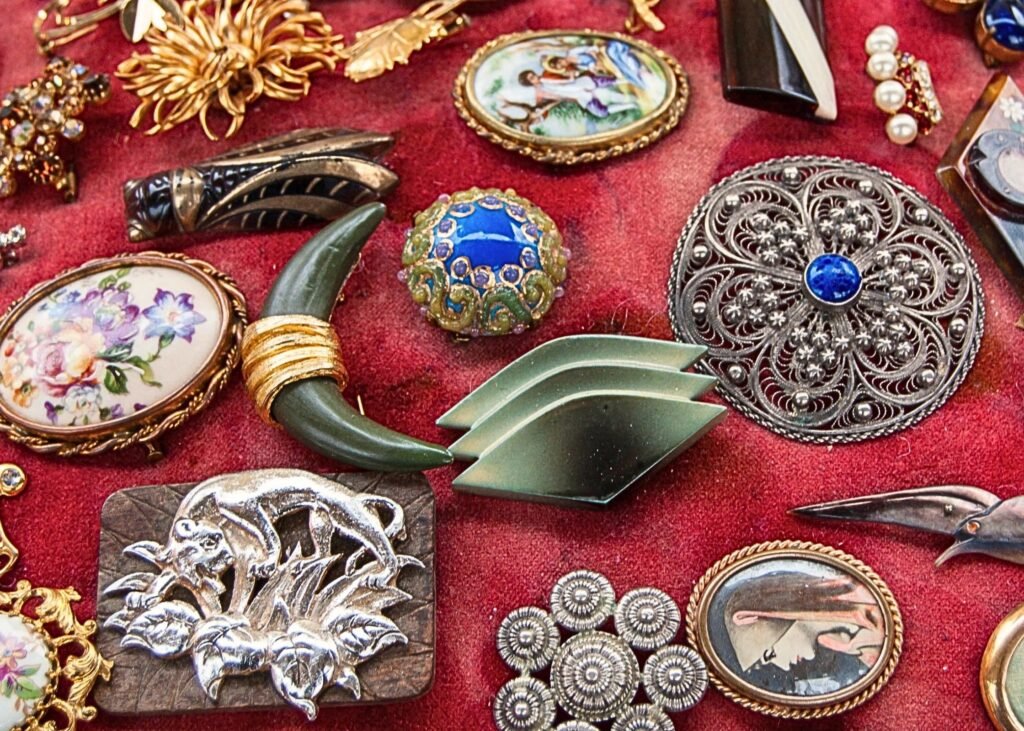
Old antique Victorian jewelry is a tricky collectible category where authentic pieces and modern reproductions look nearly identical. But once you know the clues to check, dating and valuing these pieces and spotting a $5,000 piece vs. a $50 piece gets a lot easier.
So, this guide walks you through the era, the identification tricks that actually work, and the most valuable Victorian styles collectors are still chasing today.
What Is Antique Victorian Jewelry? (Era & Context)
Victorian antique jewelry was made between 1837 and 1901, while Queen Victoria ruled. These are the sixty-four years that witnessed a change in fashion, new materials used, and a revolution in the way jewelry was manufactured and traded.
The period saw the emergence of jewelry factories, increased availability of gold due to the California and Australia Gold Rushes, and the emergence of a class of people eager to buy and wear jewelry. The events in Queen Victoria’s life also affected the fashion of that period, from her romantic marriage to Prince Albert to her long widowhood after his death in 1861.
For collectors today, that context matters because it explains why one Victorian piece looks joyful and floral while another looks dark and somber.
The 3 Sub-Periods of Victorian Jewelry & Their Visual Cues
Jewelry historians classify the Victorian period into distinct eras based on style. The eras were defined by Margaret Flower way back in 1951, and they’re relevant to date.
Each period reflects a phase in Queen Victoria’s life and its reflection on the jewelry. Knowing which period a piece belongs to is the first step in dating and pricing it.
Romantic Period (1837 to 1861)
This is the early love-struck stage of the period. These pieces are delicate in nature and have designs inspired by nature as well as sentimental motifs like hearts, bows, snakes, hands, and forget-me-nots. Some other features include yellow and rose gold, seed pearls, coral, and turquoise.
Grand Period (1861 to 1885)
It all changed after Prince Albert’s death in December 1861. Queen Victoria spent the rest of her days in mourning, and so did fashion. Grand Period jewelry is more dramatic and heavy. This means that you will find large brooches, jet, black onyx, and archaeology inspired by Etruscan, Egyptian, and Renaissance styles.
Aesthetic Period (1885 to 1901)
This period got lighter again. The pieces got smaller and more fanciful, filled with crescent moons, stars, insects, and flowers. Diamonds came back into style, along with the semiprecious stones of amethysts and opals. This is when Victorian jewelry begins to transition into Edwardian jewelry.
Victorian vs Georgian vs Edwardian vs Art Deco (How to Tell)
Collectors often mix these eras up because the transitions are gradual. Here’s the fastest way to tell them apart.
| Era | Years | Look and Feel | Key Materials |
|---|---|---|---|
| Georgian | 1714 to 1837 | Handmade, foil-backed stones, cannetille work | High-karat gold, closed settings |
| Victorian | 1837 to 1901 | Sentimental, symbolic, three sub-styles/moods | 9k to 22k gold, silver, jet, seed pearls |
| Edwardian | 1901 to 1910 | Light, lacy, feminine, garland style | Platinum, diamonds, pearls |
| Art Deco | 1920 to 1935 | Geometric, bold, symmetrical, machine-precise | Platinum, colored gemstones, onyx |
ID Tip: The clearest difference between Edwardian vs Victorian jewelry is platinum. If you see platinum with lacy openwork and a lot of diamonds, it’s Edwardian, not Victorian.
How to Identify Authentic Antique Victorian Jewelry?
Reproduction Victorian pieces have flooded the market since the 1970s, and some of them are quite convincing at first glance. But real Victorian jewelry has certain clues that easily give it away. Check them in order to know if the piece is genuine.
1. Hallmarks and Maker’s Marks
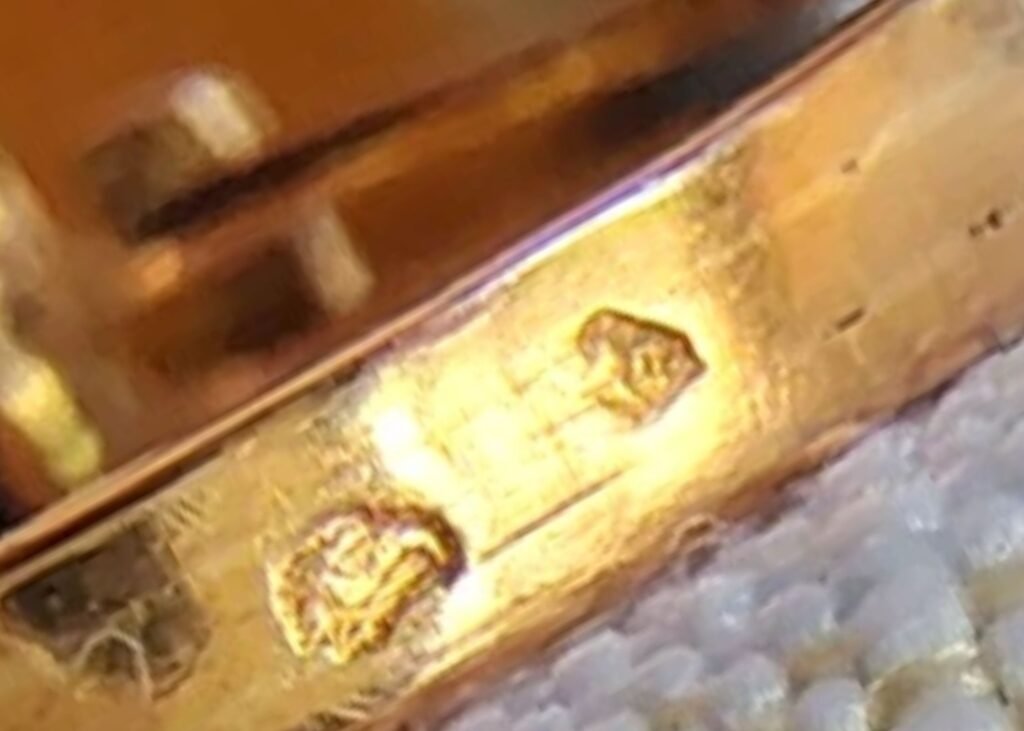
Hallmarks help with precise dating. British Victorian pieces are the easiest to date because the UK had strict hallmarking laws throughout the era. Check the following spot for marks:
- Inside the rings
- On the reverse of the brooches
- Near the clasp of bracelets.
You’ll usually find a small cluster of tiny stamps grouped together.
Only two gold purities were legally allowed in British jewelry before 1854: 18k and 22k. The law then opened up to include 9k, 12k, and 15k as legal standards. So a piece marked 15k almost certainly dates between 1854 and 1932, when that standard was dropped.
British hallmarks also carry an assay office symbol. A leopard’s head points to London, an anchor points to Birmingham, and three wheat sheaves point to Chester. There’s also a date letter that changes every year, which pins the piece to a single year if you can read it.
Quick Tip: A monarch’s head stamped alongside the other marks is the duty mark, meaning tax was paid on the piece. It was used from 1784 to 1890. Queen Victoria’s profile on the stamp confirms the piece dates before 1891.
Identifying American Victorian jewelry by the mark is a bit trickier because the US didn’t require hallmarking. Most American pieces are unmarked or carry only a purity stamp like 14k or 10k.
2. Metals Used
Real Victorian pieces stuck to certain metals. High-purity 18k and 22k gold was the standard in Britain before 1854, and that’s what most early Victorian pieces have. Post-1854 pieces were also made of 9k, 12k, and 15k gold after the law changed.
Rose gold is common in Romantic Period pieces. Silver became more common in the 1860s after the Nevada silver rush. And keep an eye out for two Victorian materials:
- Rolled gold, which is a thin gold sheet soldered onto a base metal
- Pinchbeck is a copper-zinc alloy that mimics the appearance of gold.
Both are period-appropriate and can still be valuable.
A piece stamped 14k or 10k claiming to be Victorian is almost always a later reproduction, since those karat weights weren’t the British standard during the era.
3. Construction Clues on the Back
The front of the jewelry item shows what the maker wanted you to see; the back shows how it was actually made.
- The C-clasp is the single best marker for pre-1910 brooches. It’s a plain, curved metal piece with no locking mechanism; it stays put just by friction. If a brooch has a C-clasp with a tube hinge, it’s almost certainly Victorian or earlier.
- The pin length matters, too. On brooches made before around 1890, the pin is longer than the frame, so that the wearer could weave it into the thick fabric of Victorian dresses. Short, neat pins usually mean the piece is a later revival.
- The hinge is another clue. Victorian tube hinges are long cylinders of rolled sheet metal with a visible seam. Small, round machine-made hinges took over in the early 1900s and became standard.
If you see a modern rollover safety catch, the piece is post-1920s, no matter how Victorian the front looks.
4. Motifs and Symbols
The Victorian jewelers made their jewelry meaningful using certain signs and design elements. Learning the common motifs can help you date a piece and often multiply its value.
- Snakes – eternal love, made famous by Queen Victoria’s own emerald-set snake engagement ring
- Forget-me-nots – remembrance, often paired with mourning pieces
- Anchors – hope
- Hands (clasped) – friendship or marriage
- Ivy – fidelity and eternal friendship
- Weeping willow or urn – mourning
- Ouroboros (snake eating its tail) – eternity
Pieces with clear, well-carved motifs usually sell for more than plain ones. A snake ring with garnet eyes will nearly always beat a plain gold band from the same year.
5. Stone Cuts of the Era
Victorian gem cuts look different from modern ones because they were cut by hand. Old mine-cut and rose-cut diamonds were the primary cuts in the era. Both have flat, dull backs and warmer reflections than modern brilliant cuts.
You’ll also see foil-backed stones, especially in Romantic pieces. It’s a thin metallic foil behind a closed-back setting that boosts the stone’s color. If you see a closed metal back on a ring or brooch, don’t try to clean it with water; the foil will dissolve.
Diamonds set in silver on top of gold are another Victorian construction cue. Silver made the stones look whiter, and gold underneath kept the setting strong.
Reproduction Red Flags
Based on all the above clues, the following clues give away modern Victorian jewelry copies almost immediately:
- Machine-perfect stamping and lettering (real Victorian marks are slightly uneven)
- A modern rollover safety catch on any brooch
- 14k or 10k gold on a piece marked as pre-1900 British
- Bright, uniform enamel with no wear at all
- Suspiciously lightweight for the size (real gold pieces feel dense)
How Much Is Antique Victorian Jewelry Worth?
Today, a genuine antique Victorian jewelry piece can be worth anywhere from $80 to a whopping $5,000. The value depends on five main things:
- Material
- Maker
- Condition
- Provenance
- Rarity of the motif.
Most modest Victorian pieces sell in the $100 to $400 range on eBay. Cleaner and better examples with strong hallmarks or intact enamel push into the $500 to $1,500 range. And the top tier, with signed makers or rare motifs, can hit five figures at auction.
Condition matters more than most people realize. Missing enamel on a mourning locket or replaced hairwork behind glass drops the price by half. But a piece with original patina, all its stones, and a working clasp holds strong.
8 Most Collectible Victorian Jewelry Styles & Designs to Know
Below are the most iconic antique Victorian jewelry designs that collectors hunt for today, plus their ID and value clues, and average worth.
1. Snake Rings and Bracelets
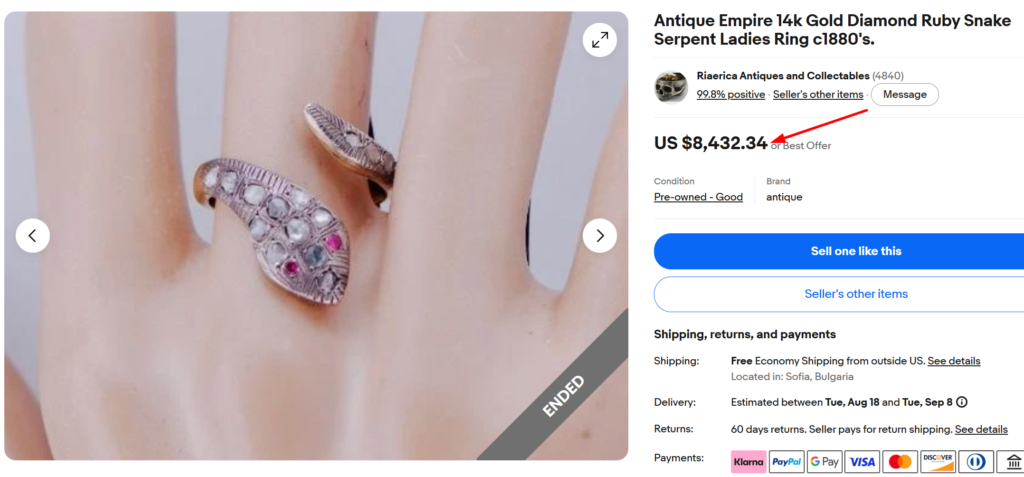
Sold for $,8430
Snake jewelry took off after Prince Albert proposed to Queen Victoria in 1839 with a coiled serpent emerald (her birthstone) ring. The motif symbolized eternal love, and snake pieces stayed popular for the entire era.
You’ll find single coiled snakes, double intertwined snakes, and sometimes triple snake bracelets. The heads usually hold gemstones like turquoise, rubies, garnets, or diamonds. Enamel snake bangles from the 1860s and 1870s are especially collectible.
- Estimated Value: $400 to $3,000, gem-set examples higher
- Production Years: 1840 to 1900
- What to Check: Textured scales, gemstone in the head
- Value Notes: Fine enamel work multiplies the value
2. Memento Mori and Lover’s Eye Pieces
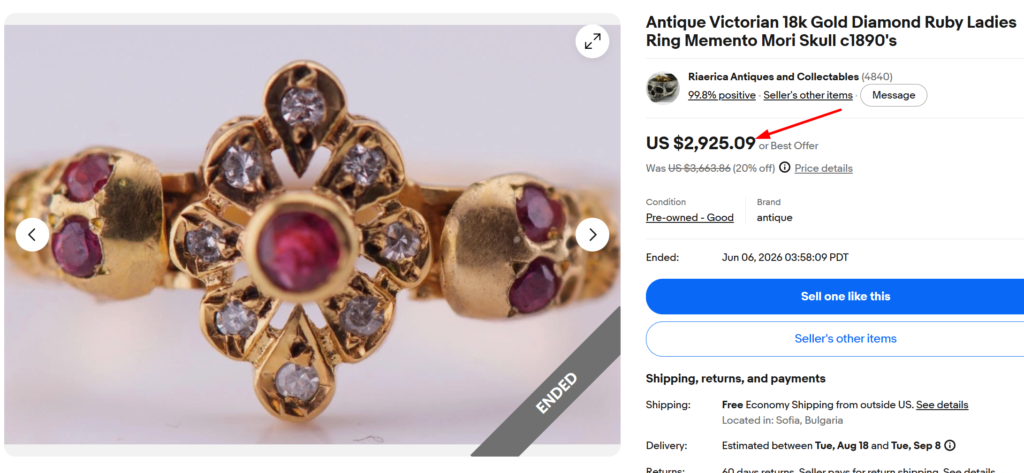
Sold for $2,925
These are the truly unusual Victorian pieces. Memento mori jewelry uses skulls, urns, coffins, or ouroboros motifs as reminders of mortality. Look for period frames in gold with seed pearls or garnets surrounding the miniature.
Lover’s eye pieces feature a tiny hand-painted watercolor of a single eye, usually a spouse or secret lover, set behind glass.
Both categories are genuinely rare. Lover’s eye pieces, especially, because most were destroyed or lost.
- Estimated Value: $600 to $5,000+, lover’s eye highest
- Production Years: 1830 to 1880 (lover’s eye earlier)
- What to Check: Hand-painted miniature, seed-pearl frame
3. Cameo Brooches (Shell, Coral, and Hardstone)
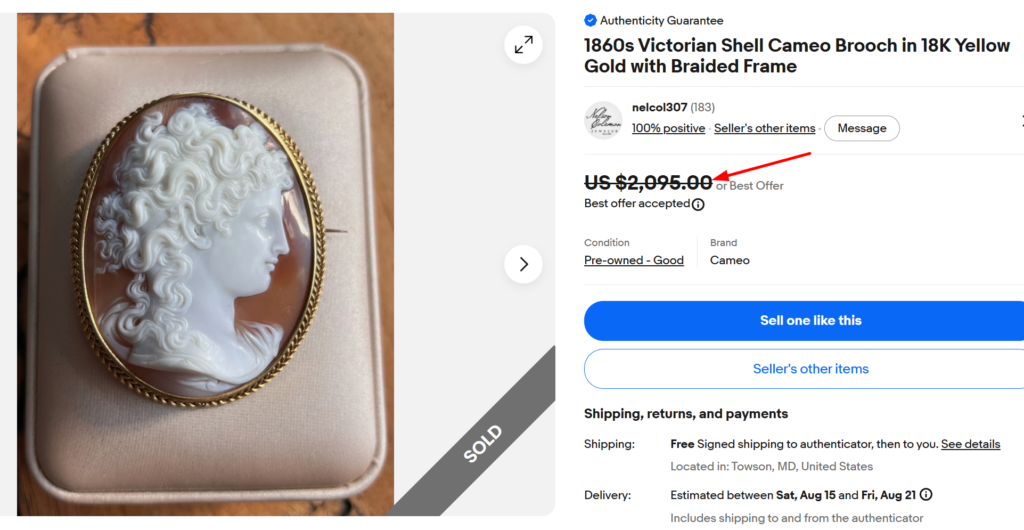
Sold for $2,095
Cameos are the most recognizable Victorian style, and they’re also the most faked pieces. Real Victorian cameos were hand-carved from shell, coral, agate, sardonyx, or lava.
Mediterranean coral pieces, especially the pale pink “angel skin” and deep red varieties, are among the most desirable. Signed cameos by carvers like Tommaso Saulini can also bring several hundred to several thousand dollars.
Always check the profile. Portrait cameos from the Victorian era usually show a straight, classical nose. If the face looks cute and pert, the piece is almost always modern.
- Estimated Value: $80 to $1,500, signed carvers sell for more
- Production Years: 1840 to 1900
- What to Check: Hand-carved relief, straight nose profile
- Value Notes: Coral and hardstone pieces are worth more than shell.
4. Bohemian Garnet Jewelry
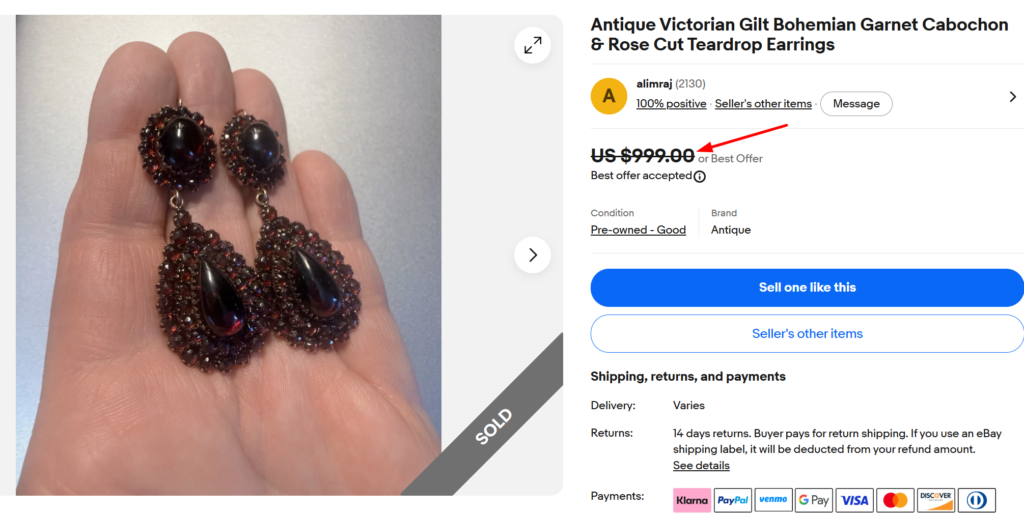
Sold for $1,000 (pair)
Deep red pyrope garnets from Bohemia were pretty common in Europe during the Victorian era. The pieces are usually cluster designs, set in rose gold or gilt metal with rose-cut garnets packed together like tiny pomegranate seeds.
Bracelets, brooches, and necklaces all appear in this style.
The metal isn’t usually high-karat, which throws people off. Most Bohemian garnet pieces use low-grade gold or rolled gold over a base metal. But the garnets themselves and the density of the setting drive the value.
- Estimated Value: $150 to $800, full parures much higher
- Production Years: 1860 to 1900
- What to Check: Rose-cut garnets, cluster settings
5. Hairwork Jewelry and Mourning Lockets
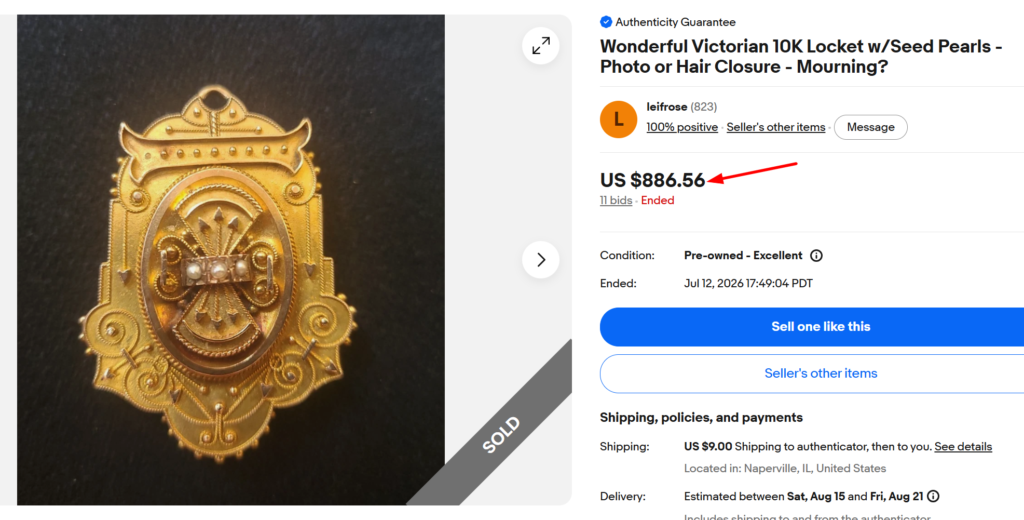
Sold for $885
Victorians wove human hair into intricate jewelry as a keepsake, both for the living and the dead. The demand got so intense that England imported around fifty tons of human hair each year during the height of the era to keep up with jewelry production.
Look for lockets with a glass compartment holding braided or woven hair, often paired with an engraved date or initials. Gold-back-and-front lockets with intact hairwork are most collectible. Hair that’s disintegrated or has been replaced significantly hurts value.
- Estimated Value: $200 to $1,100 for gold examples
- Production Years: 1840 to 1890
- What to Check: Intact glass, woven hair pattern
- Value Notes: Engraved names or dates add real value
6. Etruscan Revival Gold Pieces
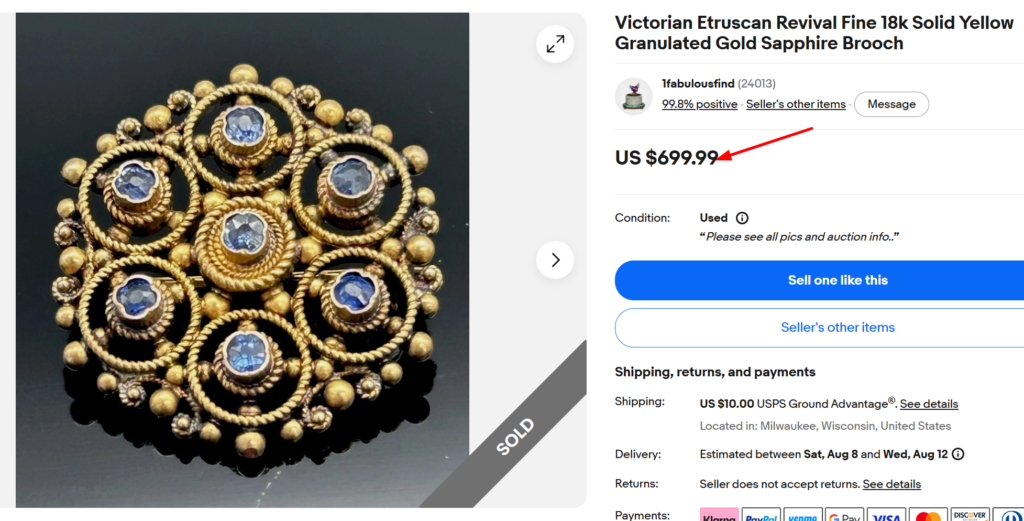
Sold for $700
Once archaeologists started uncovering Etruscan tombs in Italy in the mid-1800s, a Roman goldsmith named Fortunato Pio Castellani figured out how to recreate the ancient technique of granulation.
It’s the process of fusing tiny gold beads to a surface without any visible solder. His work became quite popular and ran roughly from 1860 to 1885.
The hallmarks of the Etruscan Revival include a heavy use of gold, granulation, fine twisting, and a soft matte surface accomplished by a process called blooming. Signed Castellani items are hard to come by. Even unsigned examples in solid gold fetch premiums.
- Estimated Value: $500 to $5,000+, signed pieces much more
- Production Years: 1860 to 1885
- What to Check: Granulation, filigree, matte gold finish
- Quick Notes: Look for Castellani or Giuliano signatures.
7. Crescent Moon and Star Brooches
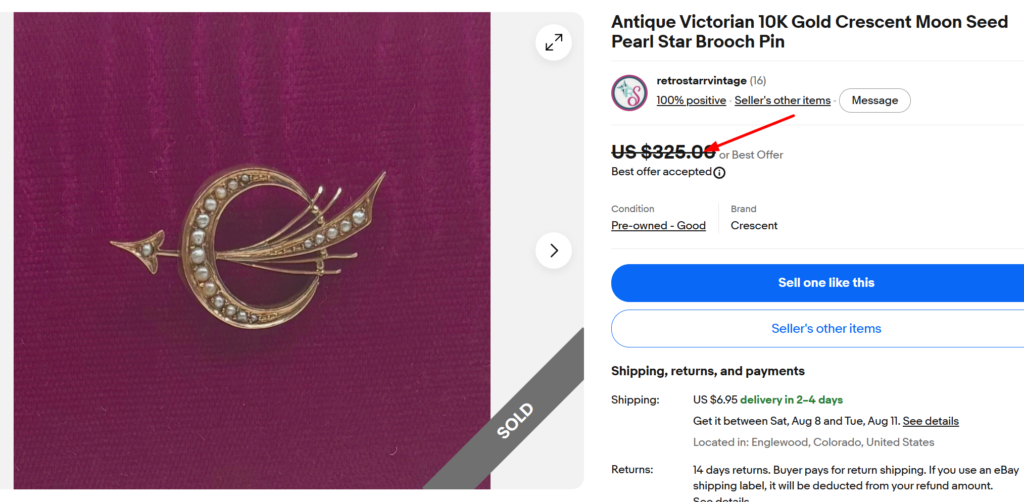
Sold for 325
Late Victorian celestial jewelry has a huge modern collector base. Crescent moons, stars, and combined moon-and-star designs were the signature look of the Aesthetic Period (roughly 1880 to 1900).
Most pieces were set with diamonds, pearls, or Bohemian garnets, and the classic construction is silver over gold, with old mine cut or rose cut diamonds pavé-set across the crescent.
Always check for a mixture of 15k gold on the back and silver on the front to spot a genuine Victorian piece. Modern reproductions use white gold or platinum.
- Estimated Value: $400 to $2,500+, depending on stones
- Production Years: 1880 to 1900
- What to Check: Silver front over gold back
8. Whitby Jet Mourning Brooches
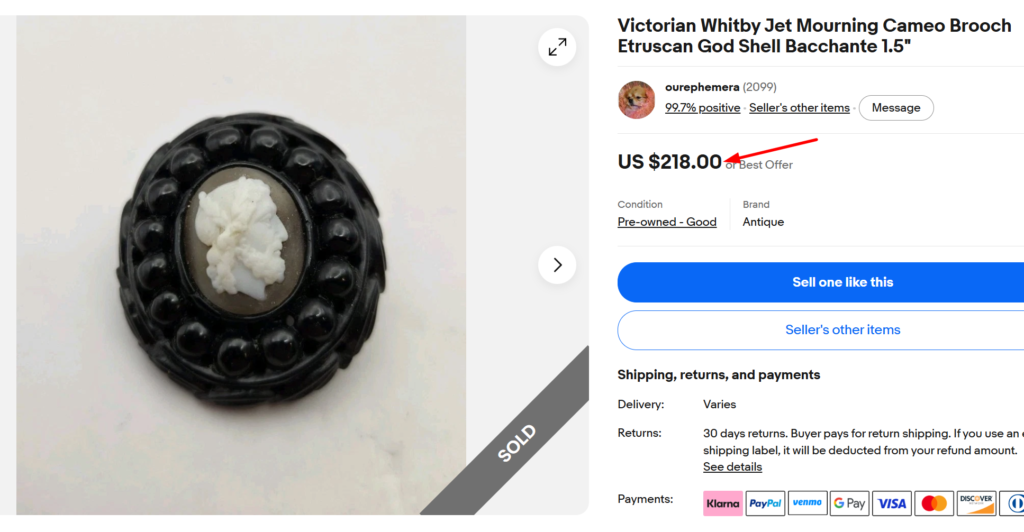
Sold for $220
Jet is fossilized wood mined almost exclusively near Whitby on the Yorkshire coast. Whitby jet pieces exploded after Prince Albert’s death and dominated mourning fashion through the 1880s.
The Grand Period pieces are big, hand-carved, and often feature weeping willows, urns, or floral motifs. And genuine Whitby is warm to the touch, surprisingly lightweight, and takes a deep polish.
Authentic pieces will have genuine hand-carving marks, not molded patterns; that’s the fastest way to separate real jet from vulcanite copies (molded rubber).
ID Tip: Vulcanite copies smell of sulfur when rubbed
- Estimated Value: $150 to $400, higher with provenance
- Production Years: 1861 to 1890
- What to Check: Hand-carved surface, warm to touch
You don’t need to memorize every hallmark or motif to identify authentic antique Victorian jewelry. It’s learning to flip the piece over first, check the clasp and hinge, then work backward to the story on the front. These steps will save you from most reproduction traps.