
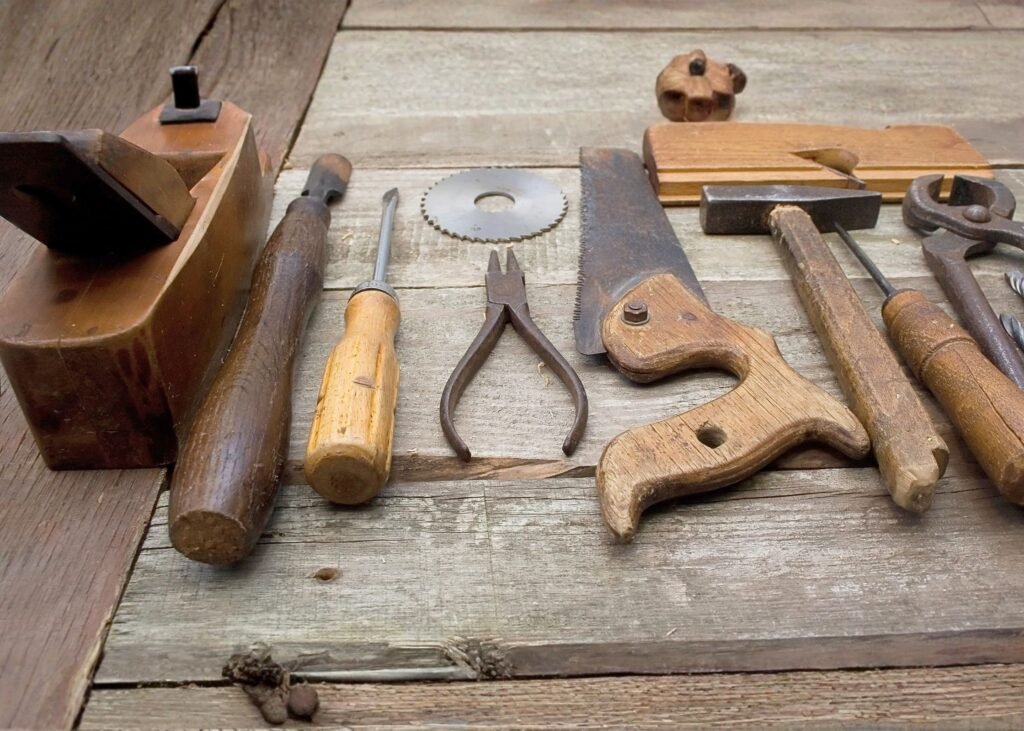
Old tools look heavy and sturdy, but not every rusted wrench and dusty plane is valuable. However, some rare hand tools actually bring $200 to $1,500+ in the resale market today.
Valuable Antique Hand Tools Collectors Are Paying For
Below are listed 9 antique and vintage hand tools that are most likely to turn a few bucks into a real fortune. Each one includes what to look for, why it matters, and roughly what it’s worth.
1. Stanley No. 1 Smooth Plane
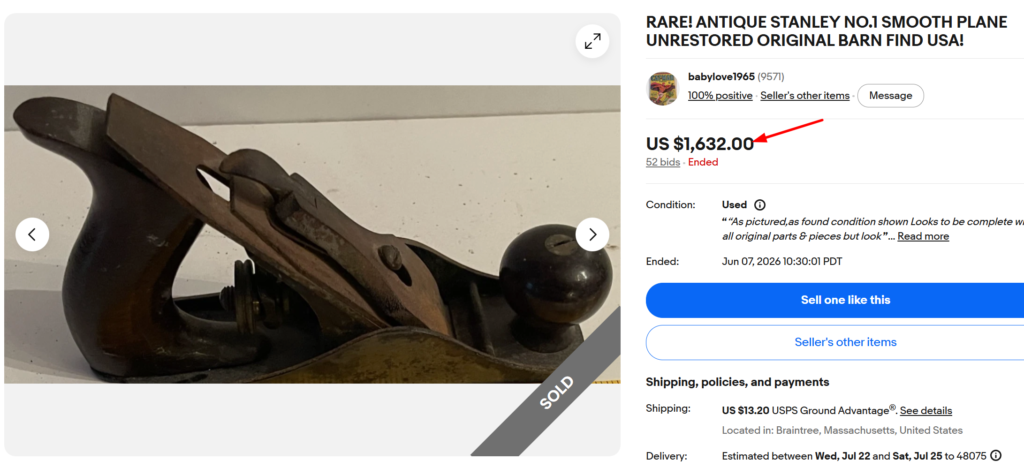
Sold for $1,630
The Stanley No. 1 is the smallest bench plane Stanley ever made, at just 5.5 inches long with a 1.25-inch cutter. It has a small rosewood tote, a mushroom-shaped front knob, and no lateral adjustment lever because the body is too small to fit one.
Collectors hunt this plane to build a complete No. 1 through No. 8 set.
- Estimated Value: $800 to $2,800+
- Production Years: 1867 to 1943
- What to Check: “No. 1” cast into body, Sweetheart logo blade
- Quick Notes: Early Type 1 to 4 planes bring the most
2. Disston D-8 Handsaw with Original Etch
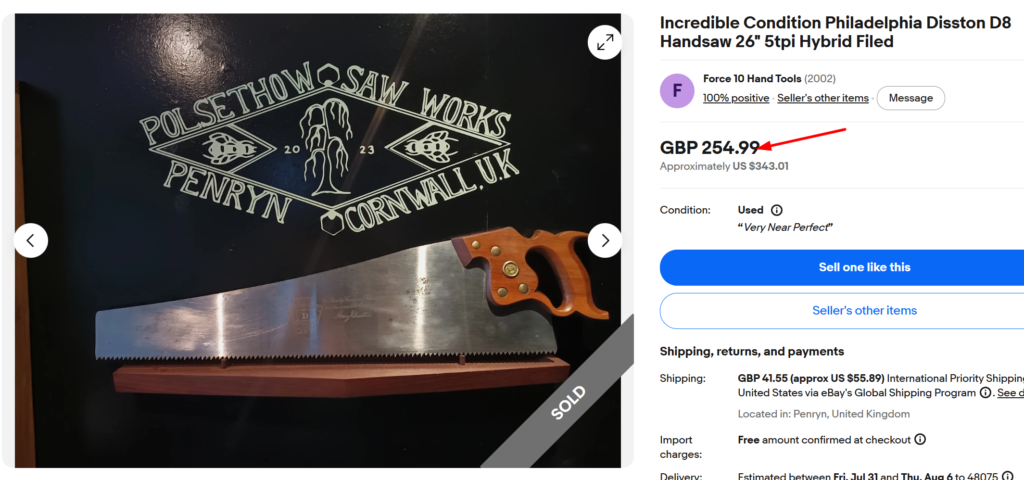
Sold for $255
The Disston D-8 is a 26-inch skew-back handsaw with a curved, carved apple wood handle, four brass split-nut screws, and a brass medallion at the top of the grip.
The blade carries an acid-etched keystone logo behind the handle. Both the medallion text and the etch style change by era, which is what makes precise dating possible.
Quick Tip: “Warranted Superior” is a generic saw, not Disston
- Estimated Value: $75 to $400+
- Production Years: 1876 to 1955 (D-8), pre-1928 for “No. 8”
- What to Check: Medallion text, blade etch, apple wood handle
3. Stanley No. 45 Combination Plane
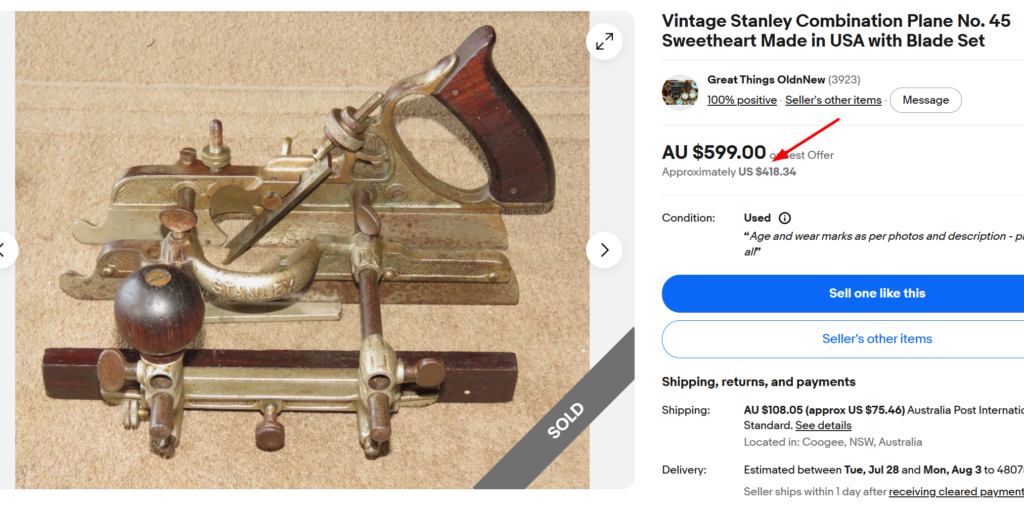
Sold for $420
The Stanley No. 45 is a nickel-plated cast-iron combination plane with a main body, a sliding fence with two threaded arms, a depth stop, and a hardwood tote.
It was marketed as “seven planes in one” and came with 22 to 23 standard cutters in two boxes. If you find one with the original wood box and paper instructions, you’ve hit the jackpot.
- Estimated Value: $75 to $450 (complete)
- Production Years: 1883 to 1962
- What to Check: Original wood box, cutter count, patent dates
- Quick Notes: Early Type 1 to 4 planes (1883–1889) bring premiums
4. Antique Wooden Molding Plane
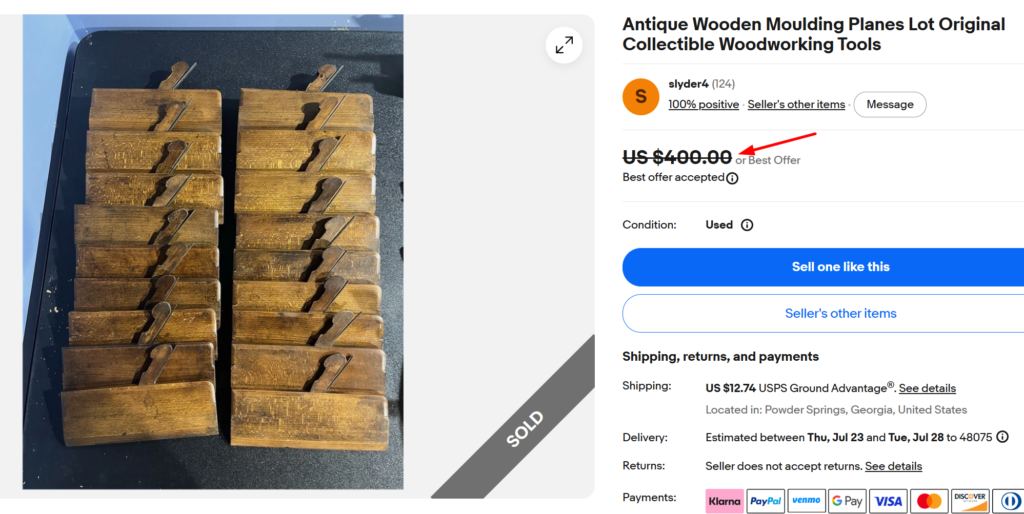
Sold for $400
Old wooden molding planes show up at estate sales in dusty piles. And most people ignore them. These are rectangular beech blocks roughly 9.5 inches long, with a shaped iron cutter, a wedge holding it in place, and a profile carved into the sole.
Hollows and rounds come in numbered pairs. Names to look for include H. Chapin, Ohio Tool Co., Sandusky Tool Co., and Auburn Tool Co., all stamped on the toe.
- Estimated Value: $15 to $100 each; sets $500+
- Production Years: Late 1700s to early 1900s
- What to Check: Maker’s stamp on toe, wedge shape, boxwood inserts
- Quick Notes: Matched sets are worth far more than singles
5. Brass Plumb Bob (Mercury-Filled)
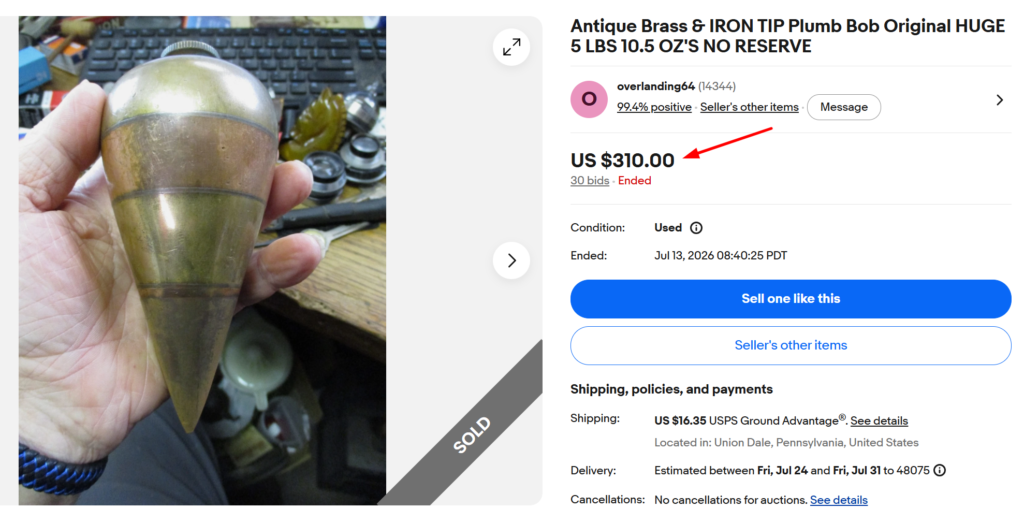
Sold for $310
A mercury-filled plumb bob is a hollow brass or steel teardrop with a small screw plug at the top and a pointed steel tip at the bottom. Starrett No. 87 and Brown & Sharpe No. 790 are the two names that collectors look for.
Mercury weighs 75% more than steel, which is why these were the premium tools for surveyors and machinists.
- Estimated Value: $50 to $200+
- Production Years: Late 1800s to 1970s
- What to Check: Screw plug at top, maker’s mark, original box
Warning: Do not open the plug, mercury inside is toxic.
6. Coes Monkey Wrench with Wood Handle
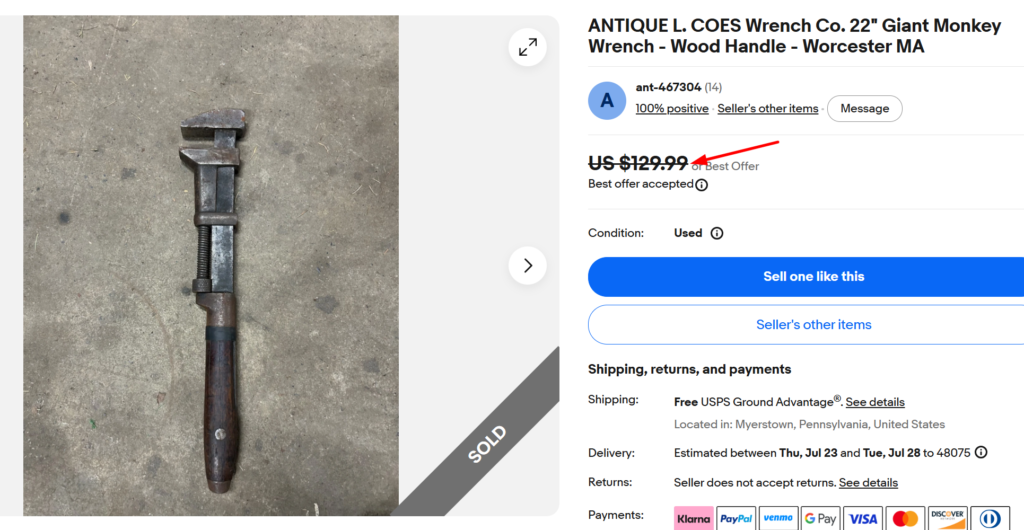
Sold for $130
The original monkey wrench patent went to Loring Coes on April 16, 1841, and the Coes Wrench Co. of Worcester, Massachusetts, made them for the rest of the century.
It features a wrought-iron head with two flat parallel jaws, a threaded screw adjuster, and a turned hardwood knife handle riveted to the shank. Look for the flyball governor logo, “L. Coes & Co.” or “Coes Wrench Co. Worcester Mass,” and patent dates stamped into the shank.
In 1928, Bemis and Call bought the Coes designs, then sold them to Billings & Spencer in 1939. That timeline helps you date any monkey wrench.
- Estimated Value: $30 to $250+
- Production Years: 1841 to 1928 (Coes), through 1939 (B&C)
- What to Check: Wood handle, “L. Coes” or “Bemis & Call” mark
7. Stanley “Yankee” No. 130A Spiral Ratchet Screwdriver
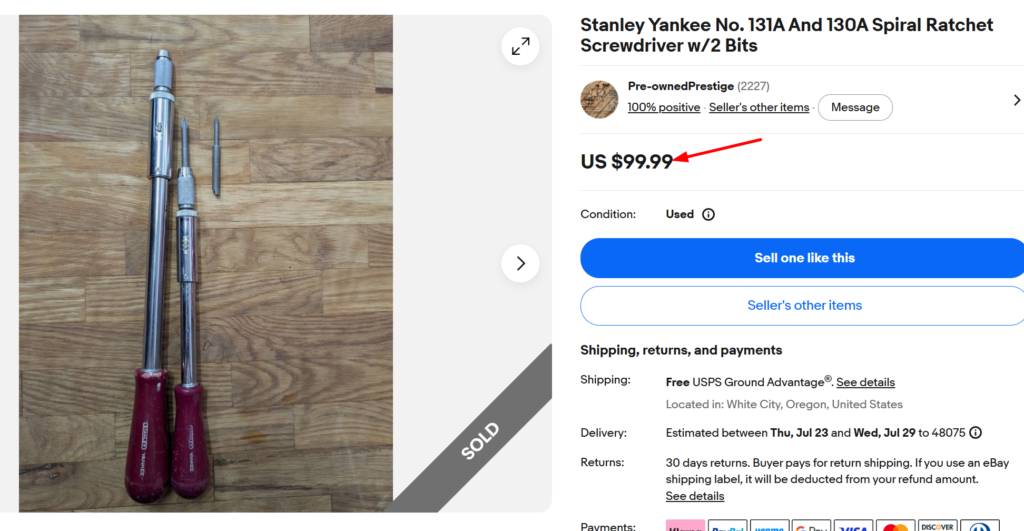
Sold for $100
Before cordless drills, there was the Yankee. Made by North Bros. of Philadelphia and later bought by Stanley in 1946, these push-driven spiral screwdrivers are pure early-20th-century engineering, measuring 12 inches closed and 17 inches extended.
The No. 130A is the medium-size model with the rapid-return spring, and it’s the one most collectors want. Original green cardboard boxes with the trade label attached can double the value.
- Estimated Value: $30 to $150 (with box, $100 to $200)
- Production Years: 1923 to 1960s
- What to Check: “PAT DEC 11 23” stamp, brass body, wood handle
8. Millers Falls No. 2 Egg-Beater Hand Drill
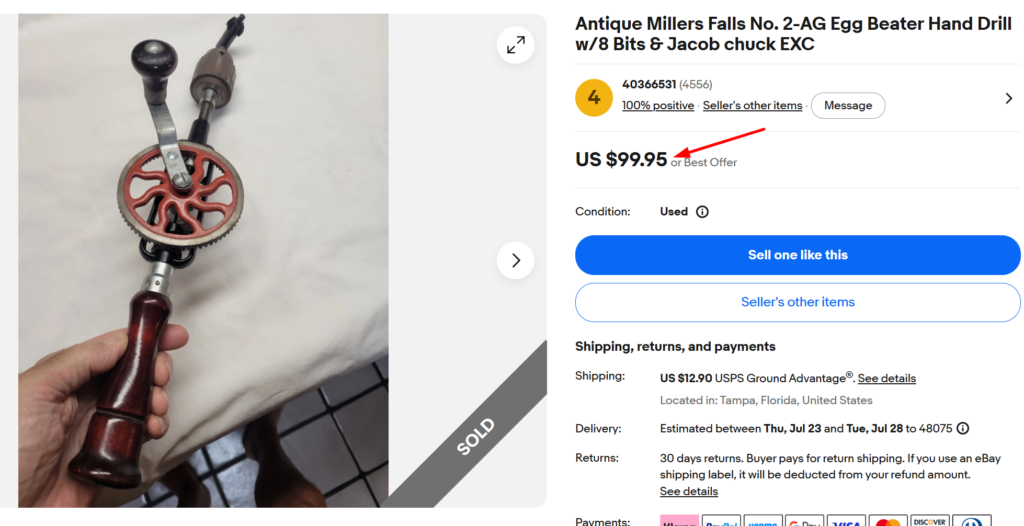
Sold for $100
The egg-beater drill is exactly what it sounds like: a hand-cranked drill that looks like a kitchen mixer. Millers Falls made the No. 2 for decades, and it’s the most common one you’ll find.
It’s about 14.5 inches long with an iron frame originally painted red, a three-jaw chuck, a large drive gear with a wooden crank handle, and a hollow wood main handle.
In 1931, Millers Falls actually bought Goodell-Pratt out; Goodell-Pratt versions are less common.
- Estimated Value: $25 to $120 (with bits, up to $150)
- Production Years: 1878 to 1970s (No. 2 pattern)
- What to Check: Red paint, chuck action, wood handle bit storage
9. Stillson-Pattern Pipe Wrench by Walworth
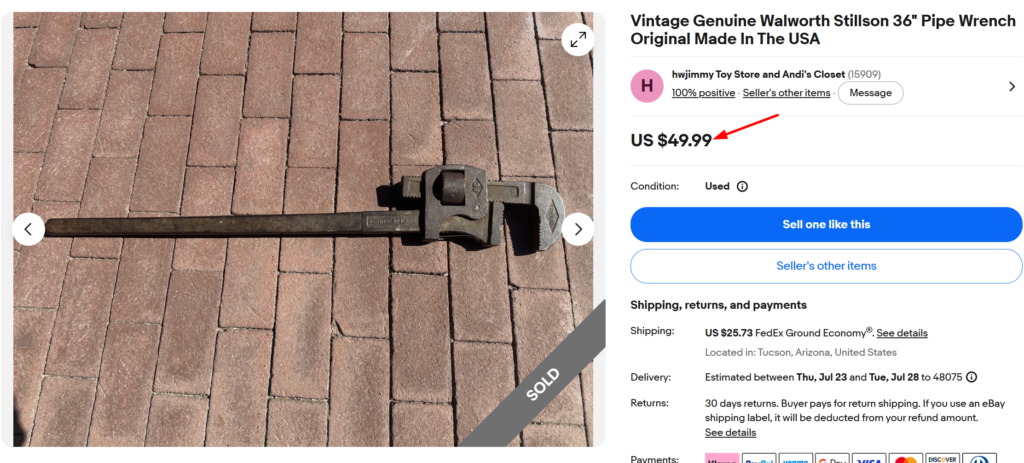
Sold for $50
Daniel Stillson patented the design in 1869 while working for Walworth in Boston. And for decades, Walworth had the monopoly on the “Genuine Stillson.” It has a heavy steel head with two serrated jaws, an adjusting nut in the middle, and a hardwood handle riveted onto the shank.
Early wood-handled examples marked Walworth Mfg. Co. Boston, USA, with the diamond Stillson trademark, is the one collectors chase.
After the patent expired around 1905, other companies started stamping “Stillson” too. So the maker’s mark matters more than the name.
- Estimated Value: $40 to $300 (rare early ones higher)
- Production Years: 1869 to 1950s
- What to Check: “Walworth” mark, wood handle, patent date
- Quick Notes: Trimo (Trimont) wrenches are common alternatives
How to Identify Valuable Old Hand Tools?
Every category above has its own quirks, but the same identification skills apply across almost all antique hand tools. Here’s how experienced collectors actually work through a piece.
1. Start With the Maker’s Mark
Maker’s marks where dating gets precise. On a plane, look at the blade first, then the lever cap, then the toe of the body. On a saw, check the brass medallion at the handle and any etched logo on the blade. On a wrench or screwdriver, the maker’s name is usually forged into the shank.
If a mark is faint, do not sand aggressively. Light 400-grit on a flat block over a maker’s mark can destroy value. So try a raking light and a soft brass brush first.
2. Date the Tool by Patent Numbers and Logos
A patent date only tells you the oldest it might possibly be; a tool bearing “Pat. Dec. 11, 1923” is at least that old, but it may have been made in 1924 or even 1955.
The Stanley Sweetheart logo (with SW inside a heart) is more specific and dates from 1920 to 1935. Disston medallions have a full timeline online at the Disstonian Institute, and they can date a saw to within about five years.
3. Check the Materials and Construction
Rosewood totes and knobs, japanning (that black lacquer coating on cast iron), and hand-cut split-nut fasteners all point to older, higher-grade tools. Beech and apple wood were common on planes. Boxwood inserts in molding planes show premium construction, since boxwood resists wear.
Cast iron with heavy pitting usually means the tool sat in a wet basement. And that always drops value, no matter how rare the piece is.
4. Know What Kills Value
Rust is not the deal-breaker most people assume. Light surface rust cleans off. Deep pitting, on the other hand, is permanent.
Real value killers are cracked or replaced totes on planes, missing chuck parts on drills, missing cutters on combination planes, sanded-out etches on saws, and any modern repaint. So if a Stanley plane looks freshly black-painted, that’s a red flag, not a plus.
Most antique hand tools you find at garage sales or flea markets will be common, worn, and worth $10 to $30. But some rare tools can turn into a $1,500 find if you know the right signs. So, look carefully.