
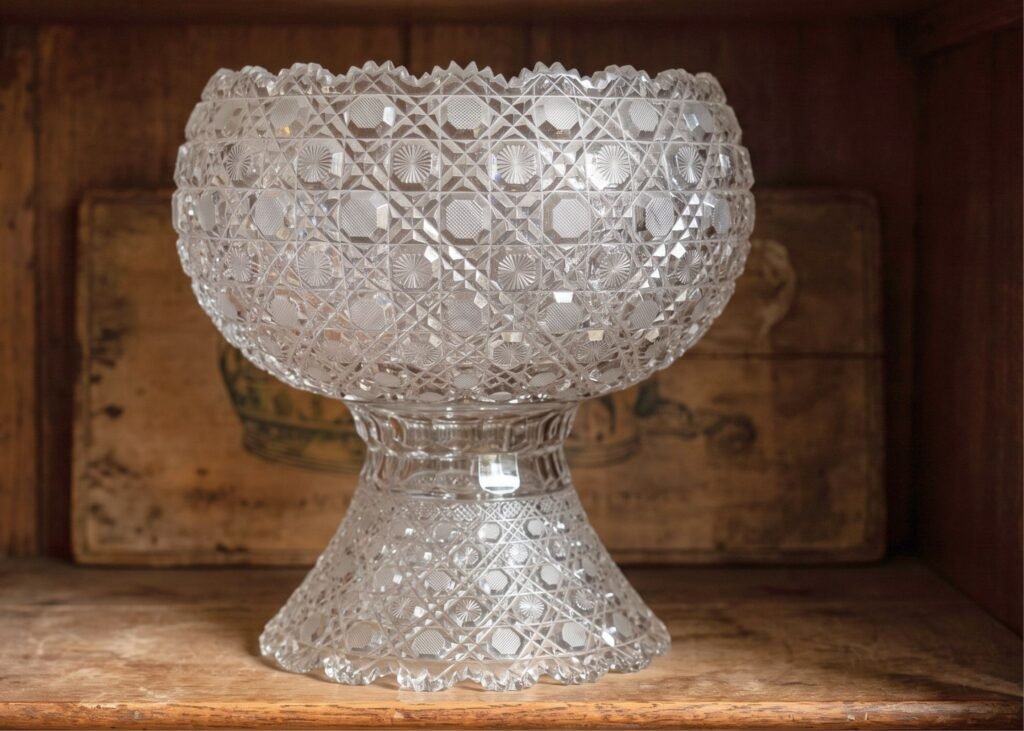
Cut glass is exactly what it sounds like. A blank piece of lead crystal is hand-cut on a spinning wheel, one facet at a time, into a geometric design that catches light from every angle. And the really valuable stuff comes from one specific era in America.
That era is called the American Brilliant Period, and it ran from roughly 1876 to 1917. Think Downton Abbey, Gilded Age mansions, and White House dinner tables. What makes ABP pieces pricey today is the craftsmanship. The lead content ran up to 50%, way higher than modern crystal, so an ABP bowl feels almost twice as heavy as modern pieces.
So this guide walks you through rare cut glass patterns and items that regularly sell big today, what makes each one valuable, and how to spot the same features on pieces you might already own.
Cut Glass vs. Crystal vs. Pressed Glass
Most people think “cut glass” and “crystal” mean the same thing, but they don’t. And pressed glass, which looks similar at a glance, is another category.
- Hand-cut glass is lead crystal that has been hand-cut.
- Crystal is simply the name of the material, which is any type of glass containing lead oxide.
- Molded or pressed glass was never cut, so it tends to have smoother pattern lines.
The first step to determining value is differentiating between the two types of glass. You can do these three quick tests at home:
- The weight test – Real ABP cut glass feels heavy for its size. A 10-inch bowl can push 5 to 7 pounds.
- The ring test – Tap the rim gently with your fingernail. Lead crystal rings have a long, clear tone. Pressed glass gives a dull thud.
- The finger test – Run your finger along the cut edges. Hand-cut facets feel sharp. Pressed patterns feel smooth and rounded because they came out of a mold.
That last one is the fastest way to spot a fake or a pressed imitation. Molded glass just can’t fake sharp, hand-polished facets.
Also, most modern imitations use figured blanks (pre-shaped molded blanks that just need surface polishing). Real ABP was cut from smooth, hand-blown blanks with no mold marks anywhere.
How to Identify Antique Cut Glass Makers & Marks
Identifying antique cut glass becomes a little tricky because the earliest pieces weren’t marked. Markings were made beginning in 1895 by some of the best houses.
Some of the valuable marks worth looking for:
- Hawkes – A small acid-etched shamrock inside a wreath, sometimes with “Hawkes” written across it. Used from around 1895 onward.
- Libbey – An acid-etched sword or a saber shape, usually on the base. Their oldest pieces (1896-1906) carry the sword mark.
- Dorflinger – Three tiny glass shapes in a circle with “Dorflinger” around them, though many Dorflinger pieces were never signed at all.
- Tuthill – The name “Tuthill” is acid-etched in a curved, fancy script.
- Sinclaire – An “S” inside a wreath of laurel leaves (also called the S-in-a-wreath mark), acid-etched into the base.
However, these markings were mostly acid-etched marks (burnt on the surface using acid) and could be seen only when the piece was turned to a certain light position.
To spot the mark on your piece, tilt the base under a good source of light. These marks can be seen faintly, like the frosty breath on a window. But if there’s nothing obvious, don’t discard the piece yet.
Valuable Cut Glass Patterns & Items Worth Finding Now
Below are some of the most valuable antique cut glass patterns and item types, based on recent sales.
1. Russian Pattern Cut Glass Bowl
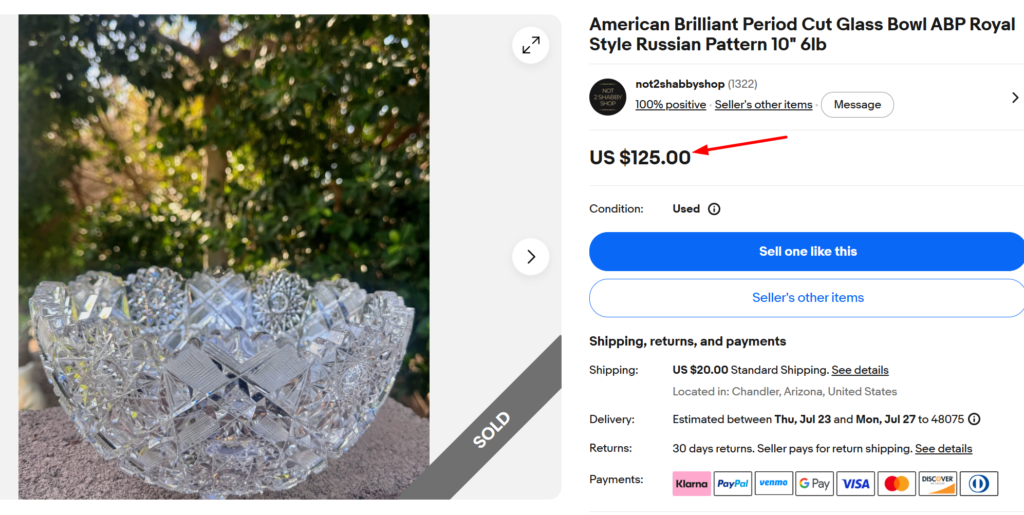
Sold for $125
The Russian pattern was patented by Philip McDonald for T.G. Hawkes in 1882, and it changed American cut glass forever. It’s built from tiny hobnails (small raised bumps), each one cut with a star, all locked together in a dense diamond grid.
The work has been commissioned many times for the White House, starting in 1891, and this explains why collectors are ready to pay the high prices.
- Estimated Value: $400 to $2,500+
- Production Years: 1882 through 1917
- What to Check: Star-cut hobnails, diamond grid
- Quick Notes: Signed Hawkes pieces command the highest prices
2. Hobstar and Fan Cut Glass Punch Bowl
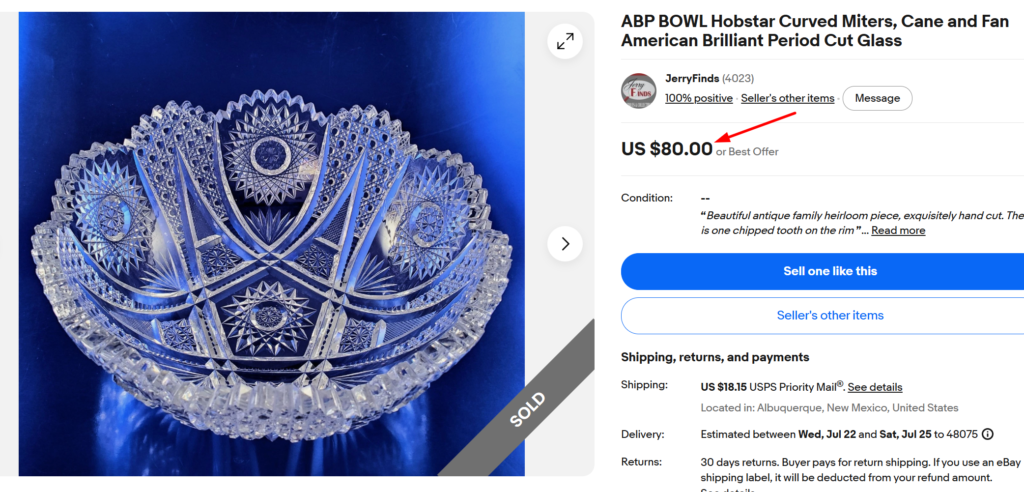
Sold for $80
The hobstar and fan is one of the most popular ABP glass designs. It is a multi-point star (typically 12 to 24 points), with a raised central hub. Along with fan cuts on the rim, this shape was very popular for use in punch bowls from 1890 to 1910.
Punch bowls made up of two pieces and pedestal bases are among the most expensive pieces due to their very low survival rate.
- Estimated Value: $300 to $3,000+
- Production Years: 1890 through 1910
- What to Check: Multi-point hobstars, matching base
3. Chrysanthemum Plate Set
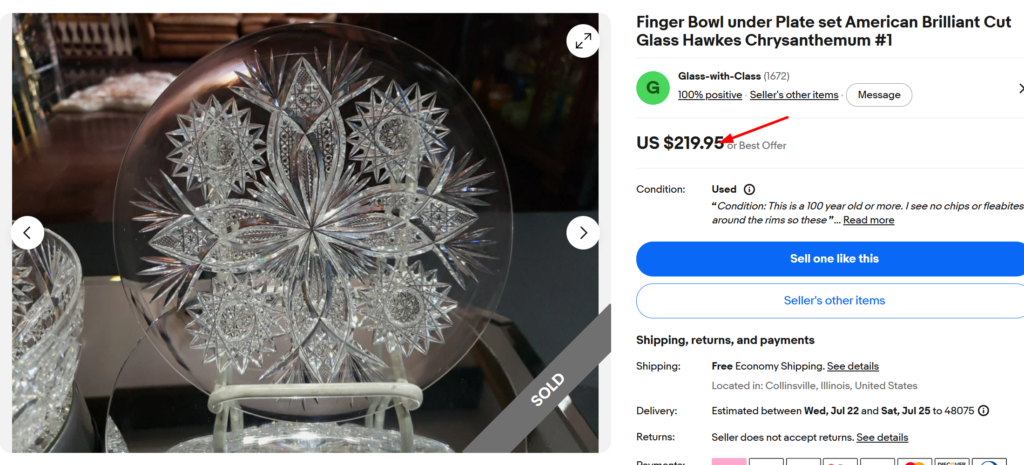
Sold for $220
T.G. Hawkes patented Chrysanthemum on November 4, 1890, and it’s one of the most desirable Hawkes patterns ever made. The design turns a flower into an abstract burst of hobstars, fans, and cane cutting.
The shape of a chrysanthemum is not clearly visible unless you move away from it. Vases with this cut-glass pattern are most appealing since there is sufficient space; tall, signed vases are highly sought after by collectors.
- Estimated Value: $500 to $4,000+
- Production Years: 1890 onward
- What to Check: Central hobstar, radial cane panels
4. Libbey Senora Pitcher
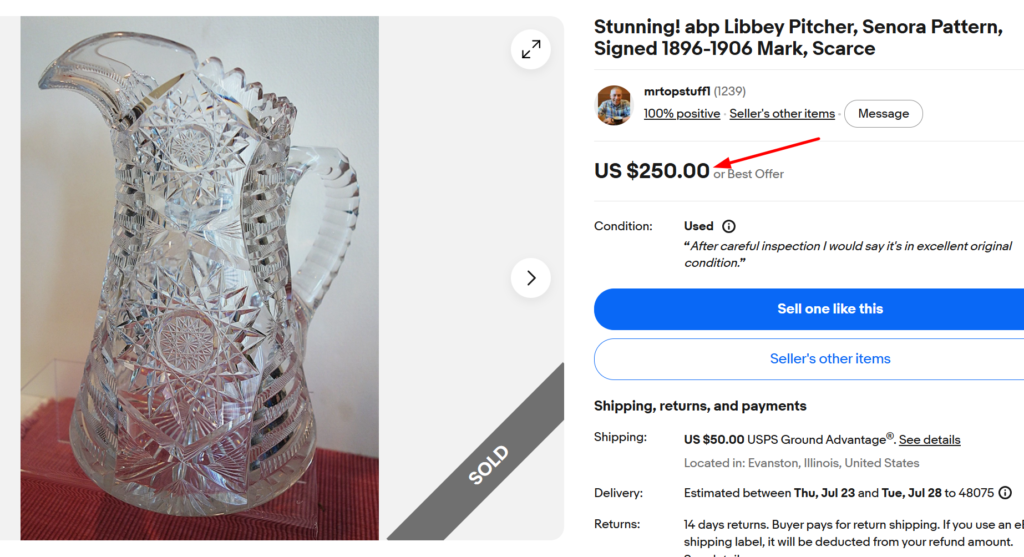
Sold for $250
The Senora pattern is a scarce Libbey design featuring large hobstars, cross-cut diamonds, and vertical prism panels running down the body. What makes any Senora piece valuable is the Libbey sword mark used only from 1896 to 1906, which dates it precisely to that decade.
- Estimated Value: $200 to $700
- Production Years: 1896 to 1906
- What to Check: Sword mark, hobstar, and prism combo
- Quick Notes: Sword-signed pieces are the earliest and best
5. Harvard Pattern Cut Glass Pitcher
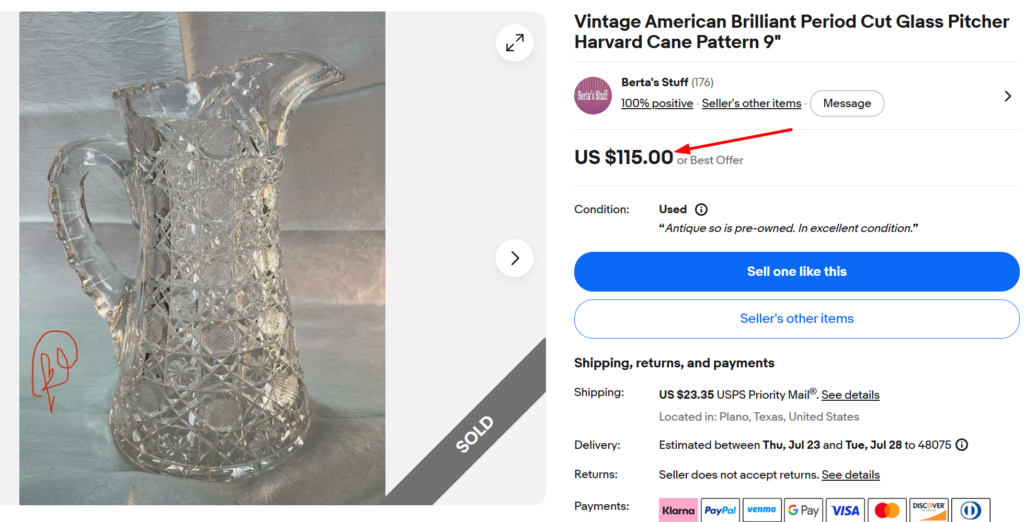
Sold for $115
The Harvard pattern is easy to confuse with cane or Russian, but it has its own unique appearance. It’s made of octagonal hobnails, each one cut with fine strawberry diamonds and a small single star.
Beginners sometimes call it “chair bottom,” which technically refers to a different cane variant. Harvard shows up on pitchers, tumblers, and full stemware sets, and it holds steady value.
- Estimated Value: $150 to $800
- Production Years: 1880s through early 1900s
- What to Check: Octagonal hobnails, tiny stars inside
6. Cranberry Cut-to-Clear Cut Glass Decanter
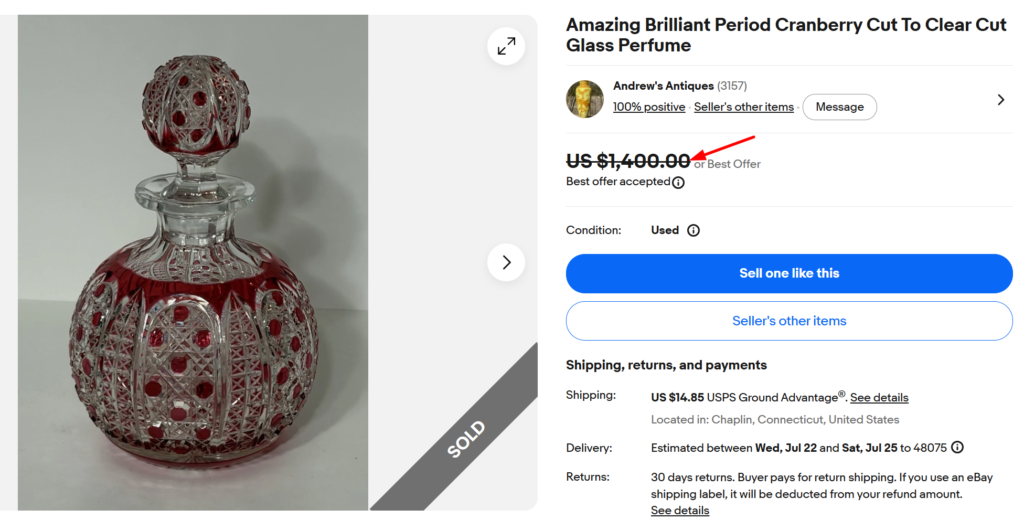
Sold for $1,400
Cut-to-clear is where cut glass gets really valuable. The decoration in this piece consists of a double layer, one with color on top and the other being clear. The cutter then cuts into the color, showing the clear glass beneath.
Dorflinger was very proficient at this technique, and it was one of the few manufacturers that made this kind of glassware, making it super rare.
- Estimated Value: $600 to $5,000+
- Production Years: 1881 through 1921 (Dorflinger)
- What to Check: Cranberry layer over clear
- Quick Notes: Ruby cased pieces bring a premium at auction
7. Cut Glass Bottle/Mug with Sterling Silver Top
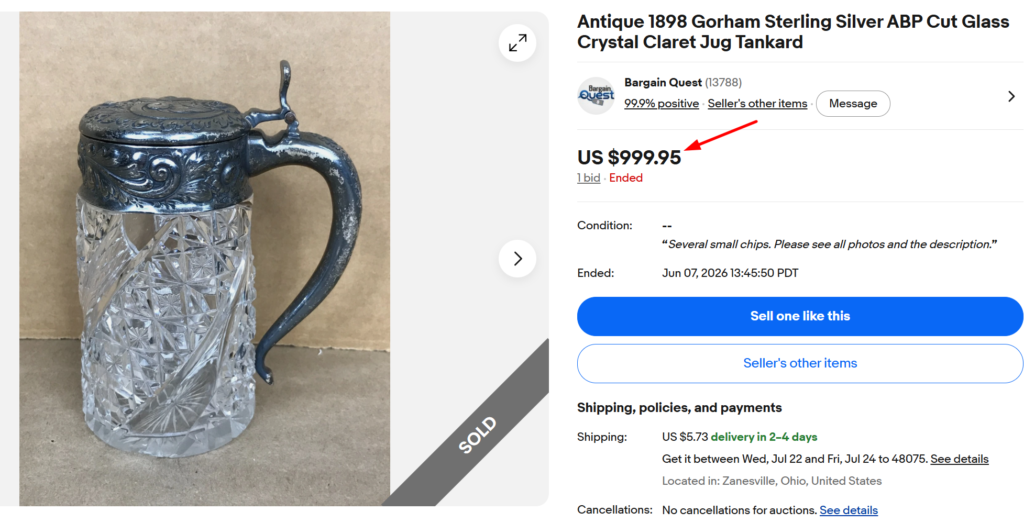
Sold for $1,000
Cut glass perfume bottles and tankards from the late Victorian and Edwardian periods look small but are highly valuable. Most feature hobstar, strawberry diamond, or fan patterns cut into heavy blanks.
But the real value driver is the fitted sterling silver top, which is usually hallmarked (stamped with maker’s initials and a sterling mark). Bottles with matching original stoppers and Gorham or Tiffany silver mounts bring the highest prices.
- Estimated Value: $100 to $1,200+
- Production Years: 1880 through 1915
- What to Check: Hallmarked silver top, original stopper
8. Blackmer Columbia Cut Glass Vase
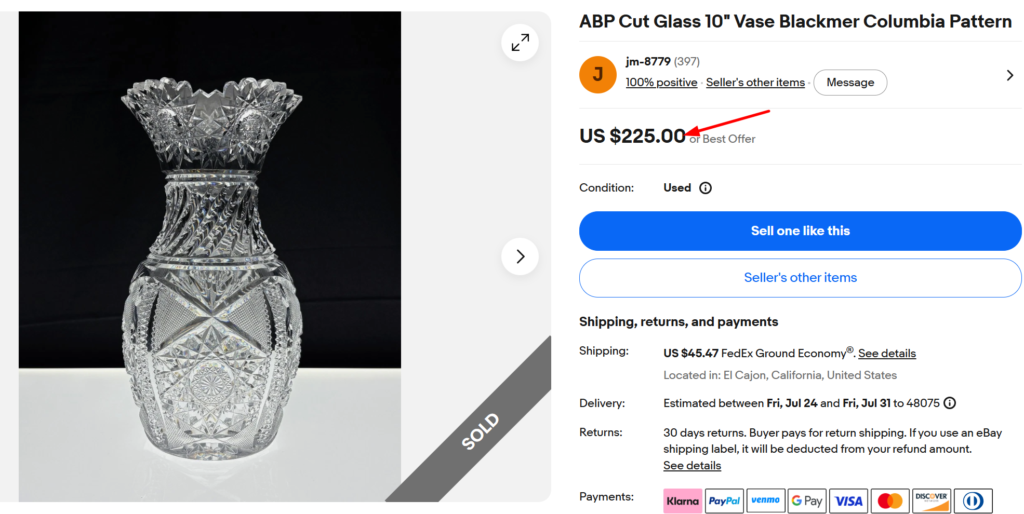
Sold for $225
A.L. Blackmer Cut Glass Company’s Columbia pattern is a collector’s favorite. It features a swirling spiral upper section paired with a bold hobstar and cross-cut diamond lower body.
Blackmer is less famous than Hawkes or Libbey, so signed pieces can be affordable yet collectible.
- Estimated Value: $175 to $600
- Production Years: Circa 1908 to 1916
- What to Check: Spiral upper, hobstar lower
9. Monarch Punch Set
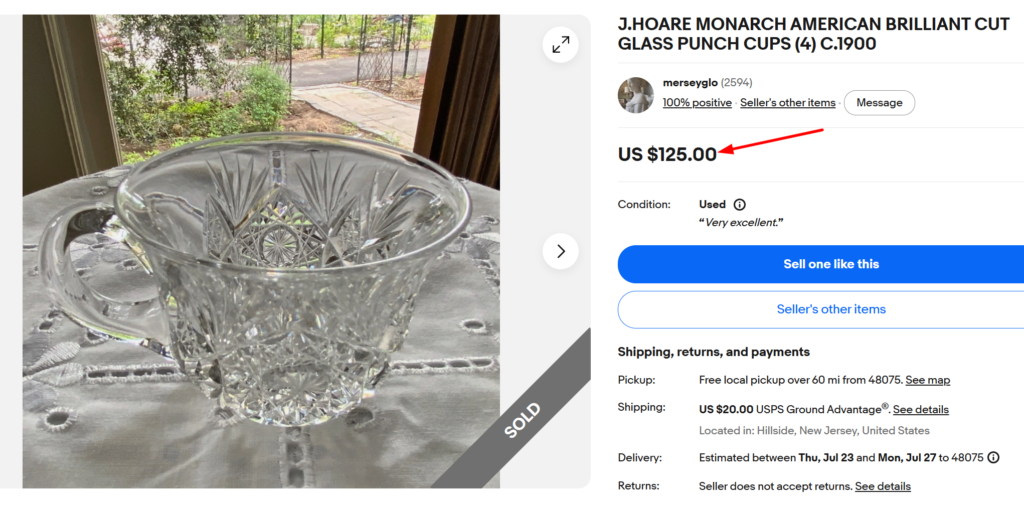
Sold for $125
The Monarch pattern by J. Hoare & Company is a classic ABP design built around a large central hobstar with radiating fan cuts and a fluted lower body. J. Hoare, based in Corning, New York, was one of the first American cut glass firms. So finding a signed Monarch piece connects you directly to that early period.
- Estimated Value: $100 to $400 (set of 4 cups)
- Production Years: Circa 1900
- What to Check: Central hobstar, fluted base
10. Strawberry Diamond and Fan Tumbler
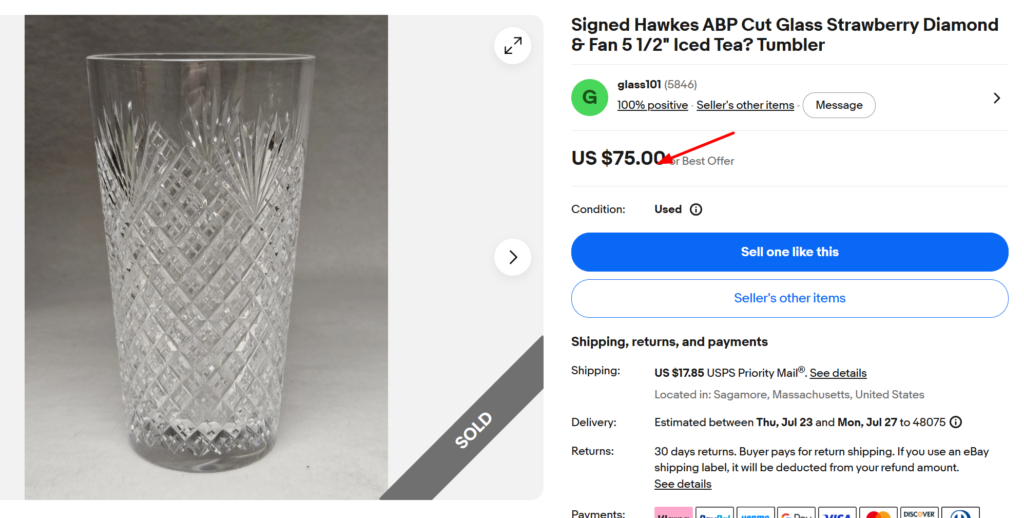
Sold for $75
Strawberry Diamond and Fan is among the oldest lace patterns, dating from the 1870s, comprising diamond panels that are filled with stitches that create the raised dot effect, and also having the fan cutouts at the edges.
Celery dishes are a classic form because Victorians served celery at nearly every formal dinner. Tumblers and vases, especially signed, also bring solid money.
- Estimated Value: $75 to $400
- Production Years: 1870s through 1917
- What to Check: Raised diamond dots, edge fans
- Quick Notes: Long oval form is the classic celery shape
What Makes Antique Cut Glass Valuable? (5 Value Factors)
The value of antique cut glass swings wildly because so many factors are in play. A common bowl might sell for $40 while a nearly identical one with a signature and better pattern can go up to $800. So here’s what actually moves the needle.
1. The Maker
Signed pieces beat unsigned ones every single time. Quality houses such as Hawkes, Libbey, Dorflinger, Tuthill, Sinclaire, Pairpoint, J. Hoare, and Meriden command a 2 to 10 multiple on unsigned pieces of similar design. Even an etched sign can increase the value of a piece worth $75 to $400.
2. The Pattern
Complex patterns beat simple ones. Russian, Chrysanthemum, Aztec, Kensington, and Devonshire are the top-tier names collectors chase. Simpler designs like plain hobstar or basic pinwheel are common and sell for less. Rarity of the specific pattern matters more than rarity of the maker in most cases.
3. Condition
Chips, cracks, and cloudiness destroy value instantly. Even the smallest of sawtooth chips in the rim could decrease the value of the product by 30 to 50 percent. The cloudiness in decanters and vases (due to water retention) is almost irreversible and decreases the value by 40 percent.
4. Rarity of Form
Punch bowls, ice tubs, humidors, tantalus sets, and large centerpieces are the rare forms. Most survived as smaller pieces like plates, bowls, and glasses. So finding a complete two-piece punch bowl in mint condition is a big deal, and prices reflect that.
5. Color
Colored cut glass is the top tier. Cranberry, cobalt blue, emerald green, and amethyst cut-to-clear pieces bring 3 to 10 times the price of clear examples. Dorflinger and Val St. Lambert were the main producers, and any signed colored ABP piece is a serious find.
The key to spotting valuable cut glass is to learn the top patterns, feel the weight, check for signatures, and always look at recently sold pieces before you decide what something is worth.