
An old, heavy white milk glass bowl with a small “WG” pressed into the base could be a $15 flea market and a $300 collector’s piece. Westmoreland glass has a wide value range, and most people have no idea which pieces are worth the money.
The Westmoreland Glass Company ran out of Grapeville, Pennsylvania, from 1889 to 1984, and for most of that time, it was one of America’s finest milk glass makers. The factory closed nearly 40 years ago, and the original pieces are now collectible.
This guide walks you through how to spot the real Westmoreland glass, which patterns and colors actually matter, and what determines their value.
How Much Is Westmoreland Glass Worth?
Most Westmoreland glass sells for $5 to $30 per piece on eBay. Common Paneled Grape, Beaded Edge, and English Hobnail pieces are plentiful. But the value can quickly go up to $100 to $500+ for the right features.
Here are the four features that matter the most:
- Color rarity – A green or cobalt English Hobnail vase can be worth 3x the same piece in clear
- Pattern – A pattern that has a short run or one that’s widely known usually has high value and collectibility.
- Completeness – A pitcher without its tumblers, or a punch bowl without cups, loses more than half its value.
- Condition – Chips, cracks, and stains wear off prices quickly. Even a hairline crack can drop a $150 piece to $40.
Based on these factors, you can value your vintage Westmoreland glass pieces using the following tiers:
- Common pieces: $5 to $30. Single milk glass plates, salt and pepper shakers, small candy dishes, and unmarked pieces.
- Mid-range collectibles: $40 to $150. Colored English Hobnail, Old Quilt sets, hand-painted Beaded Edge, uranium pieces, and Mary Gregory plates.
- Higher-end and rare: $200 to $600+. Complete Paneled Grape punch bowl sets, rare-color hen on nests, Della Robbia stained sets, verified Line 1940 lamps, Argonaut Shell dishes.
12 Most Valuable Westmoreland Glassware Items Collector Chase
Below are the Westmoreland pieces collectors actively hunt these days, drawn from patterns Westmoreland is most famous for. Learn how to spot them and what they’re worth.
1. Hen on Nest Covered Dish in Cobalt Blue
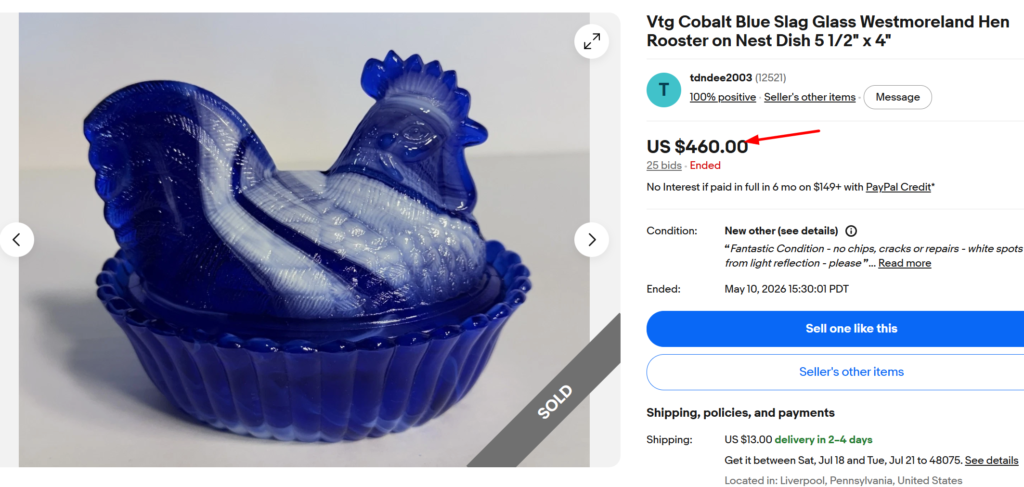
Sold for $460
Westmoreland claims the first American milk glass sitting hen, dating back to 1889. And this design became one of the most copied designs in glass history. The classic version is white milk glass with a red-painted comb and a basketweave base.
But it’s the rare colors that collectors hunt. Cobalt blue, cranberry, uranium yellow, and marbled slag versions are all worth premiums.
- Estimated Value: $85 to $250 (colored versions)
- Production Years: 1940s to 1984 (milk glass), colors vary
- What to Check: WG mark, basketweave base, comb style
2. Thousand Eye Fairy Lamp
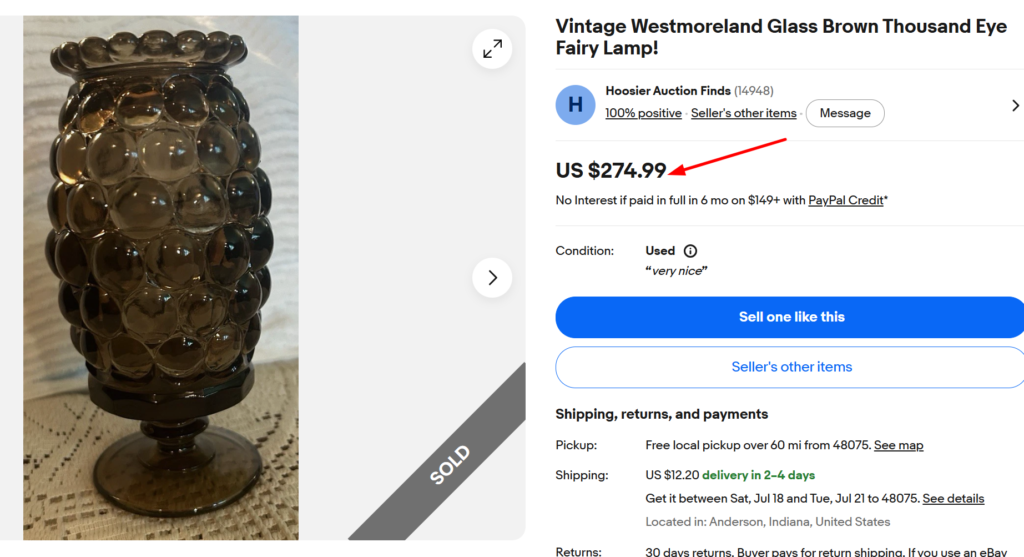
Sold for $275
Westmoreland’s Thousand Eye pattern is a hobnail-style design with small, tightly packed dome-shaped bumps covering the surface. Fairy lamps, the two-piece lamps with a footed base and a matching domed shade, in this design, are quite desirable.
The smoky brown color is one of the hardest Thousand Eye colors to find. Most collectors are used to seeing this pattern in clear, milk glass, or ruby. Brown was a shorter production run, so it regularly sells for over $200.
- Estimated Value: $200 to $350
- Production Years: 1970s
- What to Check: Two-piece fit, dome hobs, base
3. Paneled Grape Milk Glass Punch Bowl Set
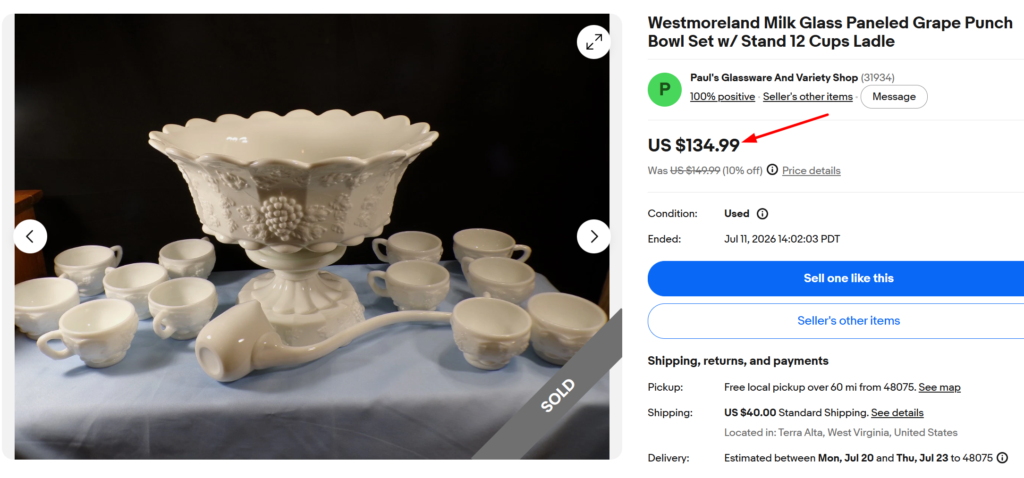
Sold for $135 (set with 12 cups)
Paneled Grape is the pattern that made Westmoreland popular among milk glass collectors. It features raised clusters of round grapes with detailed leaves and vines in repeating panels. Over 100 different pieces were made in this pattern.
The punch bowl set is the most desirable one. A complete set has the pedestal bowl, matching cups with hooks, and the milk glass ladle.
- Estimated Value: $250 to $600+ (complete sets)
- Production Years: 1940 to 1984
- What to Check: Cups, ladle, hooks, WG mark
4. Argonaut Shell Lidded Candy Dish
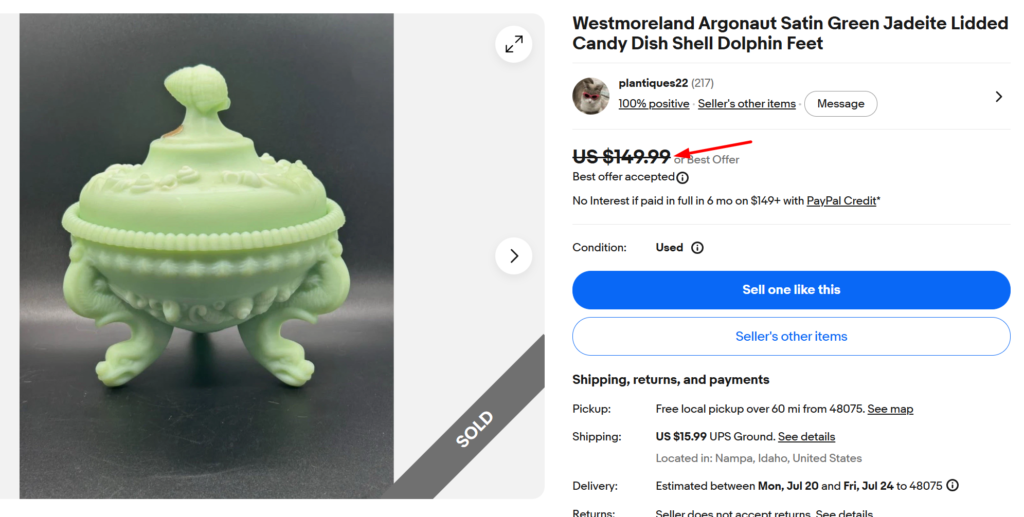
Sold for $150
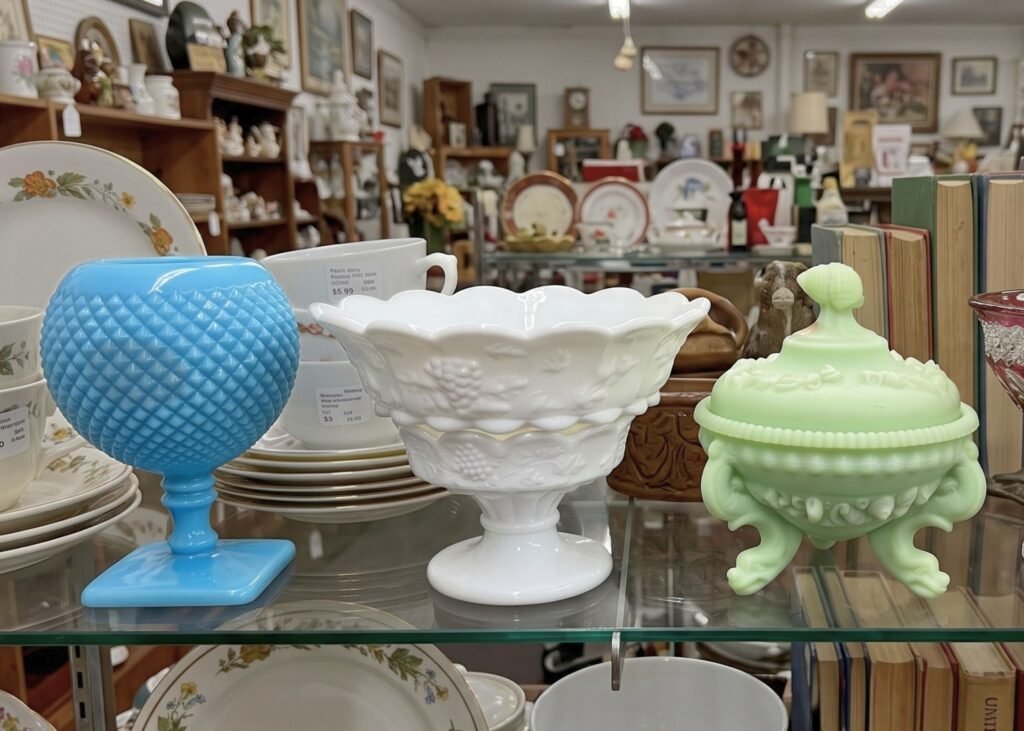
The Argonaut Shell is one of Westmoreland’s older Victorian revival forms. You can identify it by the three dolphin feet base, a shell-shaped bowl with a rope-twist rim, and a shell finial on the top of the lid. It is based on an original 1870s design.
Most collectors find it in white milk glass. The satin green jadeite version is much less common and, hence, more valuable. The presence of the lid decides the value.
- Estimated Value: $100 to $200
- Production Years: 1920s revival, reissued through 1970s
- What to Check: Dolphin feet, shell finial, satin finish
5. English Hobnail Blue Milk Glass Pedestal Vase
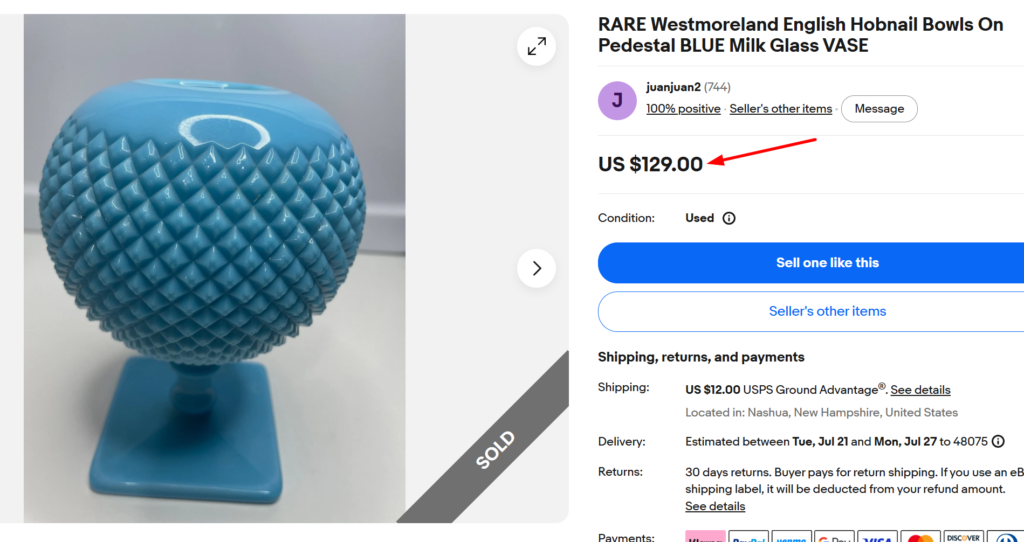
Sold for $130
English Hobnail is one of Westmoreland’s oldest patterns, dating back to about 1928. The pattern shows a diamond-grid of raised, faceted hobs, very different from Fenton’s round hobs. That diamond shape is your quickest ID.
Most English Hobnail was made in clear or white milk glass. So the blue milk glass pieces are much harder to find.
- Estimated Value: $80 to $175
- Production Years: 1928 to the 1980s
- What to Check: Diamond grid hobs, square pedestal foot
6. Della Robbia Fruit Bowl (Single or Multi-Color Stain)
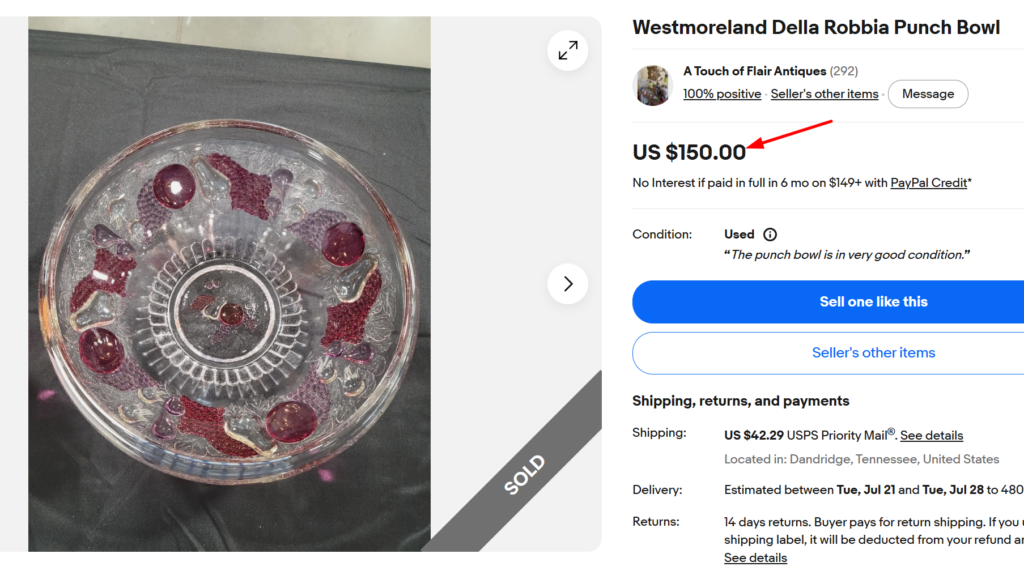
Sold for $150
Della Robbia was made from 1928 to about 1940, and it is a Depression era Westmoreland pattern that flies a little under the radar. The design shows a wreath of molded fruit and leaves around the bowl.
Collectors love the versions where each fruit was hand-stained in different colors, like red, purple, marigold, and green. Plain crystal Della Robbia is generally affordable.
- Estimated Value: $75 to $250
- Production Years: 1928 to 1940
- What to Check: Fruit wreath, colored staining, wear
7. Bramble (Maple Leaf) Milk Glass Basket
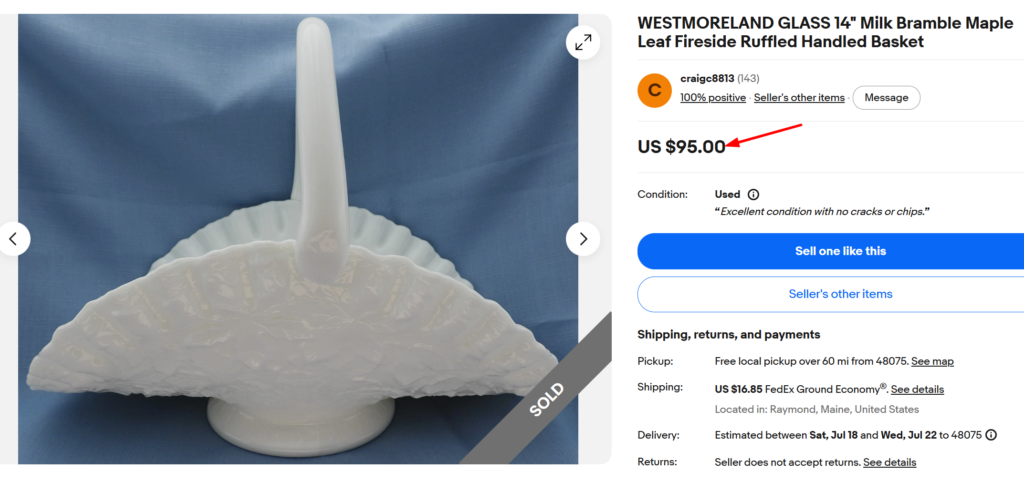
Sold for $95
Bramble, also called Maple Leaf, is a Westmoreland milk glass pattern with molded maple leaf and vine details wrapping around the piece. It appears on creamers, sugars, plates, and larger showpieces like this 14-inch fireside basket.
Collectors chase the big handled baskets for two reasons: first, they were made in smaller numbers than the tabletop pieces. Second, the tall arched handle is fragile. So an intact example, without chips or cracks, is a rare find.
- Estimated Value: $75 to $150
- Production Years: 1940s to 1970s
- What to Check: Ruffled rim, molded leaves, handle
8. Old Quilt Milk Glass Pitcher and Tumbler Set
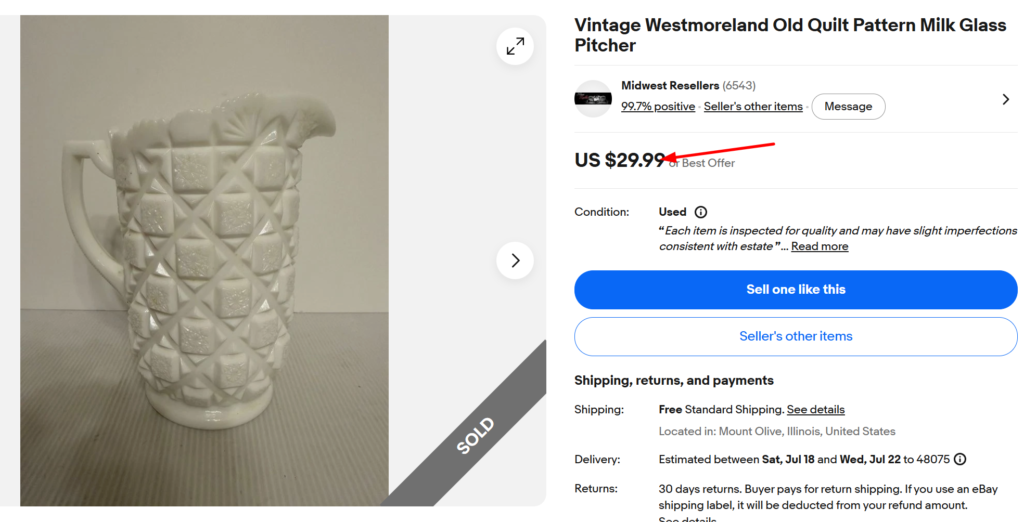
Sold for $30 (only pitcher)
Old Quilt is Westmoreland’s pattern #500 that ran from 1940 to 1984. The design is a diamond-quilted texture that looks a bit like a woven blanket pressed into the glass. It came in milk glass, carnival, slag, and sometimes with hand-painted color accents.
Water sets are the most collectible pieces. A pitcher with all six matching tumblers is harder to find; single pitchers are quite common and affordable.
- Estimated Value: $95 to $300
- Production Years: 1940 to 1984
- What to Check: Diamond-quilted texture, matching tumblers
9. Waterford/Wakefield Ruby Stained Compote
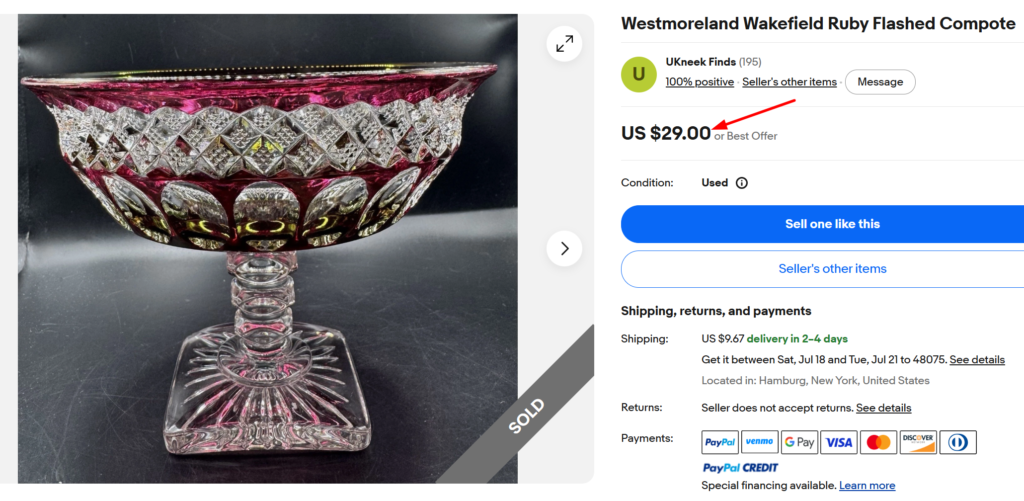
Sold for $30
Waterford, also called Wakefield, is a pressed pattern with thumbprint bowls and a rayed base. Westmoreland ran this pattern in ruby stain from about 1930 to the early 1980s.
Note that the ruby is not solid glass; it’s a thin red stain applied over clear pressed glass. And because it is a stained rather than a solid ruby, the color can wear off with heavy dishwasher use. So, an intact condition is the real value driver.
- Estimated Value: $45 to $150
- Production Years: About 1930 to 1981
- What to Check: Stain wear, thumbprint bowl, mark
10. Uranium Vaseline Glass Slipper
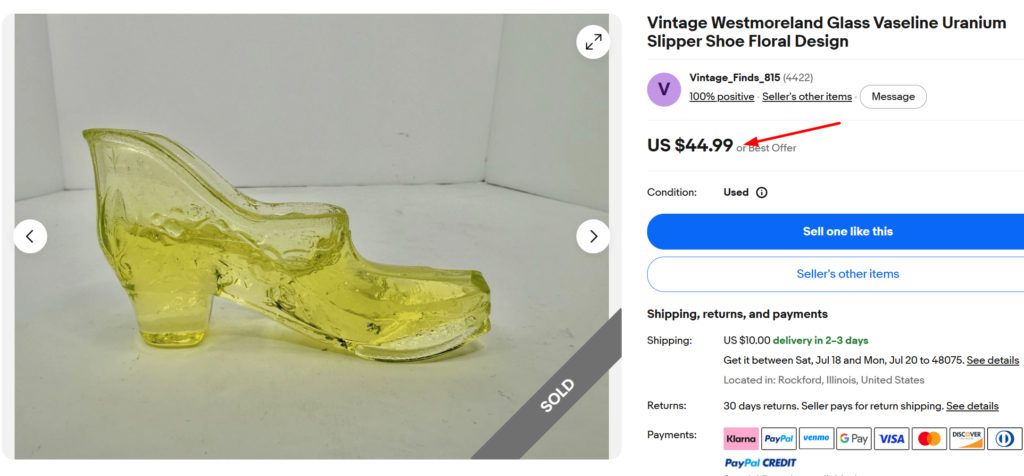
Sold for $45
Westmoreland made pressed glass slippers and shoes in a Daisy and Button style from the early 1900s onward. The uranium versions are the ones worth collecting. These have a distinctive yellow-green tint and glow bright green under blacklight.
Always look for the WG mark on the base first, plus that glow test. Reproductions from Mosser and Rosso used old Westmoreland molds, so the mark alone is not enough; the glow confirms uranium content.
- Estimated Value: $40 to $120
- Production Years: Roughly 1920 to 1940
- What to Check: UV glow, mold seams, mark
11. Owl Toothpick Holder
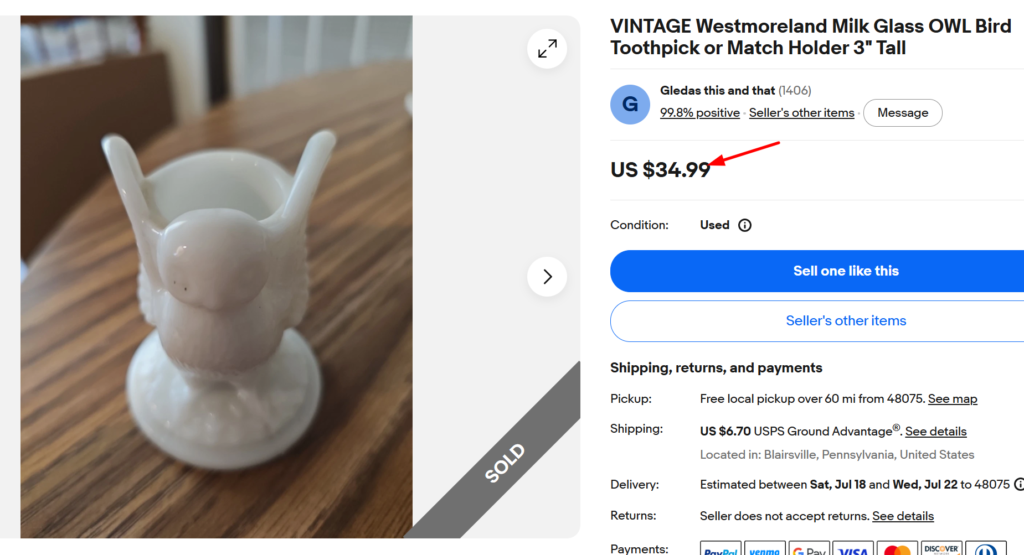
Sold for $35
The little owl toothpick holder is a Westmoreland favorite, and they made it in a rainbow of colors from the 1970s onward, including milk glass, cobalt satin, purple slag, green, amber, and uranium. The owl sits on a round base.
Milk glass and clear versions are common and cheap. But the rare colors, especially purple slag and uranium, are the ones collectors chase. Original paper labels can up the value.
- Estimated Value: $20 to $95 (color-dependent)
- Production Years: 1970s to 1984
- What to Check: Color rarity, WG mark, glow
- Quick Notes: Purple slag is hardest to find
12. Beaded Edge Milk Glass Plate with Fruit
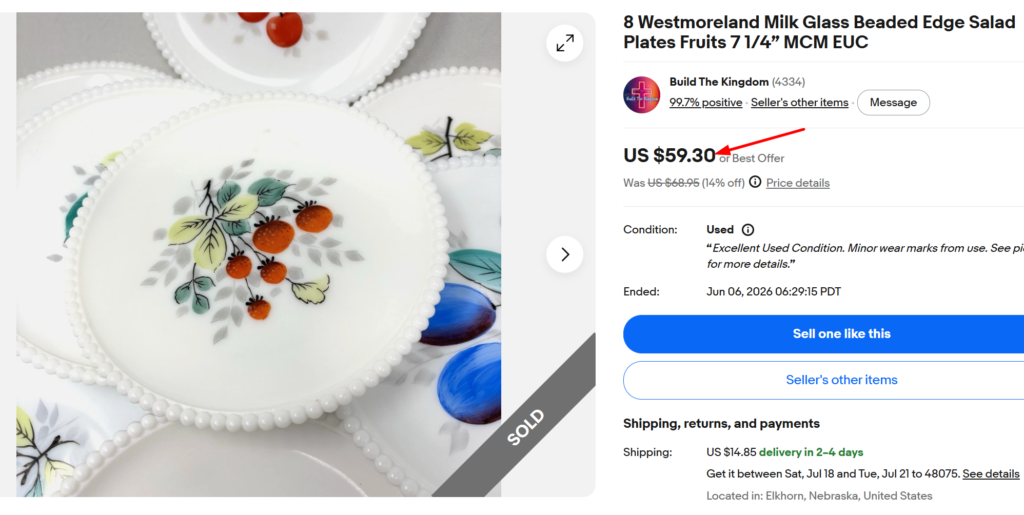
Sold for $60 (set of 8)
Beaded Edge is a simple pattern with a single row of small beads around the rim of plates and bowls. On its own, plain Beaded Edge is an affordable Westmoreland pattern. But the plates decorated with hand-painted fruit are more collectible.
Peaches, strawberries, cherries, and mixed fruit designs are common. The red apple decoration is the one collectors want most, and it consistently outsells the others.
- Estimated Value: $25 to $65 per plate
- Production Years: 1950s to 1970s
- What to Check: Painted fruit in the center, bead ring, wear
How to Identify Authentic Westmoreland Glass?
Knowing what’s valuable only helps if you know whether what you have is genuine. A lot of Westmoreland is unmarked, especially the earlier pieces, so identifying those pieces can be challenging. But the marked ones are easy to date.
Let’s see how to do both.
The Keystone “W” Mark (about 1910 to 1940s)
The first proper Westmoreland mark was a capital W inside a keystone shape. That keystone refers to Pennsylvania, which is known as the Keystone State. You will find this mark impressed into the base of pressed tableware and some early milk glass.
It was used from roughly 1910 through the mid-1940s, but not on every piece. So an unmarked early piece is not automatically a fake.
The Intertwined “WG” Mark (1946 to about 1985)
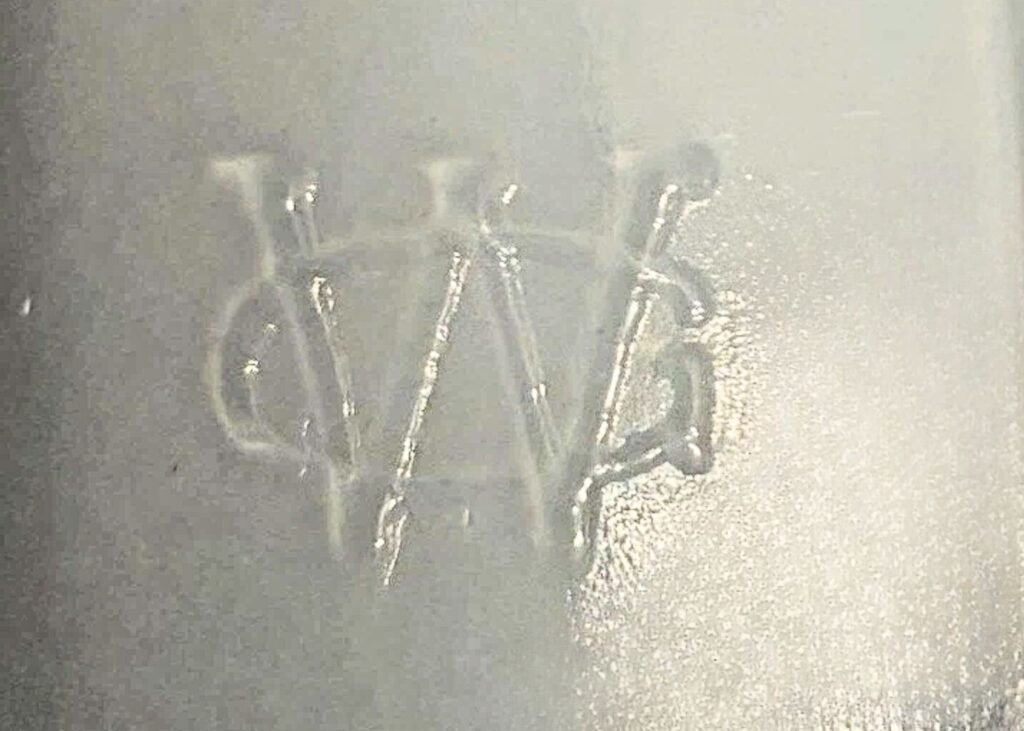
Around 1946, Westmoreland switched to its most popular mark. It is a capital W overlapping a capital G, molded right into the base of the glass. If you see this mark, you are usually looking at a piece made between the late 1940s and 1984.
Run your fingertip across it. On authentic pieces, the WG feels slightly raised and clean. Some molds got tired over the years, so a faded or shallow WG is normal on later production. That is not a red flag by itself.
Paper Labels and the Grossman Mark
Westmoreland used paper labels from about 1906 onward, and they kept using them right up to the end. But since most labels on old pieces are long gone, they aren’t very useful.
But if you find one intact, that not only confirms authenticity, but it also adds to the value.
After David Grossman bought the factory in 1981, the mark changed to “Westmoreland” in a circle around three lines. Pieces with the Grossman mark are the newest and usually the least valuable.
What to Do with Unmarked Pieces?
As I said earlier, a lot of Westmoreland has no mark at all. So how do you tell? The best way is to match the piece to a known pattern and check the glass quality.
Most Westmoreland patterns are unique, and the milk glass is dense, opaque, and has a distinct cold white tone. It feels heavy in the hand compared to newer reproductions.
So, if your piece is unmarked, but the pattern matches something Westmoreland made, and the glass has that cold, dense feel, you are probably safe calling it Westmoreland.
Reproduction molds exist, though. Companies like Plum, Rosso, and Mosser bought Westmoreland molds after 1984, and some pieces still carry the old WG mark. Color and decoration are usually the giveaway in these later pieces.
Handy tip: Carry a small UV flashlight when you shop estate sales. Some Westmoreland glass contains uranium and glows bright green under blacklight. That glow, if confirmed, can boost the value on the right pieces.
Common Westmoreland glass is affordable enough to start with, and the rare ones are still findable if you know what you are looking at. Start with the keystone W mark, the intertwined WG, and the specific patterns above to spot real collectibles.