
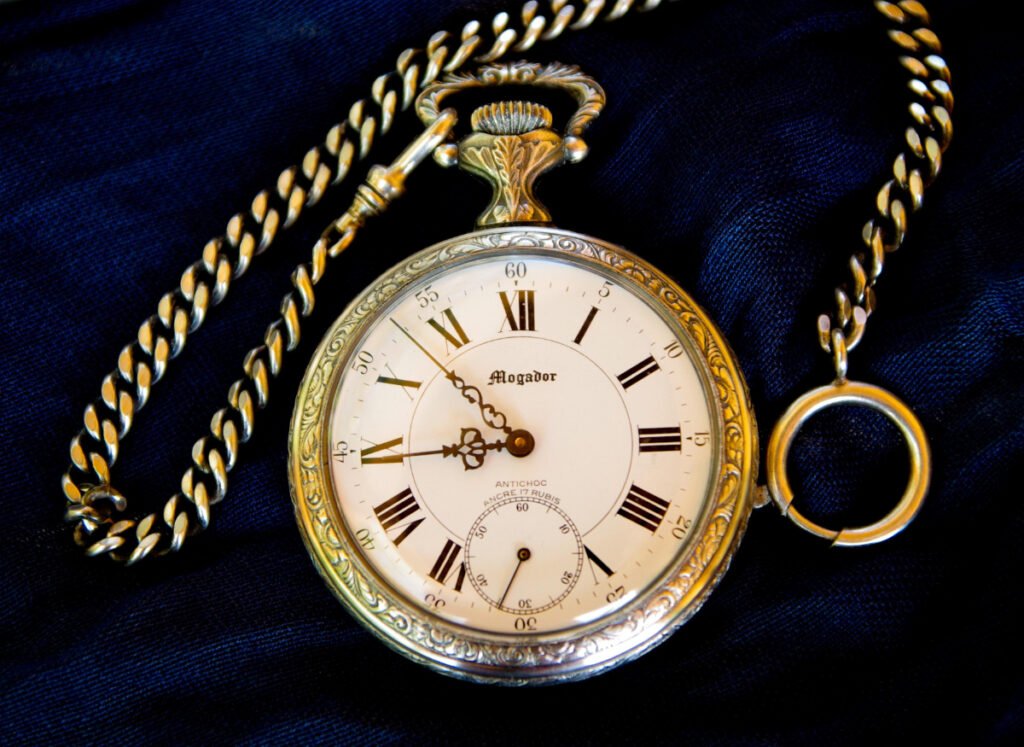
Did you know that, in 2014, a 1933 Patek Philippe pocket watch sold at Sotheby’s Geneva for around $24 million. That’s an extreme outlier, sure. But it tells us that certain antique pocket watches can be worth serious money in 2026.
But most old pocket watches sell for just $50 to $300. The key is knowing what creates the difference between the two. In this guide, you’ll learn all about identifying antique pocket watches, evaluating their worth, and the rarest models to look for!
Pocket Watch Identification in 5 Easy Steps
Trying to identify pocket watch value and history isn’t guesswork. Every watch that is produced in the United States from 1860 to 1960 has enough markings on it so that you can figure out who made it and in which grade.
Step 1: Open the Back Case
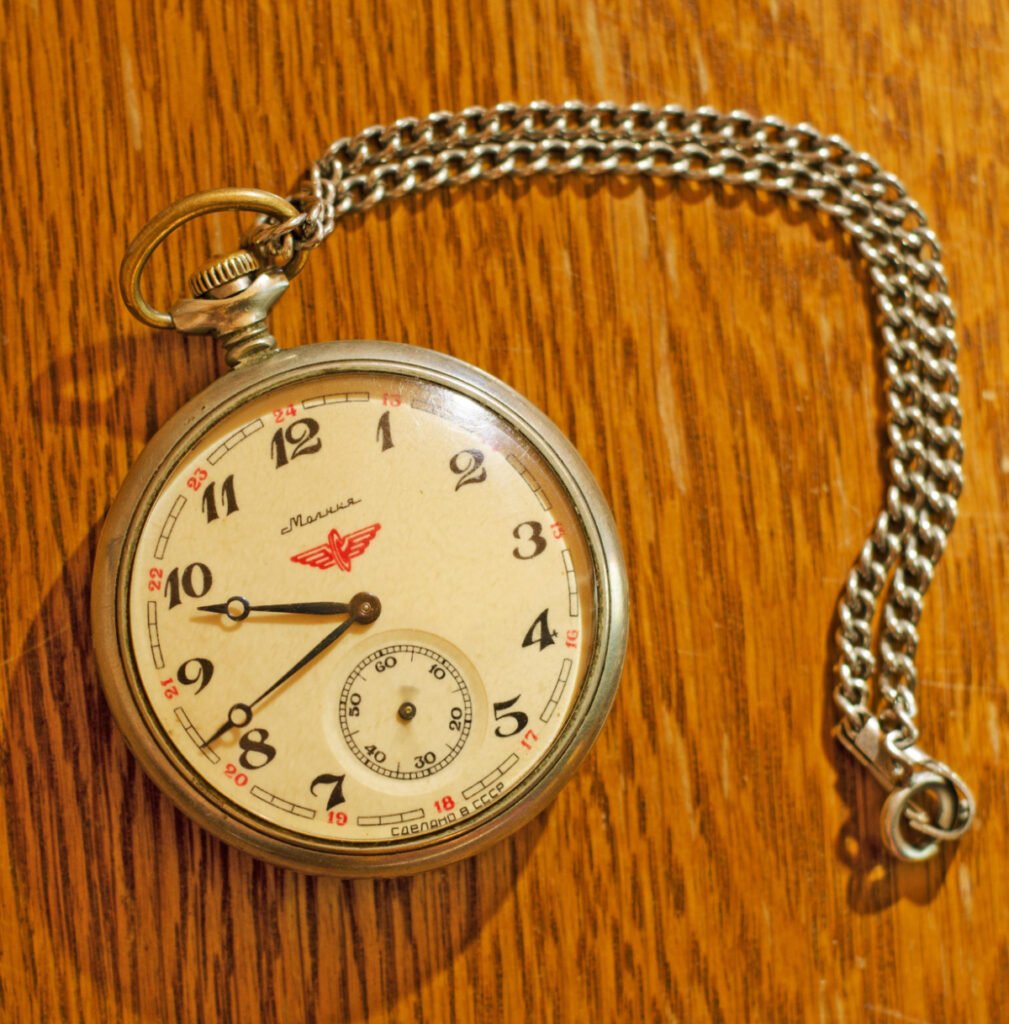
Step 2: Find and Decode the Serial Number
Step 3: Read the Case Markings and Hallmarks
The case is the first thing you need to pay attention to. Sellers love to claim “solid gold” on what’s actually gold-filled. The markings help you identify the real thing.
Here’s what case stamps actually mean:
- “14K“ or “18K” alone, with no other qualifier, usually means solid gold. “Warranted United States Assay” after the karat marking backs that claim up.
- “14K Gold Filled” or “18K Gold Filled” means the case is base metal with a layer of gold bonded to it. Still nice, but not solid gold.
- “Warranted 20 Years,” “Guaranteed 25 Years,” or any wording with a year count = gold-filled, not solid. A solid-gold case will never be marked with the number of years it is guaranteed to last.
- “Rolled Gold Plate” or “R.G.P.” indicates a thin gold layer, even less gold than gold-filled.
- “Coin” or “Coin Silver” is roughly 90% silver, common on pre-1900 American cases.
- “Sterling” or “925” is 92.5% silver. It’s more common on British and European watches.
- “Silveroid,” “Silverine,” and “Silverode” indicate nickel alloys with no actual silver. Don’t be fooled by the name.
For European watches, look for tiny pictorial hallmarks. A French eagle’s head means 18K gold. A British lion passant means sterling silver. This small marking is a legal stamp, not a decoration.
Step 4: Identify the Maker on the Movement
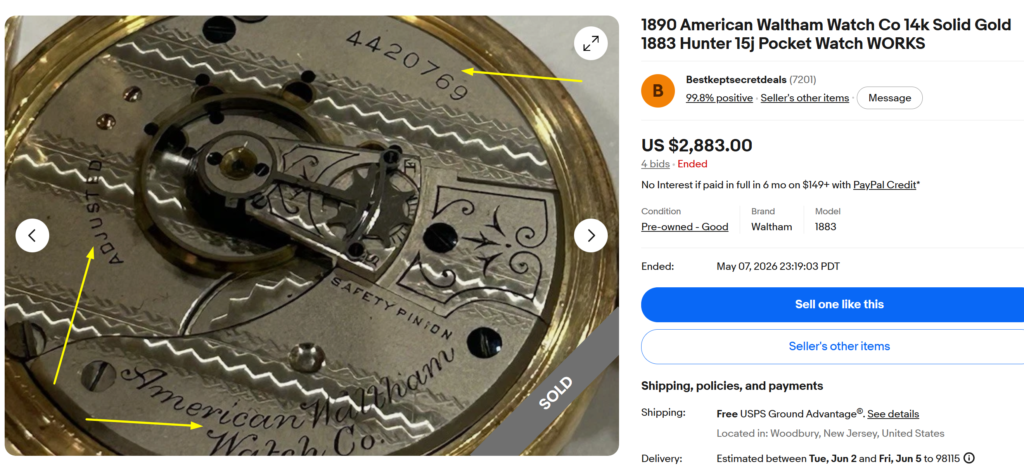
The maker’s name is often marked on the movement itself. Look in the area between the wheels, the bridges, and the area of the balance wheel. Some common names to look for include:
- Waltham
- Patek Philippe
- Elgin
- Hamilton
- Illinois
- Hampden
- Howard
- Ball
- Rockford
- South Bend.
Grade names can be tricky. “B.W. Raymond” is an Elgin grade, not a separate brand. “Bunn Special” is in Illinois. “Vanguard” and “Crescent Street” are in Waltham. The maker’s name is usually marked also; at times it can be in smaller lettering on the outer edge of the plate.
The Swiss watches with the names of Patek Philippe, Vacheron Constantin, Longines, or Omega are a different category. These are mostly identified through caliber numbers, archive records, and case markings rather than American-style movement plate signing.
Step 5: Count the Jewels
The jewels are small synthetic rubies and sapphires that are pressed into the mechanism of the watch at friction points. The jewels protect the watch’s parts from wear and tear, increasing its lifespan and accuracy for many years to come.
The most common materials used as pocket watch jewels are garnets, rubies, and sapphires .
The jewel count of a watch is usually engraved on the watch’s movement, like “17 Jewels,” “21 Jewels,” or “23 Jewels.” If you do not find this engraved anywhere, then there will be 7 jewels on the watch, which is the bare minimum.
Good to Know: Higher jewel counts don’t automatically mean higher value; the maker and case still matter just as much. But jewel count narrows down what kind of watch you’re holding, which determines its place in the market.
12 Most Valuable Antique Pocket Watches – Rare Brands & Models
Below are real examples of the most desirable antique pocket watch models from notable brands, along with their current value and key features.
1. Tiffany & Co. Pocket Watch (Patek Philippe/Vacheron Movement)
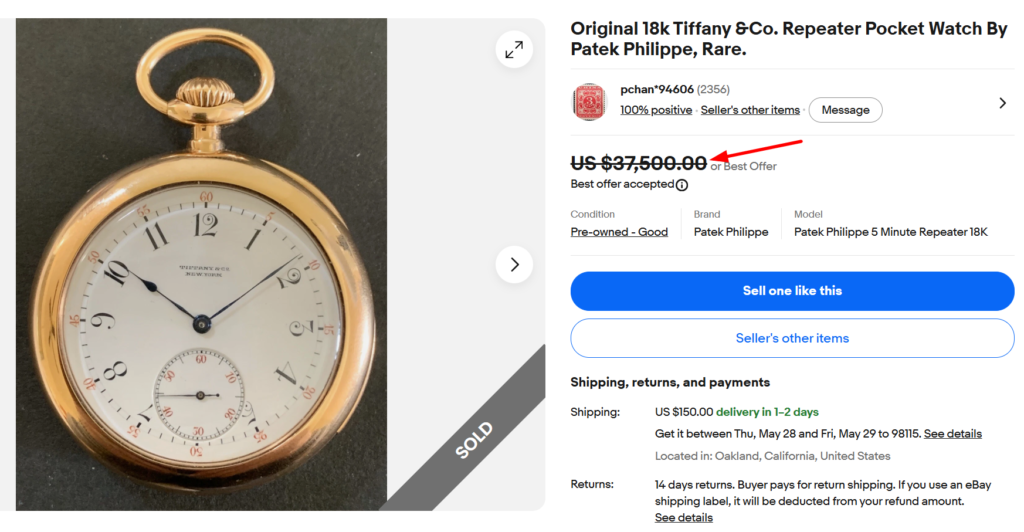
Sold for $37,500
From 1900 through 1930, Tiffany & Co. sold pocket watches fitted with movements by Patek Philippe, Vacheron Constantin, and many other high-end Swiss watch companies.
Tiffany became one of the rare retailers allowed to imprint Patek Philippe watch faces after the receipt of the timepieces from Geneva.
A dual-signed dial reading both “Patek Philippe” and “Tiffany & Co.” adds a major premium over the same Patek without the Tiffany stamp. The same goes for Vacheron-Métreau Tiffany watches, though these are less common.
- Estimated Value: $5,000–$20,000 (Patek + Tiffany dial); $3,000–$10,000 (Vacheron + Tiffany)
- Production Year: circa 1900–1930 (peak co-branding period)
- What to Check: “Tiffany & Co.” on dial, movement signed Patek Philippe or Vacheron Constantin, matching case serial.
- Quick Notes: Dual-signed dials are worth a lot more than single signs.
2. Patek Philippe Open-Face Gold
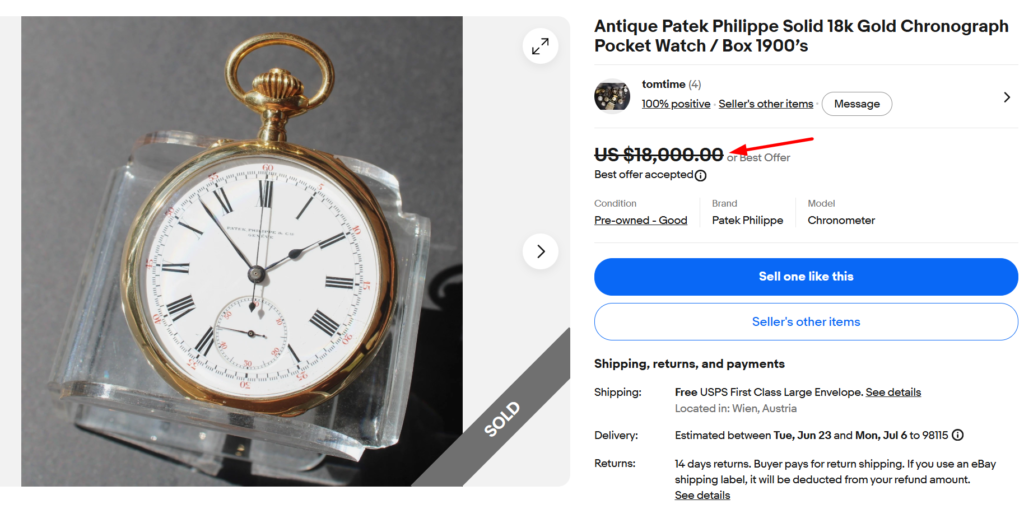
Sold for $18,000
This is the most expensive pocket watch brand. Late 1800s to 1920s Patek Philippe pocket watch models made entirely out of 18 karat solid gold will always fetch five-figure prices at auctions, even in average condition.
An ordinary 18-karat open-faced model made by Patek Philippe at the beginning of the 1900s will go for anywhere from $4,000 to over $30,000.
Rare complications push into six and seven figures. For example, a Patek Philippe Supercomplication from 1933 sold for a whopping $24 million in 2014. Always verify the Patek Philippe signature on the movement and dial before paying premiums.
- Estimated Value: $4,000–$30,000 (standard); $100,000+ (complications, provenance)
- Production Year: 1839–present (peak collector interest 1880–1930)
- What to Check: Patek Philippe signature on movement and dial, 18K gold hallmarks, Patek Archive Extract for confirmation.
- Quick Notes: Always verify with Patek Philippe’s archive service.
3. Illinois Bunn Special
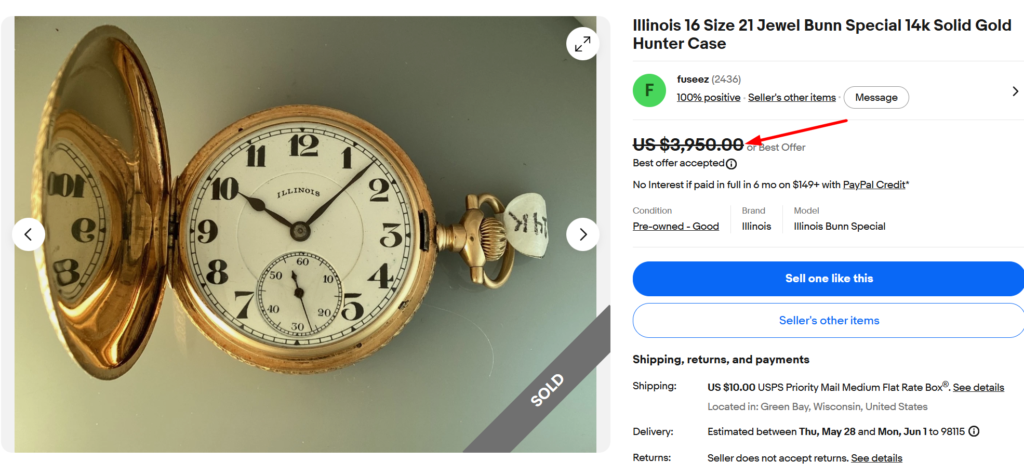
Sold for $3,950
The Bunn Special is Illinois Watch Co.’s flagship railroad line, named after company director John W. Bunn. About 500,000 Bunn and Bunn Special watches were made between 1872 and the 1940s. Bunn Specials had either 21 or 23 jewels.
The 60-hour Bunn Special from 1924 to 1925 is a very sought-after model by collectors. Other premium models from the series include the 23 jewel Grade 163 and the subsequent 163A (Elinvar hairspring). The 163 model usually sells for well over $1,000.
- Estimated Value: $400–$1,200 (21j); $1,000–$2,500 (23j Model 163)
- Production Year: 1893–late 1940s (60-hour from 1924)
- What to Check: “Bunn Special” on movement, jewel count, “60 Hour” on dial, Grade 161/163 or 161A/163A
- Quick Notes: Elinvar versions (post-1931) marked 161A/163A
4. Hamilton 992B Railroad Pocket Watch
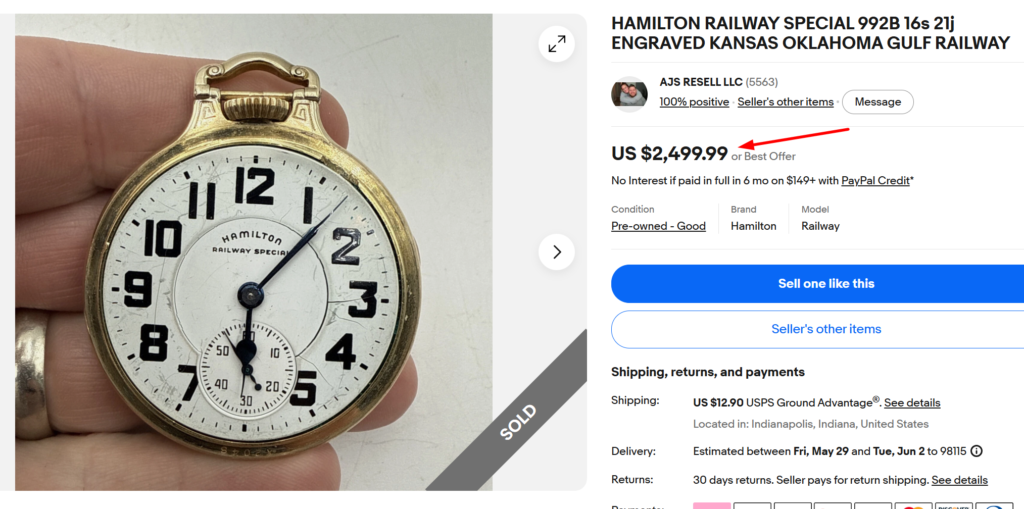
Sold for $2,500
The 992B is what most collectors think of first when mentioning an American railroad pocket watch. Launched in 1940 and made until 1969, this watch was Hamilton’s premier offering in the 21-jewel, 16-size railway grade range worn by train conductors and engineers on both sides of the North American border.
Distinctive features include a dial marked “Hamilton Railway Special” with black boxcar numerals and matching black spade/whip hands. This watch runs on a fully adjusted 6-position and temperature movement.
It was produced by Hamilton in approximately 685,500 pieces, making it a limited edition collectible piece today.
- Estimated Value: $300–$900 (gold-filled case), $1,200+ (rare configurations)
- Production Year: 1940–1969
- What to Check: Movement serial starts with “C,” 21 jewels, “Railway Special” dial, matching case.
- Quick Notes: The most collected American railroad watch.
5. Howard Series Pocket Watch
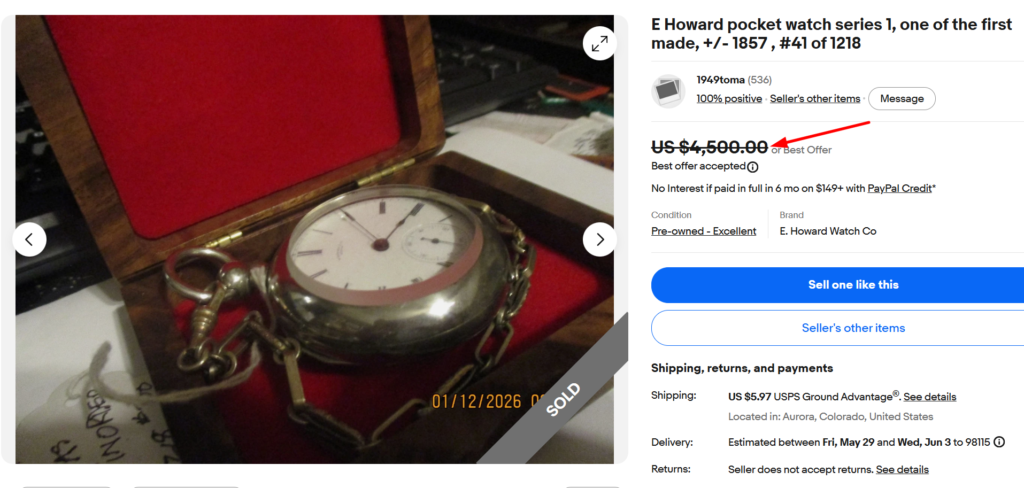
Sold for $4,500
E. Howard & Co. is the prestige name in early American watchmaking. Howard made watches that looked like nobody else’s, with distinctive plate cuts and bridge arrangements you won’t see on any other maker. The original company operated from 1858 to 1903.
Production was small, which drives the values. A Series Two Howard was made in a run of only 1,200 watches, compared to tens of millions made by Waltham and the other companies, and is worth from $1,500 to $3,000.
Earlier Series I and N-Size Howards are scarcer and bring more. Also, note that post-1903 watches that show the “E. Howard Watch Co.” marks were produced by Keystone, not Howard & Co.
- Estimated Value: $800–$3,000 (later series); $5,000–$20,000+ (early Series I, II)
- Production Year: 1858–1903 (original E. Howard & Co.)
- What to Check: “E. Howard & Co. Boston” on movement, series designation, unusual plate cuts, and bridges.
- Quick Notes: Post-1903 watches marked “E. Howard Watch Co.” are by Keystone.
6. Ball Official Railroad Standard
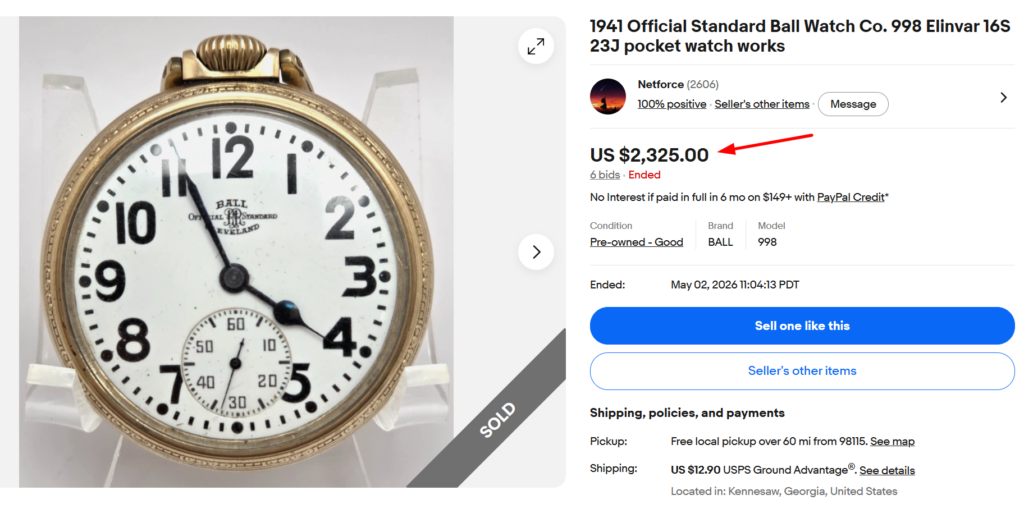
Sold for $2,325
Ball never actually made watches. The company set the railroad watch standards in 1893 and then contracted Hamilton, Waltham, Elgin, Illinois, Hampden, and Howard to build watches branded with the Ball name and inspection markings.
Ball watches are today some of the most collectible American railroad pocket watches. Any ball railroad pocket watch branded “Official Standard” carries a premium because of the strict Ball inspection history.
The Ball-Hamilton 999B is one of the most desirable models, coupled with the high-quality Hamilton watch movement and the signed Ball dial.
- Estimated Value: $500–$2,000 (common); $2,500–$5,000+ (rare 999B and early Ball)
- Production Year: 1894–1960s
- What to Check: “Ball Watch Co.” or “Ball – [Hamilton/Waltham/etc.]” on movement, original Ball dial, golden RR seal.
- Quick Notes: Ball-Hamilton 999B is the most sought-after model.
7. Hamilton Railway Special (950B Variant)
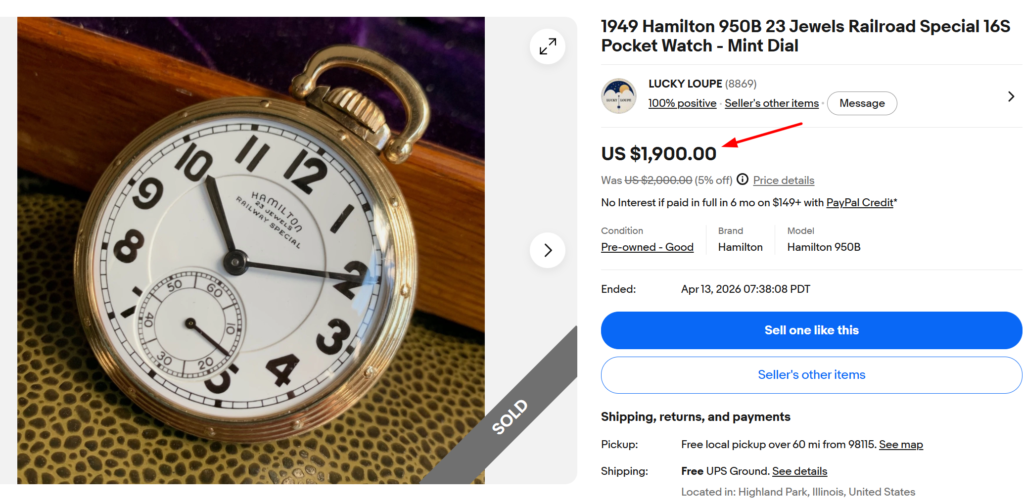
Sold for $1,900
The 950B is another highly collectible Hamilton pocket watch with the “Railway Special” trademark. It’s from the year 1941 to 1965, has 23 jewels, six position regulation, solid gold train wheels, and rhodium-plated bridges.
With regards to its performance as a timepiece, the 950B is recognized as the best railroad pocket watch ever produced in large numbers. Unlike the other model, the 992B, the production of the 950B was relatively low.
- Estimated Value: $800–$2,500
- Production Year: 1941–1965
- What to Check: 23 jewels, distinctive black baton hands, double-sunk railroad dial, solid gold train wheels visible through caseback
- Quick Notes: Watch for original matching boxes.
8. Elgin B.W. Raymond Railroad
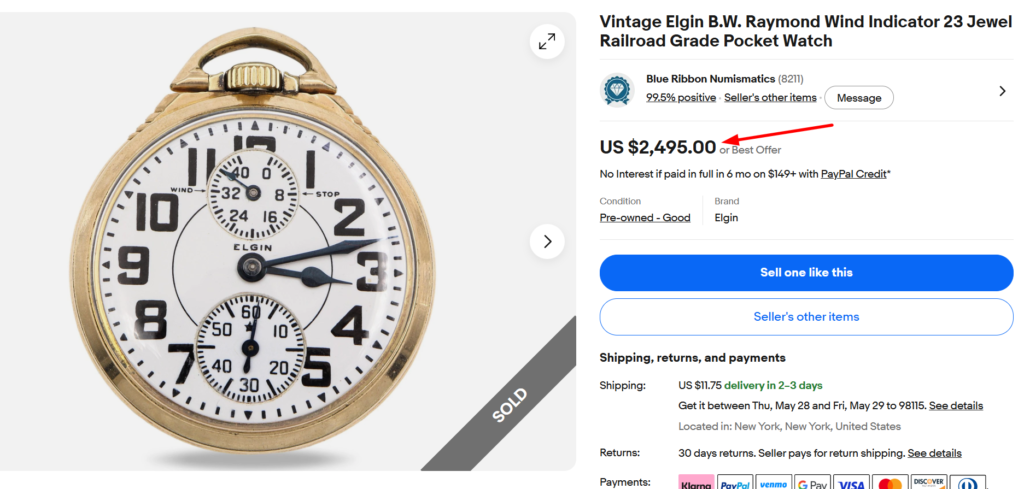
Sold for $2,495
The B.W. Raymond is Elgin’s flagship railroad line, named for company founder Benjamin Wright Raymond. The line ran an extraordinary stretch; around 1,257,831 movements were produced under the name from 1867 to the end of production.
The most popular models of B.W. Raymond timepieces include the 21-jewel Grade 478 (manufactured between 1923 and 1944) and the two 23-jewel Grade 494 and 540. Collectors particularly seek Grade 494 for its wind-indicator movements.
- Estimated Value: $250–$900 (21j); $1,500–$3,500 (23j with wind indicator)
- Production Year: 1867–1960s
- What to Check: “B.W. Raymond” engraved on movement, jewel count (look for 21j or 23j), wind indicator on top plate
- Quick Notes: Wind indicator versions are most valuable.
9. 1905 Elgin Gold Hunter Case
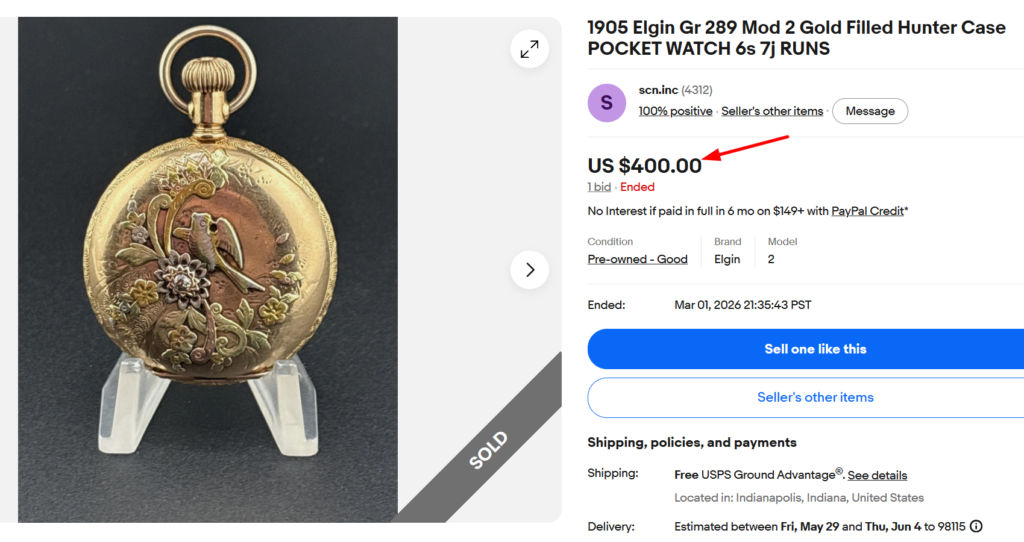
Sold for $400
By 1905, Elgin was the world’s largest fine watch producer. The hunter case Elgin pocket watch from this period, especially in solid 14K gold, is a consistently desirable model. Hunter cases close completely over the dial.
Most 1905 Elgins ran 7 to 15 jewels in 18-size or 16-size formats. It’s the solid gold examples that bring the real money. Gold-filled cases are far more common and are worth way less than solid gold case examples.
- Estimated Value: $100–$300 (gold-filled, 7–15j); $500–$1,500 (solid 14K case)
- Production Year: circa 1905 (broadly 1900–1910)
- What to Check: “14K” stamp with “Warranted U.S. Assay,” weight of case, original enamel dial
- Quick Notes: Solid gold examples can have significant scrap value alone
10. Waltham Vanguard 23-Jewel Railroad
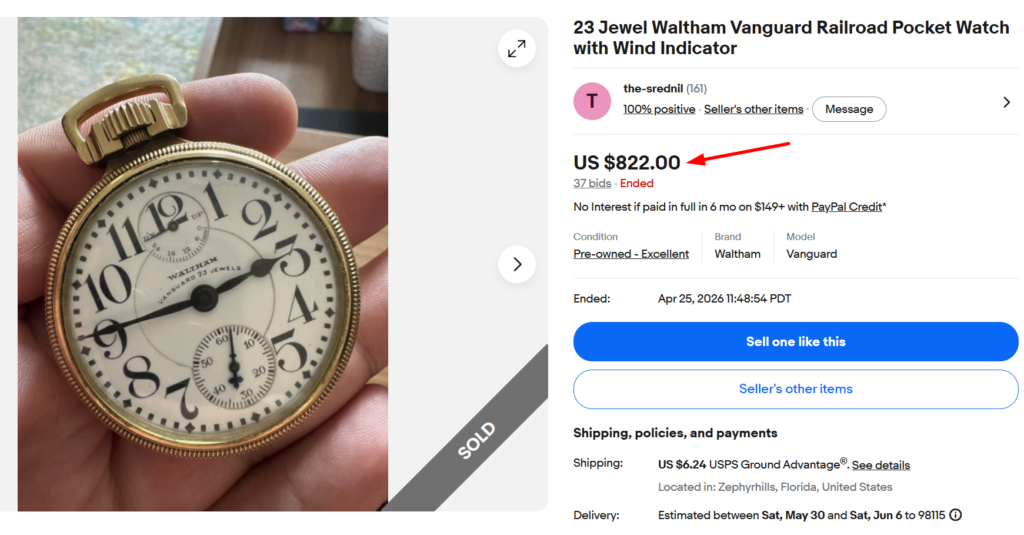
Sold for $825
The Vanguard is Waltham’s top railroad grade. The 23-jewel Vanguard, particularly the Model 1623, is the version collectors want. Production of the Vanguard grade continued as the Model 1623 Vanguard through 1953.
The most sought-after Vanguards have a wind indicator, an up/down power reserve dial on the movement that shows how much wind remains. These are noticeably rarer and command a real premium over standard Vanguards.
- Estimated Value: $400–$1,200 (standard 23j); $1,500–$3,500 (with wind indicator)
- Production Year: 1894–1953
- What to Check: “Vanguard” and “23 Jewels” on movement, Model 1623 designation, wind indicator
- Quick Notes: Direct competitor to Hamilton 950B for the 23-jewel crown
11. Waltham American 17-Jewel
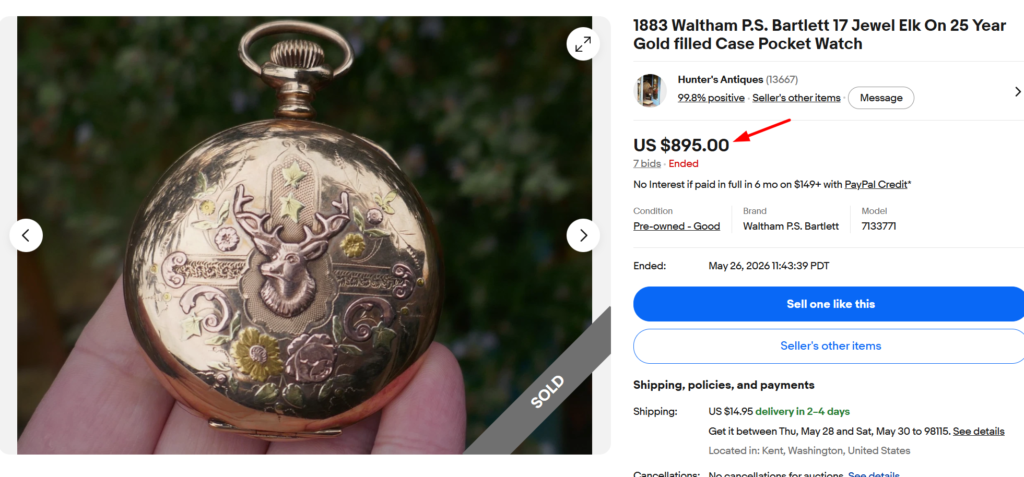
Sold for $895
The American Waltham pocket watch lineup from this era includes 17-jewel watches from the Model 1883 and Model 1899. Production ran in the millions, which means they’re easy to find; still, a clean original example in a solid gold case still brings respectable money.
These were sold under various grade names: Appleton Tracy & Co., Riverside, Crescent Street, P.S. Bartlett, and others.
The grade name matters more than most beginners realize. A Riverside in the same case outsells a P.S. Bartlett by a noticeable margin every time.
- Estimated Value: $80–$250 (common grades); $400–$1,200 (solid gold)
- Production Year: circa 1883–1910
- What to Check: Grade name on movement (Riverside, Crescent Street, more valuable), case material, dial condition
- Quick Notes: Condition matters a lot for top value.
12. Hampden Dueber Special Railway
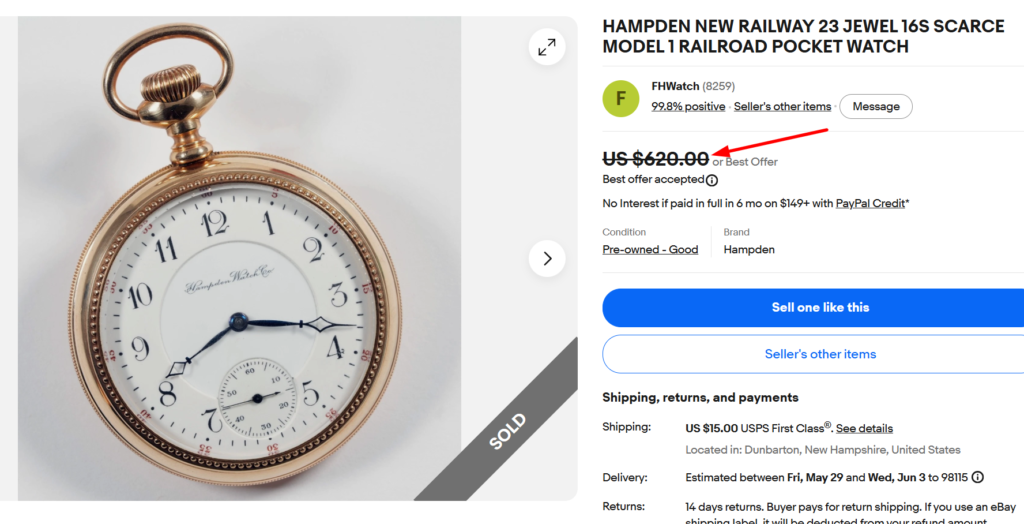
Sold for $620
The Hampden Watch Co. (later known as Dueber-Hampden following the merger with J.C. Dueber’s company of cases in 1886) manufactured high-grade railroad watches in Canton, Ohio.
The Special Railway is the brand’s most-collected railroad grade. The trademark “Railway” was registered by Hampden in July 1900.
The first watch of size 16 was made in 1890, and in 1891, Dueber-Hampden became the first US firm to sell a 23-jewel pocket watch. Two models of this company deserve our special attention: the 23–jewel 18-size Special Railway of 1896 and the 16-size Model 5.
- Estimated Value: $200–$700 (typical); $800–$2,000 (23-jewel Special Railway)
- Production Year: 1877–1930
- What to Check: “Special Railway” on movement, two-tone movement finish, 21 or 23 jewels, “Dueber Watch Case Co.” case
- Quick Notes: Hampden closed in 1927; equipment was sold to Soviet Russia.
How to Tell If Your Pocket Watch Is Valuable (6 Signs)
As you can see, not every old pocket watch is worth the same. That’s because the overall value depends on six distinct signs or factors. Let’s understand them below.
Maker
The maker is the most crucial pocket watch value driver. Names like Patek Philippe, Vacheron Constantin, E. Howard & Co. and Tiffany & Co. are top-tier companies that start in the thousands.
Top American names, Hamilton, Waltham, Elgin, Illinois, Ball, Hampden, sit in the $100 to $3,000 range.
Generic Swiss or unbranded movements are usually $30 to $150, no matter how decorative the case looks. The signature on the movement carries the value, not the engravings on the back.
Jewel Count
The more jewel count a watch has, the greater the quality and the more valuable the watch itself is. For example, an Elgin watch with a jewel count of 7 dating back to 1910 could fetch about $50. An Elgin B.W. Raymond, with a jewel count of 21 from 1910, sells for $400-$800.
The jewel count is one of the easiest signals to check, and one of the most reliable. But it works for value alongside the maker name.
Case Material
A gold pocket watch made of 14K gold with a solid gold case has more value compared to the same watch movement made of gold-filled material. Solid 18K gold cases have an inherent scrap gold value of up to $500 to $2,000 on their own.
Silver hallmarked pocket watches (coin or sterling) come in at the midway point. The value of a watch increases from $50-$200 due to coin or sterling cases, based on weight.
Gold-filled case pocket watches gain very little value, usually $20-$80, because of a very thin gold layer.
Handy Tip: A pure gold case is heavier than a gold-filled one, and the inner surface (under the dust cover) would be the same as the outer color. Gold-filled cases often show a different base metal color once the plating wears out.
Railroad-Grade vs Standard
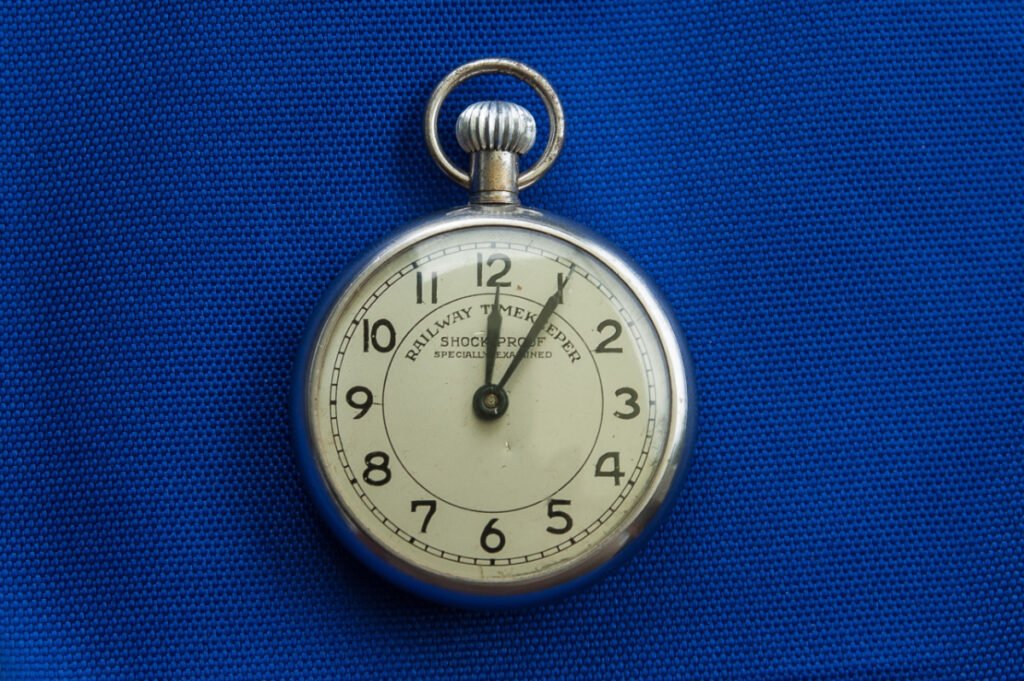
Railroad-grade pocket watches are the workhorses of American watchmaking and the most-collected category. These were built to contain a minimum of 17 jewels, be adjusted to at least five positions, temperature compensated for 34 to 100 degrees Fahrenheit, and keep time accurately to plus or minus 30 seconds a week.
The standard (non-railroad) watches by the same companies generally fetch 30 to 60% less.
Condition and Originality
Originality matters a lot for pocket watches. An original dial without cracks in the hairline, an unpolished case with good engraving, original hands, and a movement that has not undergone much repair make a watch worth something.
Cracked dials, replacement hands, redone dials, and gold-filled cases worn down to where the gold is wearing out are the usual value destroyers. A pristine original watch can sell for 2 to 3 times the same model with a refinished dial.
Provenance and Maker Rarity
Never overlook the documented history of a watch; it can multiply the value. A pocket watch with original presentation papers, railroad inspection cards, or a clear ownership history (a known railroad engineer, a military officer, a notable family) brings a meaningful premium.
Rarity adds value, too. Limited edition grades, rare case shapes, and watches by short-lived makers (early Howard, for instance, or pre-1900 Illinois) always command premiums. The smaller the production run, the greater the premium!
To summarize, the most valuable antique pocket watches have three traits: a known top-tier maker, original parts that match, and case material. If you have one, open the back, find the movement serial, run it through a lookup database, and read the case markings carefully.