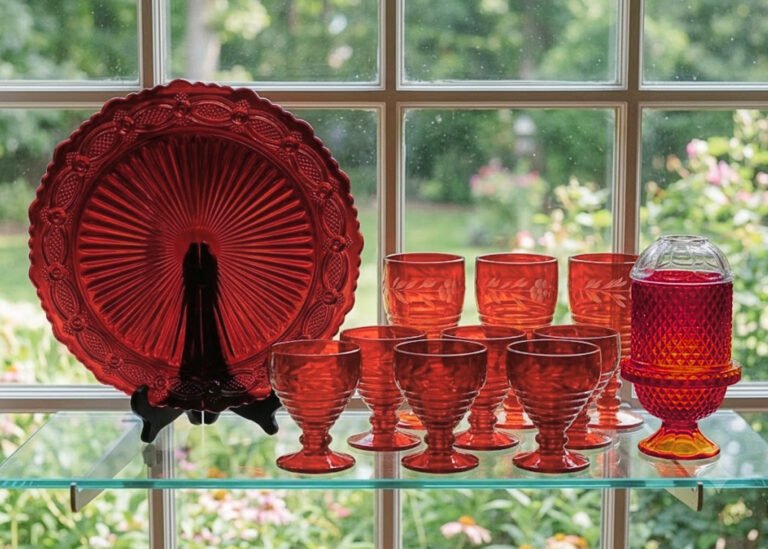

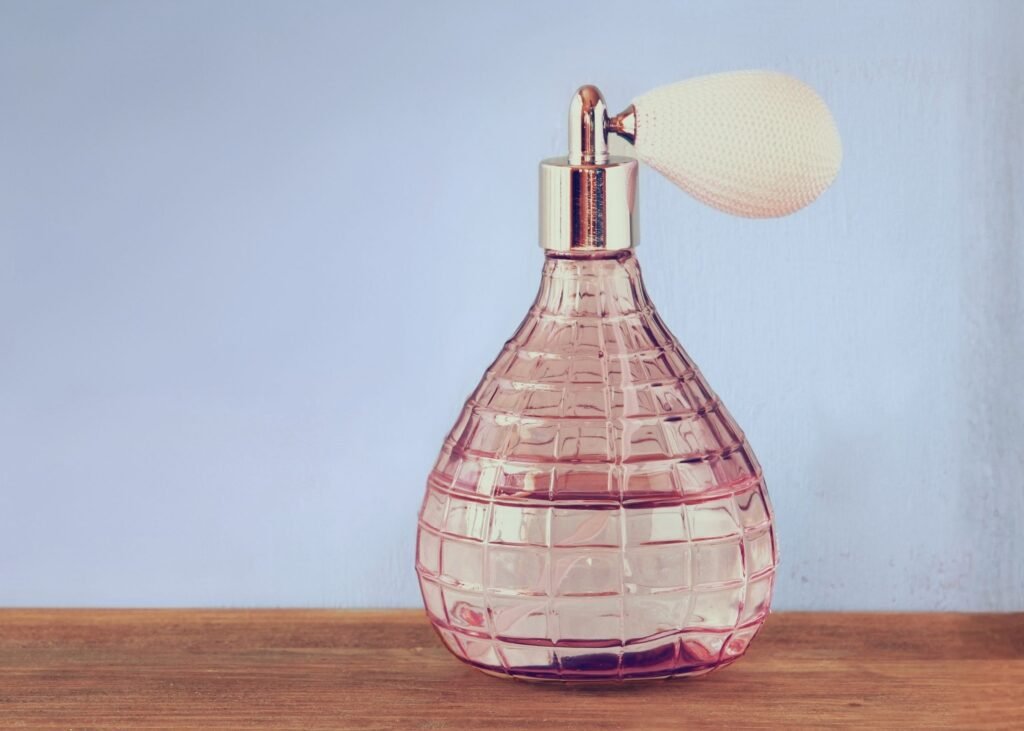
While most people are crazy for the fragrance, the scent bottle usually outlasts the perfume itself. Most old empty perfume bottles are tossed into the garbage or sold for bucks at estate sales. And that’s a BIG mistake.
Even an empty vintage perfume bottle can be worth $5,000+ today, if it comes from a renowned maker, like Lalique or Baccarat. So, before you toss your bottle, learn to identify valuable antique perfume bottles and discover the most collectible makers and designs in this guide.
How to Tell If a Perfume Bottle Is Antique & Valuable?
Antique perfume bottle identification involves assessing these five key aspects:
- The maker’s mark
- The glass body
- The stopper
- The era cues,
- The condition.
These factors work together to indicate something valuable.
A single signal rarely means much. A cut-glass body counts for little without a corresponding mark or a matching original stopper. Stacking two confirming signals can move a piece from “looks old” into a “potentially valuable” find.
Check the Maker’s Marks
You may see three types of marks on the base of an old perfume bottle: acid-etched, molded in glass, and printed labels.
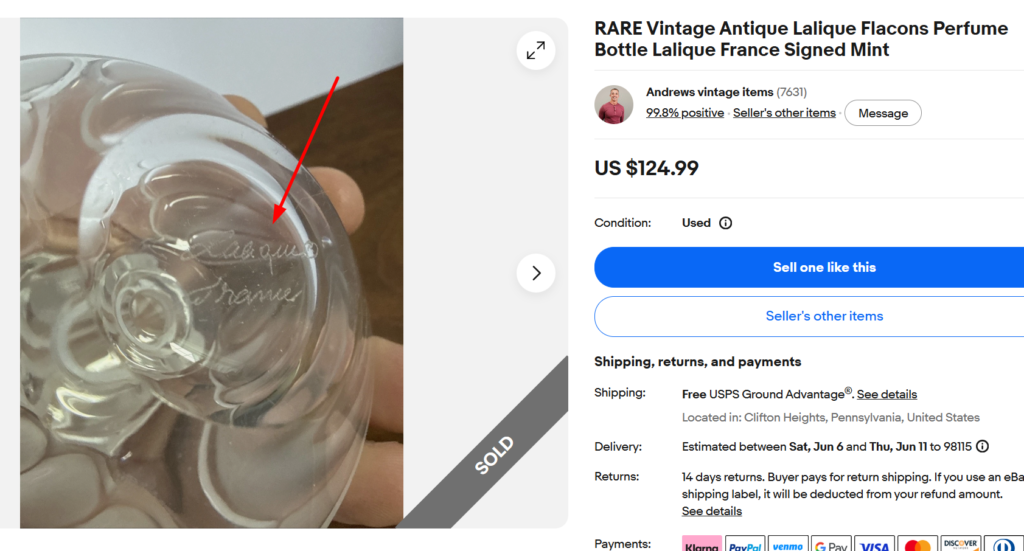
A few important marks to look out for include the “R. Lalique” (before 1945), “Lalique France” (after 1945), Baccarat’s circular acid stamp (from 1936), and “Made in Czechoslovakia.” We’ll learn about all the notable makers in the next section.
Handy Tip: Use a magnifying glass and an angled light source. Acid-etched marks are shallow and almost disappear under flat overhead lighting.
Examine the Glass Type & Color
The perfume bottle’s glass type can narrow the date and method before any mark is visible. For example, early hand-blown bottles carry small bubbles and irregularities along the seams. Pressed glass from the 1920s shows crisper mold lines.
Next, crystal pings when tapped, ordinary glass thuds. But the tap test is reliable only if you can clearly differentiate the sounds of each.
Color is more of a value driver rather than an identification sign. Cobalt blue, deep cranberry, malachite green, and amethyst all sell for higher prices than clear glass bottles. Cobalt cut-glass Victorian bottles and cranberry overlay (one color over another, partially cut away) bring a premium, too.
Inspect the Stopper (Value Driver)
Although mostly overlooked, stoppers carry disproportionate value. A bottle without its original stopper can drop 50% or more on resale, and a wrong-fit replacement is sometimes worse than no stopper at all.
The original stopper should match in glass type, in the overall design, in weight when held, and in patina along the edges. A ground-glass stopper that drops snugly into place without wobble is almost always the original.
Good to Know: French makers numbered their stoppers and bottle necks to match. Baccarat used a two-digit number on the stopper base that should appear again on the inside of the neck.
Look at the Style & Era
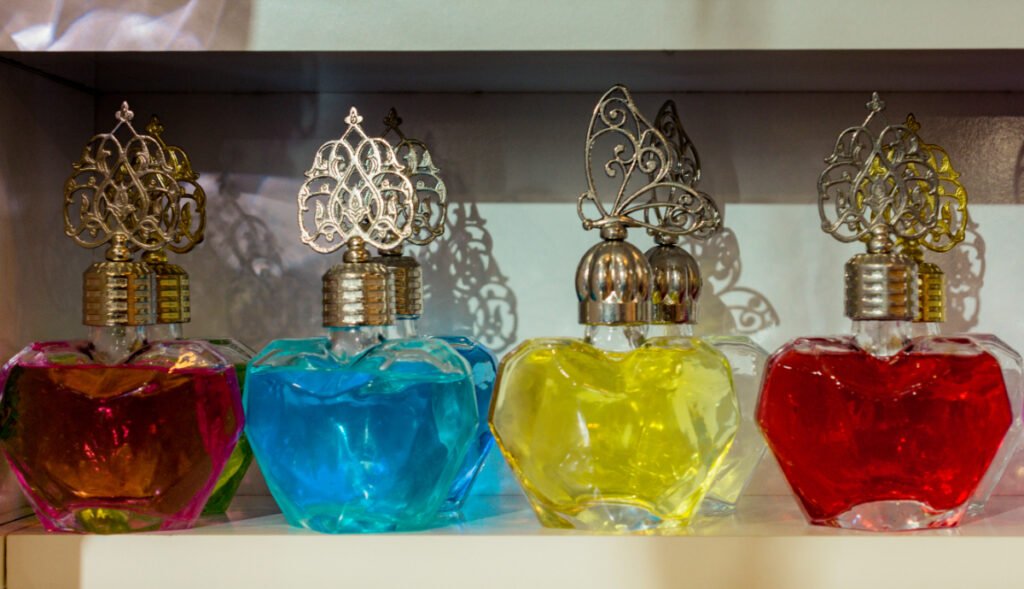
The style of your scent bottles can tell a lot about what era they come from. From the glass type and shapes to stopper types and colors, each era had unique features that are dead giveaways.
Here are the key eras and their distinctive features at a glance:
- Victorian (1837 to 1901) – You’ll see heavy cut glass, silver overlay, and double-ended scent bottles. Faceted stoppers were common. Colored pieces, like cranberry or cobalt, are also common, often paired with sterling caps.
- Art Nouveau (1890 to 1910) – Flowing organic curves, floral and insect motifs, cameo glass (multiple acid-etched layers), enameled or gilt decoration. Names like Galle and Daum Nancy were popular.
- Art Deco (1920 to 1940) – Bottles had geometric shapes, like stepped pyramids, often with both frosted and clear glass. Atomizers featured bulb sprayers, too. Top makers included Lalique, Baccarat, and Czech Hoffmann.
- Mid-Century (1940 to 1965) – Figural shapes (Prince Matchabelli crowns, Avon novelties) and machine-finished details became popular, along with commercial packaging.
- Late Vintage (1965 to 1980) – Avon figural decanters, Lalique for Nina Ricci, mass-market collectibles.
Verify Condition, Packaging & Content
Condition stands on top of every other factor. The same vintage perfume bottle, in mint versus damaged condition, can sell for five times as much.
Key damage to look for is:
- Chip rings around the stopper neck
- Fleabites along the foot rim
- Scratches across the maker’s signature
- Cloudy interiors from dried perfume
- Missing or broken stopper
Paper labels, hangtags, and original boxes raise commercial fragrance values especially sharply (Guerlain, Caron, Worth).
Lastly, the original content is another overlooked factor. A sealed bottle holding some of the original juice is rare on the market and brings additional money from serious collectors who want the fragrance archived, not just the vessel.
Important Note: Don’t try to clean a vintage label. Water marks, peeled corners, and detached labels can reduce half its value at auction or sale.
Most Notable Perfume Bottle Makers to Look For
The maker’s name can instantly change an antique cologne bottle’s value from a few bucks to hundreds of dollars. Below are the seven names that collectors look out for. Learning to spot their marks and styles is the quickest way to value a piece.
- René Lalique (France, founded 1888) – The most collectible perfume bottle brand. Commissioned by many brands like Coty, Nina Ricci, Guerlain, plus his own Maison Lalique brand. The Pre-1945 sign is “R. Lalique”; post-1945 is “Lalique France” or “Lalique.” Frosted and colored figurals are key elements.
- Baccarat (France, founded 1764) – Manufactured commercial perfume flacons for Guerlain, Caron, Schiaparelli, and Worth, plus their own Maison Baccarat line. Pre-1936 pieces went out unsigned or with a removable paper label. The round acid-etched “Baccarat France” stamp arrived in 1936.
- DeVilbiss (Ohio, founded 1888) – Started as a medical atomizer maker. They began producing perfume bottles in 1907, adding metalwork and assembling the pieces. The glass came from Steuben or Cambridge. Check for the acid-etched “DeVilbiss” on the base; sometimes there are patent numbers, too.
- Czech (Bohemian) Makers – Popularized the Art Deco Czech style with intaglio-cut figurals, faceted crystal, jeweled filigree work, and opaque malachite glass. The Hoffmann mark is a small butterfly. Schlevogt’s “Ingrid” line came in lapis blue and malachite green, with “Made in Czechoslovakia.”
- “Émile Gallé and Daum Nancy (France) – The two leading French Art Nouveau cameo houses, both active from the 1880s through the early 1900s. Gallé signed “Galle” in the cameo work itself, carved directly into the colored layers. Daum used “Daum Nancy” alongside a cross of Lorraine. High-tier names.
- Thomas Webb & Sons (England, 1880s to 1900s) – Known for cameo bottles, swan’s head design, sterling caps from Sampson Mordan (English market) or Gorham (American export market). Look for English hallmarks on the silver and registry numbers like “Rd. 11109” on the cameo work.
- Steuben (USA, founded 1903) – Produced the iridescent Aurene glass bottles (sold standalone with dauber stoppers, or with DeVilbiss atomizers). Signed pieces carry “Aurene” plus a four-digit shape number etched into the foot.
14 Rare Valuable Antique Perfume Bottles Worth Finding Now
Let’s take a look at some of the most collectible antique and vintage perfume bottles from the most popular makers. Each bottle features unique features that impact its value and desirability today, given that the condition is decent.
1. R. Lalique “Bouchon Cassis” Perfume Bottle
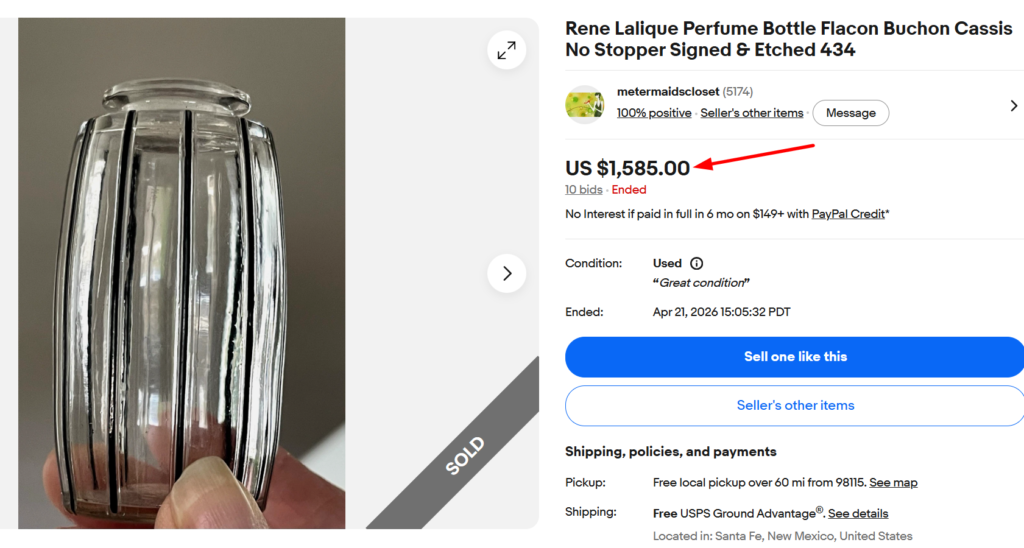
Sold for $1,585 (without stopper)
The Bouchon Cassis is one of the most coveted Rene Lalique perfume bottles ever made. Designed in 1920, it’s a spherical ribbed bottle with a stopper shaped like a tiara of cascading blackcurrant clusters.
Color matters enormously. Black and electric blue stopper versions pull far higher prices than common clear or orange variants. Bottles missing the stopper still sell, but at a fraction of their complete value, like this example.
- Estimated Value: $1,500 to $20,000+
- Production Years: 1920 to mid-1930s
- What to Check: Currant cluster stopper, R. Lalique mark
- Quick Notes: Color is a major value driver.
2. R. Lalique Helene Perfume Bottle
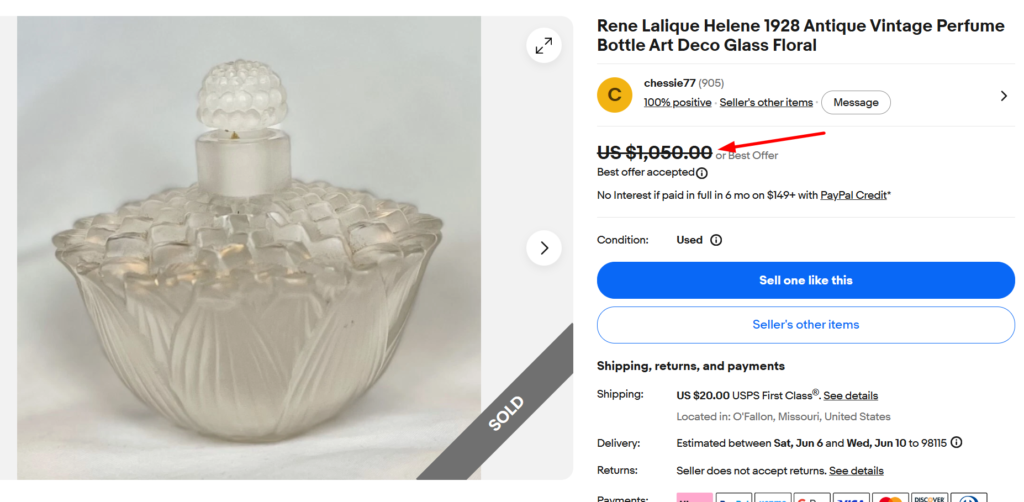
Sold for $1,050
The Helene bottle was made in 1928 by the designer René Lalique. It is characterized by its wide, flattened body, wrapped with frosted glass leaves. The closure is a berry or raspberry-shaped stopper that makes the bottle easy to recognize visually.
These pieces are scarcer than the Bouchon Cassis. Make sure to examine the signature of R. Lalique at the bottom and look out for any cracks in the berry cluster stopper; it can affect the value.
- Estimated Value: $700 to $1,500
- Production Years: 1928 to 1947
- What to Check: Leaf body, berry cluster stopper
- Quick Notes: Stopper chips cut value sharply.
3. Myon Baccarat Joies Perfume Bottle
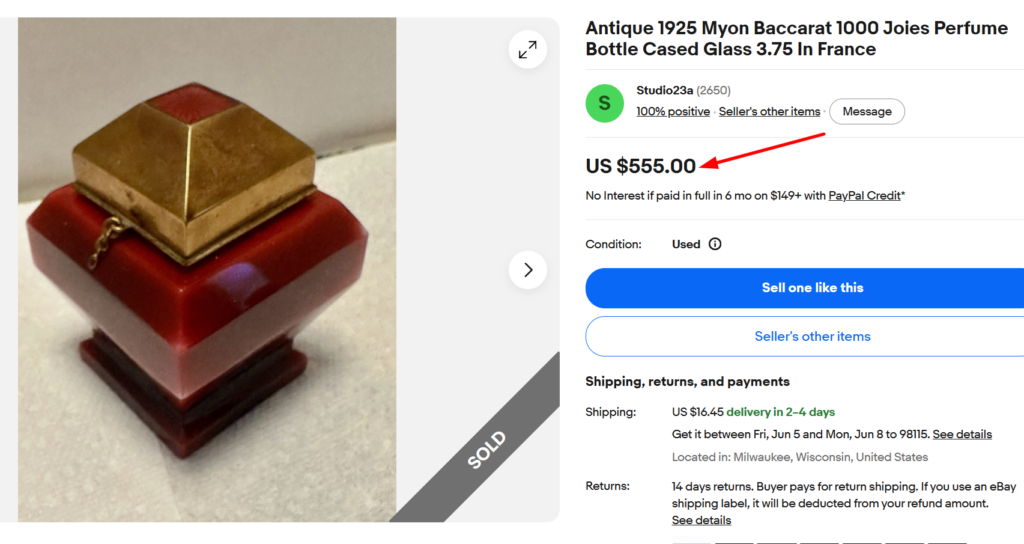
Sold for $555
Myon was a minor French perfume maker that contracted Baccarat for the production of its flacons during the Art Deco period. The 1000 Joies (1000 Joys) bottle, dated 1925, has a deep red cased crystal body in a stepped pyramid form, with a matching gilt-bronze pyramid stopper.
The brand operated only briefly, so surviving examples are rare to see at auction or online sales. Red cased glass is the primary identifier of these bottles.
- Estimated Value: $400 to $700
- Production Years: Circa 1925
- What to Check: Red cased glass, bronze pyramid cap
- Quick Notes: Short-lived brand, scarce on the secondary market.
4. Steuben Aurene Cologne Bottle
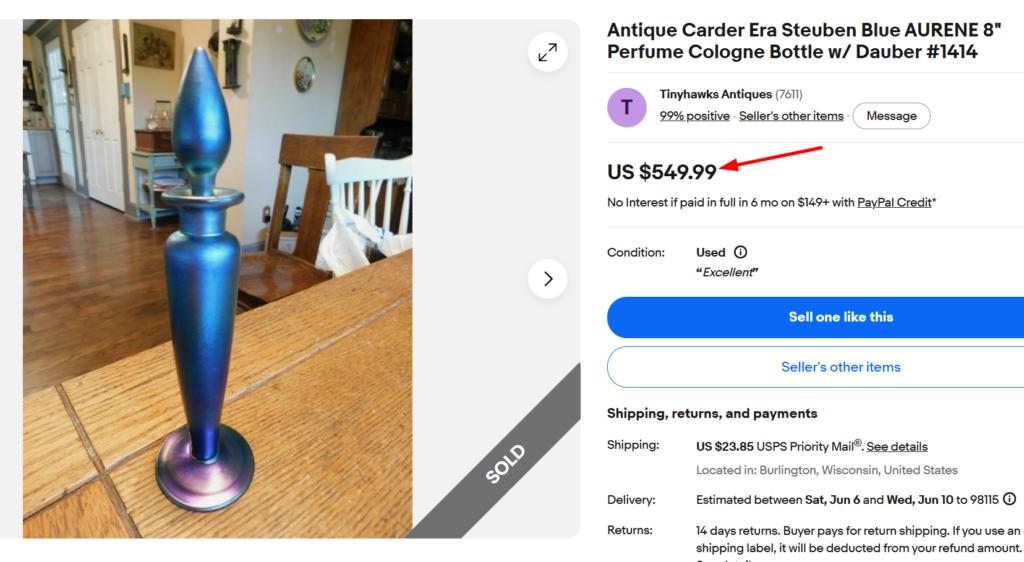
Sold for $550
Steuben Aurene perfume bottles appeared in two formats: standalone bottles with internal daubers (long pointed glass stoppers, signed by Steuben directly), and bottles shipped to DeVilbiss for atomizer assembly.
Frederick Carder developed the Aurene finish in 1904. You can identify it by the iridescent gold or blue surface. Blue Aurene is the rarer of the two color treatments.
Signed examples carry “Aurene” with a four-digit shape number etched on the foot.
- Estimated Value: $400 to $1,200
- Production Years: 1904 to 1932
- What to Check: Iridescent finish, Aurene signature
- Quick Notes: Blue Aurene is rarer than gold.
5. Baccarat Crystal Empire Atomizer
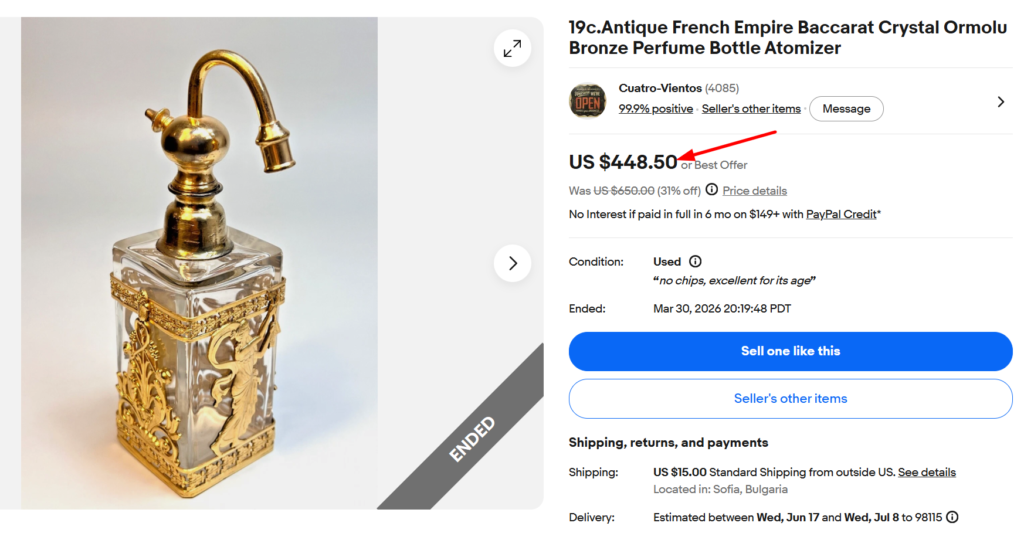
Sold for $448
The Empire pattern is a late 19th-century Baccarat design with green or cobalt overlay cut to clear in a heavy crystal body. Most of these pieces come with gilt-bronze mountings and figural panels in the base.
Pre-1916 Baccarat antique perfume bottles don’t have signatures; compare them to the illustrations in the 1916 Baccarat catalog to identify them.
- Estimated Value: $400 to $1,500
- Production Years: Late 1800s to early 1900s
- What to Check: Empire pattern, ormolu mount, cut overlay
- Quick Notes: Often unsigned, verify it by the pattern.
6. Czech Art Deco Jeweled Filigree Bottle
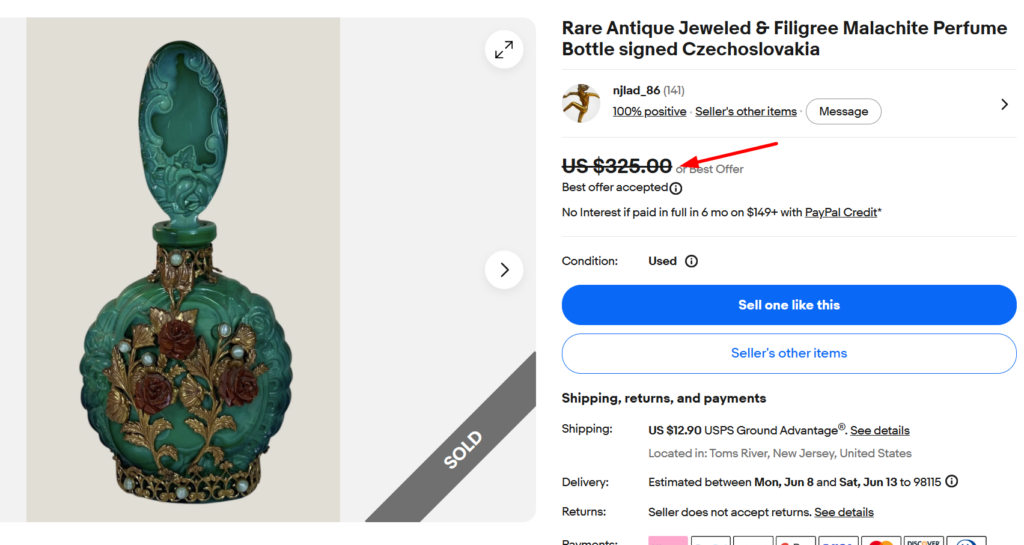
Sold for $325
There are two types of old Czech perfume bottles from the 1920s and 1930s that people who collect them really want. These are Hoffmann bottles that are shaped like figures and have cuts on them. The other type is atomizers, with filigree and jewels.
The filigree versions wrap brass or gilt metalwork around a colored glass body, with paste rhinestones and faux pearl accents. Malachite green, pink, cobalt, and emerald are the premium colors. A missing or replaced dauber takes a serious bite out of value.
- Estimated Value: $150 to $700
- Production Years: 1920s to 1940s
- What to Check: Jeweled filigree, Czech mark
- Quick Notes: Missing daubers significantly hurt the value.
7. DeVilbiss Glass Atomizer
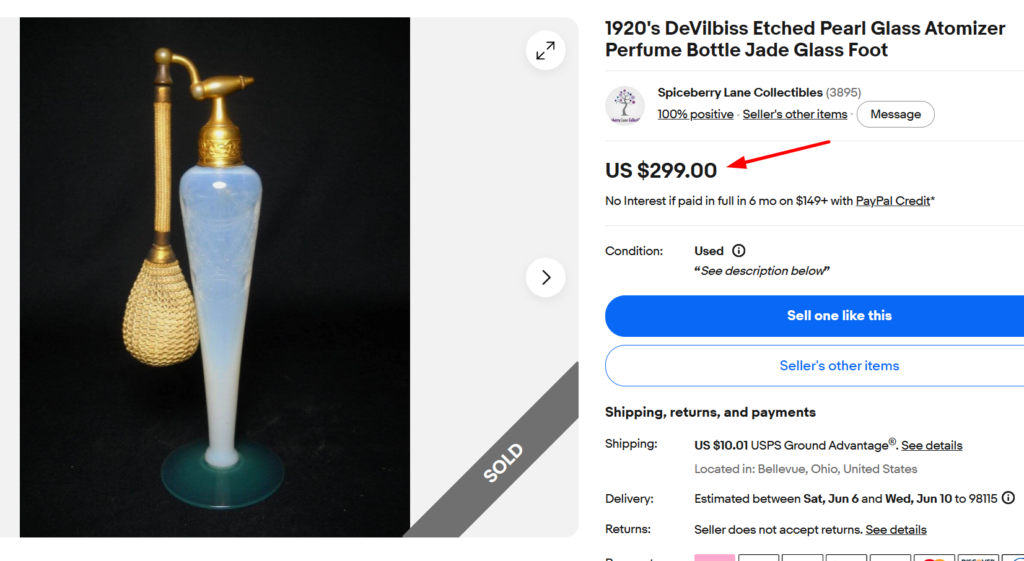
Sold for $300
DeVilbiss antique perfume bottles come in several styles with a wide value range, but the cameo glass atomizers from 1920 to 1928 are the most collectible and high-end pieces.
These vintage perfume bottles with pump mechanisms layer acid-etched glass in two colors, most often black or amethyst, cut back to a pink or orange base. Original silk-covered bulbs and tassels lift the price meaningfully when present.
- Estimated Value: $400 to $1,200
- Production Years: 1920 to 1928
- What to Check: Acid-etched cameo layers, working bulb
- Quick Notes: The original silk bulb is important for top value.
8. Alvin Sterling Silver Overlay Perfume Bottle
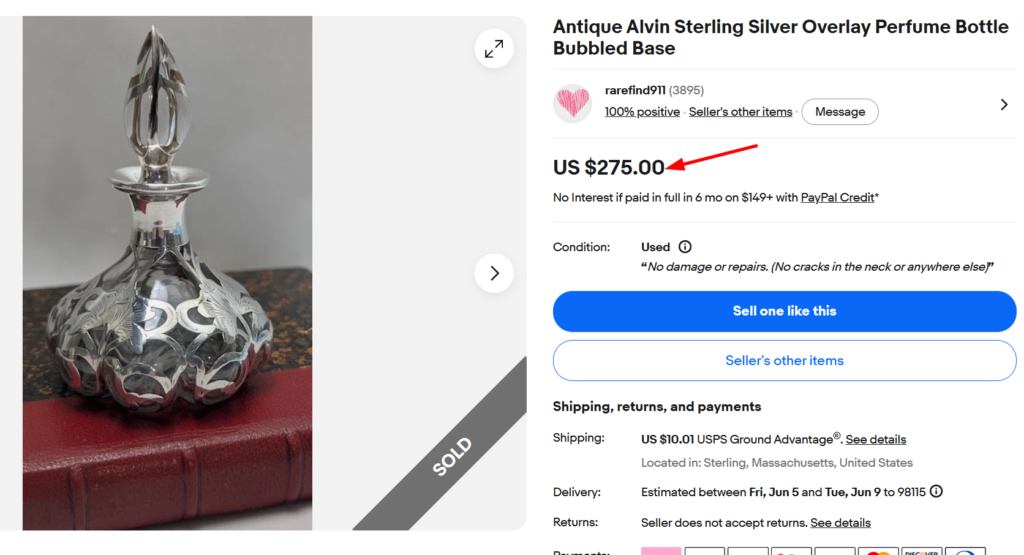
Sold for $275
Antique perfume bottles with silver tops draw consistent Victorian-era buyer interest. The main American producers were Gorham, Alvin, and Mauser, active between 1890 and 1910, applying sterling overlay (silver electrochemically deposited onto glass) in Art Nouveau whiplash and floral motifs.
Alvin pieces carry a distinctive bubbled or scalloped base. Gorham used a “D-series” design number that helps with dating. Also, rare Cranberry and emerald bodies are worth more than clear ones.
- Estimated Value: $275 to $1,600
- Production Years: 1890 to 1915
- What to Check: Sterling mark, maker stamp
- Quick Notes: Bubbled base signals Alvin’s work.
9. Schiaparelli “Shocking” Dressmaker Bottle
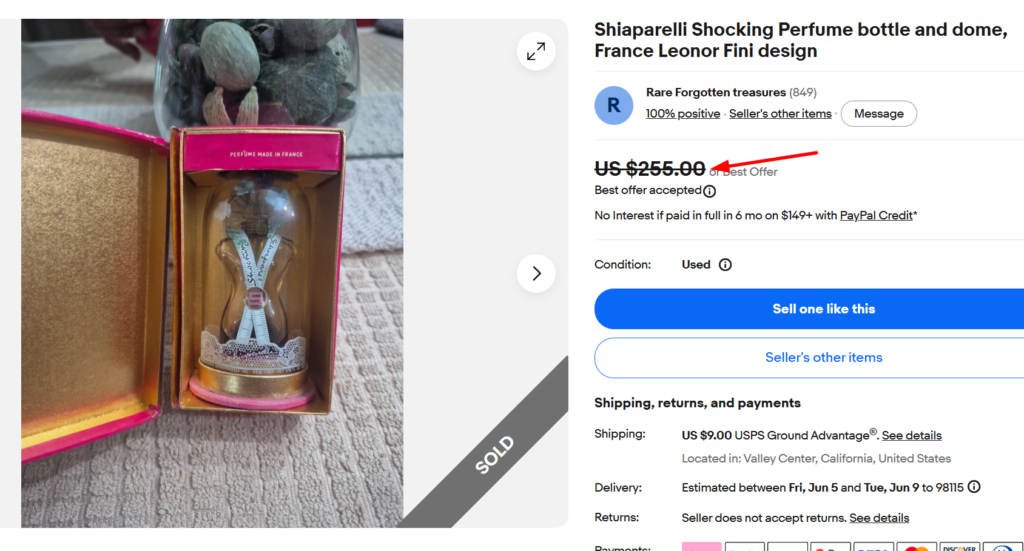
Sold for $255 (with original box)
The flacon takes the form of a dressmaker’s mannequin built to Mae West’s measurements. The Léonor Fini design from 1937 carries a paper tape measure around the neck, a metal “S” badge on the front, and small hand-blown glass flowers ringing the collar.
The glass flowers are almost always missing or broken on surviving examples. So, complete sets with the glass dome cover, along with the pink presentation box, are the most desirable and valuable.
- Estimated Value: $150 to $600
- Production Years: 1937 to the 1950s
- What to Check: Tape measure, glass flowers, S badge
- Quick Notes: Original dome and box are critical for top value.
10. Victorian Cobalt Blue Perfume Bottle
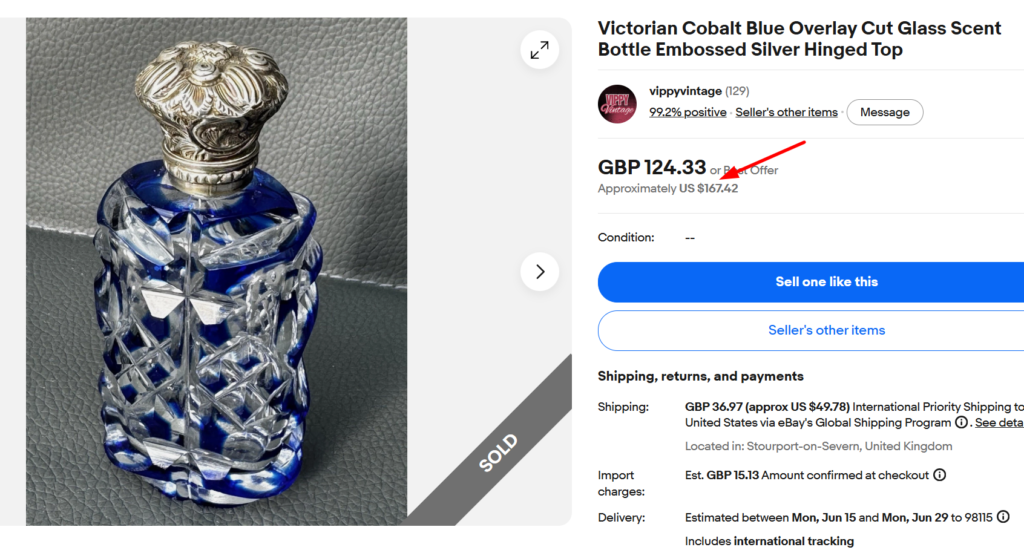
Sold for $168
Victorian blue perfume bottles are steadily collectible today, particularly the cobalt blue glass antique perfume bottles fitted with sterling tops or hinged silver caps. The color itself comes from cobalt oxide added to the molten batch.
American and English glassworks cut deep facets into the cobalt body to create elegant designs. Some pieces feature clear-cut-to-cobalt glass bodies, like this example.
Also, English hallmarked silver caps add meaningfully to the price over later or unmarked caps.
- Estimated Value: $150 to $600
- Production Years: 1870 to 1910
- What to Check: Cobalt color, hallmarked silver
- Quick Notes: Hallmarks date the silver work.
11. L’Air du Temps “Doves” Bottle
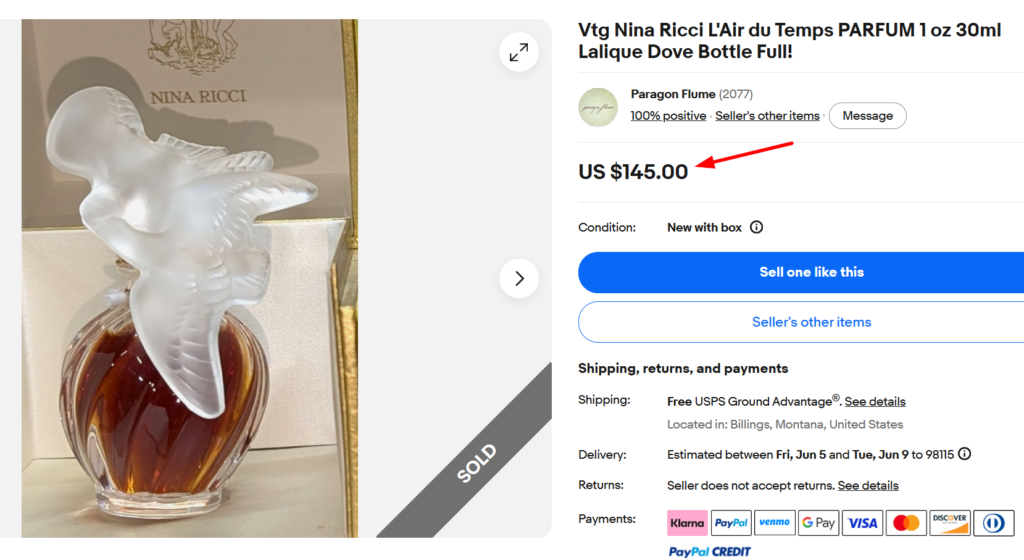
Sold for $145
The Lalique perfume bottles Nina Ricci collaboration is the most recognized pairing of glass designer and perfumer. Marc Lalique drew up the double-dove stopper in 1951; the bottle has remained in production since.
The 1950s and 1960s examples carrying the “Lalique France” signature and original packaging command the top of the market.
Later 1980s reissues are priced much lower. The dove necks are the most vulnerable spot; check both for hairline cracks.
- Estimated Value: $80 to $1,500+
- Production Years: 1951 to present
- What to Check: Two doves, Lalique signature
- Quick Notes: Early 1950s versions are worth most
12. Prince Matchabelli Crown-Shaped Bottle
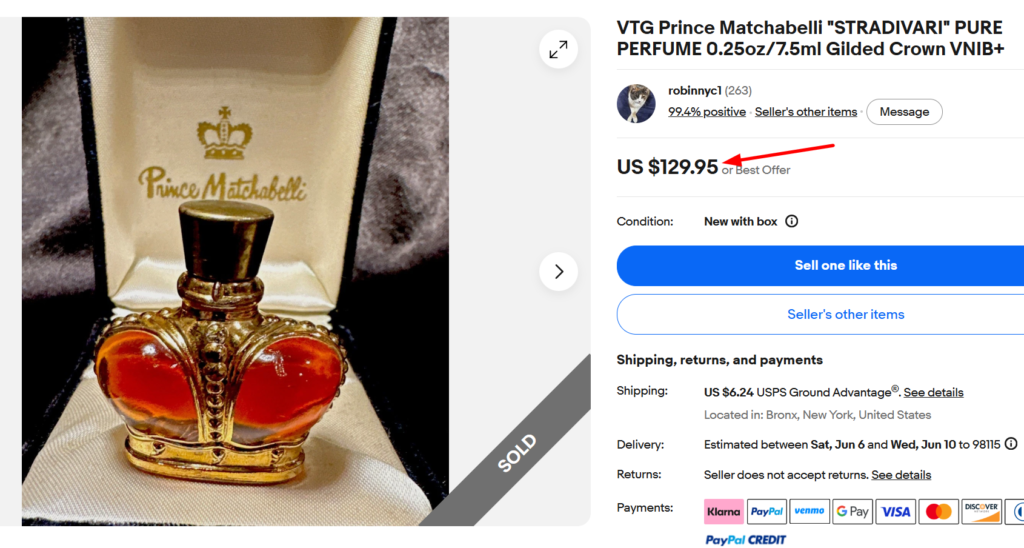
Sold for $130
These Prince Matchabelli bottles are identified by their unique crown-shaped bodies. The crown shape appeared in cobalt blue, ruby red, black, and clear with gilt enamel work.
Wind Song, Cachet, and Stradivari are the three most collected labels. Original gold paper labels and crown-shaped presentation boxes significantly increase value.
- Estimated Value: $25 to $150
- Production Years: 1930s to 1980s
- What to Check: Crown-shaped bottles, enamel detailing
- Quick Notes: Color and label condition affect the value.
13. Guerlain Mitsouko Baccarat Bottle
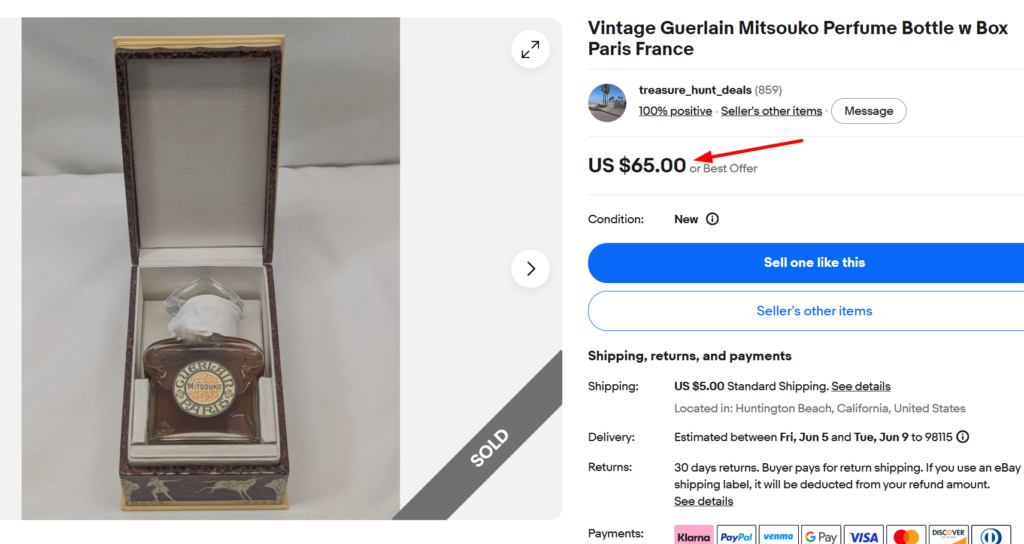
Sold for $65
Raymond Guerlain designed the original Mitsouko bottle, which Baccarat made from 1919 on. It has an octagonal shape with the famous heart-shaped stopper, or “Bouchon Coeur” in French.
Pieces made before 1936 lack the round Baccarat acid stamp. So, the absence of this mark identifies the very first, most collectible batch. An original bottle with preserved content and the original box is where the value lies.
- Estimated Value: $65 to $600
- Production Years: 1919 onward
- What to Check: Heart stopper, octagonal base, original label
- Quick Notes: Pre-1936 examples lack the Baccarat stamp
14. Caron “Nuit de Noel” Black Baccarat Bottle
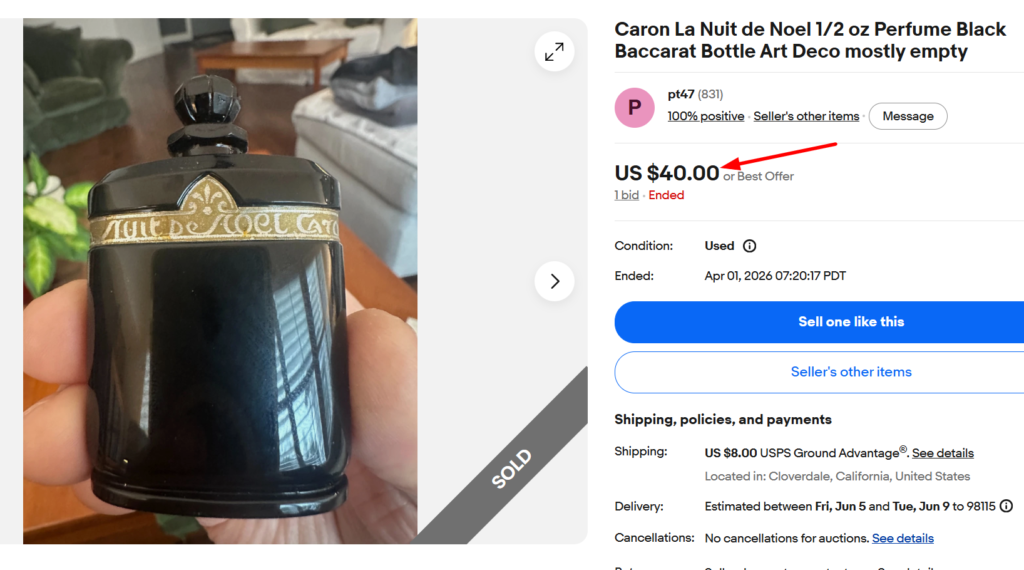
Sold for $40
A jet black crystal flacon designed by Félicie Vanpouille for Caron’s 1922 fragrance, produced by Baccarat. The black glass body shipped in an original green sharkskin-textured presentation box.
Pre-reformulation production from before the 1990s holds the most collector interest. Mostly empty bottles trade at the low end of the range; full or sealed examples with the silk cord intact reach the high end.
- Estimated Value: $40 to $400
- Production Years: 1922 onward
- What to Check: Black crystal, gilt label, original box
- Quick Notes: Empty bottles bring far less
Honestly, most old, empty perfume bottles aren’t worth much unless the mark says it’s a Lalique, Baccarat, or a Thomas Webb piece from their earliest years, and the original stoppers are intact. So, always check the mark, track the era, and assess the condition of old scent bottles to know if they are worth anything.