
Did you know that a pink Hot Wheels Volkswagen bus the size of your thumb sold for around $150,000? It is a 1969 Hot Wheels prototype, and only two are known to exist.
That sum always shocks people, but it explains why every collector who grew up in the 60s and 70s eventually asks the same question about the beat-up cars in their old shoebox.
So this guide covers what actually makes a vintage Hot Wheels valuable, how to identify the rare toys, and which models collectors chase the most in 2026.
How to Identify Vintage Hot Wheels? 4 Details to See
Before we get to identification, a quick note on eras. Collectors treat 1968 to 1977 as the Redline era, named for the red stripe on the tires. Anything after that uses plain black tires and is called Blackwall. The 1968 to 1972 models are the most collectible.
1. Check the Base First
Flip the car over and spot the marking. Real vintage Hot Wheels have a heavy metal base stamped with a country of origin like USA or Hong Kong, a copyright year, and often a patent number.
A plastic base or a missing stamp is a red flag. Hong Kong cars usually have blue-tinted windows, while USA cars have clear glass.
2. Read the Wheels Carefully
The wheel style tells you the era right away. Redlines have a painted red ring inside a recessed groove on the tire. Stickers or a red ring sitting on a smooth surface means it is a reproduction.
Blackwall tires have no red at all. Real Riders, which came later, use rubber tires with white lettering.
3. Look for Spectraflame Paint
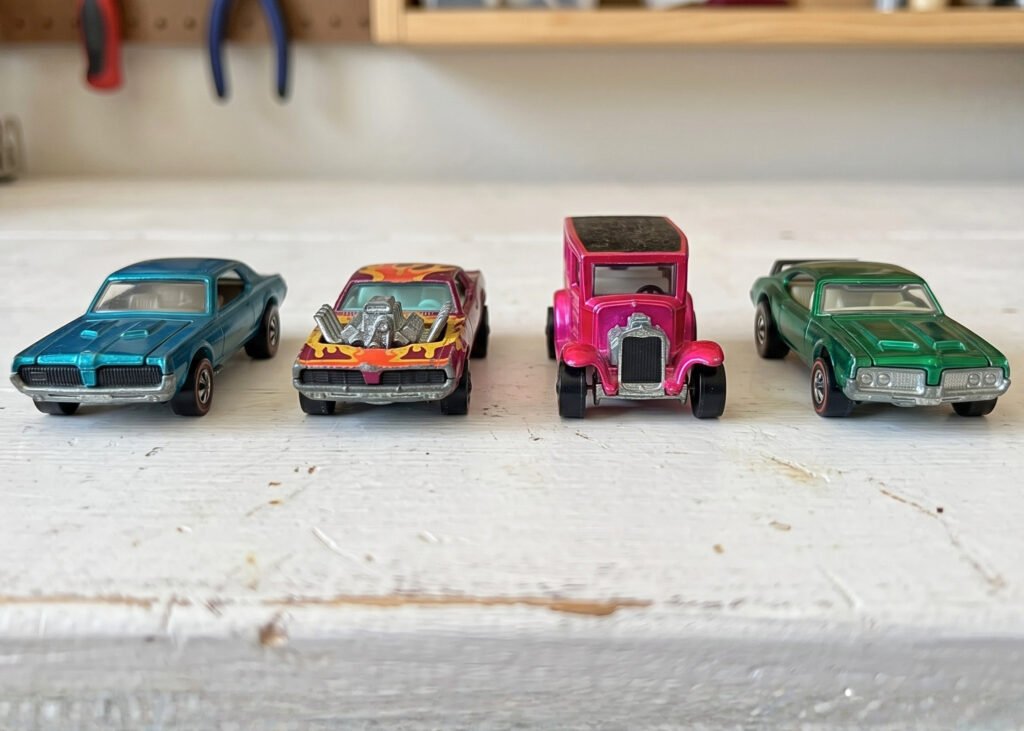
Spectraflame is the candy-metallic finish Mattel used on Redlines from 1968 through the early 70s. The paint is translucent, so you can see the raw zinc metal shining through the color.
Aqua, gold, hot pink, and antifreeze green are common Spectraflame shades. If the paint looks flat and opaque, the car is probably later production or a repaint.
4. Check the Packaging
Early blister cards from 1968 and 1969 have unique artwork like the Cheetah card, and those are prized on their own.
A vintage Hot Wheels on its original blister card, called Mint on Card by collectors, can be worth 5 to 10 times more than the same car loose. Loose cars are still very collectible, just at a different tier.
What Determines the Value of a Vintage Hot Wheels?
The value of old Hot Wheels toys can range from $10 to $10,000 in the resale market. This huge difference comes down to five major factors. Once you know them, you can know what your Hot Wheels toy car is worth.
- Color – This is the biggest one. Two identical castings can differ by 10x in price based on paint alone. Hot pink, magenta, purple, and salmon are usually the rare colors across most Redline castings. Blue, aqua, and gold are typically common.
- Year and casting – 1968 and 1969 cars sit at the top because they were the first two years of production. The Sweet 16, meaning the original 16 castings from 1968, always pull a premium. Later Redlines from 1975 to 1977 are more common and cheaper.
- Country of origin – For most castings, Hong Kong versions are scarcer than USA versions, but a few castings flip that rule. Always check both the base stamp and the wheel type together, since certain Hong Kong wheel styles command their own premium.
- Condition – Collectors grade cars from Mint on Card down to Player, which means heavy playwear. A mint loose car in a common color can still bring $40 to $80. That same car with paint chips and axle wobble might sell for $5.
- Completeness – Some castings came with parts. A Deora without its two surfboards loses roughly $40 to $60 in value. A Sky Show without its plane loses even more. Missing parts always hurt, and reproduction parts should be disclosed honestly.
For a rough price map in 2026, common loose Redlines Hot Wheels in decent shape usually sit at $20 to $100. Better colors and cleaner examples move into the $150 to $500 range.
Rare colors, Hong Kong variants, and Mint on Card examples routinely clear $1,000. Prototypes and one-off variants live in their own world, from $3,000 up to six figures.
To check any car yourself, search the exact model and color on eBay, then check the Sold Listings. That gives you real prices that collectors pay, not asking prices.
12 Rare Vintage Hot Wheels Toys Collectors Chase
These are the most collectible vintage Hot Wheels worth knowing by name. Find out how much these rare pieces are worth today, and how to spot them easily.
1. 1969 Pink Rear-Loading Beach Bomb
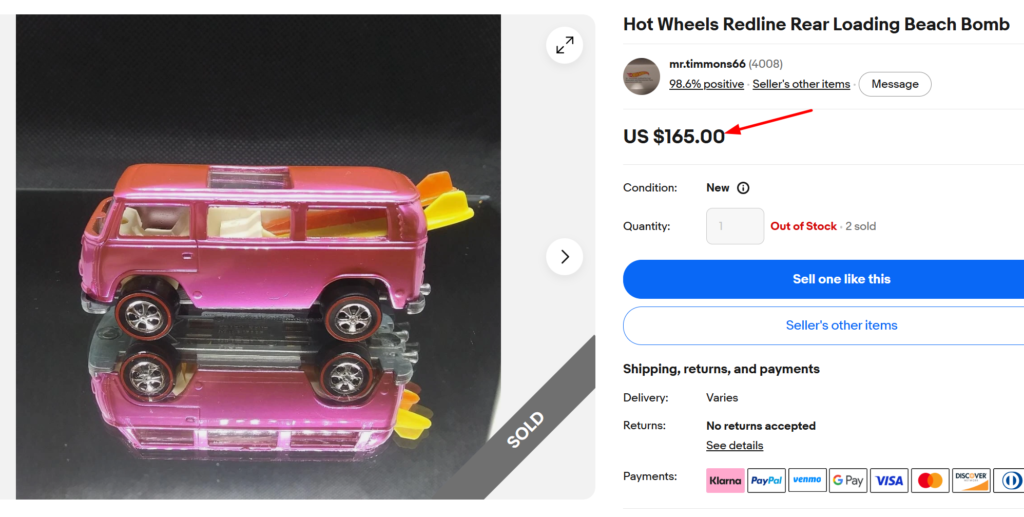
Sold for $165 (replica, for representation)
This is a sort of prototype, and hence, highly rare.
Mattel designed this pink Volkswagen bus with surfboards loading through the rear window, but the body was too narrow and top-heavy for the orange track. So they widened it and moved the boards to side pods.
Only two pink original rear-loaders are confirmed to exist, and one lives in collector Bruce Pascal’s collection. The regular side-loader version is common and affordable.
- Estimated Value: $150,000 to $175,000
- Production Years: 1969 prototype only
- What to Check: Narrow body, rear-window surfboards
2. 1971 Purple Olds 442
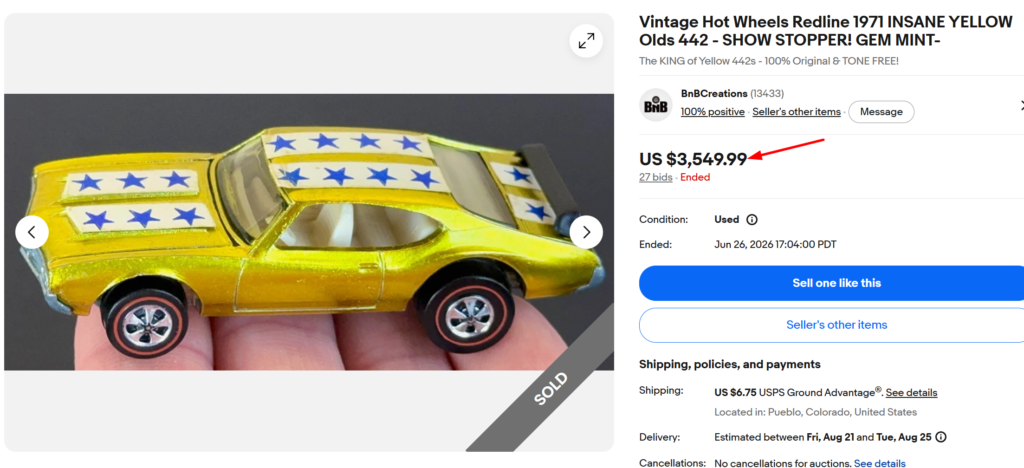
Sold for $3,550
Widely considered the rarest production Redline of them all. Made only in Hong Kong for a single year, the Olds 442 came in several Spectraflame colors, but Purple and Yellow sit alone at the top of the value list.
The car has an opening hood, a detailed engine underneath, and came with a decal sheet of white stripes with dark stars on them. Also, all originals have white interiors. So, check this to confirm authenticity.
- Estimated Value: $3,500 to $12,000
- Production Years: 1971 only
- What to Check: Hong Kong base, opening hood, white interiors
3. 1975 MMA Winter Ball Chrome 2+2 Chevy Monza
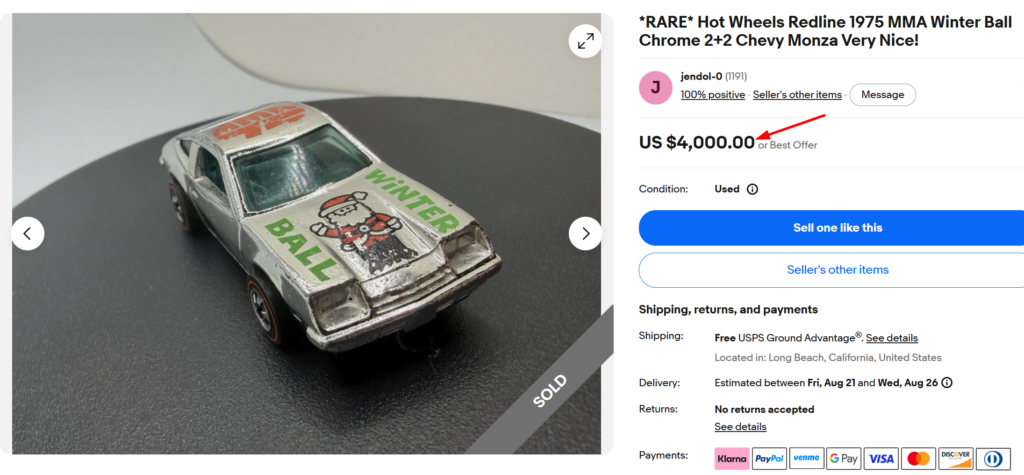
Sold for $4,000
This one is a Mattel employee party giveaway, not a store release. Only around 200 were handed out at the 1975 Mattel Managers Association Christmas Ball, and the tampo artwork was done by Mattel designer Aaron Cohen.
The Santa design on the roof and the red and green “MMA Winter Ball” lettering are unique to this run. The car is a Hong Kong casting with a bright chrome body, redline wheels, and blue-tinted windows.
Regular chrome Monzas from the 1976 Super Chromes series look similar at first glance, so the Santa tampo is the key ID sign.
- Estimated Value: $2,750 to $4,000+
- Production Years: 1975 employee promo only
- What to Check: Santa tampo, red/green MMA lettering
4. 1968 Grail Brown Store Display Custom Camaro
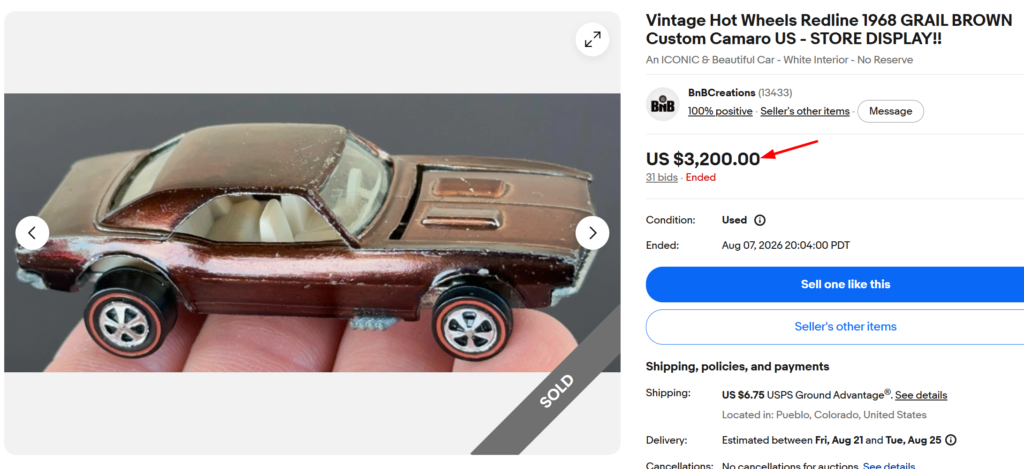
Sold for $3,200
Sitting just below the enamel white prototype, Brown is the second rarest color for USA Custom Camaros. Most examples are believed to have been made as store display pieces rather than retail sales, making them rare.
The car has a white interior, clear windows, no door lines, and the common zinc base. Look for the “kidney bean” shaped holes on the underside, since that base style is a hallmark of early USA production.
Even worn examples pull strong money because of the highly rare color.
- Estimated Value: $3,000 to $9,000
- Production Years: 1968 to 1969
- What to Check: Brown Spectraflame, kidney bean base
5. 1968 Enamel Custom Camaro (White Prototype)
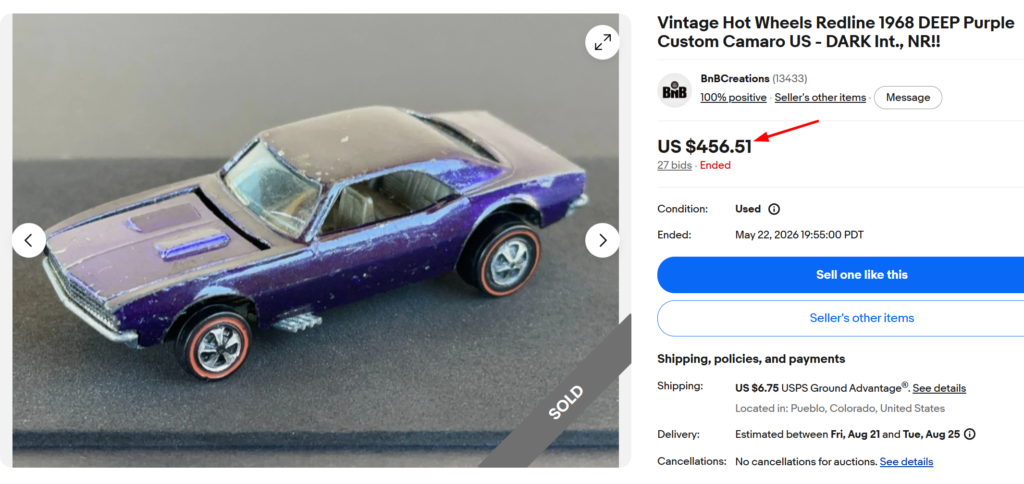
Sold for $456 (not the white version)
Hot Wheels designers coated the new castings of Camaro in flat white enamel to spot casting flaws before applying real paint. But a few slipped into production and reached store shelves.
Around 200 are believed to have been made, but only about 25 are still accounted for today. The white Custom Camaro is ranked as the third rarest Hot Wheels by Michael Zarnock in his Warman’s Field Guide.
Value Tip: Hong Kong bases command the top prices.
- Estimated Value: $25,000 to $100,000+
- Production Years: 1968 prototype
- What to Check: Flat white enamel, not Spectraflame
6. 1968 Cheetah Base Python
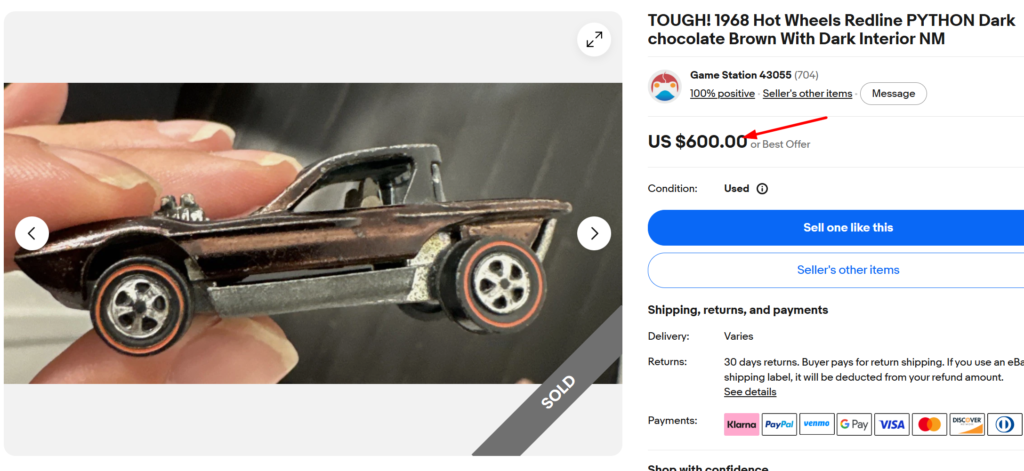
Sold for $600
The Python was originally called Cheetah inside Mattel. General Motors already owned that name for a Corvette race car, so Mattel renamed it before mass release.
A handful of early Hong Kong castings went out with Cheetah still stamped on the base, instead of Python. Red is the most well-known color, and collectors have been hunting these since the 70s. Dark chocolate versions are also quite collectible.
- Estimated Value: $3,000 to $10,000
- Production Years: 1968 early production
- What to Check: Cheetah name stamped on base
7. 1969 Pink Classic ’31 Ford Woody
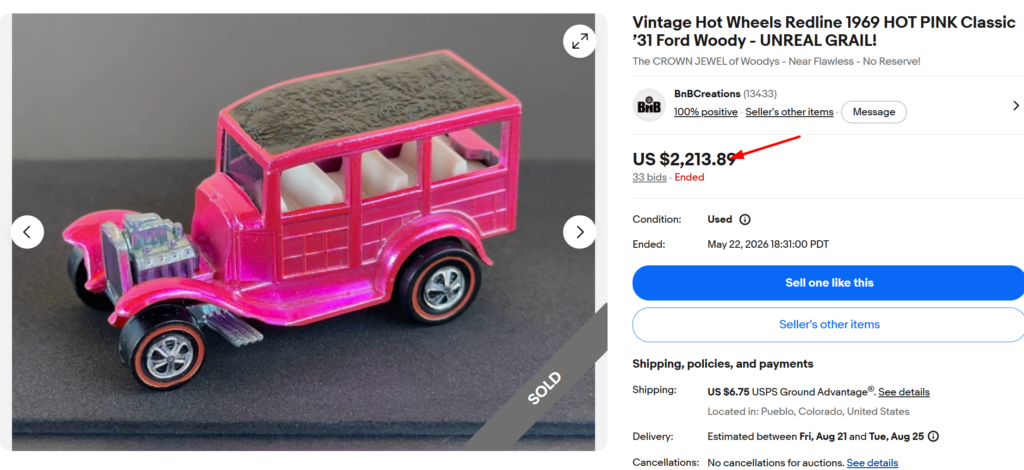
The Classic ’31 Woody has a boxy body and an exposed engine sticking through the hood. Most Spectraflame colors are affordable and easy to find. Brown and Hot Pink are the exception.
Experts believe only around a dozen exist, most likely a preproduction batch given to Mattel employees before regular colors went into production.
- Estimated Value: $8,000+ (brown examples)
- Production Years: 1969 preproduction batch
- What to Check: Brown Spectraflame, not enamel
8. 1970 Red Baron with White Interior
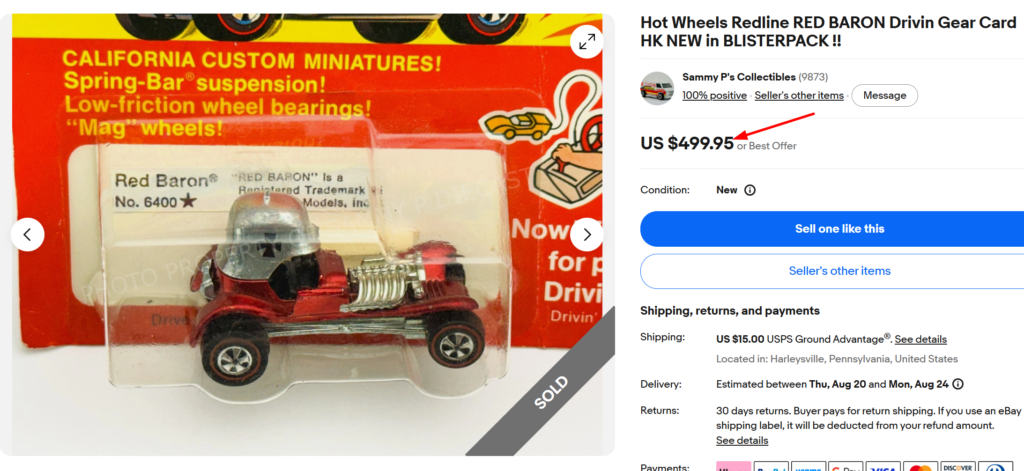
Sold for $500 (black interior variant)
The Red Baron is one of Tom Daniel’s show rod castings, shaped like a German helmet with an Iron Cross on each side. Standard versions have a black interior and are affordable.
A small variant run left the factory with a white interior. Fewer than 10 white interior examples are known, which are among the rarest Hot Wheels ever.
- Estimated Value: $3,000+
- Production Years: 1970 to 1971
- What to Check: White interior, Hong Kong base
- Quick Notes: Reissues with white interior are marked Vintage
9. 1969 Redline Red Ferrari 312P
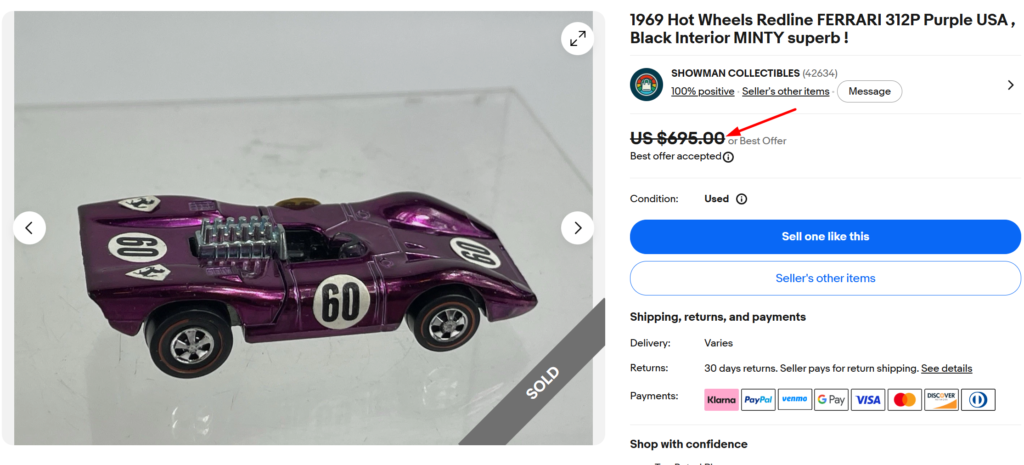
Sold for $695
Based on the real Ferrari 312 P Spyder that raced at Le Mans in 1969, this casting was designed by Ira Gilford and joined the Grand Prix Series for the 1970 lineup. It has an opening rear hatch with the V12 engine, painted taillights, and a low race body shape.
The model was made in both the USA and Hong Kong across many Spectraflame colors. Common colors like magenta and aqua stay affordable, but Purple, Rose, and Salmon jump into the hundreds.
- Estimated Value: $75 to $700+
- Production Years: 1969 to 1974
- What to Check: Opening hatch, #60 Ferrari decals
- Value Notes: HK red with white interior can hit $5,000+
10. 1969 Twin Mill
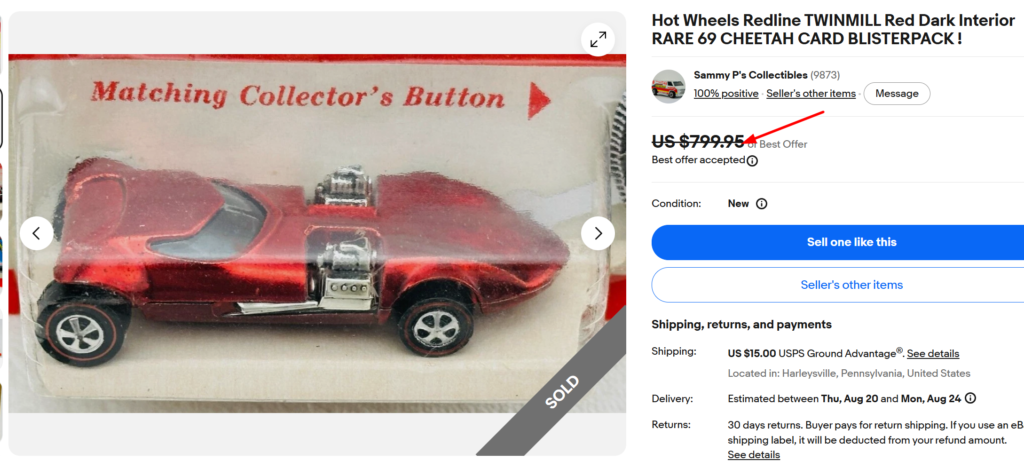
Sold for $800 (with blister pack)
Another Ira Gilford design and one of the most recognized Hot Wheels ever made. You can identify it by the two big exposed engines poke up through the hood.
This model was made only in the USA between 1969 and 1971. The rare cut-rear-fender variation, where the fenders sit closer to the body and do not cover the tires, adds a hefty premium for advanced collectors.
ID Note: This Hot Wheels variant is heavily reproduced, so verify originality carefully.
- Estimated Value: $50 to $800+
- Production Years: 1969 to 1971
- What to Check: Twin engines, cut fenders on rare variant
11. 1968 Deora
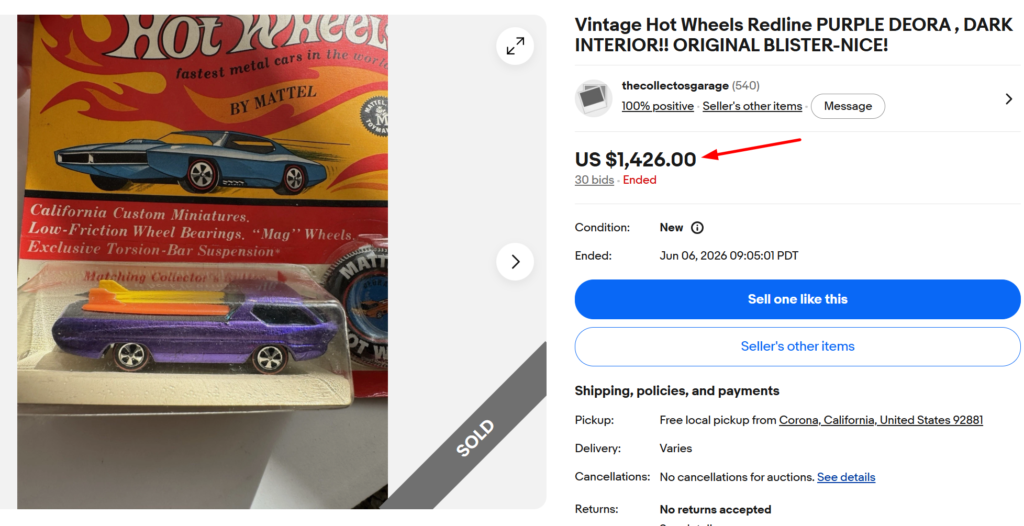
Sold for $1,426
This toy car is a part of the original Sweet 16. The Deora is a Dodge concept truck with a cab-forward design and two removable surfboards on the back. It was cast in both the USA and Hong Kong across 11 Spectraflame colors.
Rare colors like antifreeze, hot pink, and purple bring 2x to 4x the price of common shades. Missing surfboards drop the value significantly.
- Estimated Value: $75 to $1,000+
- Production Years: 1968 to 1969
- What to Check: Original surfboards, base stamp
12. 1974 Blue Rodger Dodger
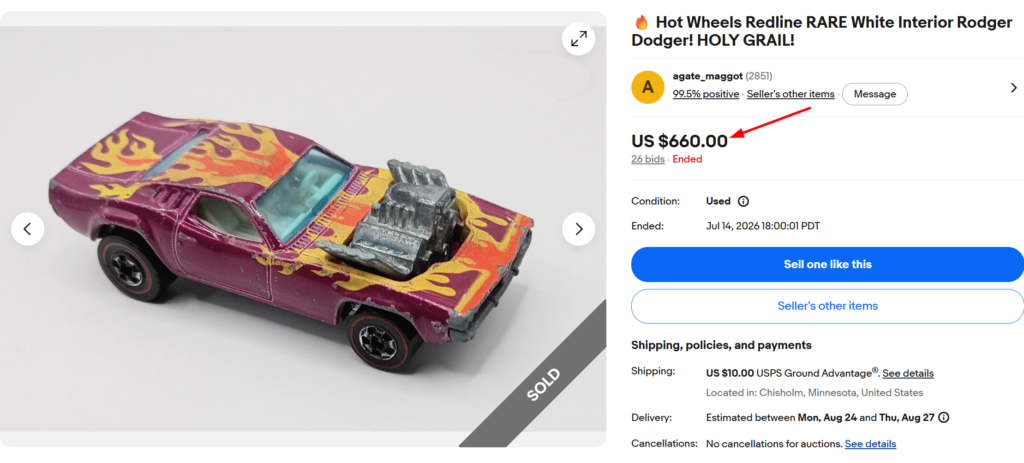
Sold for $660
Styled after the 1973 Dodge Charger, the standard plum-color Rodger Dodger is a collectible to find.
The Blue version is a completely different model. Roughly seven examples came out of the UK in the mid-70s, discovered by a US collector trading Matchbox cars for UK Flying Colors Hot Wheels. All seven went to private collections quickly.
- Estimated Value: $200 to $1,000 (common colors) $8,000+ (blue)
- Production Years: 1974 UK release
- What to Check: Colored enamel, white interior
Vintage Hot Wheels are still one of the most collectible diecast toys, with the prices of rare examples climbing year after year. So next time you see an old Hot Wheels, check the base, read the wheels, and check the model to see if you have a rare one.