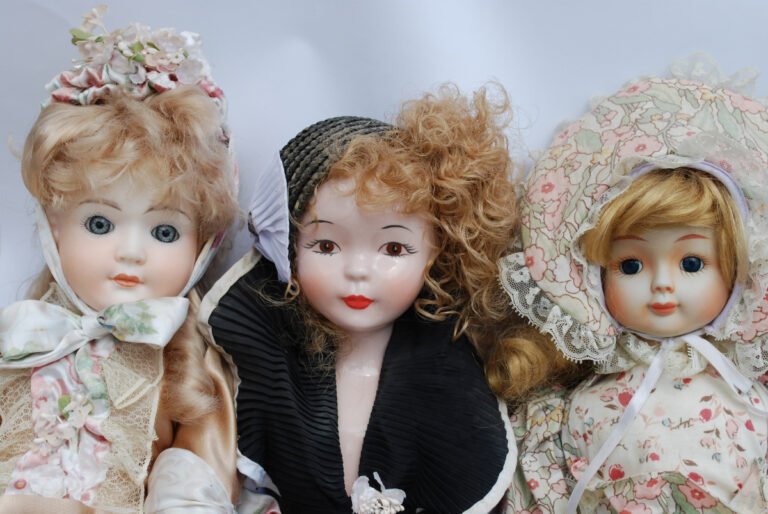

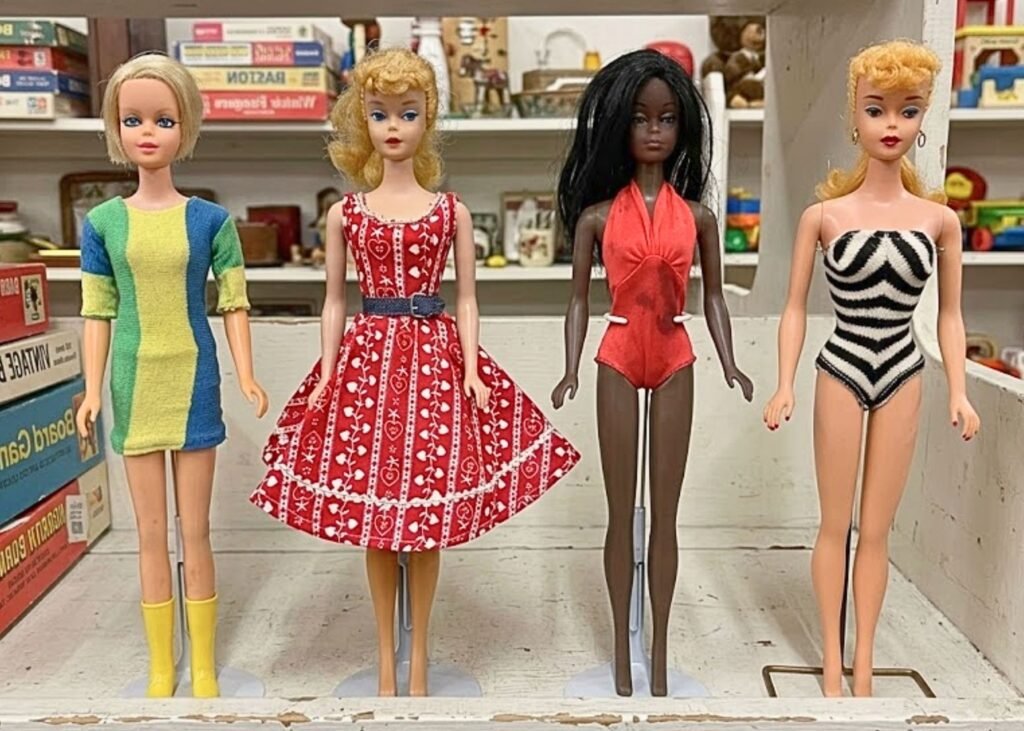
While Barbie is one of the most popular vintage toys, not every Barbie is really “vintage.” The Vintage Barbies refer to the ones Mattel made from Barbie’s 1959 debut through 1972.
Everything from 1973 onward gets called “modern” or “collectible,” even if it looks old to you. There’s also the Mod era inside that vintage window, running from about 1967 through 1972. So that’s when Barbie got bendable waists, groovier outfits, and friends like Christie and Francie.
The status matters a lot for collectors. This guide explains easy ways to spot and value authentic vintage Barbie dolls and reveals the rarest models.
How to Identify a Vintage Barbie Doll (Step by Step)
Identifying a vintage Barbie doll is necessary. If you cannot distinguish between an original and a reprint, then you will not be able to value it properly. So take out your doll, turn her around, and go through the list below.
Check the Body Markings and Date Stamps
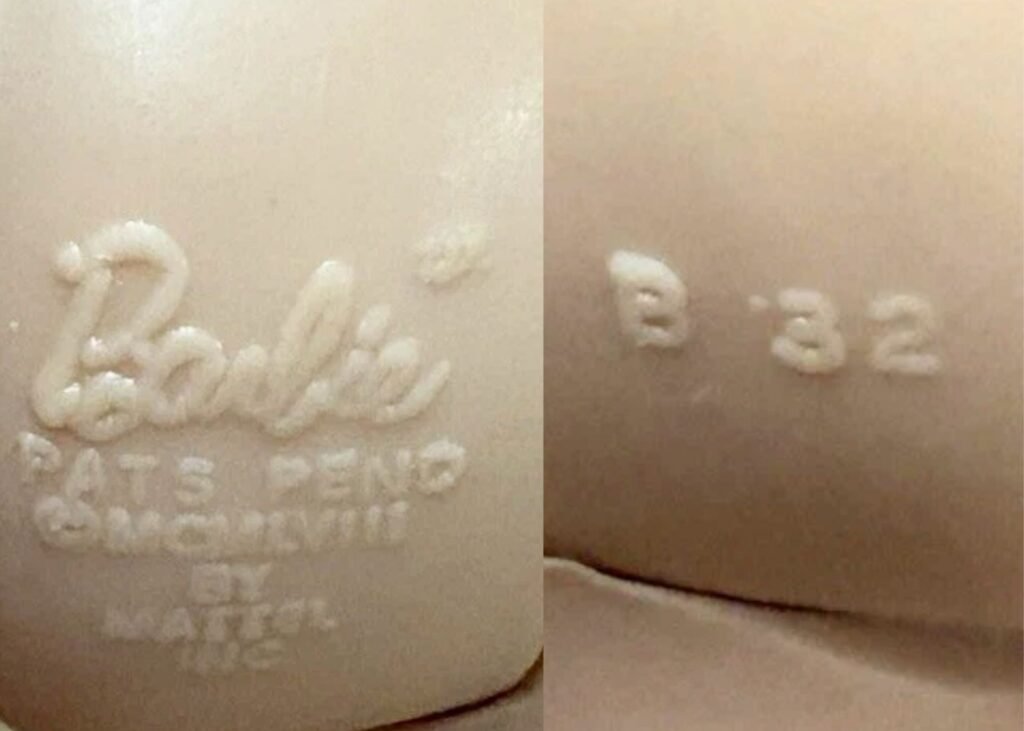
The markings on the lower back or bottom are the fastest way to date a Barbie. On genuine vintage dolls, these are pressed into the plastic before assembly. Feel them with your fingernail. So real ones sit slightly below the surface, not printed on top.
The earliest 1959 to 1960 Barbies say “Barbie T.M. / Pats. Pend. / ©MCMLVIII / by / Mattel, Inc.” Roman numerals for 1958. Later 1960s dolls read “Midge 1962 / Barbie 1958 / by / Mattel Inc.” Any doll marked “Made in Japan” was produced between 1959 and 1972, when Mattel used Japanese factories.
Barbies stamped Taiwan, Mexico, Hong Kong, or the Philippines came later, so they don’t fall in the vintage window. And printed labels on the surface, not pressed in, mean a reproduction or a modern piece.
Check the Face Sculpt and Eye Type
Face design is the single best clue to the year of a doll. Because Mattel changed the sculpt several times, each face type has a nickname and a date range that collectors instantly recognize.
Here are the key vintage face types to check for:
- Teenage Model (TM), 1959 to 1961 – Heavy black eyeliner, arched pointed brows, and side-glancing eyes. The earliest #1 dolls had white irises. Later ones switched to blue.
- Bubble Cut, 1961–1967 – Same TM face with the curly bubble hairstyle. Blonde, brunette, titian (red), platinum, and the very hard-to-find brownette colors were available.
- American Girl/Bendable Leg, 1965–1966 – Softened face, blue eye makeup, chin-length hair. Side-part or straight hairstyles.
- Twist ‘N Turn (TNT), 1967 to 1972 – Rooted eyelashes, a more childlike face, and painted lower lashes gone. Also called the “Mod” face.
Check the Hair, Rooting, and Body Type
Original vintage hair was made of Saran fiber, so it has a soft feel with a slight sheen. Reproductions use Kanekalon, which looks glossier and stiffer. Also, check the scalp’s rooting pattern. Vintage rooting is dense and even, without visible bald spots along the part.
Body types matter too. Straight-leg bodies (1959 to 1964) don’t bend at the knee. Bendable-leg bodies (1965 onward) have a rubber-like knee joint. Twist ‘N Turn bodies (1967 onward) also swivel at the waist. So knowing which body your doll has narrows the year fast.
Check the Feet, Fingers, and Ears
Small details like the fingers, ears, and feet can easily separate the earliest Barbie dolls from later ones. On the very first #1 Barbie, the feet have copper tubes and small holes so she can stand on a metal-pronged stand.
That’s the single biggest #1 tell. By #2, Mattel removed the holes and switched to a wire stand.
Fingers changed, too. Pre-1968 dolls have fully divided fingers that you can slide a fingernail between. After 1968, fingers were molded together.
Lastly, check the ears for green stains, called green ear, from oxidized copper earrings. Green ears are common on 1960s dolls and hurt the value.
Check the Box, Booklet, and Accessories
A boxed doll with her original wrist tag, fashion booklet, stand, and swimsuit is worth several times what a nude, tagless doll fetches. Even torn booklets and shelf-worn boxes count. So keep everything that came with the doll, even loose shoes and single earrings.
Handy Tip: For “R” versus “TM” markings on the box, the earlier TM (trademark) label boxes from 1959 are considerably rarer than later R (registered) label boxes.
Highly Collectible Barbies Worth Keeping Today
Below are some of the rarest or most valuable Barbie dolls that consistently pull premium prices today.
1. 1959 #1 Ponytail Barbie
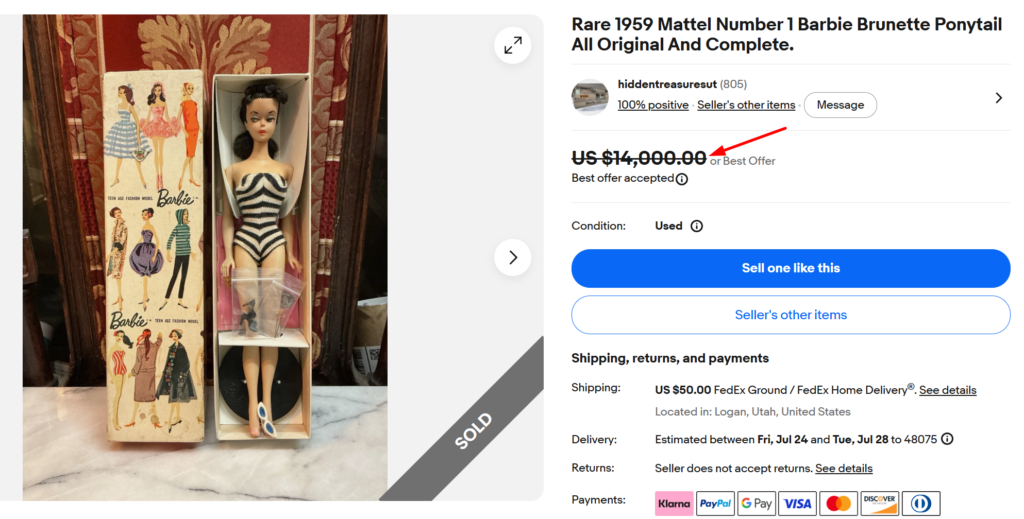
Sold for $14,000
This is the one doll that started everything. She has a hard vinyl body, blonde or brunette Saran ponytail, heavy black eyeliner, arched brows, and those signature white irises. So the dead giveaway is her feet.
Look for copper tubes and small holes designed for the metal-pronged stand. That single detail separates a #1 from every other doll in the series.
- Estimated Value: $8,000 to $27,000+
- Production Years: 1959 only
- What to Check: Foot holes, copper tubes, white irises
- Quick Notes: Brunettes are rarer than blondes.
2. 1967 Inland Steel Barbie Loves the Improvers Doll
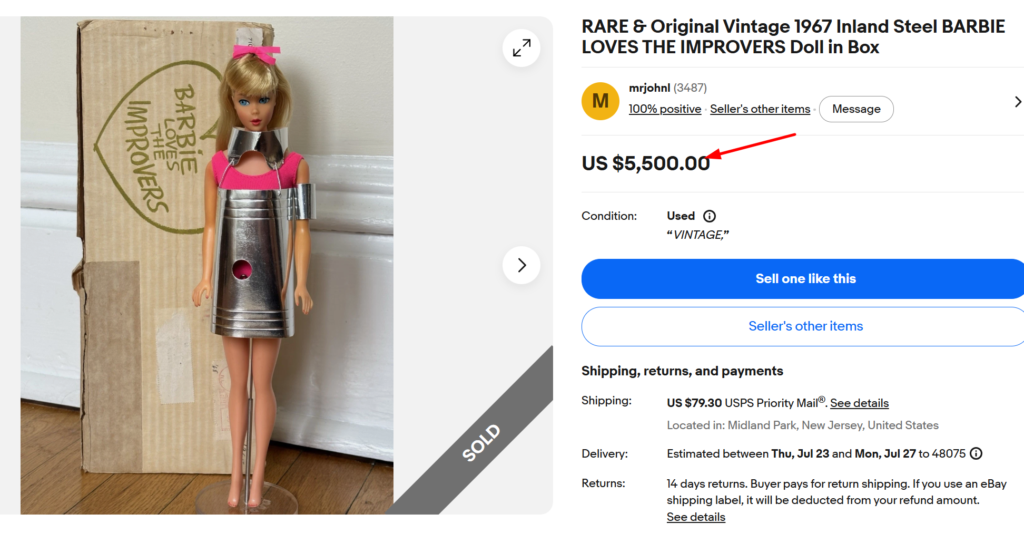
Sold for $5,500
Only a handful of these Barbies have ever surfaced, making it super rare. She was a mail-in-only promotional gift set from Inland Steel, never sold at retail, so surviving examples are counted in the single digits.
The set includes a Standard Straight-Leg #1190 Barbie in blonde or red hair, a pink two-piece swimsuit, hot pink shoes, and a metallic silver cardboard tin-can dress with a matching collar and arm cuff.
The dress was inspired by Spanish designer Paco Rabanne’s metal fashions and echoes the wardrobe from the film Barbarella. And everything shipped in a plain brown mailer stamped “Barbie Loves the Improvers.”
- Estimated Value: $4,000 to $6,000+ complete
- Production Years: 1967 only (mail-in promo)
- What to Check: Silver tin-can dress, “Improvers” mailer, pink shoes
3. 1966 Color Magic Barbie
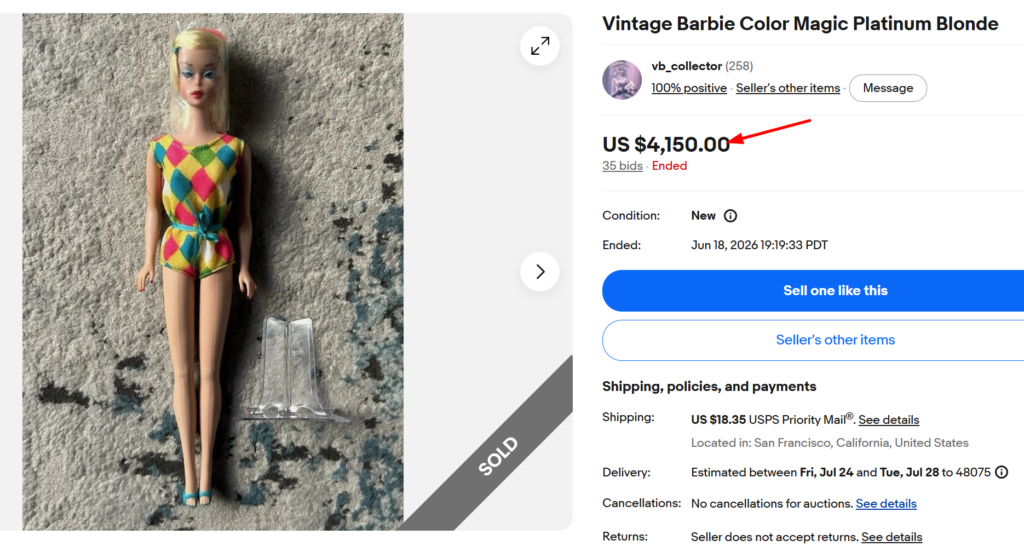
Sold for $4,150
Color Magic came with a solution kit that let kids change their doll’s hair color at home. Two base colors were made: Golden Blonde (changes to Scarlet Flame) and Midnight (changes to Ruby Red).
The Golden Blonde is significantly rarer, since lighter hair showed damage faster, and Mattel produced fewer of them. So her original diamond-patterned swimsuit and the color-change solution are both worth watching for.
- Estimated Value: $400 to $2,500 (complete NRFB higher)
- Production Years: 1966 to 1967
- What to Check: Long straight hair, diamond swimsuit, solution kit
4. 1959 #2 Ponytail Barbie
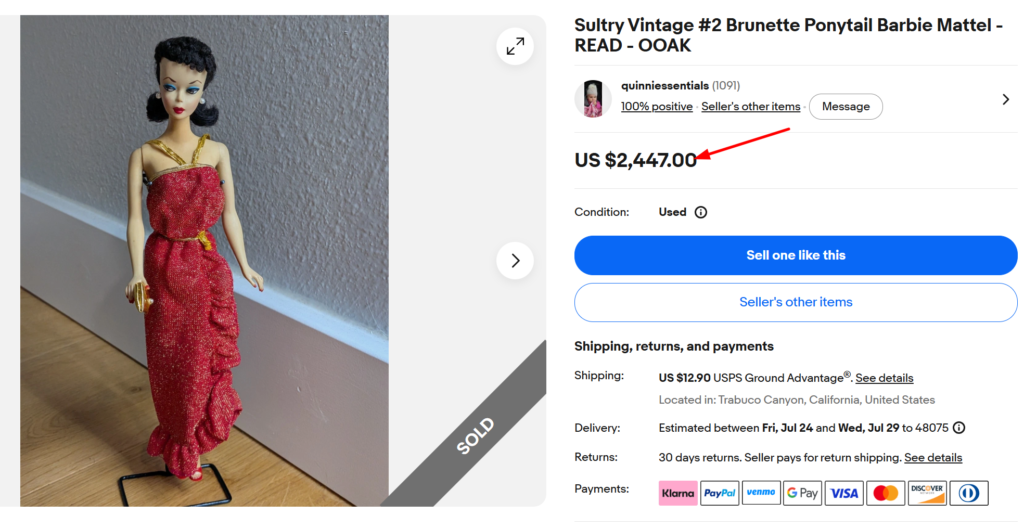
Sold for $2,450
Mattel dropped the foot holes and copper tubes almost immediately, moving the doll onto a black wire stand. The face and body still match the #1, but she now stands on her heels alone.
Both blonde and brunette versions exist. And the earliest #2s still use “T.M.” box labels rather than “R,” which is another small sign collectors look for.
- Estimated Value: $4,000 to $10,000+
- Production Years: Late 1959 to early 1960
- What to Check: No foot holes, wire stand, white irises
5. Barbie Ponytail #3 Barbie
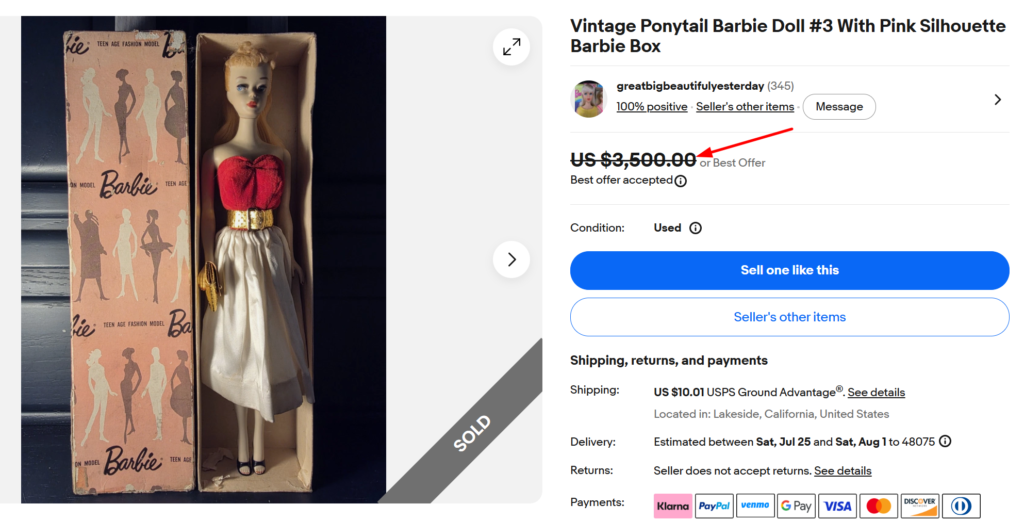
Sold for $3,500
The #3 is the first Barbie with blue eyeliner, though brown eyeliner examples do exist. The hairstyle remains the same, although her face paint has been toned down slightly, and she now sports blue iris eyes instead of the white ones.
Although #3 dolls can be found in higher frequency than the #1 and #2 dolls, high-quality specimens are rare and valuable.
- Estimated Value: $600 to $4,000
- Production Years: 1960
- What to Check: Blue irises, blue eyeliner, no foot holes
- Quick Notes: First doll with blue eyes
6. Francie “Black Francie”
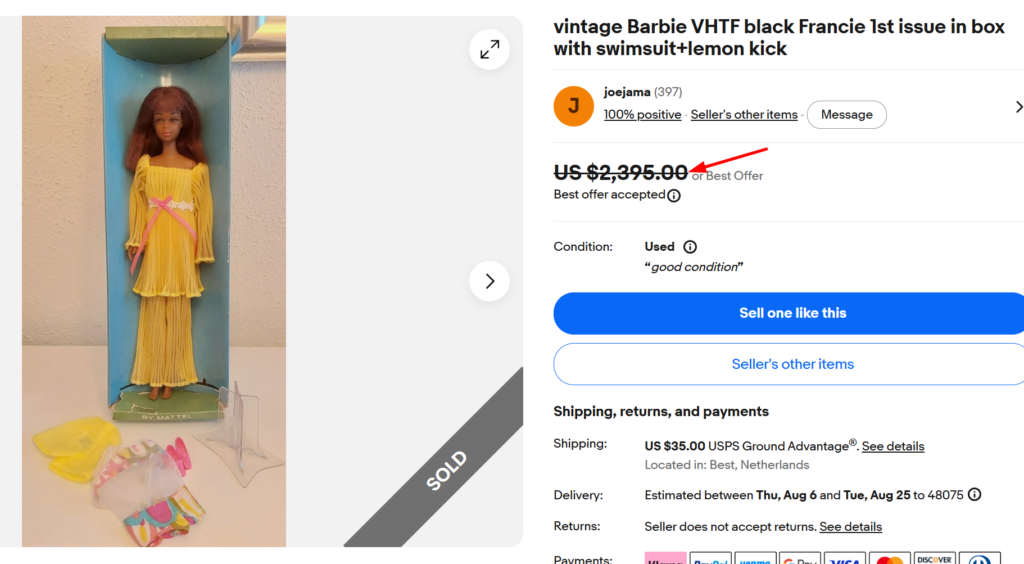
Sold for $2,395
Mattel originally marketed her as “Colored Francie,” making her the brand’s first doll with dark skin, even though she used the same head mold as white Francie.
The first issue has red rooted hair that oxidized over time, light brown painted eyes, rooted eyelashes, and a two-piece floral swimsuit with an attached white mesh top.
However, poor sales caused Mattel to pull her from the shelves in 1968. That’s why surviving examples are genuinely scarce. Her lower back is marked “©1966 Mattel, Inc. / Made in Japan.”
- Estimated Value: $800 to $2,400+ boxed
- Production Years: 1967 to 1968 (first issue)
- What to Check: Red oxidized hair, light brown eyes, Japan mark
- Quick Notes: Discontinued fast.
7. 1961 Bubblecut Barbie
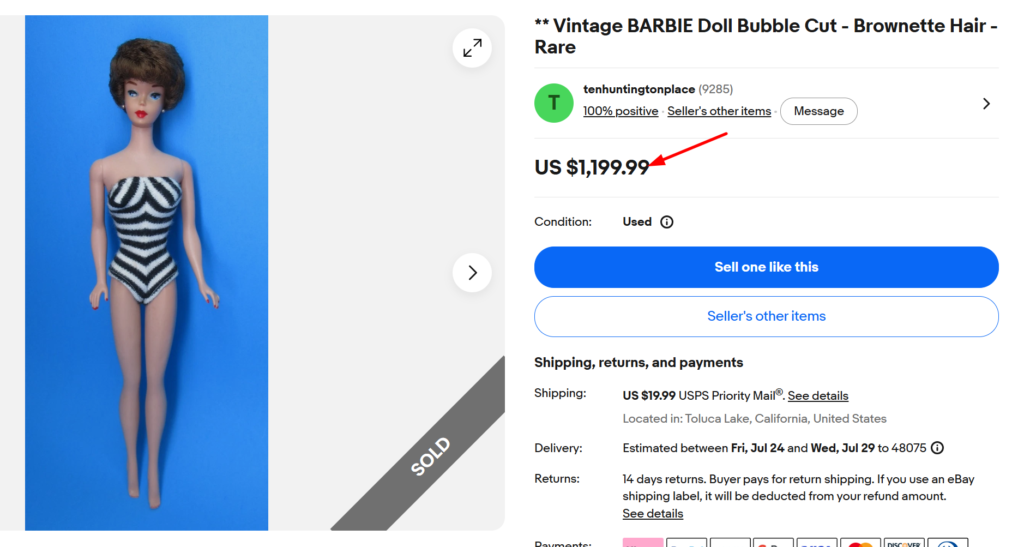
Sold for $1,200
The Bubble Cut hairstyle debuted in 1961 in the standard blonde, brunette, and titian, but Mattel briefly made a sable-brown “brownette” version as a Sears exclusive.
The color proved hard to reproduce consistently, so Mattel pulled it fast. Her Bubble Cut box is unmarked for hair color. And if you see this rich mink shade in person, you’re looking at a genuinely rare doll.
- Estimated Value: $1,200 to $3,500
- Production Years: 1961 only
- What to Check: Sable-brown hair, unmarked Bubble Cut box
8. 1965 American Girl Barbie
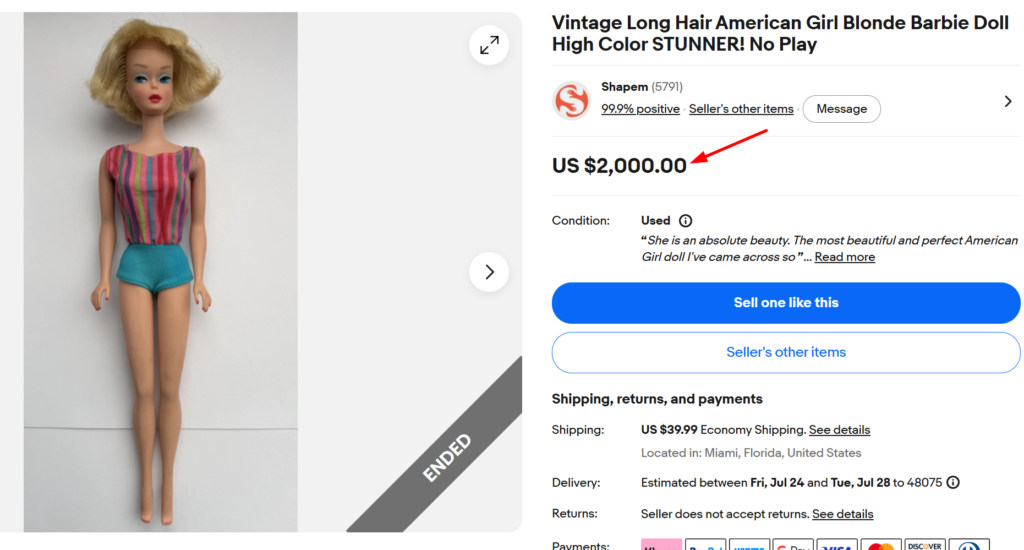
Sold for $2,000
The American Girl came in center-part and side-part hairstyles, and the side-part is exponentially rarer. She has a bendable-leg body, softer face paint, and shoulder-length hair with a defined side part.
There’s also an even rarer Japanese variant with pink-toned skin sold only in Japan. Silver, ash blonde, and long-hair titian are the top hair colors to find.
- Estimated Value: $2,500 to $5,000+
- Production Years: 1965 to 1966
- What to Check: Side-part hair, bendable legs, blue eyeliner
9. 1988 Happy Holidays Barbie
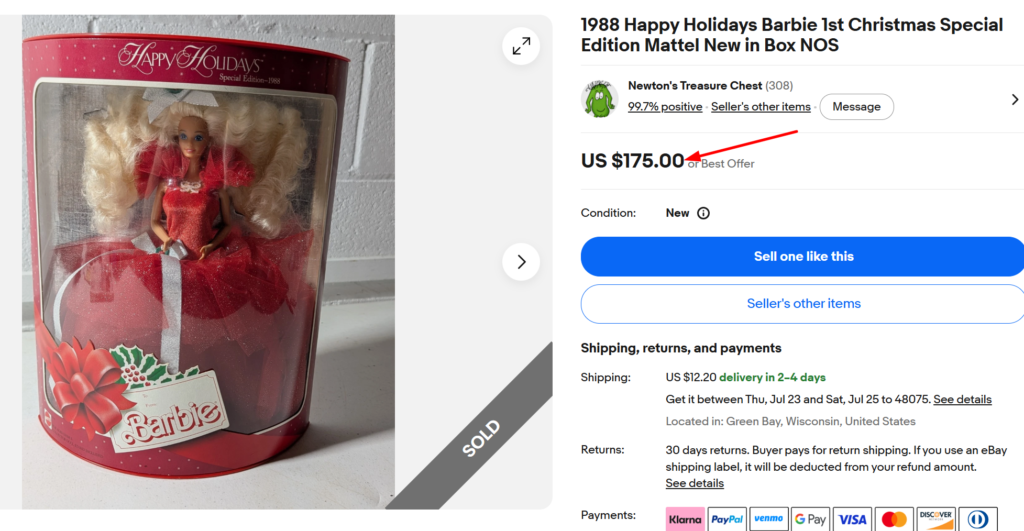
Sold for $175
This doll launched the whole collectible Barbie range. She wears a red velvet gown with a white faux-fur trim and a big silver-white bow, plus silver jewelry. Mattel didn’t plan her as a collectible, so stores stocked lightly, and she sold out fast.
That surprise scarcity built the entire adult Barbie market. The 1988 outperforms every later Happy Holidays year, and MIB examples with intact box graphics still bring strong money.
- Estimated Value: $70 to $450+ MIB
- Production Years: 1988 only
- What to Check: Red velvet gown, silver jewelry, “Special Edition” box
- Quick Facts: First doll in the collectible series.
10. 1967 Twist ‘N Turn Barbie
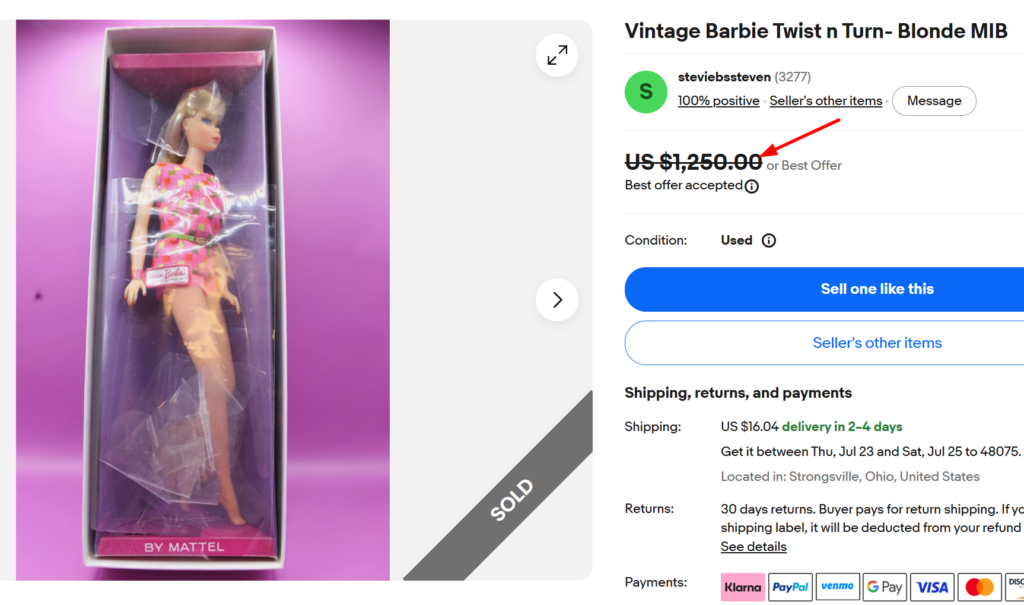
Sold for $1,250
Twist ‘N Turn was a mechanical revolution, giving Barbie a swivel waist and bendable knees for the first time. She also has rooted eyelashes and a softer, more childlike face.
Available with long straight hair in blonde, brunette, and titian, plus a rare Marlo Flip hairstyle from 1969.
Her body markings read “©1966 Mattel, Inc.” with “Made in Japan” on the lower back. Check these to verify and authenticate the original doll.
- Estimated Value: $150 to $1,500
- Production Years: 1967 to 1972
- What to Check: Twist waist, rooted eyelashes, bendable legs
11. 1962 Fashion Queen Barbie
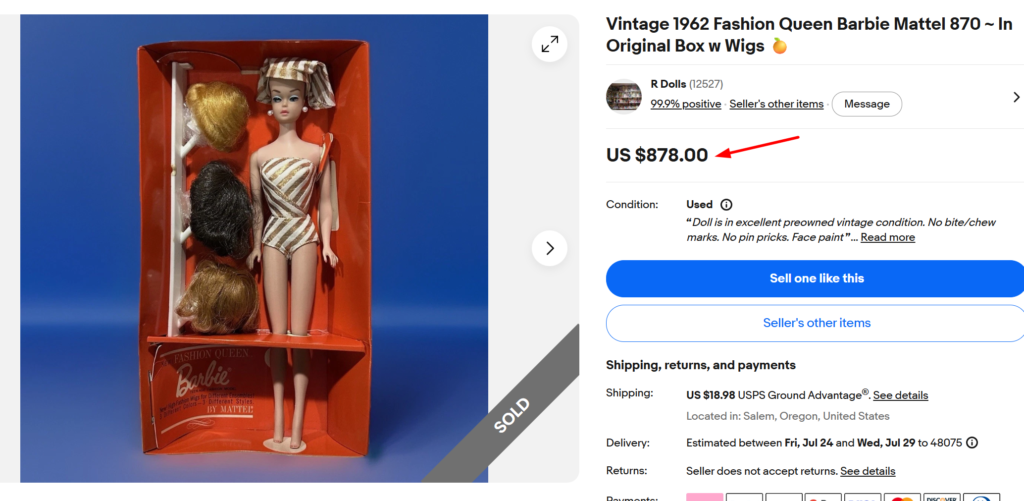
Sold for $880
The Fashion Queen ditched rooted hair. Instead, she has a molded, painted-on brunette hairstyle and comes with three interchangeable wigs: a red flip, a brunette pageboy, and a blonde bubble.
Plus, she wore a gold-and-white striped swimsuit with a matching turban. The wigs got lost often, so complete examples with all three, plus the turban and wig stand, are more valuable.
- Estimated Value: $75 to $400+
- Production Years: 1963 to 1964
- What to Check: Molded painted hair, turban, three wigs
What Makes a Barbie Doll Valuable? 4 Things That Matter
Clearly, not every old Barbie is worth the same. Two dolls from the same year, same box, same factory can trade at wildly different prices. So it comes down to five things collectors weigh every single time.
1. Rarity
Short production runs, prototypes, employee-only editions, and regional exclusives push prices the highest. The 1959 #1 Barbie, the brownette Bubble Cut from 1961, and the side-part American Girl are famous for exactly this reason. There just aren’t enough surviving examples to meet collector demand.
Hair rarity also matters a lot. Blonde is the most common color for most eras. Brunette usually sells for more, and Titian (red) sells for even more within the same doll release.
However, it varies. Some rare pieces, like the Sears-exclusive brownette Bubble Cut, use a hair color made only for one short season, so those command steep premiums.
2. Condition Grades
The condition of the doll’s body, hair, clothes, etc., matters a lot for the value.
Collectors have their own abbreviations to judge the condition: NRFB (never removed from box), MIB (mint in box), mint (loosely), excellent, very good, played-with, and TLC. The most valuable dolls are the NRFB models.
Green ear, hair reroots, faded face paint, chewed limbs, and neck splits are the biggest value killers. And even one of these can cut a doll’s value by 60 percent or more.
3. Original Outfit and Accessories
A vintage Barbie with her original zebra-striped swimsuit, wrist tag, open-toed heels, sunglasses, stand, and booklet often sells for two to three times what a nude version brings. So keep those loose accessories together, even if they seem tiny.
4. First-Year Editions
Being first counts. Dolls from the first year in the series are always more valuable than those made after (as in the case of 1988 Happy Holidays, 1980 Black Barbie #1293, or 1968 Christie dolls). Thus, when choosing between the 1988 and 1990 Happy Holidays dolls, the former is the best choice.
If you want to know if your old Barbie is worth a fortune, the fastest path is to flip her over, read the mark, look at her feet, and check her face type against the descriptions and rare examples in this guide.