
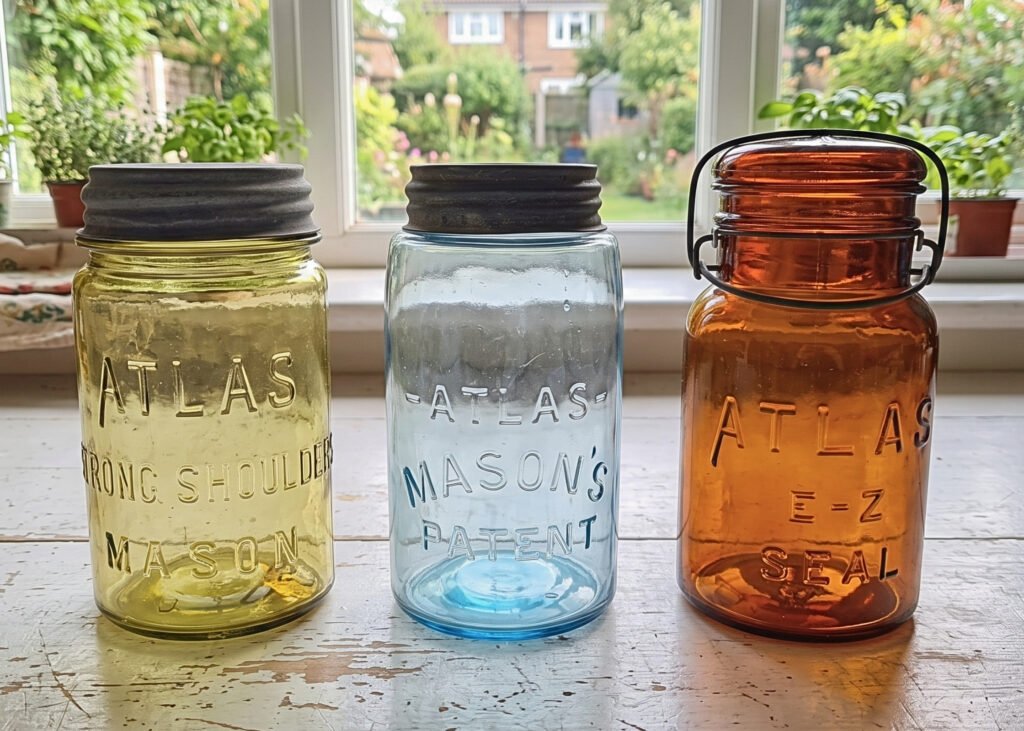
If you found an old crate of glass jars that says “ATLAS” on the front in your attic, this is the guide you need. Most people would toss them in the yard sale pile for a buck apiece. But some of those old Atlas Mason jars could be worth $50, $100, even $200.
The key is to know what the valuable ones look like.
From color and design to closure type and logo, this guide breaks down how to spot a valuable Atlas mason jar in seconds, plus the jars that are actively collected today.
The Story Behind Atlas Mason Jars
The Atlas Glass Company started off in 1896 in Washington, Pennsylvania. Just six years later, it merged with three other firms (Hazel Glass, Republic Glass, and Wheeling Metal) to become the Hazel-Atlas Glass Company based in Wheeling, West Virginia.
From there, it grew into the third-largest glass container producer in America. Atlas Mason jars rolled off the lines from 1902 all the way until 1964, when Brockway Glass took over the last of the operations.
So every real Atlas jar you find today is at least 60 years old, and many push past the 100-year mark. That’s why collectors treat them as genuine antiques.
How to Identify a Genuine Old Atlas Mason Jar?
Identifying and dating an Atlas jar isn’t about one single feature. It’s about reading a few clues together, such as the logo, seams, and colors. Once you do so, you can date most jars easily.
1. Read the Logo & Base Marks
The marks on Atlas jars changed with the decades, and each one narrows down the manufacturing era pretty accurately. Flip your jar upside down and check the base against this quick timeline.
- Pre-1902 – Jars from before the Hazel-Atlas merger were made by the Hazel Glass Company and carry a “HAZEL” or “HAZEL PRESERVE JAR” mark on the front. No Atlas name on these yet.
- 1902 to early 1920s – The “ATLAS” name started appearing on the front once Hazel-Atlas formed in 1902. Base marks from this stretch often show a simple “N” and sometimes just “HA” stacked together.
- 1923 onward – The now-famous H-over-A trademark was registered in 1923 (a capital H with a smaller A tucked inside its lower legs). Any jar with this mark on the base dates from 1923 or later.
- 1924 to 1964 – The H-over-A mark shows up alongside 4-digit catalog numbers and single-digit mold numbers. Some also carry a plant letter code like Z (Zanesville) or K.
- Post-1957 – Continental Can Company bought Hazel-Atlas in 1957. Jars made after this often carry a “CCC” logo (two overlapping Cs with one offset) alongside or replacing the H-over-A mark.
- 1964 and after – Brockway Glass took over most Hazel-Atlas plants in 1964. Any Atlas-branded jar after this point is technically not a true Hazel-Atlas product, even if the mold and name carried over.
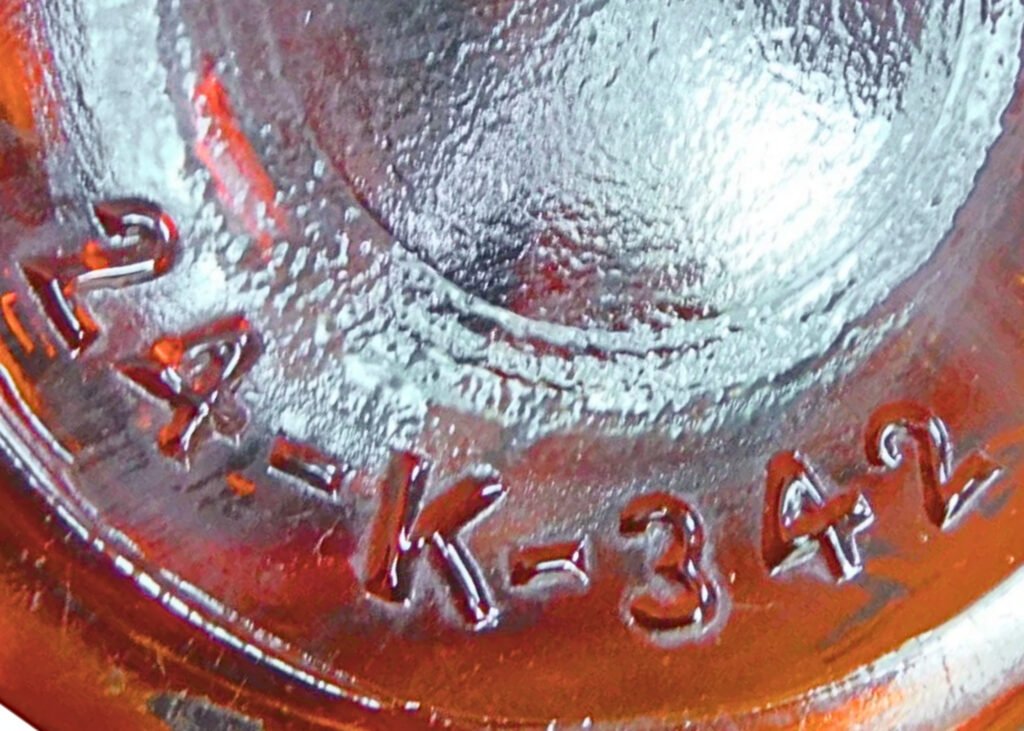
Front embossing shifted over time too. Early jars just say “ATLAS,” while later ones spell out “ATLAS MASON” or the full style name like “Atlas Strong Shoulder Mason.” So the front tells you the style, and the base tells you the age.
Quick Tip: The “Nov. 30th 1858” patent date on some Atlas jars is NOT the year the jar was made. That was John Mason’s original patent date, and companies kept re-embossing it well into the 1900s.
2. Check the Mold Seams
Run your finger along the side of the jar from base to rim. If you feel a raised vertical line, that’s a mold seam. It tells you the jar was machine-made after 1915.
Atlas jars made before 1915 were hand-finished and feel completely smooth on the sides with no ridges at all.
3. Look at the Glass Texture
Older Atlas jars almost always show tiny air bubbles trapped in the glass, faint ripples, or slightly wavy surfaces (collectors call this a “whittled” look). Newer jars are uniform, clean, and reflect light evenly.
So a jar with visible bubbles and imperfections is usually the older, more valuable one.
4. Identify the Closure Style
Closure styles changed with each era, so a matching original lid can quickly narrow down the date.
- Early Atlas jars from the 1900s to 1920s used a screw-on zinc lid with a milk-glass porcelain liner inside.
- Then came the wire bail with glass lid design, used on E-Z Seal and Good Luck jars through the 1920s to 1940s.
- Post-1930s jars often switched to a two-piece metal band with a flat sealing disk.
Just remember that jar lids get swapped over decades, so trust only original ones for dating.
5. Use Color as a Clue
Most Atlas jars were made in clear or aqua glass because those were cheap and standard. But Hazel-Atlas also ran limited batches in cornflower blue, amber, olive green, apple green, and amethyst purple.
Any Atlas jar in one of those unusual colors is worth pulling aside for a closer look.
Rare Atlas Mason Jars That Are Highly Collectible Today
Below are the Atlas Mason jar styles and variants collectors keep hunting for. Prices swing based on color depth, size, and condition, but these ranges reflect what real examples have been fetching in recent eBay and Etsy sales.
1. Atlas E-Z Seal Jar in Amber
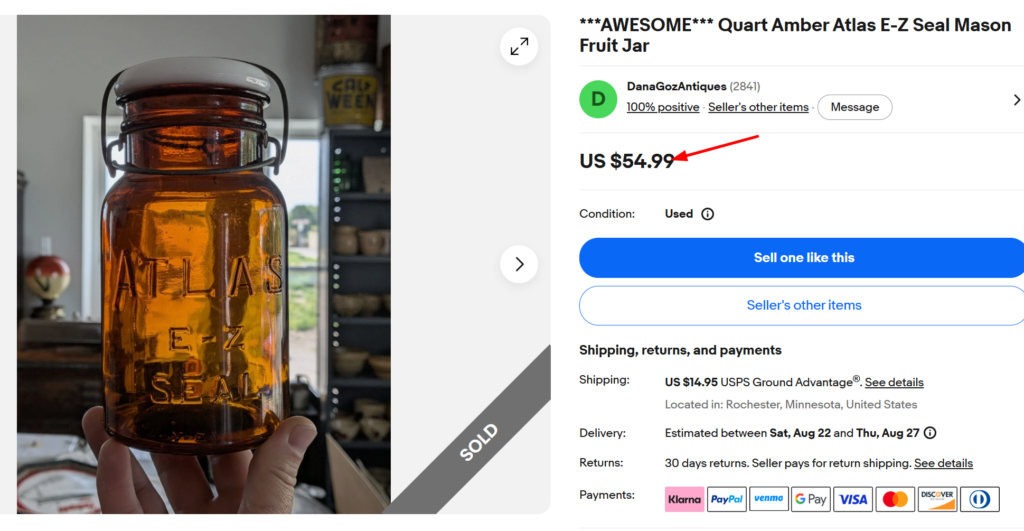
Sold for $55
The E-Z Seal is one of Atlas’s most collectible designs, with a round body, integrated glass lid, and a metal wire bail closure. Clear and aqua ones are common. But the amber E-Z Seals made around 1910 are the ones that collectors actively chase.
- Estimated Value: $50 to $150
- Production Years: 1910 (amber run)
- What to Check: Amber tone, wire bail, glass lid
- Quick Notes: Make sure the wire bail is original.
2. Strong Shoulder Mason (in Olive/Amber & Cornflower Blue)
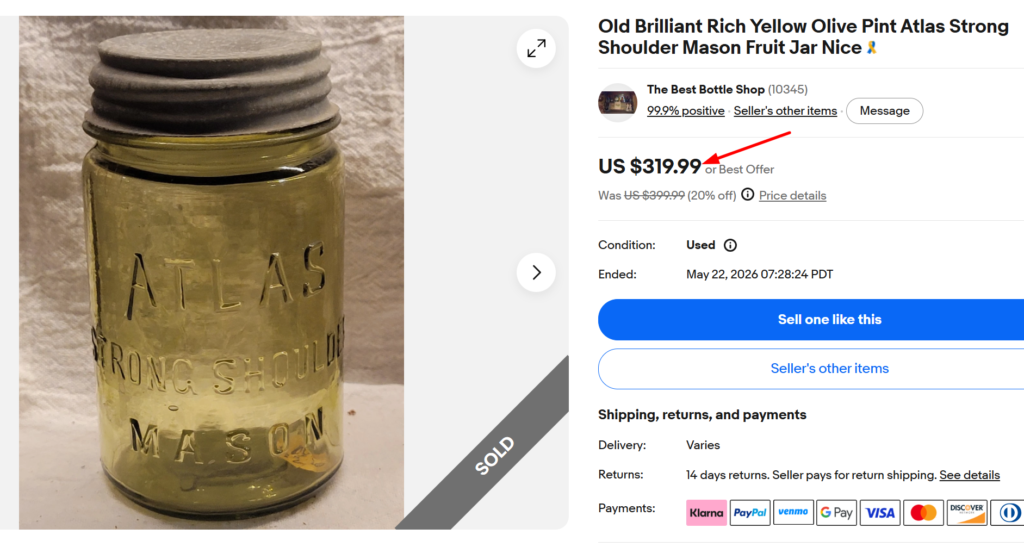
Sold for $319
Strong Shoulder jars get their name from the thick reinforced ring below the threads, built to stop cracking during sealing.
Most Strong Shoulder jars are clear or aqua. But yellow olive/light amber and cornflower blue examples pop up rarely and go for big money.
- Estimated Value: $100 to $130
- Production Years: 1920s to 1940s
- What to Check: Reinforced shoulder ring, blue tint
3. Atlas Patent Mason in Amethyst Purple
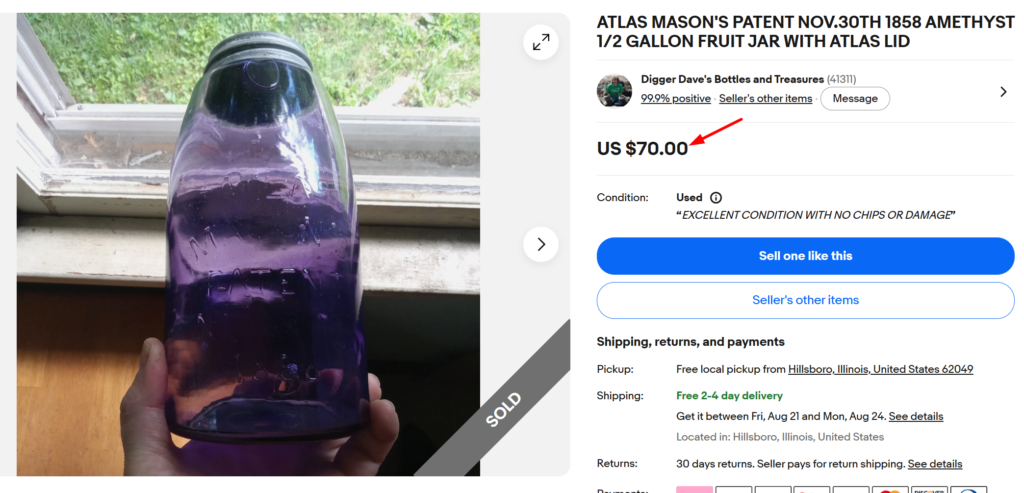
Sold for $70
Some early Mason’s Patent jars carry manganese in the glass mixture. Over decades of sun exposure, that manganese slowly shifts to a soft amethyst purple.
Half-gallon examples with the original Atlas lid and the full “MASON’S PATENT NOV. 30TH 1858” embossing are the ones collectors chase, and one recently sold on eBay for $70 in excellent condition.
ID Note: Fake irradiated purple exists too, so always identify rightly.
- Estimated Value: $70 to $150
- Production Years: Pre-1915 (purpled over time)
- What to Check: Even purple tint, original lid
4. Atlas Good Luck Jar with Four-Leaf Clover
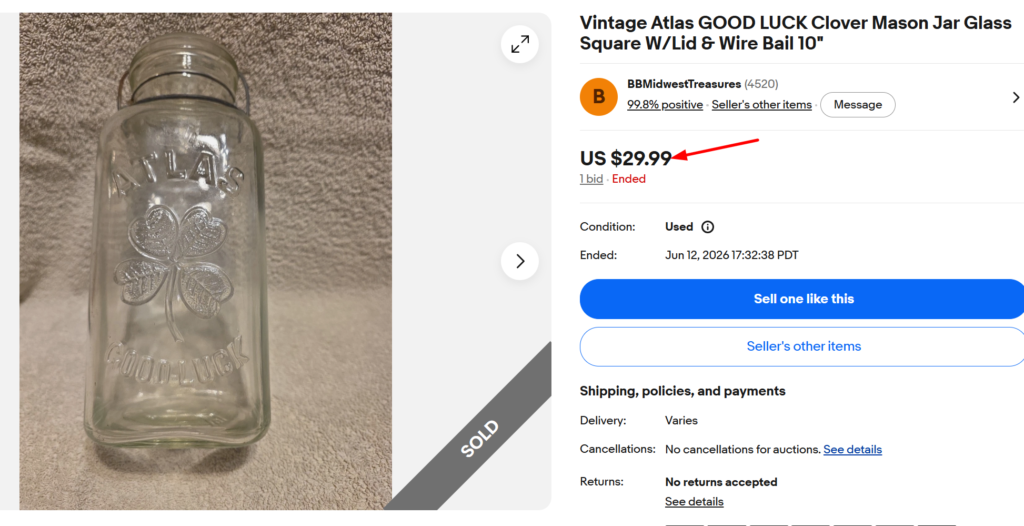
Sold for $30
Easily the most charming Atlas variant, the Good Luck is a square Lightning-style jar with a glass lid and wire bail. What sets it apart is the big four-leaf clover motif molded right into the front below the “GOOD LUCK” name.
Larger sizes are the ones that bring stronger money; the half-gallon size is the scarcest and most valuable.
- Estimated Value: $15 to $60
- Production Years: 1921 to 1956
- What to Check: Four-leaf clover, “GOOD LUCK” text
5. Atlas Whole Fruit Jar
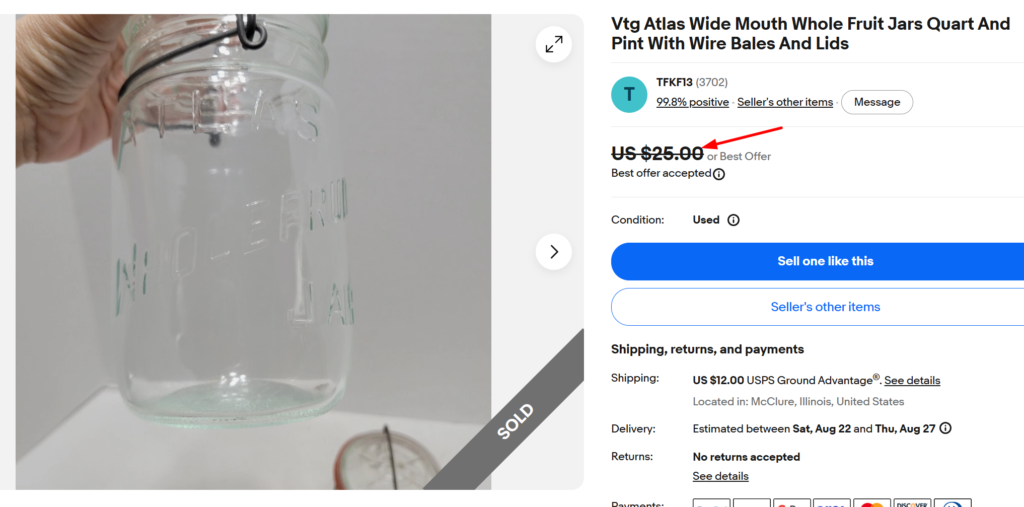
Sold for $25 (pair)
The Whole Fruit jar has a wide mouth, a wire-bail clamp, and a matching glass lid. You’ll spot the diagonal “WHOLE FRUIT” wording across the front, sitting between “ATLAS” and “JAR.”
Clear ones are common finds. Colored versions in aqua or light green rarely show up in sales and are the ones actually worth grabbing.
- Estimated Value: $10 to $50
- Production Years: 1920s and 1930s
- What to Check: Diagonal “WHOLE FRUIT” text
6. Aqua Blue Improved Mason Jar
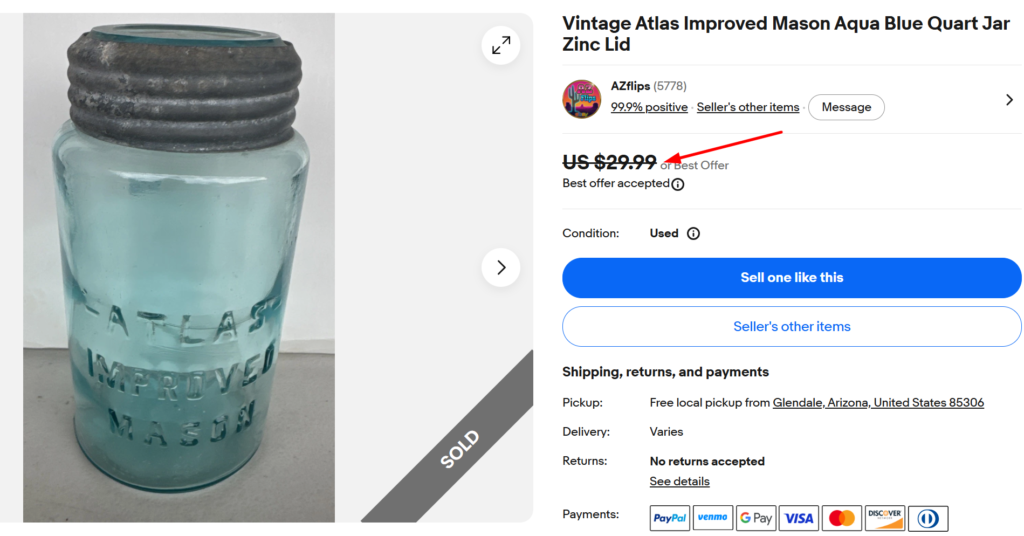
Sold for $30
The Improved Mason has a cylindrical shape and a threaded lid built to hold both wet and dry contents (unlike earlier watertight-only versions). Aqua blue examples with a matching zinc-and-glass lid combination are becoming popular among collectors building complete Atlas sets.
- Estimated Value: $20 to $50
- Production Years: Early 1900s
- What to Check: “IMPROVED” embossed on body
7. Atlas Special Mason in Aqua or Green
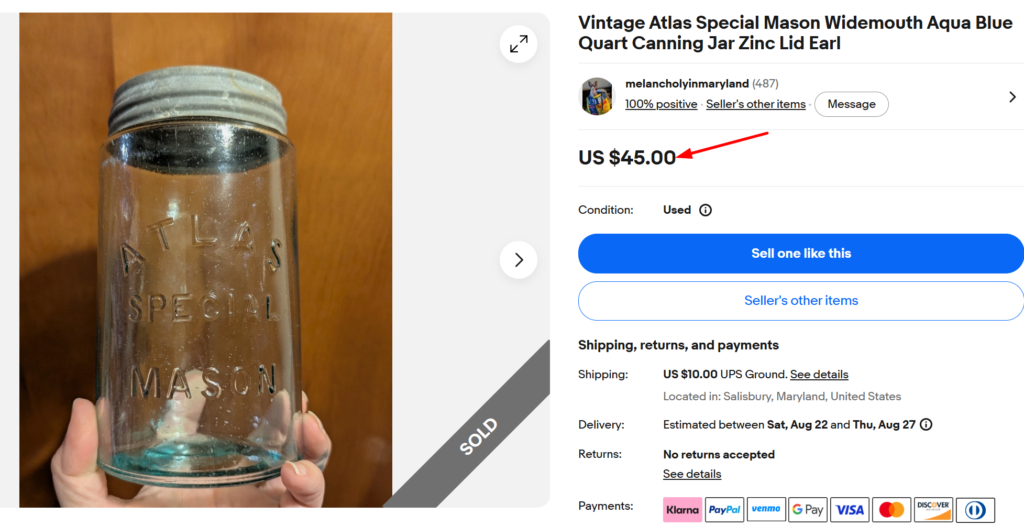
Sold for $45
The Special is a wide-mouth Atlas variant in either square or round form, marked “ATLAS SPECIAL MASON” or just “ATLAS SPECIAL” across the front.
Clear ones sell for pocket change. But squat pint-sized versions in aqua or green come up occasionally and bring solid returns. Squat pint form is scarcest.
- Estimated Value: $20 to $60
- Production Years: Early 1900s
- What to Check: “SPECIAL” text, wide-mouth opening
8. Atlas Square Mason Jar
Square Masons are exactly what they sound like. Squared-off bodies with the big embossed H-over-A trademark front and center. They came in half-pint, pint, quart, and half-gallon sizes. Clear ones are everywhere and cheap. But any Square Mason in a tinted color is worth setting aside.
- Estimated Value: $10 to $50
- Production Years: 1915 to 1964
- What to Check: Square body, front H-over-A logo
- Quick Notes: Matching zinc lid boosts price
How to Tell If an Atlas Mason Jar is Valuable?
Not every old Atlas jar is worth money, but the ones that fetch top dollar usually have several features working together, such as colors, design, lids, size, and condition. Here’s how:
- Color rarity – cornflower blue, amber, olive green, and purple beat clear or aqua every time
- Style/variant – Good Luck, amber E-Z Seal, and colored Mason’s Patent jars sell for premiums
- Complete closure – original wire bail, matching zinc lid, or glass insert intact
- Size – half-gallon jars often bring double what a pint would
- Condition – no rim chips, no cracks, no heavy cloudiness inside
But there’s one thing that often catches collectors off guard. Original manufacturing quirks like bubbles, whittle marks, and mold seams do NOT lower the value. They actually confirm the jar is genuinely old and machine-made in the right era.
What kills value is post-production damage like chips, cracks, or hazy staining that won’t wash off.
Atlas Mason jars in plain aqua color are quite common and usually worth only a few bucks. But rare colors like cornflower blue and purple and designs like Strong Shoulder and E-Z Seal could be worth way more. So, always check the details.