
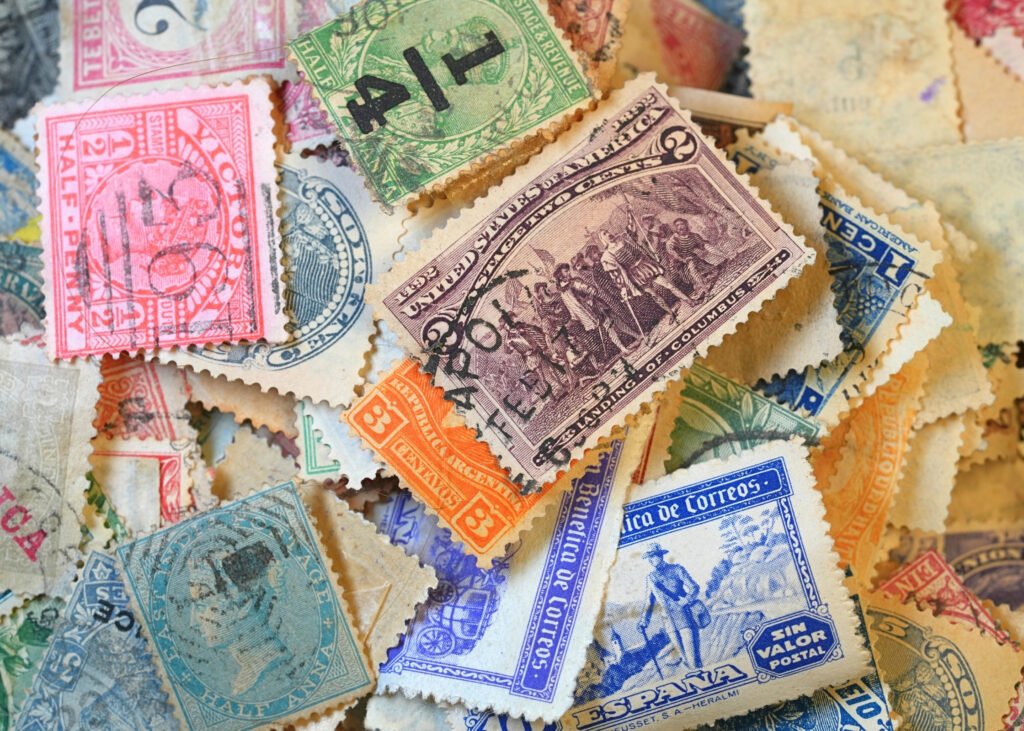
Most old stamps you’ll pull out of a shoebox in the attic or a garage sale are worth a few cents each. But every so often, one of them turns out to be worth a small fortune.
The trick is knowing what to actually look for before you toss the lot or hand it to a dealer for pennies. This guide walks you through how to spot valuable stamps, what drives their value, and which vintage stamps are most valuable today.
How to Identify Vintage Stamps? Step-by-Step
Before we get into identification, you must know what the terms mean. “Vintage” stamps are anything from roughly the 1930s back to about 1900. Anything older is antique stamps, and anything newer than the 1970s is usually just “modern.”
Now, here’s how you can identify what your old stamps actually are:
1. Check the Country and Denomination First
Start with the most obvious details. Look at the country name and the printed value. Older US stamps often say “U.S. Postage” with a cent value, while foreign issues will name the country or use a monarch’s initials.
The denomination gives you a rough sense of the era, since 1- to 3-cent stamps were common through the early 1900s.
2. Look for a Date, Series, or Scott Number
Some stamps carry a printed year, but most don’t. Instead, you’ll match the design to a catalog like the Scott Specialized Catalogue (the standard reference in the US) or Stanley Gibbons for British issues. Both list every stamp by number, year, and known variety.
3. Examine Perforations, Watermarks, and Paper
Feel the stamp in your hand. Vintage paper is thinner, often slightly yellowed, and may show a watermark (a faint design pressed into the paper).
Perforations are the small punched holes along the edges. Count them across 20 millimeters using a perforation gauge, because that number is often the difference between a common stamp and a scarce one.
4. Hunt for Printing Errors
Errors are where the real money hides. Inverted designs, missing colors, double impressions, or shifted perforations can turn a 24-cent stamp into a six- or seven-figure sale.
So examine every stamp with a magnifier before dismissing it.
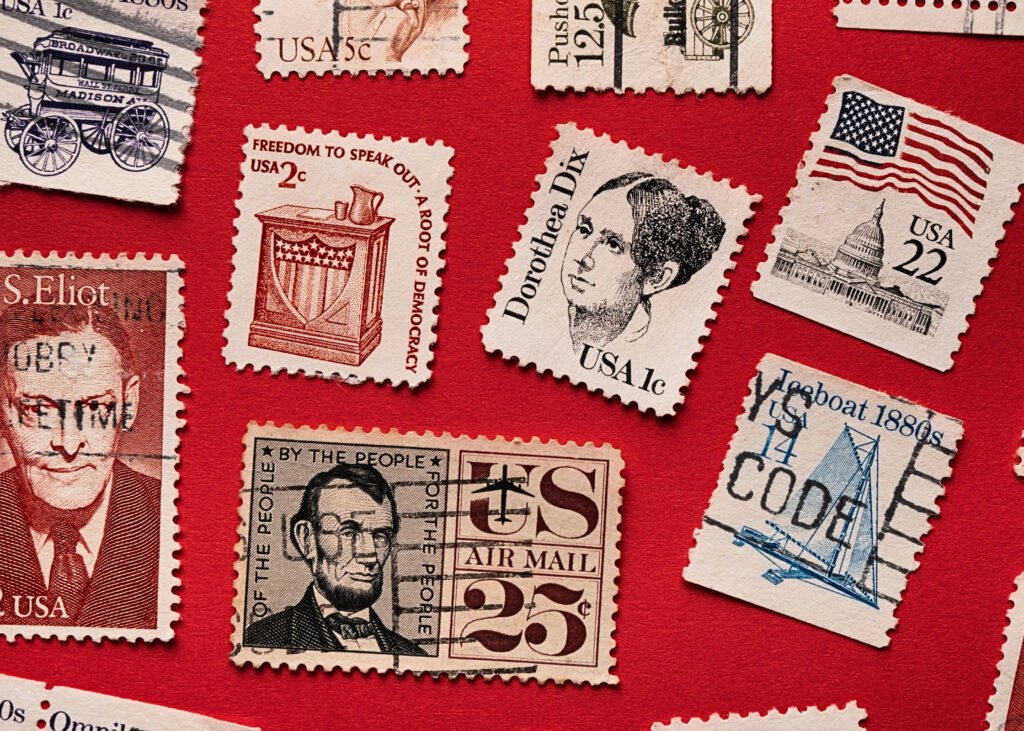
5. Use a Stamp Identification App
If the catalogs are too much, then there are apps like StampSnap and Stamp Value & Identifier App that will allow you to take a photograph and find out the exact identification along with the approximate value of the stamps.
Value tip: Never wash, trim, or re-glue a vintage stamp. Any restoration or cleaning kills its value, sometimes by 90 percent or more.
What Determines the Value of Vintage Stamps?
While age is considered the most important value factor, it alone doesn’t make a stamp worth anything. Plenty of 100-year-old stamps sell for a dollar or two. What collectors actually pay for comes down to a few things.
- Rarity is the biggest driver. Fewer surviving examples mean higher prices, especially for short print runs, discontinued issues, or stamps pulled from circulation quickly.
- Condition matters just as much. A mint stamp with full original gum and sharp perforations can be worth ten times a used, hinged copy of the same issue.
- Then, there are printing errors, which almost always add value. Inverts, missing colors, and misperforated stamps are catnip to serious collectors.
- Lastly, historical significance, like wartime issues or first day covers, plus steady collector demand, have a strong impact on the stamp’s value.
Not every old stamp checks these boxes, but the ones that do can be surprising.
Highly Valuable Old Stamps Collectors Are Hunting Today
Here are twelve vintage stamps worth knowing about, whether you’re sorting inherited albums or scanning estate sales. Prices reflect general market ranges rather than any single sale.
1. 1918 Inverted Jenny (24-Cent Airmail)
- Estimated Value: $500,000 to $2 million+
- Production Years: 1918
- What to Check: Upside-down blue biplane
- Quick Notes: Only 100 exist; needs certification
The Inverted Jenny is the crown jewel of American philately. It’s printed with the Curtiss JN-4 airplane flying upside down thanks to a rushed print run at the Bureau of Engraving and Printing.
Only one sheet of 100 was ever released, so every surviving example is tracked and numbered. If someone shows you one, always ask for a Philatelic Foundation certificate first.
One pristine example set a record at a Siegel auction in November 2023, bringing just over $2 million and making it the priciest single US stamp ever sold.
2. 1868 Benjamin Franklin Z-Grill (1 Cent)
- Estimated Value: $3 to $5 million
- Production Years: February 1868
- What to Check: Franklin profile, horizontal grill
- Quick Facts: Only two exist worldwide
This blue one-cent stamp shows Benjamin Franklin in profile and has a distinctive waffle-like “Z-Grill” pattern pressed into the paper to prevent reuse. Just two examples are known to exist today. One sits at the National Postal Museum, and the other belongs to a private collector.
The Z-Grill pattern runs horizontally instead of vertically like most grills, and production lasted only a few weeks in 1868. That short print run is why it’s often called America’s rarest stamp.
3. 1856 British Guiana 1c Magenta
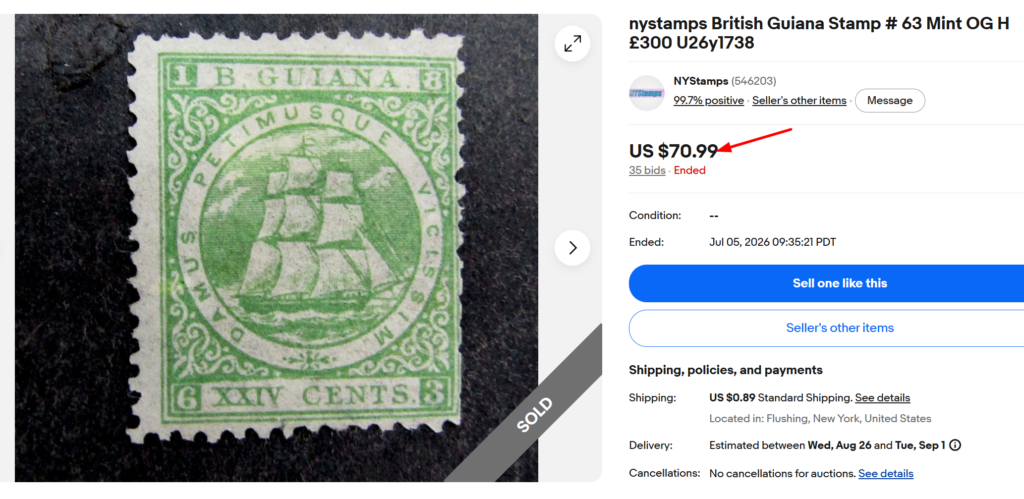
Sold for $70
Often called the “Mona Lisa of stamps,” this small magenta scrap from a British colony in South America is the only surviving example of an emergency print run. It features a three-masted ship with the Latin motto “Damus Petimus Que Vicissim.”
Most serious collectors consider it the single most famous rare stamp on the planet. It last sold at Sotheby’s for over $8 million, making it the most valuable stamp ever auctioned by weight.
- Estimated Value: Over $1 million for mint examples.
- Production Years: 1856
- What to Check: Three-masted ship, magenta paper
- Quick Facts: Only one is known to exist.
4. 1840 Great Britain Penny Black
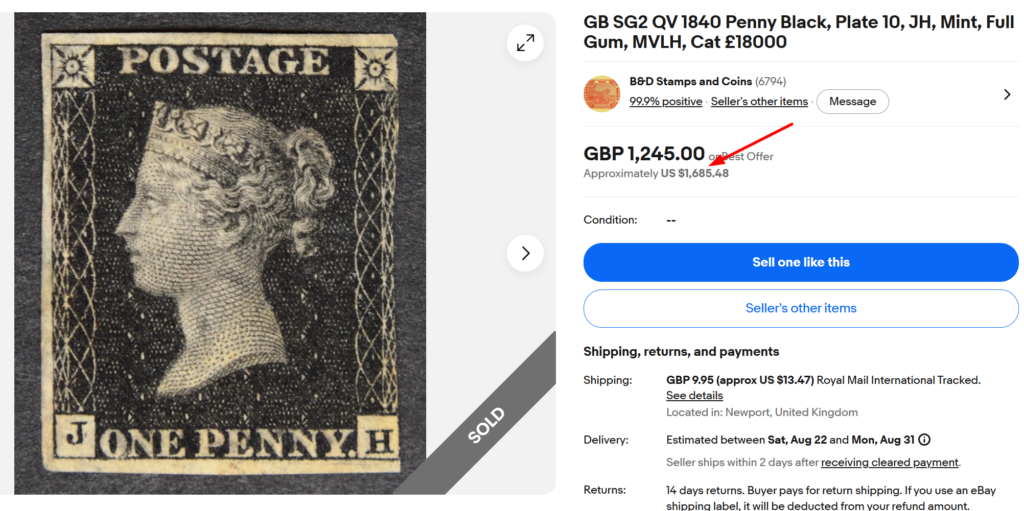
Sold for $1,685
The Penny Black is the first adhesive postage stamp ever issued. It shows Queen Victoria’s profile against a black background and was printed in large enough quantities that examples still turn up regularly at estate sales.
Value depends heavily on plate number, margins, and cancellation clarity. A four-margin example with a light red Maltese Cross cancel commands far more than a heavily inked, cut-close copy.
- Estimated Value: $50 to $3,000+
- Production Years: 1840 to 1841
- What to Check: Queen Victoria profile, black background
5. 1851 Hawaiian Missionaries
- Estimated Value: $50,000 to $500,000+
- Production Years: 1851
- What to Check: Central numeral, thin paper
- Quick Notes: About 15 known survivors
Named for their use on missionary correspondence from the Kingdom of Hawaii, these stamps came in 2-cent, 5-cent, and 13-cent denominations with a simple central numeral design framed by printer’s ornaments.
They were printed on incredibly fragile paper, so nearly all surviving examples show damage or repairs. Even so, the 2-cent value is among the rarest US-related stamps in existence and always sells at major auction when it appears.
6. 1893 Columbian Exposition Issue
- Estimated Value: $5 to $5,000+
- Production Years: 1893
- What to Check: Columbus imagery, denomination
- Quick Notes: First US commemorative set
Released for the 1893 World’s Fair in Chicago, this was America’s first commemorative stamp series and ran from 1 cent all the way up to $5. The high-value dollar stamps, especially the $2 “Columbus in Chains” and $5 Columbus portrait, are what serious collectors chase.
Lower denominations still turn up in old albums for a few dollars, but a clean, well-centered $5 Columbian in mint condition remains one of the most desirable classic US stamps you can own.
7. 1898 Trans-Mississippi Exposition ($1 Cattle in Storm)
- Estimated Value: $50 to $3,500+
- Production Years: 1898
- What to Check: Cattle scene, single-color print
- Quick Notes: Only about 25,000 sets sold
The 1898 Trans-Mississippi set was the second US commemorative issue, and the $1 “Western Cattle in Storm” stamp is widely considered one of the most beautiful US stamps ever engraved. It has topped collector popularity polls for more than a century, and the $1 value in particular keeps landing at the top of “favorite US stamp” lists.
Mint examples with strong color and centering can command serious premiums, especially with original gum.
8. 1930 Graf Zeppelin Set (C13, C14, C15)
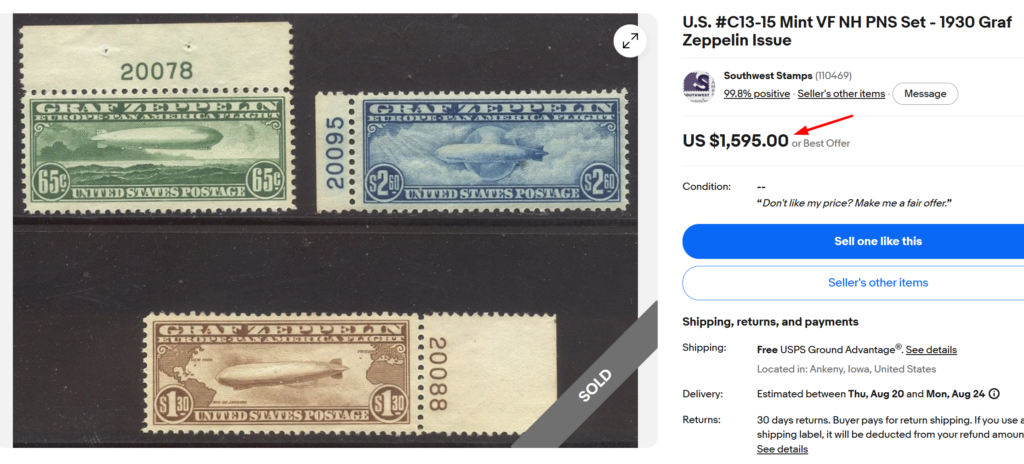
Sold for $1,595 (set of 3)
This set of three airmail stamps featured the German Graf Zeppelin airship and carried face values of 65 cents, $1.30, and $2.60. That was steep money during the Depression, so sales flopped.
The Post Office pulled them from counters after roughly ten weeks and destroyed most of the unsold stock, which is exactly why survivors are scarce today.
A complete mint never-hinged set is one of the most iconic acquisitions in US airmail collecting today.
- Estimated Value: $500 to $2,500+
- What to Check: Airship imagery, high denomination
- Quick Notes: Most were destroyed by USPS
9. 1979 CIA Invert ($1 Rush Lamp)
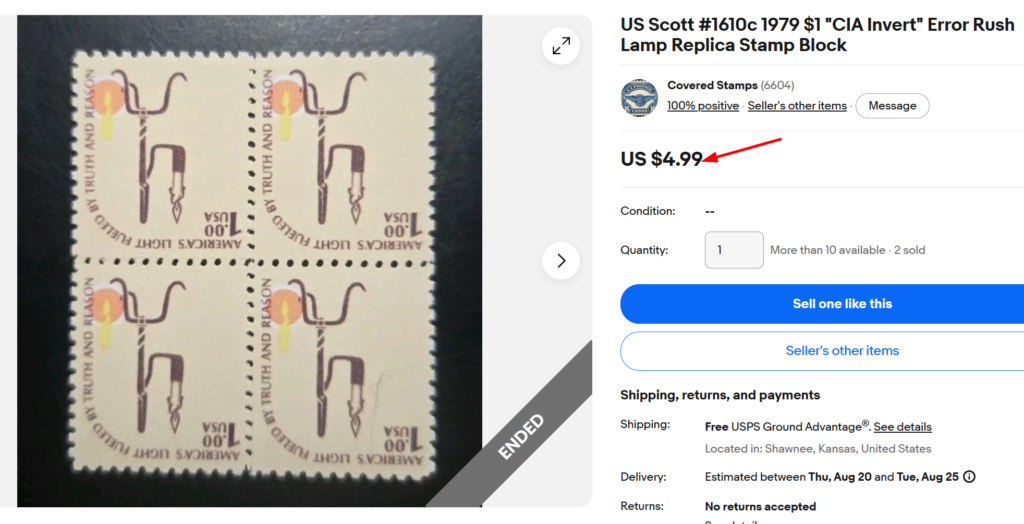
Sold for $5 (replica)
This modern rarity comes with one of the wildest backstories in stamp history. A CIA employee bought a partial sheet at a Virginia post office and noticed the brown ink was printed upside down.
The employees pooled their money, swapped the sheet for normal stamps, and each kept one. The find first went public when an auctioneer specializing in error stamps announced he had 85 of the inverted 1979 $1 Rush Lamp stamps in hand.
The scandal made front-page news and turned a $1 stamp into a five-figure collectible almost overnight.
- Estimated Value: $15,000 to $25,000
- What to Check: Inverted candleholder, brown ink
- Quick Facts: Roughly 95 exist; famous CIA story
10. 1962 Dag Hammarskjöld Invert (4 Cent)
Here’s a fascinating cautionary tale. A genuine invert error was discovered on this commemorative honoring the UN Secretary-General, and it should have been worth a fortune. But the Post Office deliberately reprinted millions with the same error to prevent collectors from profiting.
So while it looks like a rare error, over 40 million exist. Value collapsed. It’s a great teaching example of how scarcity, not just the error itself, actually determines what a stamp is worth.
- Estimated Value: $0.50 to $2
- What to Check: Yellow background inverted
- Quick Notes: Reprinted intentionally, killed value
11. 1993 Elvis Presley 29-Cent
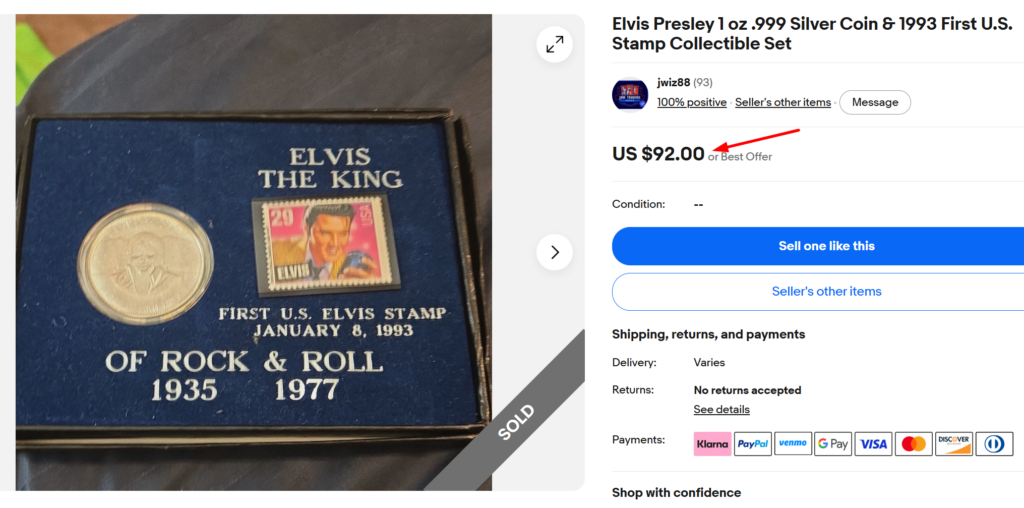
Sold for $95 (with coin)
The 1993 Elvis stamp remains one of the most collected US commemoratives ever issued. It was the first stamp whose design was chosen by public vote, with the “young Elvis” beating out the older Vegas-era version.
Individual mint stamps stay cheap because so many were saved, but full uncut sheets with coin and card, first-day covers, and any misprinted variants can bring meaningful money. Color-shift errors are also quite collectible.
- Estimated Value: $1 to $100+ (higher coin & card)
- What to Check: Young Elvis, pink background
12. Early 1900s 1-Cent Thomas Jefferson (Green)
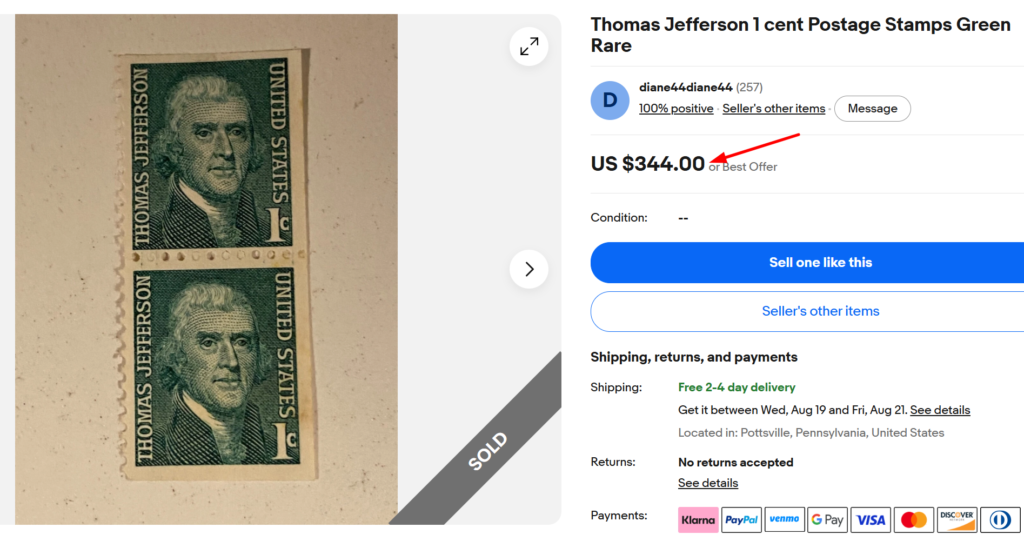
Sold for $345 (2 stamps)
Most 1-cent green Jefferson stamps you’ll find are worth almost nothing because they were printed by the millions. But specific varieties, particularly early 1900s issues with unusual perforations, watermark differences, or plate flaws, can jump into the hundreds.
The key is the Scott number and comparing against catalog notes. A common-looking stamp with the right perf count can be way more than its everyday cousin.
- Estimated Value: $1 to $500+
- Production Years: Multiple issues 1903 onward
- What to Check: Green ink, perforation count
- Value Notes: Common; only scarce varieties are valuable.
Old stamps require a closer look. It’s usually just the number of perforations, watermark, or ink offset that makes the difference between a two-dollar stamp and a two-thousand-dollar stamp. So, always verify details before selling or buying.