
People have been obsessed with fine ceramics for centuries. Back in the 1700s and 1800s, owning high-quality porcelain from makers like Meissen or Sèvres was a major status symbol for European royalty.
While the evolution of manufacturing led from hand-painted art to detailed transferware, dishes still retained their elegance.
Nowadays, collectors are on the lookout for such items because they reflect an era of craftsmanship that cannot be replicated in today’s mass-produced dinnerware.
15 Most Valuable Antique Dishes Worth Money Today
Not all vintage dishes are valuable. Those that carry real value have certain characteristics, like being made by a known maker or having a known pattern, having a distinct manufacturing characteristic that makes them rare, and high collecting value.
Here is a list of 15 valuable antique and vintage dishes worth money.
1. Herend Rothschild Bird Plates
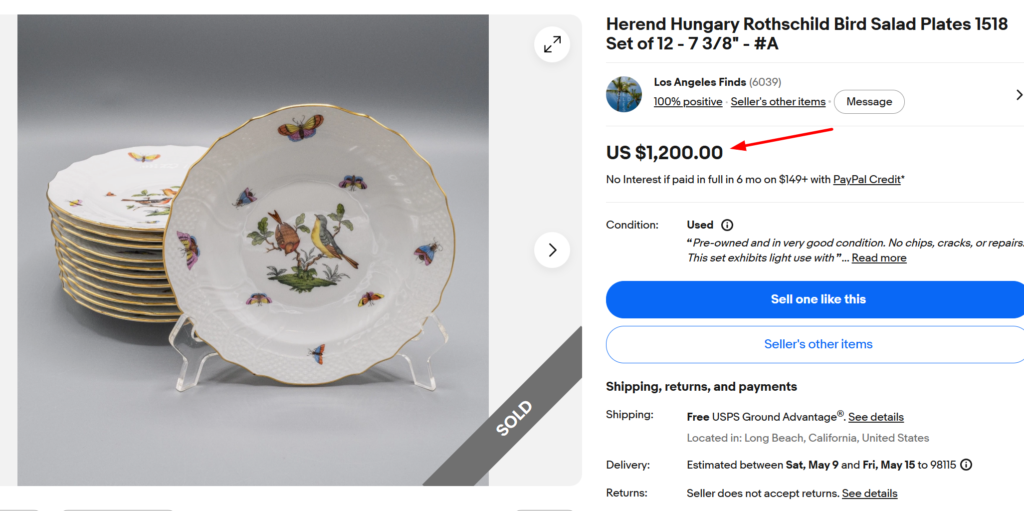
Sold for $1,200
The Rothschild Bird pattern (code RO) was commissioned by the Rothschild family in 1860. It features 12 different pairs of birds, butterflies, insects, and a pearl necklace draped over branches, all hand-painted on white porcelain with 24-karat gold trim.
The Rothschild Bird pattern was chosen by Princess Diana for her wedding in 1981. This adds a strong collector appeal and value. Even the regular dinner plates can sell for up to $1,000. If you have a big set of the Rothschild Bird pattern with rare serving pieces, it can sell for more than $3,000.
- Estimated Value: $1,200 – $1,800 (Set of 12); $3,000+ (large sets)
- Brand & Pattern: Herend / Rothschild Bird
- Production Year: 1860 to present
- Key Details: Hand-painted birds & insects; 24k gold trim
- Marks: Blue Herend shield mark with “RO” code and painter’s mark
2. Indiana Glass Cobalt Hen on Nest Candy Dish
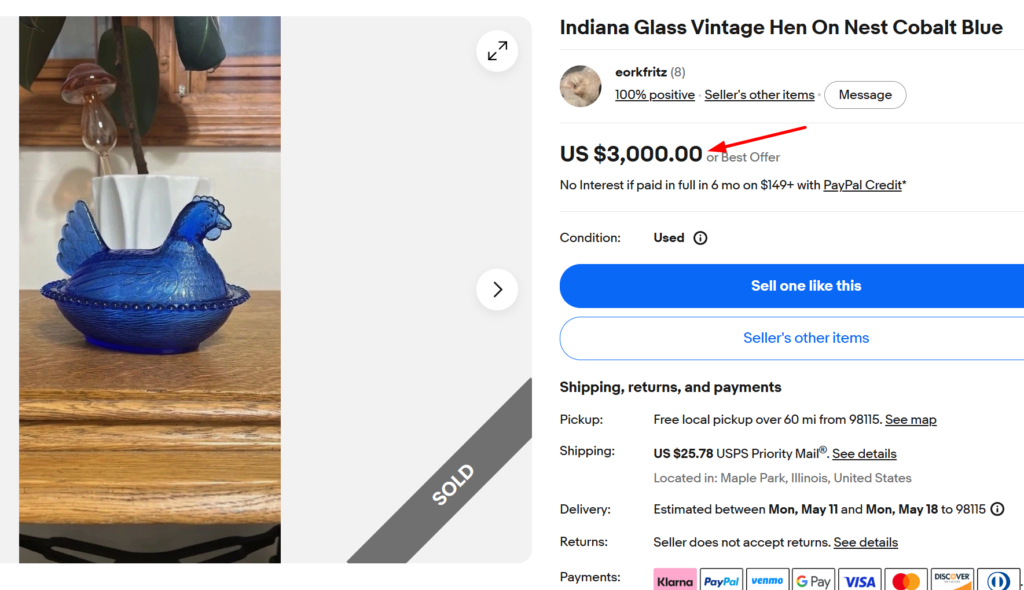
Sold for $3,000
The Cobalt Blue Hen on Nest candy dish is easily among the most valuable antique dishes. Indiana Glass produced hen-on-nest candy dishes from the 1960s onward in several colors, like amber, avocado green, and clear.
The Cobalt blue is the most sought-after and most debated, with some researchers noting that cobalt examples differ slightly from standard Indiana molds.
Genuine pieces are identified by a narrow flat tail and a circular valve mark about 1.25 inches across on the hen’s back.
- Estimated Value: $500-$3,000+ (cobalt blue); $30-$100 (common colors)
- Brand and Pattern: Indiana Glass Company / Hen on Nest
- Production Year: 1960s to 1980s
- Key Details: Molded hen lid and nest-shaped base.
3. Royal Copenhagen Flora Danica Plates
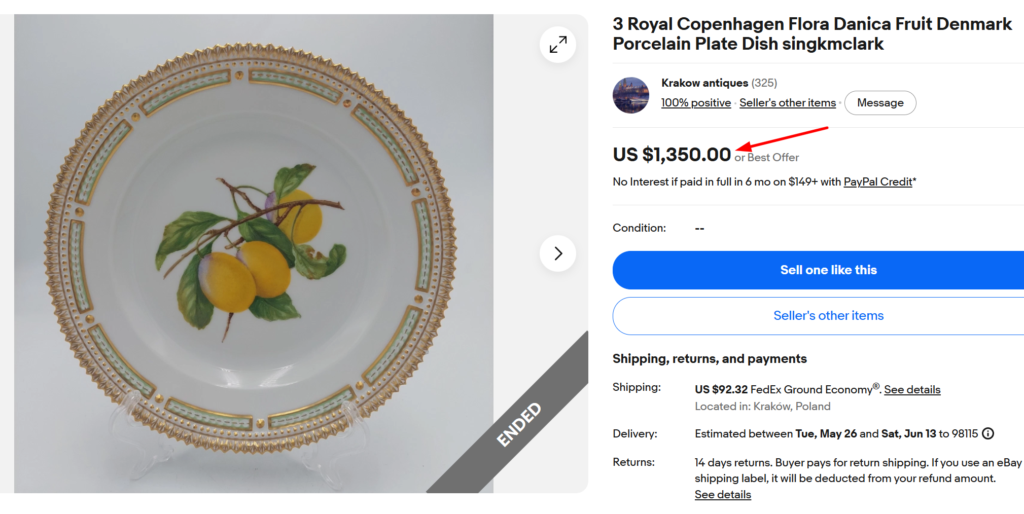
Sold for $1,350
Flora Danica is among the most prestigious dinnerware lines ever produced. The king of Denmark had this line made in 1790 as a gift for Catherine the Great of Russia, but it stayed in production even after she died. So, the original 1,800-piece service stayed with the Danish Royal Family.
Each piece is hand-painted with a different botanical motif copied directly from real botanical plant illustrations. This means that every single Flora Danica piece is unique, and no two pieces have the same design.
Antique 19th-century Flora Danica pieces are among the most valuable china dishes. Complete sets and large services can reach $30,000+.
- Estimated Value: $1,500–$8,000 (set of plates)
- Brand & Pattern: Royal Copenhagen / Flora Danica
- Production Year: c. 1790–1900
- Key Details: Hand-painted botanical motifs, scalloped edges, gold trim
4. MacBeth-Evans Cobalt American Sweetheart Salver
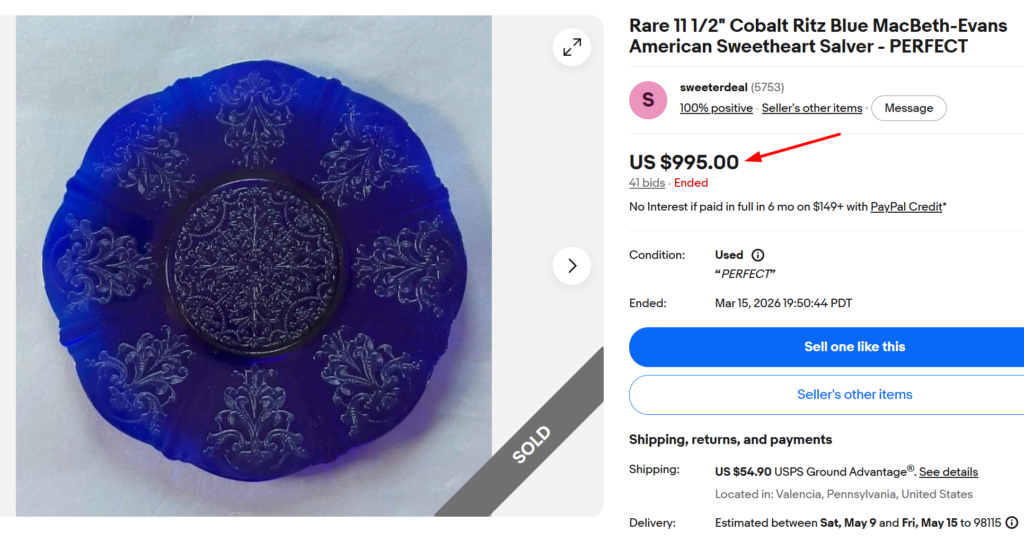
Sold for $995
MacBeth-Evan’s American Sweetheart pattern was made from 1930 to 1936, with the Pink and Monax (translucent white) being the most common colors. The surface carries a pressed scroll and medallion design.
Ritz Blue or cobalt is extremely rare because the company made it in a very limited range of forms, and the 11.5-inch salver is among the rarest. In pristine condition, this salvar can easily fetch $800 to $1,200. Most pieces are unmarked, though some carry a circle-M mark.
- Estimated Value: $400-$1,200+ (cobalt salver); $10-$50 (pink/Monax)
- Brand and Pattern: MacBeth-Evans Glass / American Sweetheart
- Production Year: 1930 to 1936
- Key Details: Pressed scroll and medallion design
5. Pyrex Turquoise Gold Atomic Starburst Casserole Dish
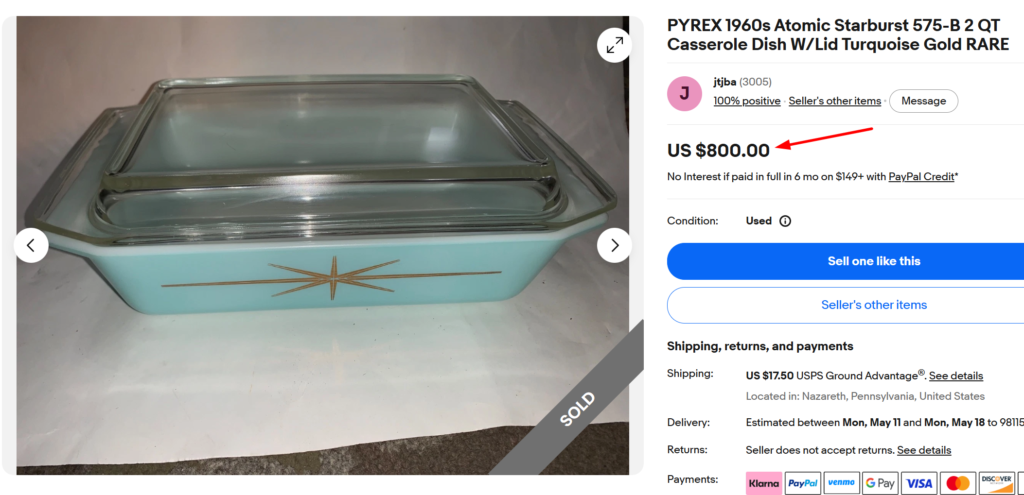
Sold for $800
This Atomic Starburst 575-B is a one-year-only promotional item from 1960, and this is why it is among the rarest antique casserole dishes worth money. It’s made of turquoise-colored borosilicate glass with a big 8-point gold star on each of its long sides.
This product has “PYREX 575-B 2QT MADE IN U.S.A.” inscribed on the base of the piece, while the clear glass cover has “PYREX 550-C” written on it. Originally, these pieces came with a gold candle warmer; sets with the warmer can go over $1,000.
- Estimated Value: $400-$1,000 (with lid); $1,000+ (with warmer)
- Brand and Pattern: Corning / Pyrex Atomic Starburst (575-B)
- Production Year: 1960 only
- Key Details: Turquoise base with golden star motif
- Marks: “PYREX 575-B 2QT MADE IN U.S.A.” on base, “PYREX 550-C” on lid
6. Herend Queen Victoria Serving Platter
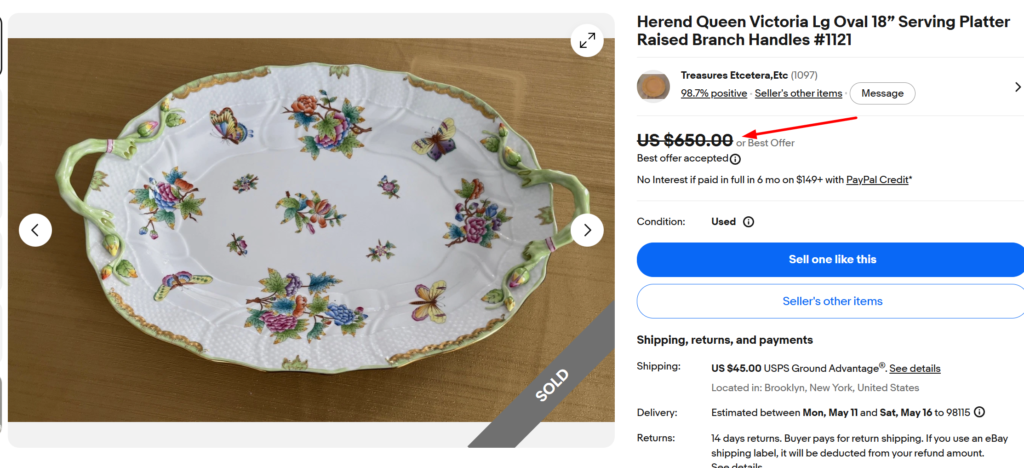
Sold for $650
The Queen Victoria pattern (code VBO) was created after Queen Victoria selected it at the 1851 Great Exhibition in London. It features hand-painted butterflies, roses, and peony clusters on a white ground with a green molded basketweave border and 24-karat gold edge.
Serving dishes and platters like the one above are less common in this pattern and highly collectible than dinner plates. Complete dinnerware services with scarce serving pieces can go for $3,000 to $5,000+!
- Average Value: $150-$800 (singles, small sets); $3,000-$5,000+ (service)
- Brand and Pattern: Herend / Queen Victoria
- Production Year: 1851 to present
- Key Details: Green basketweave border, hand-applied decoration
- Marks: Blue Herend mark with “VBO” on base
7. Meissen Blue Rich Onion Platter
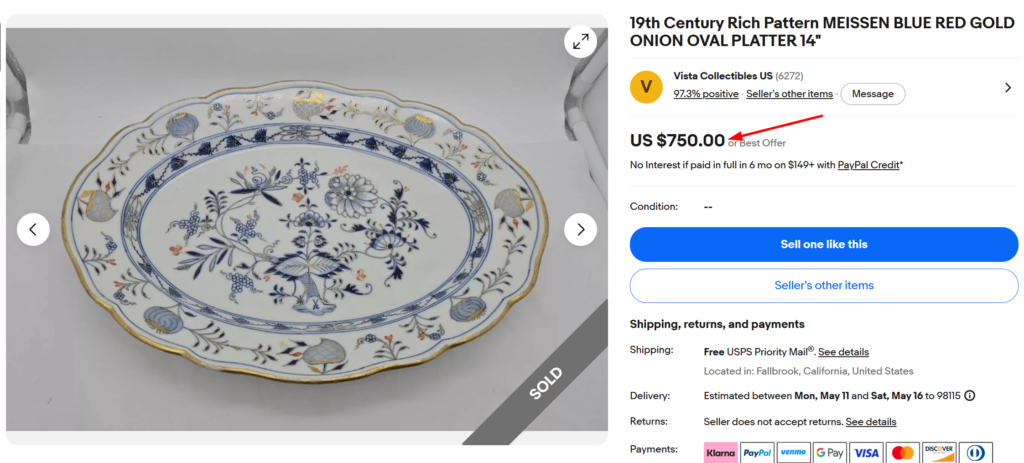
Sold for $750
The Blue Onion Rich Pattern adds red and gold overglaze accents to the standard cobalt blue underglaze design. That’s what sets it apart from plain blue-and-white design.
The bamboo, peonies, and stylized fruit motifs carry additional hand-painted color and gilding that standard pieces lack entirely. You can identify and date an original piece by the crossed-swords mark in underglaze blue.
Blue Onion Rich dishes are slightly rarer and more desirable than Meissen’s standard Blue Onions variants, especially large platters like this example.
- Estimated Value: $300-$1,500+
- Brand and Pattern: Meissen / Blue Onion Rich Pattern (Zwiebelmuster)
- Production Year: 19th century
- Key Details: Red, gold overglaze accents on Blue Onion.
- Marks: Blue crossed-swords underglaze mark
8. Sèvres Tuileries Plates
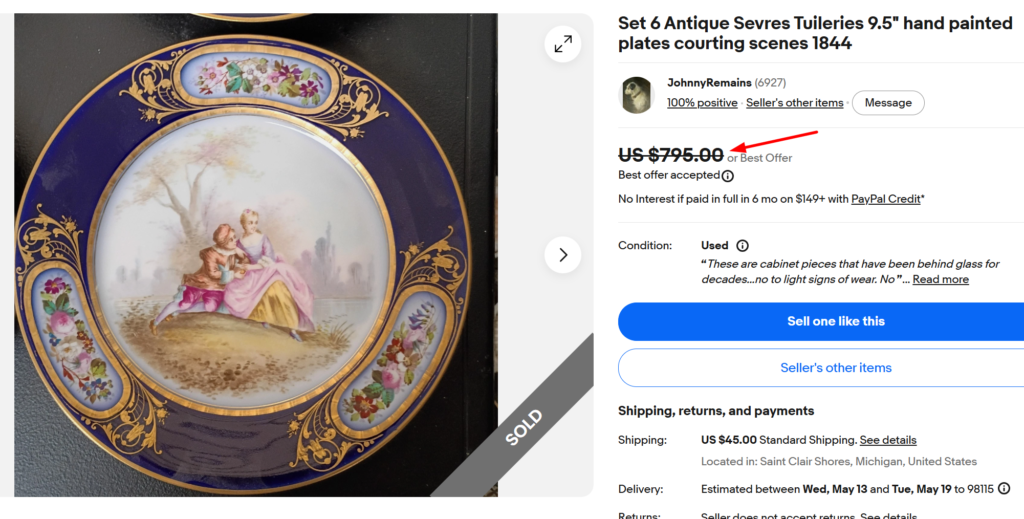
Sold for $795
These 9.5-inch plates were made at Sèvres for the Tuileries Palace in Paris during the reign of Louis-Philippe. The deep cobalt blue border is heavily gilded, and the center shows an individually hand-painted courting scene. Also, no two centers in a set are the same.
Each carries a red printed “Chateau des Tuileries” mark and a Sèvres date code on the base. Always check this to authenticate an original piece; fakes might show a blurry mark and flat, even gilding. A large set of 8 or more of these Sèvres plates can reach $1,000 or higher.
- Estimated Value: $100-$300 (per plate); $400-$1,200 (6 or more)
- Brand and Pattern: Sèvres / Tuileries palace service
- Production Year: 1840s to 1870s
- Key Details: Red “Chateau des Tuileries” printed mark with Sèvres date code on base
9. Tiffany Studios Favrile Glass Dishes
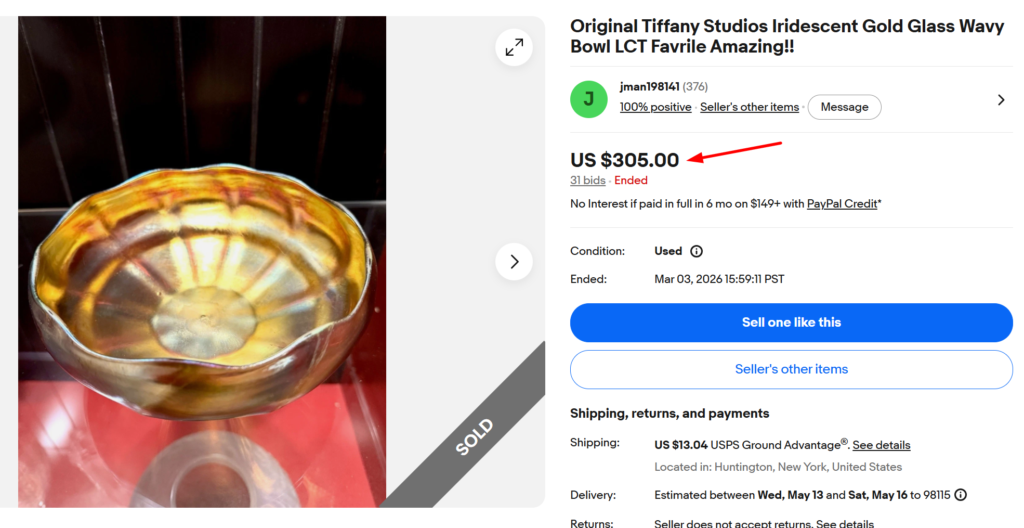
Sold for $300+
Favrile glass, patented by Tiffany in 1894, achieves iridescence by incorporating metallic oxides into the molten glass, not by surface spraying. This gives it a deep, shifting luster noticeably richer than carnival glass.
Dishes have ruffled rims and ribbed interiors, all hand-formed. The base is incised “L.C.T.” or “L.C. Tiffany Favrile” with a registration number. Pieces without an authentic incised mark are not genuine.
Because the company mostly made vases and other decorative pieces in favrile glass, Authentic Tiffany Favrile glass dishes are rare and highly collectible.
- Estimated Value: $200-$1,500+
- Brand and Pattern: Tiffany Studios / Favrile glass
- Production Year: 1894 to 1933
- Key Details: Wavy edge; iridescent finish
- Marks: Incised “L.C.T.” or “L.C. Tiffany Favrile” with registration number
10. Wedgwood Jasperware Dishware

Sold for $500+
This is a tricolor Jasperware saucer/plate from Wedgwood. Jasperware has colored pigment throughout the clay body, not just on the surface, and the white neoclassical relief figures are applied separately before firing.
Because most Jasperware production went into urns, medallions, and vases, flat plates and dishes are significantly rarer in this body. Black-ground and tri-color versions are especially hard to find.
- Estimated Value: $150-$1,200+ (per piece); $1,500-$5,000 (sets)
- Brand and Pattern: Wedgwood / Jasperware
- Production Year: 1774 to present (pre-1860 examples most collectible)
- Key Details: Earliest pieces marked “Wedgwood” in block letters.
11. Royal Worcester Painted Fruit Plates
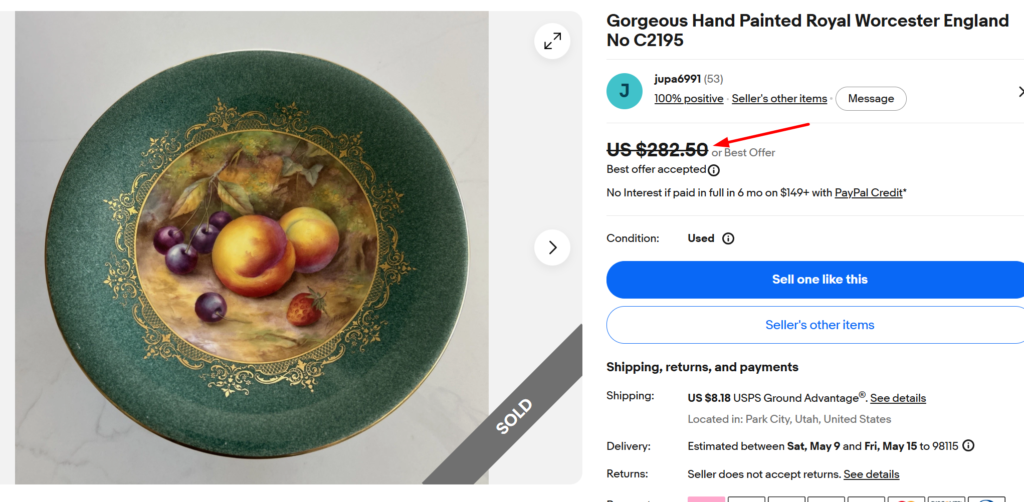
Sold for $280+
Royal Worcester’s painted fruit plates are signed works by named factory artists. Each plate features freehand-painted life-size fruit in translucent layered colors on a dark mossy green ground.
The artist’s signature appears on the front face, and the base carries a puce or black Worcester backstamp with a year date code and pattern number.
Artist attribution is the primary value driver for these pieces; Sebright and Austin names fetch the highest prices.
- Estimated Value: $150-$600+
- Brand and Pattern: Royal Worcester / Painted Fruit
- Production Year: 1880s to 1960s
- Key Details: Naturalistic hand-painted fruits, colored border
- Marks: Artist sign on the front, backstamp (year & pattern code) on base.
12. Lenox Autumn Gold Dinner Plates
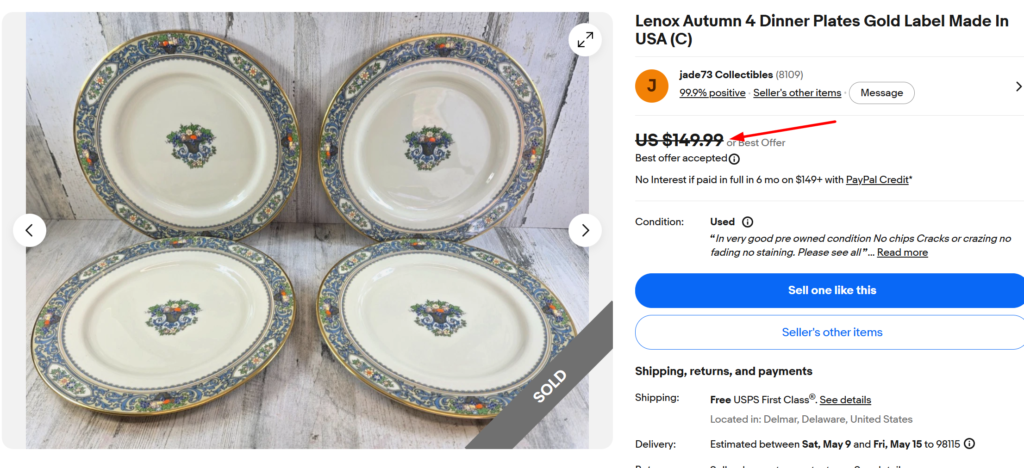
Sold for $150
Lenox’s Autumn pattern was introduced in 1918. It shows hand-applied enamel dots forming a cornucopia of fruit and flowers on ivory bone china, with a blue scrollwork border and 24-karat gold rim.
This is one of Lenox’s most expensive designs to produce because of the hand-applied enamel “jewels” that create a 3D texture on the flowers.
This pattern was later produced via transfer-printing; applied enamel dots distinguish it from transfer-printed versions. The backstamp also helps date these pieces: a green wreath indicates 1906 to 1930; the gold label indicates post-1953.
- Estimated Value: $30-$80 (per plate); $300-$1,500+ (sets)
- Brand and Pattern: Lenox / Autumn (pattern code S1)
- Production Year: 1918 to present
- Key Details: Raised enamel jeweling, 24k gold trim, ivory porcelain
- Marks: Green wreath mark (1906 to 1930), gold label (post-1953)
13. Spode Blue Italian Tea Cups
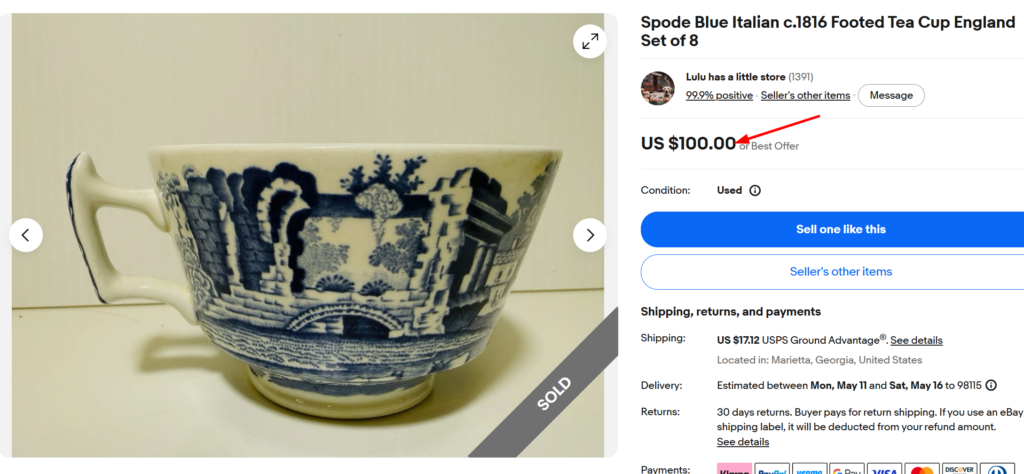
Sold for $100
Blue Italian features a romanticized Italian landscape with ruins, a bridge, and a church, printed under the glaze in cobalt blue. Underglaze printing, introduced by Spode in 1816, protects the design and gives it lasting crispness.
The earliest pieces on pearlware, made before the company became Copeland in 1833, carry only the script “Spode” mark and are the most valuable. “Copeland and Garrett” mark dates from 1833 to 1847.
Single early plates and tea ware in good condition sell for $100 to $400; rare serving pieces can go over $500.
- Estimated Value: $75-$600 per piece (early antique services more)
- Brand and Pattern: Spode / Blue Italian
- Production Year: 1816 to present (“Spode” marked pieces are pre-1833)
- Key Details: “Spode” marking, crisper and detailed printing
14. Johnson Brothers “His Majesty” Turkey Platter
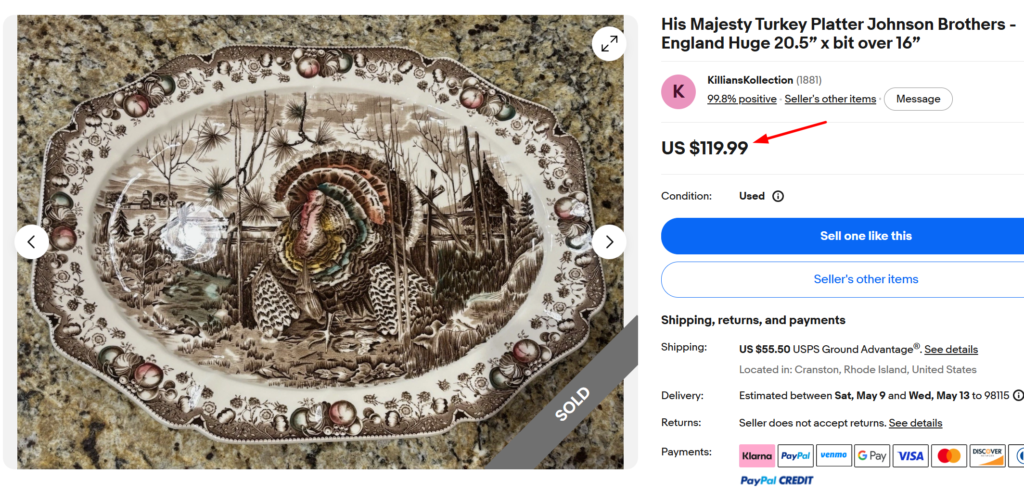
Sold for $120
His Majesty started as an accent plate in Johnson Brothers’ Friendly Village range and became its own pattern around 1930 after strong demand. It features brown transferware on cream ironstone, with a central turkey-in-display scene and a harvest border of fruits and nuts.
The base carries a Johnson Brothers England backstamp with the “His Majesty” pattern name. Large 20-inch oval platters are the most collected form in this design. Sets with these pieces are naturally worth more.
- Estimated Value: $40-$150 (per plate); $100-$250 (large platters, sets)
- Brand and Pattern: Johnson Brothers / His Majesty
- Production Year: 1930 to present
- Key Details: Brown transferware, detailed turkey
- Marks: Johnson Brothers England backstamp with the pattern name
15. Minton Majolica Game Pie Dish Tureen
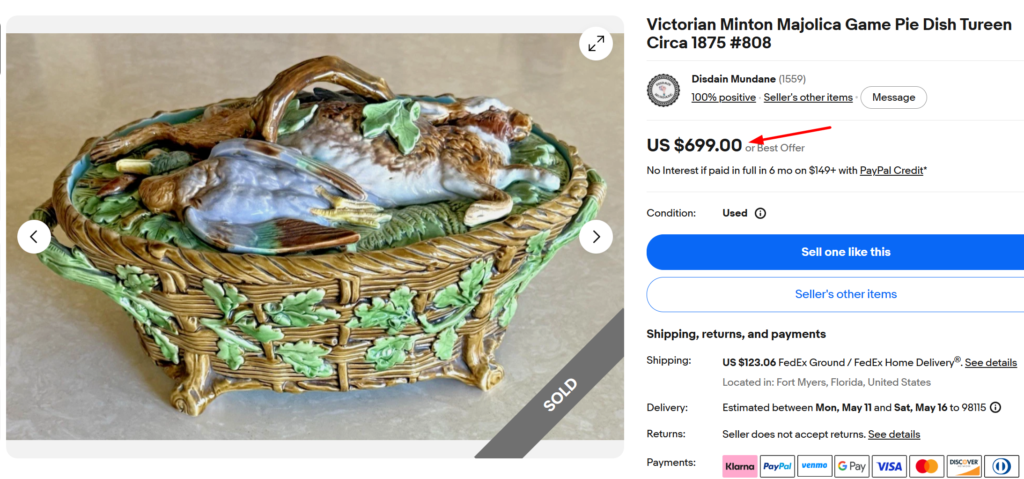
Sold for $700
The lid of this Minton majolica game pie dish (shape no. 808, circa 1875) is modeled with a dead hare and mallard duck resting on a bed of fern and oak leaves, glazed in naturalistic polychrome colors.
The oval base mimics a basketweave body in ochre brown with applied green oak leaf and vine decoration. The interior carries the turquoise glaze unique to Minton’s majolica game range. Minton’s majolica dishes are highly collectible today, especially complete sets with original lids.
- Estimated Value: $500-$2,500+
- Brand and Pattern: Minton / Majolica Game Pie Dish
- Production Year: circa 1875
- Key Details: 3D dead game modeling on lid, turquoise interior glaze
- Marks: Impressed “MINTON” or “MINTONS” with shape number & year cipher
What Determines If Old Dishes Are Valuable?
Dishes don’t get valuable just from sitting around for a long time. Specific factors determine whether an antique plate, bowl, or platter is worth $5 or $5,000. The most significant factors are:
- Maker and reputation – A dish from Meissen, Spode, Wedgwood, or Royal Copenhagen starts with a built-in collector base. These brands have documented production histories, recognized marks, and active auction markets. Unknown makers are less valuable, even if the piece is very old.
- Age and production period – Earlier examples from any major maker usually fetch higher prices. A Spode plate from 1815 will outprice one from 1915. Within a maker’s history, certain periods, like Meissen’s 1710 to 1750 pieces, are considered the most valuable.
- Rarity – Limited production runs, discontinued patterns, pieces produced for a single year, or forms that were never made in large quantities all attract collector attention. The Swan Service and Fairyland Luster are worth so much, partly because relatively few pieces turn up in the market.
- Type of decoration – Hand-painted decoration is generally more valuable than transfer-printed, which is more valuable than machine-printed. On pieces where both hand-painting and transfer work appear, how much is hand-applied matters.
- Material – Hard-paste porcelain (Meissen, Chinese export) is considered the finest ceramic material. Bone china (Spode, Royal Doulton) follows. Earthenware and ironstone are usually more common and worth less. The material affects how the piece sounds when tapped, how it looks held up to light, and ultimately how it’s valued.
- Condition – Chips, cracks, crazing, and repairs all reduce value, some dramatically and some modestly, depending on the category. A hairline crack on a rare Chinese export plate matters less than on common transferware, because the former has so few replacements. Crazing (fine surface crackle in the glaze) is common on very old earthenware and does not always hurt value.
- Completeness – A full dinner service for 12 with matching serving pieces is worth more than the sum of its individual parts. A partial set missing key serving pieces is worth less than the individual plates suggest. Original boxes and any documentation add further premium.
- Provenance – A dish traced to a royal household, a famous collection, or a historically significant event carries extra value. The Meissen Swan Service commands prices it would never achieve if the pieces were identical but anonymous.