

So you found an old black Singer sewing machine in the attic, at an estate sale, or sitting in your grandmother’s cabinet. It’s heavy, it has gold scrollwork, and somewhere there’s a serial number.
The next question you get is, “What’s it actually worth?”
The honest answer is that prices for an antique Singer sewing machine swing from about $50 to well over $3,000. The difference lies in the model, year, condition, and what came with it. This guide walks you through identifying a genuine Singer machine and finding its real worth.
History & Overview of the Singer Sewing Machine
Contrary to popular belief, Isaac Merritt Singer was not the inventor of the sewing machine. He simply created the first efficient one for domestic use.
Issued in 1851, Singer was awarded U.S. Patent No. 8,294 for an improved version, and from then on, it’s history. In 1851, Singer started his partnership with lawyer Edward Clark by founding the company known as I.M. Singer & Co. It was Mr. Clark who developed the installment plan in 1856.
By 1890, Singer held about 90% of the worldwide sewing machine market. The company opened its massive Kilbowie factory in Clydebank, Scotland, in 1885, and the Elizabethport plant in New Jersey in 1873. Those two factories made millions of machines that still survive today.
So, your old Singer probably may not be rare, but it can definitely be a valuable collectible.
How to Identify Your Singer Sewing Machine?
Identifying your antique Singer sewing machine is the first step in the process of valuing it. Usually, this is done using the serial number, followed by the model number, body shape, and decals.
All of them add unique information that allows you to date your Singer sewing machine reliably.
Look at the Trademark Badge
The small oval brass badge on the front of the pillar is one of the fastest ways to roughly date your antique Singer. Singer used several distinct badge designs over the decades, each used for a defined period.
So, even before decoding the serial number, you can have an approximate idea about the time period when it was made. The classic logo displays the needle, shuttle, and thread enclosed in a wreath, with the company’s name following the circle of the wreath.
What helps determine its dating is the inscription itself on the badge.
- 1875–1885 – Reads “The Singer Manufacturing Co. New York” with the shuttle/needle/thread logo. Attached with 2 small rivets.
- 1885–1951 – Same badge but with “New York” dropped. Just “The Singer Manfg. Co.” curving around the wreath logo, plus “Trade Mark” at the bottom. This is the most common badge you’ll see on antique Singers.
- 1950–1952 (Centennial) – Special “A Century of Sewing Service 1851–1951” inscription around the oval. About 1 in 10 Featherweights from this period have one, and Centennial badges add a small value premium.
- 1952–early 1960s – New badge style with a patterned border (black, brown, or green depending on machine color) around an embossed brass center.
- Early 1960s onward – Redesigned badge with a red “S” Singer logo instead of the classic shuttle and needle motif. This was the last metal riveted badge.

Location of the Serial Number
On treadle and crank sewing machines, the serial number can be found stamped on a metal plate or directly on the machine bed itself. For early electric Singer sewing machines, the location of the serial number is on the side panel or under the motor.
If there is only one number, then this is the serial number. However, if you notice two numbers on Singer machines produced from 1855 to 1889, these will be placed side by side.
In such cases, the large number will be the serial number while the smaller one will be the register number.
The serial number is the single most reliable way to date a Singer. Antique Singer sewing machine serial number lookup is handled by the ISMACS database (International Sewing Machine Collectors’ Society) for free online. Type your number in, and it gives you the allotment year and factory.
How to Read the Serial Number Format?
The format of the serial number itself tells you roughly when the machine was made. There are three patterns to know, and they’re consistent across the whole Singer catalog.
- Numbers only, up to 8 digits – Manufactured before 1900. Singer didn’t use letter prefixes until that year. For example, serial 16,831,099 was assigned in 1899.
- One letter prefix followed by numbers – Manufactured from 1900 onward. The letter usually indicates the factory. K-series numbers, for instance, were Elizabethport, New Jersey.
- Two-letter prefix followed by numbers – Also post-1900 but used for higher-volume runs. AB-prefix machines were made between 1926 and 1928, AE in the late 1930s, and AJ in the late 1940s.
Important: If there are no letters in the serial number of your antique Singer sewing machine, then chances are it predates 1900 and is definitely worth checking out further.
Determining the Model Number
While the model number is not the same thing as the serial number, they tend to get confused, especially among beginners. The model tells you what kind of machine it is, which is what actually drives the value.
Singer didn’t always stamp the model number on the body. Sometimes it’s printed on a small plate on the bed. Sometimes it’s stamped into the metal near the bobbin area. And on a lot of older treadles and hand-cranks, it isn’t shown anywhere at all.
When the model number is missing, the easiest path is to run your serial number through the ISMACS database. It returns the model along with the year. So the serial number is doing double duty: it dates the machine and tells you the model.
You can also identify the model by physical features. The bobbin system is the biggest clue. A long bullet-shaped shuttle bobbin points to the 27, 28, 127, or 128 family. A horizontal drop-in round bobbin points to the 66, 99, or 201. A vertical bobbin loaded from the left points to the Model 15.
Check the Type

How the machine is powered narrows down the era fast. Singer made treadle, hand crank, and electric machines, and each one has a fairly clear date window.
The treadle machine comes with a foot-rocking pedal that sits on a cast-iron stand. An antique Singer sewing machine treadle dates to pre-1950s in most cases.
The hand-crank machine will come with a small handle on the right-hand side of the wheel. This will not come with an electric motor and so is probably pre-1920.
The electric antique Singer sewing machine comes with a small motor that bolts to either the back or right-hand side of the body. The company manufactured the first commercially successful electric sewing machine back in 1889, although home models did not become widespread until the 1920s.
Easy tip: Most treadle and hand crank machines have been electrified at a later date. The retrofit usually shows as a non-original motor or extra drilled holes. That conversion lowers the value compared to a machine in its original setup.
Observe the Decals
The decals (gold scrollwork decorating the sides) can also provide reliable clues of identification. While Singer never officially labeled any of them, many collectors came up with their own names for the decal designs.
Here are the most common ones and what they tell you:
- Sphinx/Memphis (1890s-1950s) – Egyptian design featuring sphinxes and palm leaves. Most frequently used on Models 27 and 127.
- Red Eye (early 1900s-1920s) – Floral scrollwork with two red “eyes” appearing on either side of the branding. Very closely associated with the Model 66.
- Tiffany/Gingerbread (1900-1930) – Gold scrollwork featuring flowers and leaves around the head of the bed.
- Lotus/Egyptian Green (1907-1920) – Multi-colored lotus flowers in golden, green, red, or blue colors. Found on Model 66.
- Filigree (1911-1940s) – Lace-like scrollwork around the branding
Factors That Affect Antique Singer Machine Value
Two Singer machines from the same year can sell for radically different prices. The model matters, but so do other factors like condition and originality that collectors pay attention to. Here’s what moves the price most.
1. Condition
Condition is the biggest single factor in what your antique Singer sewing machine is worth. A working machine with crisp decals can sell for three or four times what a rusted, faded version of the same model brings.
Most collectors assess the condition as follows: clean decals without any peeling and silvering or fading gold, smooth movements, paint without any chips, and no rust on the metallic parts.
Surface dust and old oil don’t hurt much. Pitted chrome, cracked bobbin cases, and faded decals do.
2. Model and Type
Some models are simply worth more, and it isn’t always the oldest ones. The Singer Featherweight 221, made starting in 1933, regularly outsells machines that are 40 years older. The reason is collector demand: quilters love it, it works, and it’s cute.
Plain Model 15s and 99s are everywhere and don’t bring much. Model 201s have a strong following because of their smooth stitch. Pre-1900 hand-crank machines and the rare “Turtleback” from the 1870s sit at the top of the market.

3. Original Parts and Originality
A Singer with all its original parts, original wiring, and original finish brings more than one with replacement parts. Collectors check for the right motor, the right foot controller, original bobbins, and the original needle plate.
Aftermarket parts are easy to spot because they often don’t match the rest of the machine.
Repainted bodies and replaced decals tank the value. A Model 66 with crisp original Red Eye decals can sell for $400–$800. The same machine, repainted or with decals replaced, often won’t crack $100. Original finish, even worn, is worth more than restored.
4. Accessories and Documentation
Original accessories add real value to an antique Singer sewing machine, especially models with a case or table setup.
Look for the original bentwood case, the original wooden carrying box, the original foot pedal and power cord, the bobbin tin, the attachment box, the manual, and the receipt or paperwork, if any survived.
A bare Featherweight 221 head might sell for $300. The same machine with its original black case, original tray of attachments, original oil can, and the manual easily clears $700. Each piece adds value because complete sets are getting harder to find every year.
5. Cabinet, Table, or Stand
The furniture matters, too. An antique Singer sewing machine and table combo or an antique Singer sewing machine with a cabinet usually adds $50–$300 on top of the head value.
Art Deco cabinets from the 1930s and 1940s are the most desirable. Plain modern cabinets from the 1960s add almost nothing.
A complete antique Singer sewing machine treadle in working order, with a clean cast iron stand and a finished wood cabinet, generally sells for $200–$600. Ornate cast iron stands push the treadle Singer sewing machine value higher.
Cabinet’s condition matters, too. Damaged cabinets, water rings, or missing drawers can significantly reduce the overall value.
6. Rarity and Provenance
Some machines are just uncommon. For example, the Singer 222K (the free-arm version of the Featherweight) is rare in the US market and regularly fetches $1,500. The pre-1900 “Turtleback” can hit several thousand dollars.
Unusual factory colors like white, tan, or red on Featherweights also command a premium.
Provenance adds value, too, but only when it’s documented. A machine that belonged to a known historical figure with paperwork can sell for many times the normal market price. But paperwork is important.
Most Valuable Singer Sewing Models to Look for
Once you’ve used the badge, decals, and serial number to narrow down the era, the next step is matching your machine to a specific model. Below are the most popular Singer models you must know:
1. Singer Model 27 and 127

Sold for $230
The Singer Model 27 is one of the earliest mass-produced Singers that most people will encounter. It launched in the late 1880s as Singer’s first vibrating shuttle machine, replacing the earlier VS1, VS2, and VS3 versions.
The Model 127 is the same machine with a 1910 update that added a shuttle ejector button. You’ll spot it by the long bullet-shaped shuttle bobbin, the split slide plates running front to back on the bed, and most often the Sphinx (Memphis) decal set with Egyptian motifs.
Many surviving examples are treadle machines in oak cabinets. Millions were made, so the Model 27/127 is common today but still genuinely antique.
- Average Value: $100–$400 (head only); $300–$700 with cabinet
- Production Years: 1880s–1960s
- Key Features: Vibrating shuttle, long bullet bobbin, split slide plates, high arm
- Marks: Sphinx/Memphis decals (most common), oval “Singer Manfg. Co.” badge
- Quick Notes: Treadle versions in original cabinets are most valuable.
2. Singer Model 28 and 128

Sold for over $300
The Model 28 is the 3/4-size sibling of the Model 27, using the same vibrating shuttle system in a smaller body. The Model 128 is the updated version with the same 1910 improvements as the 127. Most were sold as hand-crank machines fitted into a wooden base with a bentwood cover.
Identification is easy. Same long bullet bobbin and split slide plates as the 27/127, but the machine itself is noticeably smaller. Hand-crank versions are more common than treadles in this size.
- Average Value: $100–$300 (head only); $250–$500 with bentwood case
- Production Years: 1880s–1960s
- Key Features: 3/4-size vibrating shuttle, hand-crank or electric, bentwood case
- Marks: Sphinx, Filigree, or simpler later decals
- Quick Notes: Hand-crank models with intact bentwood cases are the most desirable.
3. 1920s Singer Model 15

Sold for $350
The Singer Model 15 has the longest production run of any sewing machine ever made. The original “Improved Family” machine launched in 1879, and the design we now call the Model 15 was introduced in 1895. The same basic machine stayed in production for over 100 years.
The fastest way to identify it is by the tension unit position. On a Model 15, the tension assembly sits on the left face of the machine, and the needle is threaded left to right. That’s the opposite of almost every other vintage Singer. The Model 15-91 (made 1930–1956) is the most common American electric variant.
- Average Value: $75–$250 (head only); $200–$500 (cabinet/accessories)
- Production Years: 1895–1950s (officially); clones still made
- Key Features: Tension unit on left face, vertical bobbin, oscillating shuttle
- Marks: Multiple decal sets (Sphinx and Filigree) used over time
- Quick Notes: The 15-91 with a potted motor is the most sought-after.
4. 1910s Singer Model 66
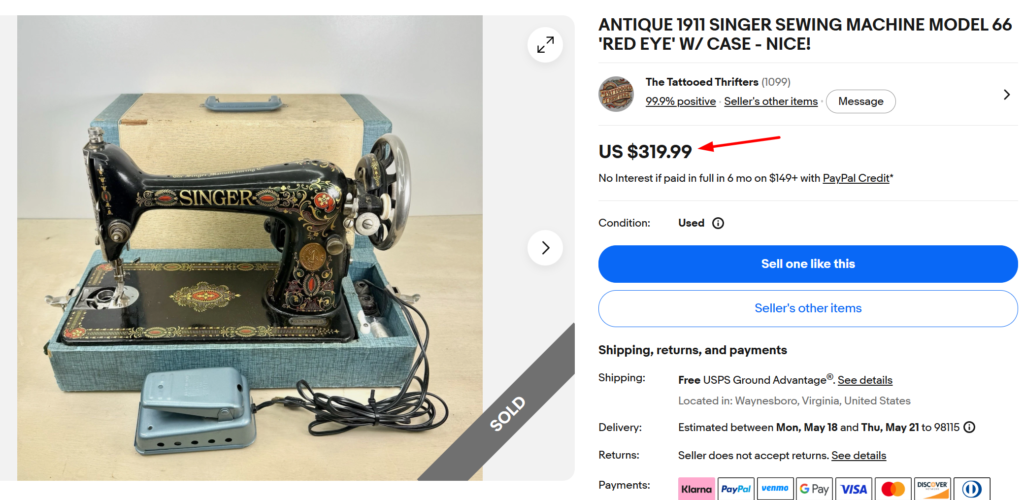
Sold for $320
The Model 66 was introduced in America in October 1902 and quickly became Singer’s flagship full-size domestic machine. It was the first Singer to use a horizontally mounted rotary hook with a drop-in round bobbin, a system almost every modern machine uses today.
The Red Eye decal is what most collectors remember the 66 for. Made in the US from about 1907 onward, it features two red elliptical “eyes” framed by laurel wreaths on the front.
UK-made 66Ks usually had Lotus or Sphinx decals instead. Early Red Eye treadle machines are some of the most photogenic antique Singers.
- Average Value: $150–$400 (head only); $400–$800 with cabinet
- Production Years: 1902–1956 (USA); 1907–1960 (Scotland)
- Key Features: Full-size, horizontal drop-in bobbin, smooth straight stitch
- Marks: Red Eye decals (USA), Lotus or Sphinx decals (Scotland)
- Quick Notes: Red Eye treadle versions are most valuable.
5. Singer Model 99

Sold for $400
The Model 99 was introduced in 1911 as the 3/4-size portable version of the Model 66. It used identical internal mechanics in a smaller body, weighing just 22 pounds. In 1921, Singer added a factory-fitted electric motor, making the 99K the first truly portable electric sewing machine. Production continued until 1958.
Early Model 99s came in wooden bases with bentwood covers. Later versions had mock-crocodile carrying cases or plastic bases. The Model 99K-31 from the mid-1950s added reverse stitch and a graduated stitch-length lever. It’s a common machine, nicknamed the “Little Beast” for its toughness.
- Average Value: $75–$200 (head only); $200–$450 with bentwood case
- Production Years: 1911–1958
- Key Features: 3/4-size, horizontal drop-in bobbin, portable, often electric
- Marks: Egyptian scroll faceplate (early), striated faceplate (later)
- Quick Notes: Early 99s with bentwood cases are the most desirable.
6. 1950s Singer Model 201

Sold for $400
Many collectors call the Model 201 the finest domestic sewing machine that Singer ever made. It was introduced in 1935 as the top-tier straight-stitch model, with a full rotary hook, hardened-steel matched gears, and a potted gear-drive motor on the 201-2 variant. It runs at up to 1,100 stitches per minute.
The 201 came in four variants. The 201-1 was treadle-powered. The 201-2 used a direct gear-drive potted motor. The 201-3 had an external belt-driven motor, and the 201-4 was a hand-crank.
Early 201s have cast iron bodies and weigh about 30 pounds. Later 1950s versions (201K21–24) used a lighter aluminum body in black, beige, or brown. The black aluminum 201s are the rarest of the late models.
- Average Value: $200–$500 (head only); $500–$900 with cabinet
- Production Years: 1935–1961
- Key Features: Full rotary hook, gear-driven, drop feed, straight stitch with reverse
- Marks: Chrome scrollwork faceplate (early), striated faceplate (later); 1951 Centennial badge on some
- Quick Notes: The 201-2 with a potted motor is most sought after.
7. 1930s Singer Model 221 (Featherweight)
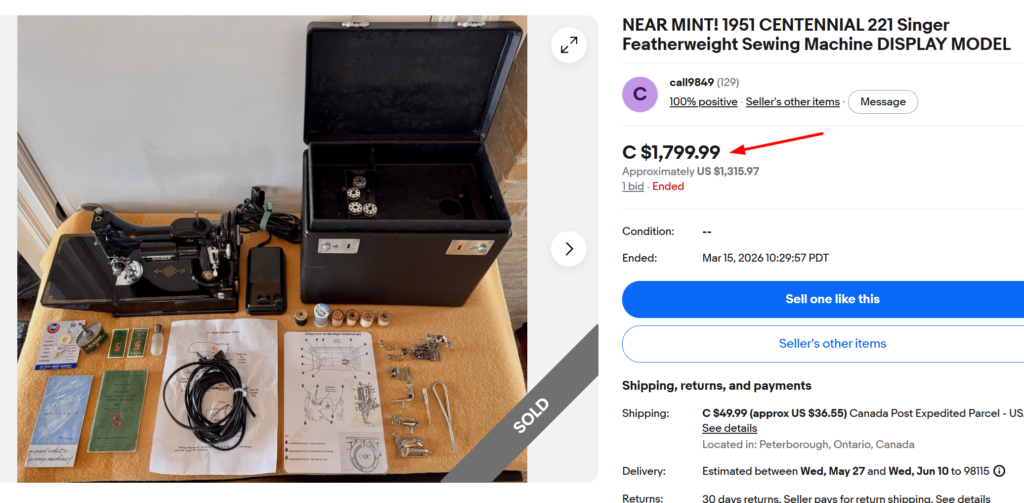
Sold for $1,315
The Featherweight is the most collected Singer and the only one that regularly sells for over $1,000 in working condition. It was introduced at the 1933 Chicago World’s Fair as a lightweight aluminum portable, weighing just 11 pounds and measuring 9¾ inches wide.
It’s a straight stitch only, with no zigzag option. The 222K is the free-arm version of the 221, made mostly for the UK market from 1953 to 1964.
Standard Featherweights are black with gold scrollwork, but Singer also produced factory examples in white, tan, and pale green during the 1960s. Those colored versions sell for a big premium.
- Average Value: $400–$900 (heads); $700–$1,500 (original case/attachments)
- Production Years: 1933–1964
- Key Features: Aluminum body, 11 lbs, 9¾” wide, straight stitch only, portable
- Marks: Gold scrollwork, 1933/1934 World’s Fair badges on early machines, 1951 Centennial badge
- Quick Notes: Colored Featherweights (white, tan, green) are rare.
8. Singer Model 401A

Sold for $400
The 401A was Singer’s slant-needle electric introduced in 1958. It’s technically vintage rather than antique, but it often shows up in the secondary market.
It was Singer’s first machine to combine zigzag stitching, decorative cam-driven stitches, and a slant-needle design in a single domestic machine.
You’ll recognize it by the slanted needle bar (the needle sits at an angle instead of vertical), the tan or beige metal body, and the round cam discs that can be inserted to change stitch patterns. The 401A was built with cast aluminum and steel internals, so it’s a mechanically tough machine.
- Average Value: $100–$300 (head only); $300–$600 with cabinet and cams
- Production Years: 1958–1964
- Key Features: Slant needle, zigzag, decorative cams, all-metal gears
- Marks: “401A Slant-O-Matic” badge, tan/beige body
- Quick Notes: Vintage, not antique. Complete sets with original cams and accessories are the most valuable.
9. Singer Model 237

Sold for $400
The Model 237 is a mid-century straight-stitch machine produced mostly in Singer’s overseas factories from around 1968 into the 1970s. It’s well past the antique cutoff, but turns up often in family inheritances.
It’s a simple zigzag machine with a metal body, low-shank feet, and basic stitch options. The Model 237 is honest, reliable, and easy to sew on, but it isn’t collected the way the older Singers are.
- Average Value: $50–$150 (head only); $150–$250 with cabinet
- Production Years: 1968–early 1970s
- Key Features: Zigzag, metal body, low-shank feet
- Marks: “237” badge, simpler later branding
- Quick Notes: Vintage, not antique.
Most antique Singer sewing machines are worth less than people hope and more than most people guess. The key to knowing the value is model rarity, condition, and originality of the model, which you must never overlook.