

CorningWare came out in 1958 by Corning Glass Works after Dr. S. Donald Stookey developed glass ceramic, which resulted in the creation of Pyroceram. It is a white glass ceramic that is resistant to heat and has low expansion.
According to Corning themselves, the invention of glass ceramic by Dr. Stookey became the foundation of all consumer products of Corning Cookware.
Collectors love vintage CorningWare today for its durability and flexible aesthetics. Some designs are especially more popular. Let’s explore these popular designs, their values, along with tips to spot genuine and valuable pieces.
How to Identify Authentic Vintage CorningWare?
CorningWare’s popularity led to a flood of knockoffs and imitations over the years. Some look nearly identical at first glance. But there are four reliable ways to tell if you’re holding the real thing.
1. The Pattern Name
Each CorningWare pattern was made for a specific time period. So, the pattern name itself is the first identification and dating clue. If someone claims to have a “1950s Wildflower,” that’s a red flag right away because the pattern didn’t exist until the late 1970s.
Some patterns were limited to just one or two years, such as the Butterscotch pattern in 1969 alone, the Nature’s Bounty pattern in 1971 alone, and the Blue Heather pattern between 1976 and 1977. These short production runs are worth checking further.
2. The Backstamp and Markings
Flip the piece over. The backstamp (the marking on the bottom) is the most reliable way to confirm you have genuine CorningWare. Here is how backstamping evolved through the years:
- Before 1961 – Stamps were embossed with “CORNING WARE” in block capital lettering, often in blue ink. Some old items will also carry mold numbers such as B-34 and C-18, meaning they were made by hand rather than machines.
- 1961 to 1966 – Embossed stamps, often with a small cornflower or starburst logo alongside “CORNING WARE” and model numbers.
- 1966 to 1972 – A black starburst logo appears. The words “For Range & Microwave” were added around 1969 to 1972.
- 1972 to 1998 – Printed (not embossed) stamps became standard. Model numbers range from the P-series (stovetop items) to the A-series (bakeware products, including casserole dishes).
- Post-1998 – The name changed from being two words, “Corning Ware,” to being one word, “Corningware,” and finally “CorningWare.”
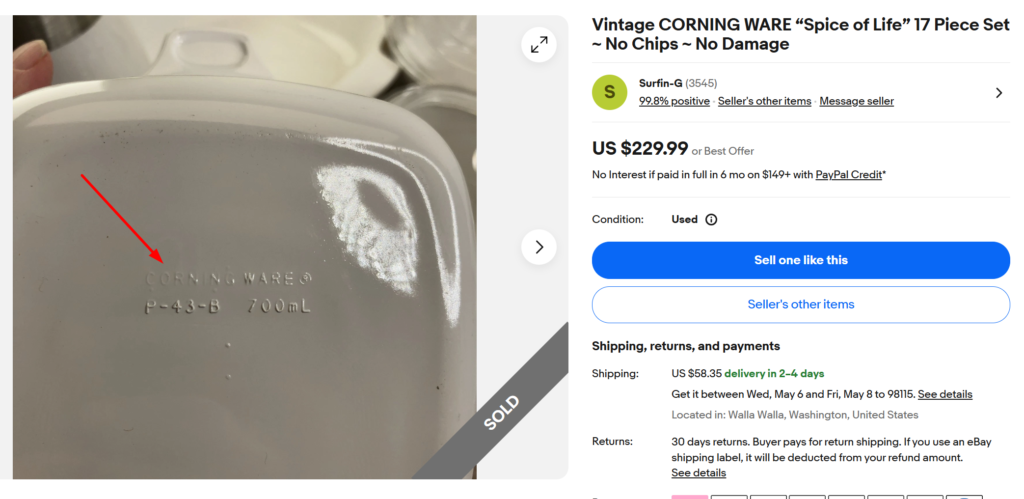
If the stamp says “Not for Stovetop Use,” the piece is not Pyroceram. It’s likely the later stoneware version, which is far less collectible.
Quick tip: “Microwave safe” alone does not prove a piece is early. Check for the full model number, material clues, and whether the base says it is safe for stovetop or range use.
3. The Shape & Size
CorningWare shapes changed over time, and these details matter a lot to trace the production era.
For instance, early pieces (pre-1972) have small tab handles and noticeably sloped sides. After 1972, the sides became straighter, and the handles got bigger. If you’re looking at a Blue Cornflower dish with sloped sides and small handles, it’s an earlier piece, and earlier pieces are generally more valuable.
You can also identify the shape by the model number on the back and the box. Common vintage model clues include:
- P-series: earlier pieces, often rounded forms.
- A-series: post-1972 casserole shapes with straighter sides and wider handles.
- DC-series: Designer Casseroles from the late 1970s, including Blue Heather and similar patterns. CorningWare 411 notes DC stands for Designer Casseroles.
- F-series: French White family, introduced later in the 1970s.
4. The Lid Type
Original CorningWare lids were made of Pyrex glass, not Pyroceram. The earliest lids (late 1950s to early 1960s) had a distinctive “fin” handle on top, a flat, raised ridge you could grip. These were replaced in later years by the more common round knob handles.
If the lid has a Pyrex stamp with a matching model number (like P-7-C for a specific casserole size), that’s a good sign it’s original. Original lids add real value. A casserole dish with its matching lid can sell for two to three times what the dish alone would bring.
Also, check whether the lid sits correctly, has the right shape, and matches the dish’s model size. Chips on the lid rim are common and may hurt the value, so check carefully.
List of All Corningware Patterns (by Years & Values)
Here are the CorningWare patterns that collectors search for most, and their average values in the market today.
1. Black Starburst (1958 to 1972)
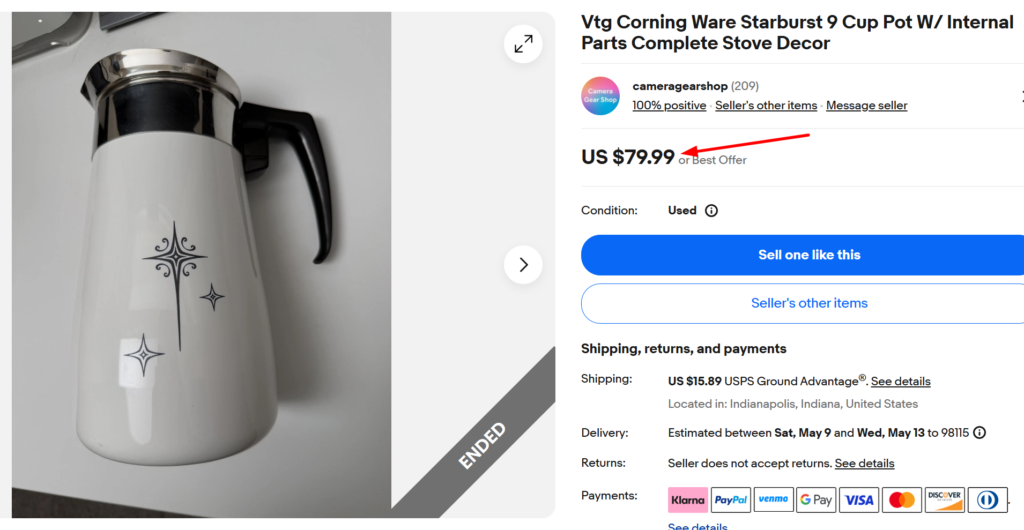
The very first CorningWare pattern ever released. What makes the early versions special is the sloped sides and small tab handles, which were only made from 1958 to about 1972. After that, sides straightened, and handles grew.
The earliest pre-1961 pieces with embossed backstamps and no model numbers are the hardest to find. Later Blue Cornflower is common and worth $10 to $30.
- Estimated Value: $100 to $500+ (early sloped-side versions with lids)
- Production Year: 1958 to 1972 (early versions)
- Design Element: Stylized star motifs
2. Spice of Life (1972 to 1987)

The design shows a row of red tomatoes, green peppers, artichokes, mushrooms, and garlic on a field of green herbs.
Early versions have French script names like “L’Echalote,” “La Marjolaine,” or “Le Romarin” printed beneath the vegetables. Later production dropped those French names entirely.
Today, mint-condition 4-quart casseroles with original lids and the French script have sold for thousands. Without the script, they’re $20 to $80.
- Estimated Value: $20 to $4,000+ (depending on script variant, size, and condition)
- Production Year: 1972 to 1987
- Design Element: Vegetables and herb band
3. Shadow Iris (1985 to 1993)

Corning introduced Shadow Iris around 1985 as part of a shift toward softer, more understated designs. The pattern shows tall, wispy purple iris flowers arching gracefully across the white Pyroceram surface.
The production of Shadow Iris ended around 1993. It was then relaunched by Corning for a brief period. This indicates just how much of a hit it was among its fans. While individual items are reasonably priced, sets fetch between $150 and $350 now.
- Estimated Value: $10 to $135 (complete sets at the high end)
- Production Year: 1985 to 1993/1995
- Design Element: Purple iris flower wisps
4. Country Festival/Friendship (1975)

Country Festival came out around 1975. It’s also known by collectors as the “Friendship” or “Blue Bird” pattern, because it shows two bright blue birds facing each other on green vines, surrounded by orange and red flowers.
The symmetrical layout looks like a cross-stitch pattern, which gives it a handmade folk-art feel of the mid-1970s. Complete CorningWare cookware sets in this pattern are the most valuable pieces; small single pieces usually go for $5 to $15.
- Estimated Value: $5 to $15
- Production Year: 1975
- Design Element: Two bluebirds, folk flowers
5. Wildflower (1977 to 1984)
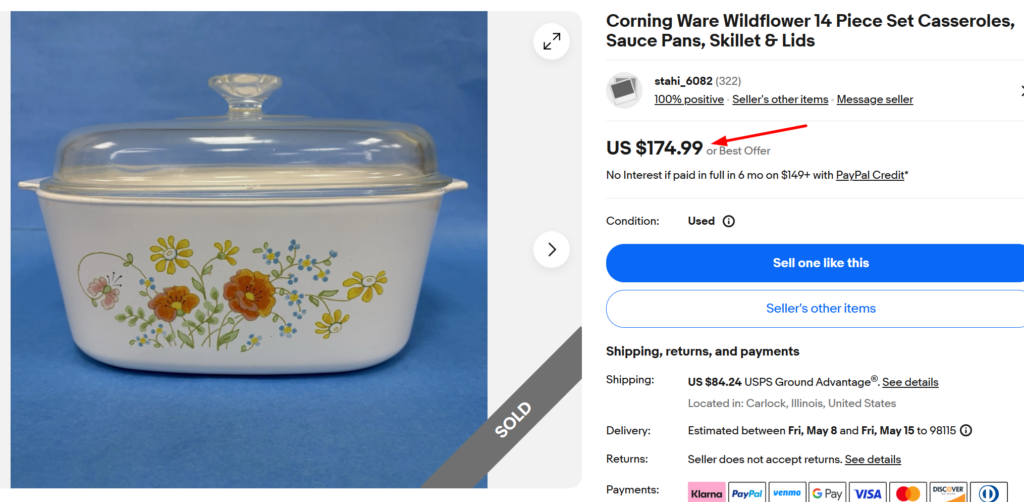
Corning brought out the Wildflower pattern in approximately 1977, and its manufacture continued until about 1984. The pattern consists of vividly colored orange-red poppies, sunflowers in shades of yellow, and small blue flowers along with their green leaves.
It was among the most intricate and colorful designs made by Corning. The original pieces of the Wildflower pattern were manufactured in sets of seven, making the complete sets highly collectible.
- Estimated Value: $10 to $500 (sets in top condition at the high end)
- Production Year: 1977 to 1984
- Design Element: Poppies, daisies, blue flowers
6. Renaissance (1970)
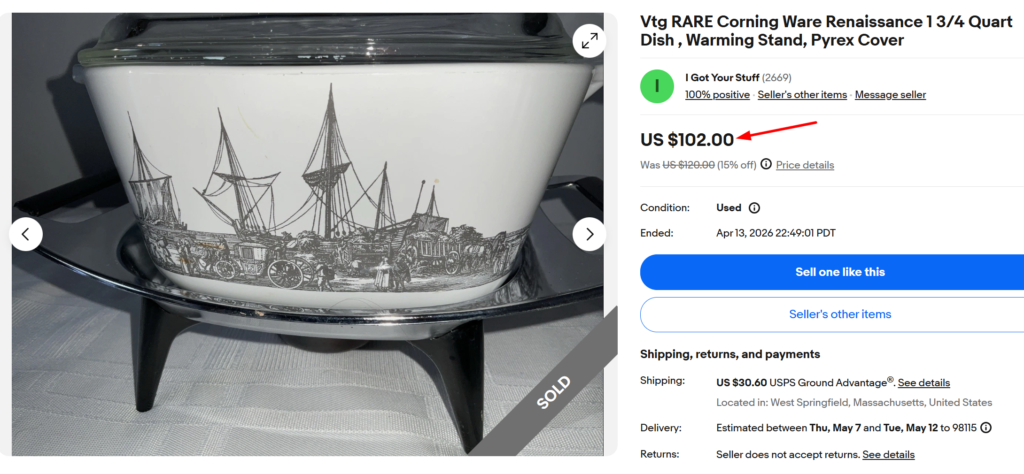
The Renaissance was completely different from every other CorningWare pattern. Instead of flowers or kitchen themes, it shows detailed black ink sketches of a 17th-century European city on a cream-colored body.
The artwork came from etchings of Stockholm’s seaport in Erik Dahlbergh’s historical book Suecia Antiqua et Hodierna. The 4-quart version shows a skyline with steeples. The 1.5-quart shows a port with ship masts.
Corning only made it in 1970 as a limited-edition gift line, so these are very rare.
- Estimated Value: $100 to $300+
- Production Year: 1970 (limited edition)
- Design Element: Ink-sketched city skyline
7. Blue Heather (1976 to 1977)

Corning made Blue Heather from about 1976 to 1977, though some sources say it lasted until 1979. Still, it had one of the shortest production runs. It features blue flowers in five petals that are joined together by slender vines and leaves on a mostly white dish.
This relatively short time period meant that very few of them were ever made, thus making them hard to find in sales events.
- Estimated Value: $30 to $150
- Production Year: 1976 to 1977
- Design Element: Scattered blue petal flowers
8. Platinum Filigree (1966 to 1968)

Platinum Filigree has a repeating metallic platinum-colored filigree border on a white body. It looked more formal and dressy than the casual florals on other CorningWare patterns.
This was one of the first premium gift lines that Corning ever created. They produced it from 1966 to 1968 and marketed it specifically as a wedding gift set. including only five piece types: two saucepans, two Electromatic percolators, and a 4-quart saucepot. Because of the small production run and gift-only distribution, complete sets are extremely hard to find.
- Estimated Value: $50 to $200+ (complete sets worth more)
- Production Year: 1966 to 1968 (limited edition)
- Design Element: Metallic filigree border trim
9. Nature’s Bounty (1971)

Corning released Nature’s Bounty in 1971 as a limited-edition gift line, the same way they handled Platinum Filigree and Renaissance. The design shows mustard-yellow mushrooms and vegetables on a white background, capturing the early-1970s earthy harvest look.
Corning only made it for that one year. But even though it is genuinely rare, most collectors have never been interested in it. So prices stay surprisingly low for a one-year pattern.
- Estimated Value: $15 to $120
- Production Year: 1971 (limited edition)
- Design Element: Yellow harvest vegetables
10. Butterscotch (1969)
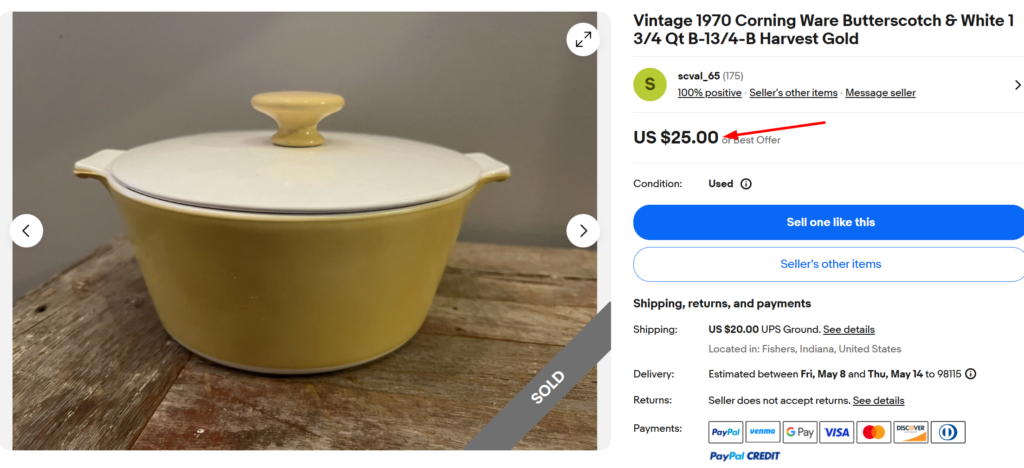
The Butterscotch pattern was made for just one year in 1969. It was sold as a buffet-style serving dish. There is no printed design on it; the entire Pyroceram body is a warm, solid amber-butterscotch color instead of the usual white.
That bold amber tone was completely different from anything else in the CorningWare lineup at the time. Corning dropped it after that single year, which may mean it did not sell well and is moderately valuable.
- Estimated Value: $40 to $150+
- Production Year: 1969 only
- Design Element: Solid amber-toned body
11. Medallion – Shell Oil Promotional (1972 to 1974)
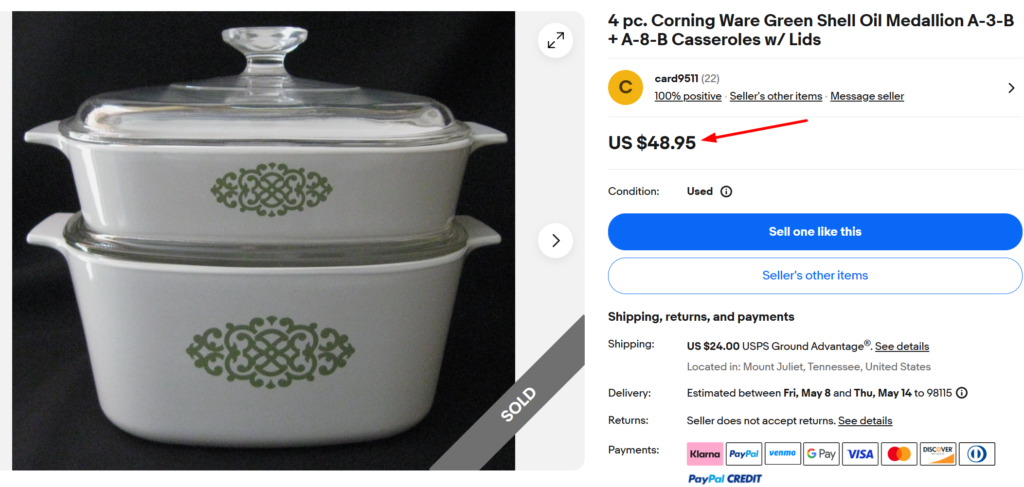
The Medallion pattern was never sold in any store. Corning made it exclusively for the Shell Oil Company between 1972 and 1974 as a gas station promotion.
Customers earned the dishes by filling up their tanks. The design shows an olive-green stenciled geometric pattern of interlocking lines that form a medallion shape on a white body. Some pieces may have a blue pattern, too.
Because it completely skipped normal retail channels, far fewer pieces were made and handed out. That makes the Medallion one of the hardest CorningWare patterns to find in the wild.
- Estimated Value: $30 to $100+
- Production Year: 1972 to 1974
- Design Element: Green geometric medallion lines
12. Floral Bouquet (1971 to 1975)

Floral Bouquet shows large outlined flower blooms with hints of blue and yellow at the centers, with clusters of smaller flowers on each side. It had a retro, hand-drawn look that was popular in the early 1970s.
Corning first released Floral Bouquet in 1969 as a gift line. It went mainstream in 1970 and stayed in production until about 1975. Today, single pieces sell for around $15 to $20 today; complete original gift sets in their boxes can bring more.
- Estimated Value: $15 to $80 (gift sets at the high end)
- Production Year: 1971 to 1975
- Design Element: Outlined blooms, blue-yellow
13. All White/Just White (1965 to 1968)

Corning introduced the All White in 1965 for buyers who wanted a clean look without any decoration. There are no motifs or designs at all; just plain white Pyroceram.
Most customers in the 1960s chose the patterned versions like Blue Cornflower instead, so All White never sold in large numbers. Corning ended production by 1968, giving it only a three-year run. That short run and low survival rate is what gives them value now.
- Estimated Value: $30 to $100
- Production Year: 1965 to 1968
- Design Element: Plain undecorated white
14. Pastel Bouquet (1985 to 1990)

Pastel Bouquet came out during the 1985 time frame, which is about the same time as Shadow Iris. It has an elegant pastel flower bouquet that consists of pink, blue, and purple flowers arranged against a white background.
This pattern was made by Corning throughout the late 1980s until the early 1990s. Pastel Bouquet is not as scarce as Blue Cornflower and Spice of Life, yet it isn’t really rare. The value of one piece ranges from $10 to $30, while sets come at a price tag of up to $350.
- Estimated Value: $10 to $100 (complete sets up to $350)
- Production Year: 1985 to early 1990s
- Design Element: Soft pastel flower cluster
15. Wheat (W-Series) (1962 to 1971)
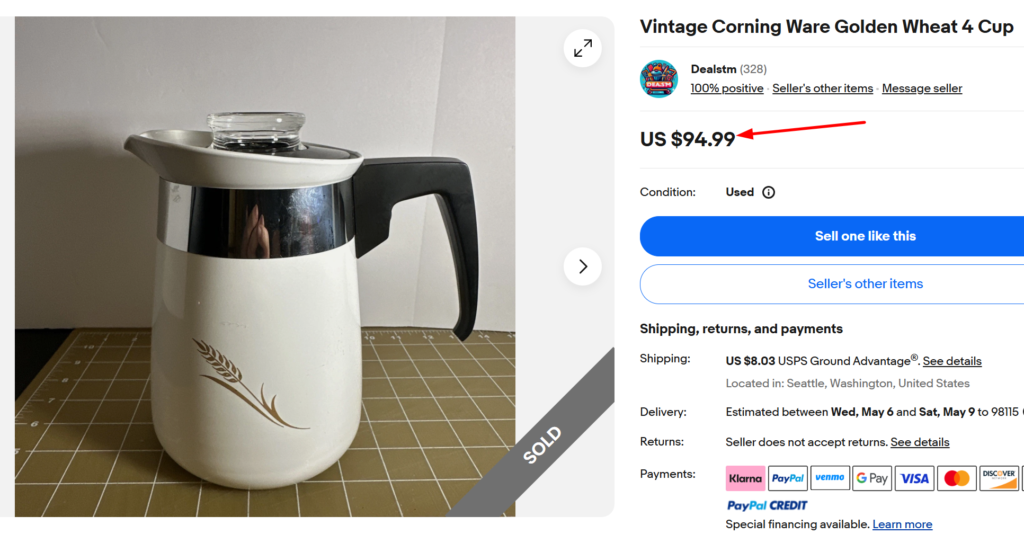
Wheat holds a special place in CorningWare history because it was the very first pattern Corning ever designed. But because the pattern was not ready for full production, Corning went on with Blue Cornflower, which became an instant hit.
The pattern shows golden wheat stalks on a white body. Wheat was later brought back and produced from around 1962 or 1963 through to roughly 1969 to 1971, with its own W-series model numbers.
Because of the limited original test run and the smaller production compared to Blue Cornflower, authentic Wheat pieces are among the rarest Corning Ware items you can find. A vintage Corningware coffee pot in Wheat design can easily fetch up to $100 in good condition.
- Estimated Value: $50 to $300+ (depending on piece type and condition)
- Production Year: 1958 (not mass produced); 1962 to 1971
- Design Element: Golden wheat stalks
What Determines the Value of Vintage CorningWare?
Not every old CorningWare dish is worth real money. Most pieces sell in the $5 to $40 range. But specific combinations of factors push certain pieces into the hundreds or even thousands. Here’s what matters.
- Rarity – This is the biggest value driver. Patterns that were only made for a year or two, like Butterscotch (1969 only) or Nature’s Bounty (1971 only), are harder to find than the long-lasting Blue Cornflower. Promotional pieces that were never sold in stores, like the Medallion pattern, are also rarer.
- Age – Older patterns are usually worth more than later ones or reissues of the same design.
- Condition – Condition matters enormously. Chips, cracks, and heavy wear to the pattern can drop the value by 50% or more. Dishwasher fading on the printed design is common and reduces the value significantly.
- Form/Shape – The form of the piece also matters. Coffee percolators are especially collectible because many were recalled in the late 1970s, and few survived. Browning skillets, detachable handles, and large Dutch ovens tend to sell for more than common casserole dishes in the same pattern.
- Completeness – Complete pieces with matching original lids are worth much more than dishes sold alone. A bare vintage CorningWare casserole dish worth $20 might bring $60 or more with its original Pyrex lid.
- Pattern Demand – Some patterns just have more collector demand than others. Wildflower, Black Starburst, and the early sloped-side Blue Cornflower pieces are actively pursued. Meanwhile, Country Festival and some of the later 1990s patterns generate very little interest.