
Vintage glass bottles have become popular collectibles, but most old bottles are common and sell for a few dollars. The ones worth money have something extra, like a pontil scar on the base, an unusual color, or the name of a small-town bottler; a 1969 Gatorade bottle sold for $750.
In this guide, you’ll learn everything you need to identify valuable bottles, understand what makes them worth money, and see real examples with their prices.
How to Identify and Date Vintage Glass Bottles
There are numerous types of glass bottles, from early medicine and wine bottles to later milk bottles, perfume bottles, and others.
Figuring out if a vintage glass bottle is valuable needs attention to detail. Once you know what things to look for, it gets easier. In short, you date an old bottle by how it was made: the mold seams, the base (pontil scar or not), the lip and closure, and any maker’s mark.
Here are the key signs.
Age Indicators and Manufacturing Methods
Try to understand the way a bottle was made; it can tell you a lot about when it was produced. Here’s what to examine:
Mold Seams
- Free-blown and dip-molded bottles (mostly before the late 1860s) – No mold seams on the neck, and often a pontil scar on the bottom.
- Mouth-blown bottles made in a mold (mostly 1800s to about 1920) – Seams run up the sides and stop or fade out before the lip, because the lip was finished by hand.
- Machine-made bottles (early 1900s onward; most bottles by about 1920) – Seams run all the way to the top of the lip, usually with a horizontal seam ring just below it.
Treat these dates as a first guide. The Society for Historical Archaeology’s Historic Glass Bottle Identification site, which the dates here and in the pontil section follow, warns that seams alone can’t date a bottle precisely, so check the base and lip too.
Pontil Marks
The pontil marks were caused by an iron rod used to hold the bottle. Look at the bottom for a pontil.
If there is an open pontil, which appears as a jagged scar or an iron pontil (a circular mark), then your bottle was most likely made before about 1865, and almost always before the early 1870s (some perfume, barber, and other fancy bottles kept pontils longer).
Lip and Closure Types
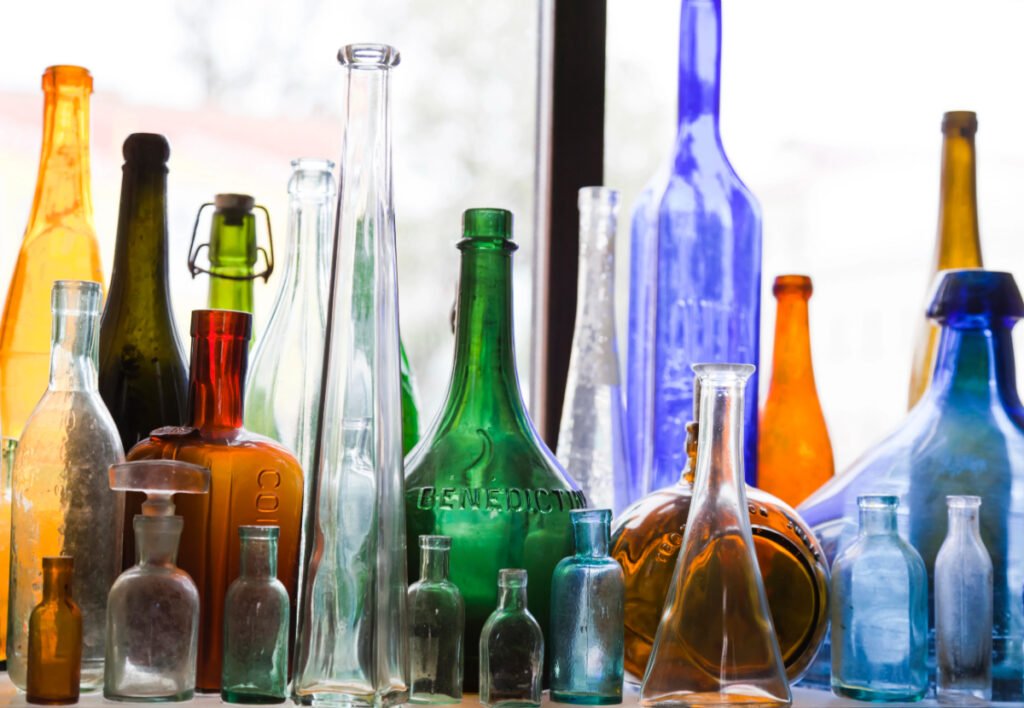
With time, new bottle closure systems and shapes emerged, which are useful signs to date old bottles. Use the table below (dates mostly from the SHA’s guide to bottle closures) to estimate the age of your bottle by its closure.
| Closure Type | Time Period | What It Looks Like |
| Cork top | 1800s to about the 1920s | Plain lip shaped for cork (applied or hand-tooled on older bottles) |
| Crown cap | 1892-present | The crimped metal cap groove |
| Screw top | Common from the 1920s (earlier on jars and flasks) | Threaded finish for screw-on caps |
| Hutchinson stopper | 1879 to the mid-1910s | Internal wire loop closure system |
| Lightning closure | 1875-present | Wire bail with ceramic or rubber stopper |
Embossing, Labels & Maker’s Marks
From the start, different companies have used different ways to mark their bottles. You can identify them by the following types of markings:
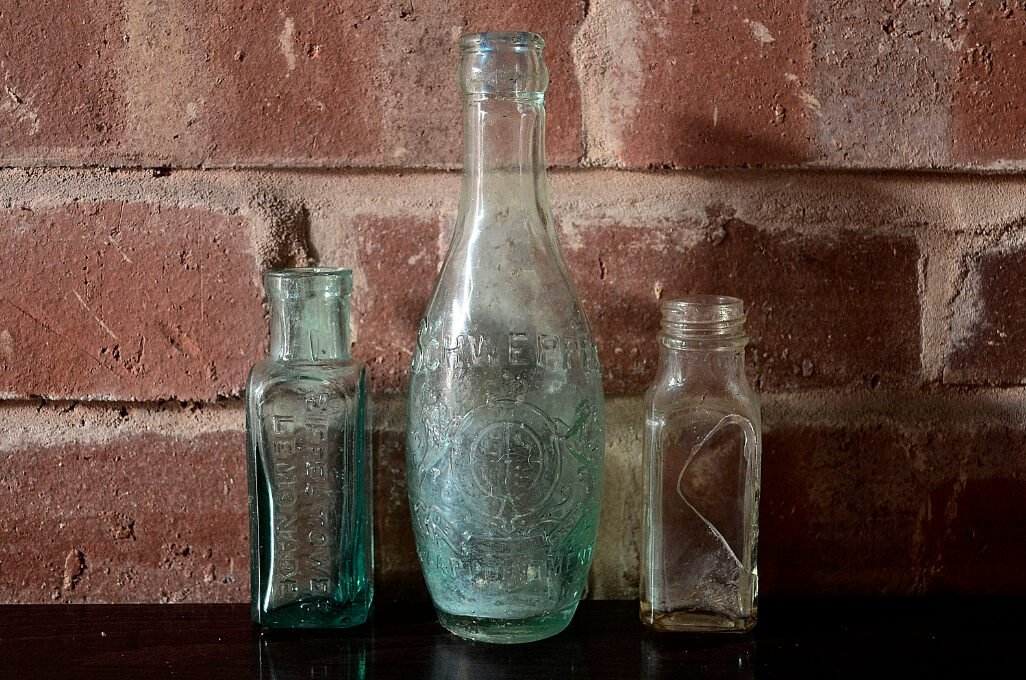
Embossed Text
This is raised lettering or designs molded into the glass bottle. This can tell you about the company name and location, product information, and date codes or patent information.
Original Paper Labels
Many vintage bottles had paper labels glued to them instead of embossing. Finding an intact original label is very difficult today, since they are easily lost over time.
Maker’s Marks
You usually find these marks on the base of old bottles. These can tell you about:
- Maker’s marks – Symbols or initials identifying the glass manufacturer (like Owens-Illinois or Whitall Tatum)
- Mold numbers – Help identify production specifics
- Date codes – Some manufacturers included year codes
You can cross-reference these marks with bottle identification guides, like the Glass Bottle Marks site, to pinpoint the exact maker and production period. Some popular vintage bottle makers to know:
- Owens-Illinois (O-I) – An “I” inside an oval inside a diamond (from 1929 into the late 1950s), later an “I” inside an “O”
- Whitall Tatum – “W.T. & Co.” on many 1800s druggist bottles, later “WT” in a triangle, major medicine and poison bottle maker
- Hazel-Atlas – “H” over “A” symbol, common on food jars and bottles
- Ball Brothers – Made Ball mason jars and commercial bottles, various “Ball” marks
- Anchor Hocking – An anchor over an “H”, used since 1938
- Brockway Glass – “B” in a circle (from the late 1920s or early 1930s), active 1907-1988
Shape and Design Features
The shape or design of an old bottle is another great clue to date it, because certain shapes are directly associated with specific eras and uses. Below are some popular designs:
- Blob tops (1840s-1910s) – Thick, rounded lips on soda and beer bottles.
- Hutchinson bottles – Short neck and sharp shoulder, sealed with an internal wire-spring stopper.
- Figurals – Bottles shaped like people, animals, or objects, including the figural Avon bottles made as cologne decanters.
- Bitters bottles – Often cabin-shaped, barrel-shaped, or had unique, ornate designs.
- Poison bottles – Deliberately made with unusual shapes, ridges, or rough textures so people could identify them by touch in the dark.
How to Tell If an Old Glass Bottle Is Worth Money
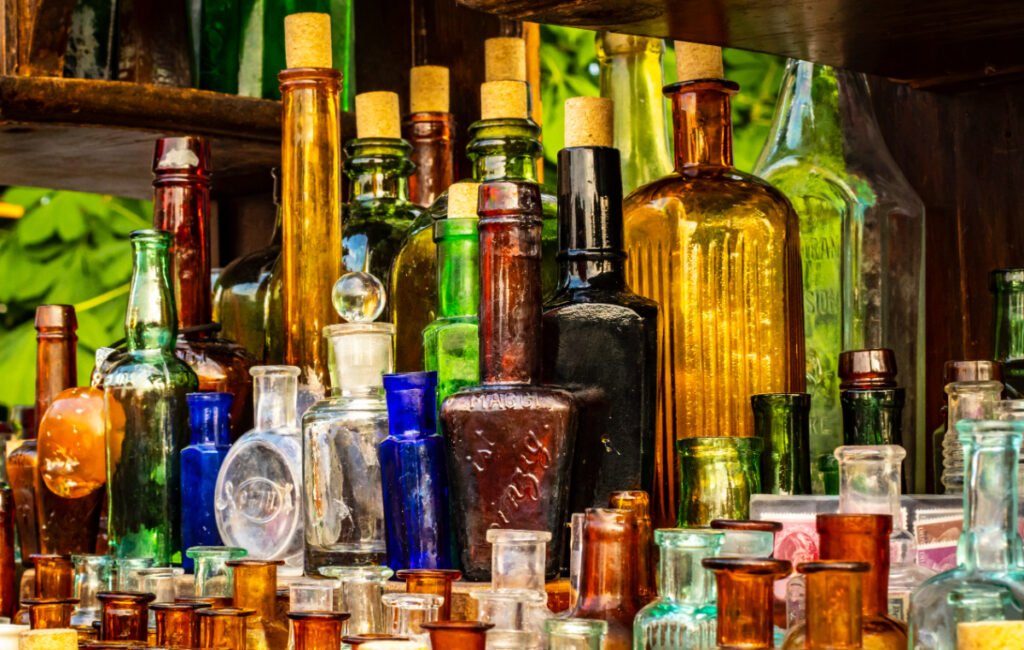
So you’ve identified your bottle; now you might ask, “What’s it actually worth?” The valuation of old glass bottles comes down to a few factors working together.
- Rarity – Rarity is about how many bottles (of a certain type) were made or how many survived. Bottles from small local bottlers, limited production runs, or companies that closed too soon are naturally scarcer.
- Age – Generally, older is better, but not always. A common bottle from the 1700s might be worth less than a rare bottle from the 1920s. Age matters most when combined with other crucial factors.
- Color – Color largely affects the value of a glass bottle. Unusual colors like cobalt blue, purple/amethyst, milk glass, black glass, red, yellow, or other vivid tints are more valuable than common clear, aqua, brown, and green bottles.
- Condition – Even a rare bottle can sell for just a few bucks if it’s damaged. So, check your bottle for cracks, even hairline cracks. Also, look for any chips, especially at the lip or bottom, cloudiness or stains, and serious scratches.
- History – If a bottle is linked to some major historical event, brand, or cultural milestone, it will be more valuable. For example, a prototype bottle for a Coca-Cola bottle or a bottle from a Wild West saloon. Also, documentation, boxes, photographs (if owned by a famous person), and paperwork add value.
- Design & Aesthetics – Bottles with ornate or unusual designs are usually worth more than plain bottles. Figural bottles, fine embossing, and unique shapes are value-boosting features.
- Demand – Like all vintage items, some bottle styles are just more popular than others, namely Bitters bottles, poison bottles, and early soda bottles. You can research current auction results and online sales to get an idea.
7 Vintage Glass Bottles Worth Money (With eBay Prices)
Below are seven vintage bottles, with prices running from $250 to $750 (not all of them sold). Each one has something special, from a rare color to an original label, that lifts it above a common bottle.
1. Vintage Gatorade Glass Bottle (1969, Stokely Van Camp)
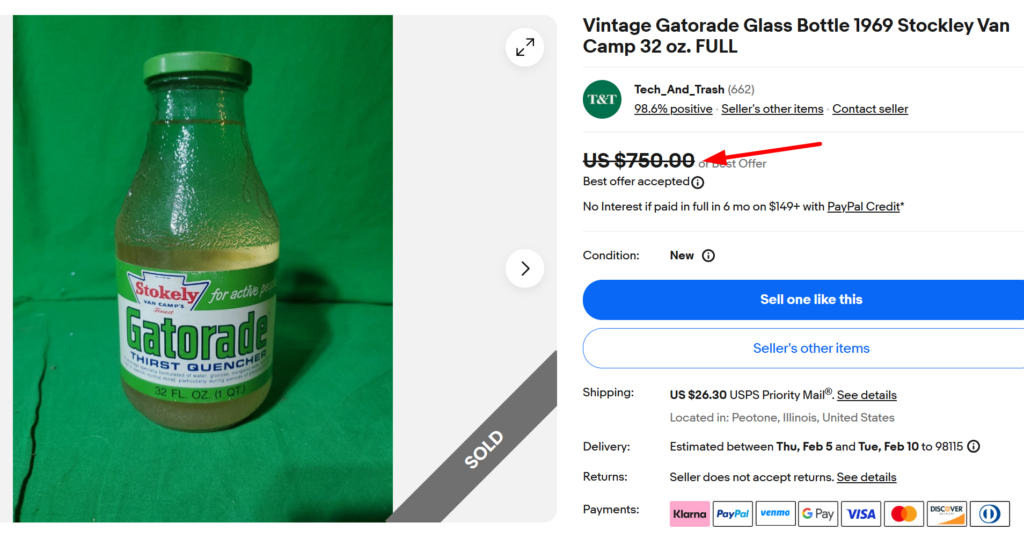
Early Gatorade came in glass bottles, and plastic bottles only arrived in the late 1980s. This 1969 Stokely Van Camp version with original contents and label was an early commercial production. The textured glass, sealed liquid, and intact “Thirst Quencher” label set these bottles apart.
- Estimated Value: $400-$750
- Brand: Gatorade (Stokely Van Camp)
- Production Year: 1969
- Pattern: 32 oz textured glass with original label
2. Dr. Townsend’s Sarsaparilla Green Bottle
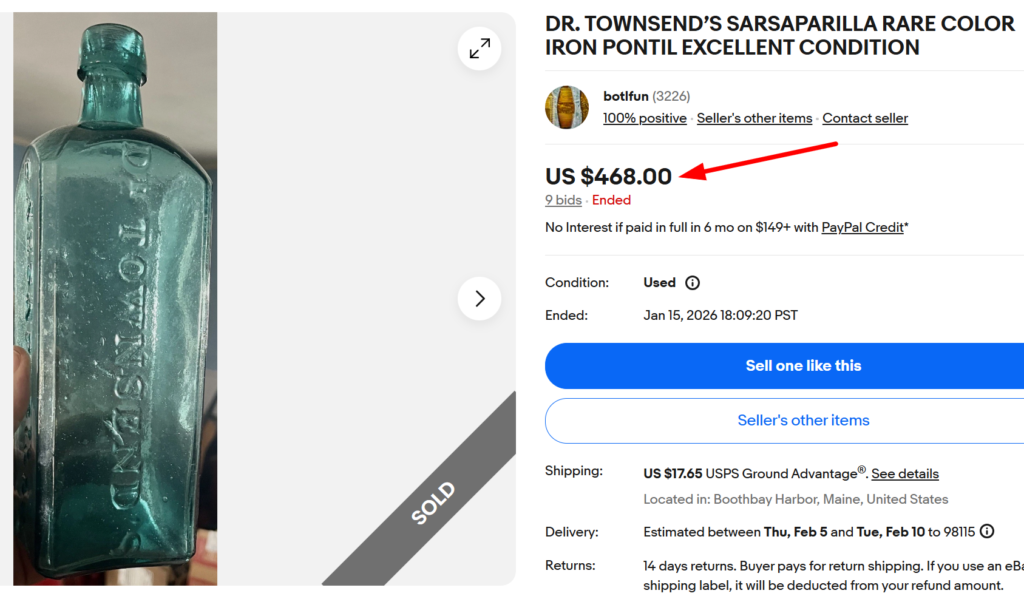
This rectangular bottle with a pontil mark and applied top was made for one of the most famous patent medicine companies of the era.
Dr. Townsend’s was one of the most popular sarsaparillas before the Civil War, according to the SHA’s medicinal bottles page, so its bottles turn up fairly often.
What lifted this one is its unusual teal-green color, which the seller listed as a rare color, and its iron pontil from the 1840s-1850s.
3. Davis Dairy Lockhart Quart Milk Bottle
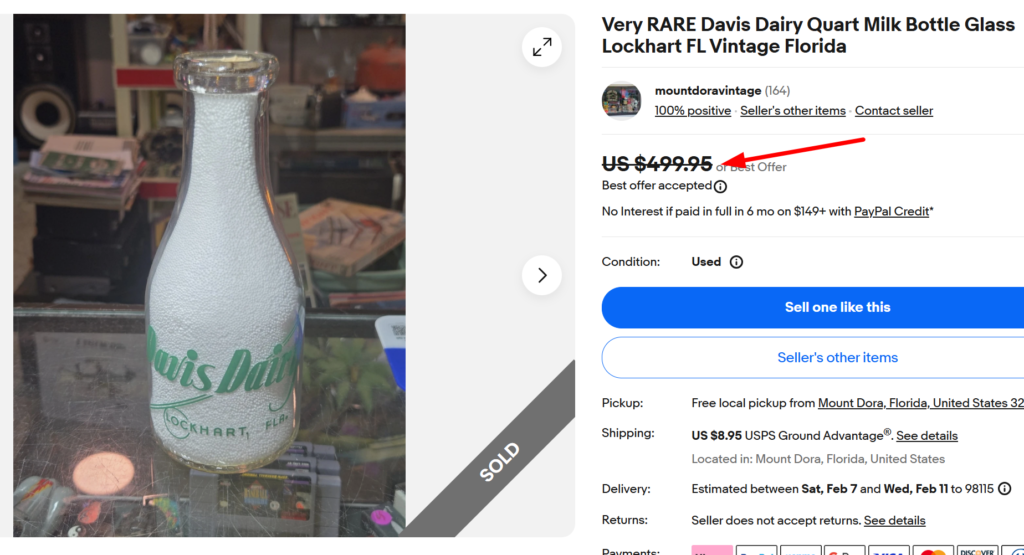
Old quart milk bottles from small local dairies are sought after by collectors. This Davis Dairy bottle from Lockhart, Florida, has green painted lettering, called an applied color label (ACL), which dairies used from the 1930s onward. The regional appeal makes such old milk bottles collectible.
- Estimated Value: $200-$400+
- Brand: Davis Dairy
- Production Year: 1940s-1950s
- Pattern: Quart milk bottle with green painted (ACL) lettering
4. Bols Ballerina Music Box Bottle
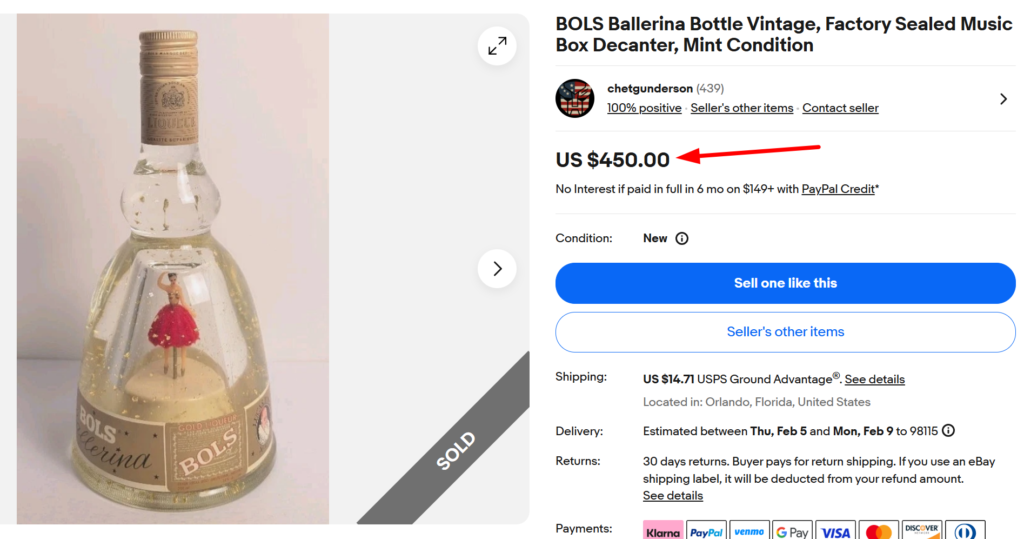
This Dutch liqueur bottle comes with a tiny ballerina that works as a wind-up music box. Bols made these bottles from the late 1950s into the 1970s, and many were kept as decorations.
Factory-sealed examples like this, especially with working music mechanisms and unfaded ballerinas, are worth the most.
- Estimated Value: $60-$450
- Brand: Bols
- Production Year: Late 1950s-1970s
- Pattern: Ballerina figural music box decanter
5. Straight-Sided Coca-Cola Bottle (Hamlet, NC)
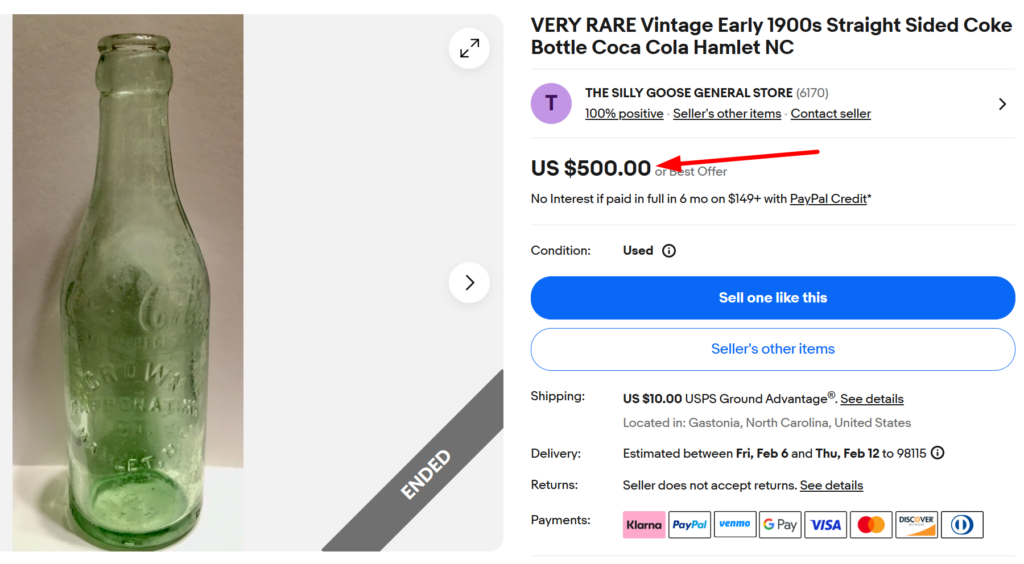
Before the famous 1915 contour bottle, Coca-Cola used straight-sided bottles embossed with bottler locations. This early-1900s example from Hamlet, North Carolina, shows a crown cap closure and raised “Coca-Cola” script.
Bottles from small-town bottlers are often harder to find than big-city ones, which is why collectors look for them.
- Estimated Value: $100-$400
- Brand: Coca-Cola (Hamlet, NC bottler)
- Production Year: Early 1900s (pre-1915)
- Pattern: Straight-sided with crown top
6. Signed R Lalique French Glass Perfume Bottle
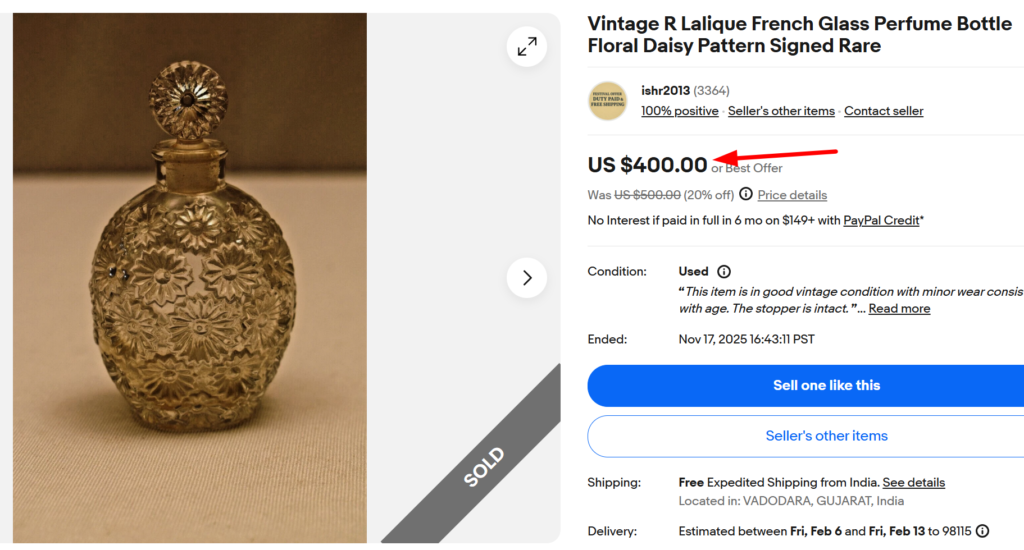
René Lalique perfume bottles from the 1920s-1930s are highly collectible, and rare models can sell for far more than this one. This signed bottle has daisy/floral relief molded into the glass with an ornate stopper.
Lalique produced such bottles for specific perfume companies for limited periods, making them rare. Check the signature closely: as our guide to valuable antique perfume bottles explains, “R. Lalique” marks belong to pieces made before 1945 and “Lalique France” to later ones.
- Estimated Value: $300-$1,000+ (top prices for rarer ones)
- Brand: R. Lalique (René Lalique)
- Production Year: 1920s-1930s
- Pattern: Floral/Daisy relief with ornate stopper
7. J.J. Melchers Cosmopoliet Schiedam Gin Bottle
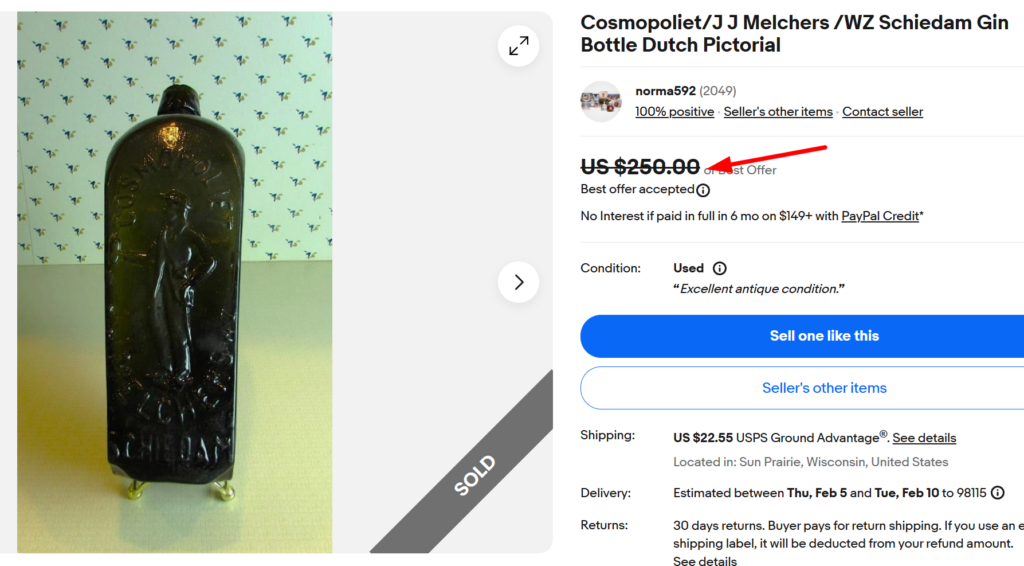
These dark olive-black Dutch gin bottles were made for J.J. Melchers, a gin distiller in Schiedam, in the traditional square-case gin shape. The embossing shows a man in a hat and the brand name Cosmopoliet.
Finding one of these old bottles, usually dated to the late 1800s or early 1900s, in good condition today can be a big deal.
- Estimated Value: $200-$300
- Brand: J.J. Melchers
- Production Year: Late 1800s-early 1900s
- Pattern: Square case gin with pictorial embossing
If you’re exploring flea markets or digging through your own attic, knowing what to look for can save you from passing on a valuable old bottle. For other kinds of old glass, browse our guides to old glass by type and maker. Save this guide before you begin your hunt.
Found this guide useful?
Save it for later
Share it with someone
Keep the old finds coming
New guides and finds worth looking for, delivered to your inbox.
Keep exploring
More guides in Vintage Glass
 10 finds10 Valuable Old Coke Bottles Worth Money (ID Guide & Price List)
 13 finds13 Old Glass Bowls Worth Money: Top Makers, Patterns & ValueTop sale $797
 11 findsOld Libbey Glassware: How to Spot Rare Vintage PiecesTop sale $595
 12 findsCollectible Red Glass: 12 Rare Vintage Pieces to Look For TodayTop sale $550