

Most of us remember seeing Pyrex in our mothers’ or grandmothers’ kitchens, like those turquoise mixing bowls or avocado-green casseroles. Most of those everyday pieces sell for modest prices today, but a few vintage Pyrex patterns are worth serious money.
Vintage Pyrex dishes have become highly sought after by collectors. The five rare pieces in this guide run from a $1,125 Atomic Starburst casserole to a $4,500.00 Pink Duchess casserole with its cradle.
This guide shows how to identify and value vintage Pyrex by its backstamp, model number, glass, and pattern.
A Short History of Pyrex, From 1915 to 1998
Back in 1915, Corning Glass Works developed a heat-resistant glass for laboratory beakers. Some engineers at the company figured out this borosilicate glass would be perfect for home cooking, too, and that’s how Pyrex got started.
The first Pyrex pieces were clear and practical. This continued for thirty years until 1945, when Corning introduced their Primary Color series. These bright red, yellow, blue, and green mixing bowls completely changed American kitchens.
The 1950s and 1960s brought the patterns collectors love most, like snowflakes on turquoise casseroles, farm scenes on mixing bowls, and pink daisies on refrigerator dishes.
In 1998, Corning sold its consumer products business, Pyrex included, to Borden (later World Kitchen) and licensed it the Pyrex name. By then Corning had already moved most clear Pyrex from the original borosilicate glass to tempered soda-lime glass. Collectors usually treat the 1998 sale as the end of the vintage Corning era.
Identifying Vintage Pyrex Dishes: Key Signs
Authenticating vintage Pyrex is easy once you know the key signs to look for. The backstamp and model numbers, combined with patterns and glass type, provide you with the most reliable information about age and authenticity.
The quick check: vintage Pyrex usually has PYREX in capital letters on the base, often with the Corning name, and the colored or patterned pieces are milky white opal glass, white on the inside.
Pyrex Backstamps by Decade
The backstamp on the bottom of your Pyrex tells you when and where it was made. Nearly every genuine piece has an embossed marking. These stamps changed over the decades, serving as a clue to age.
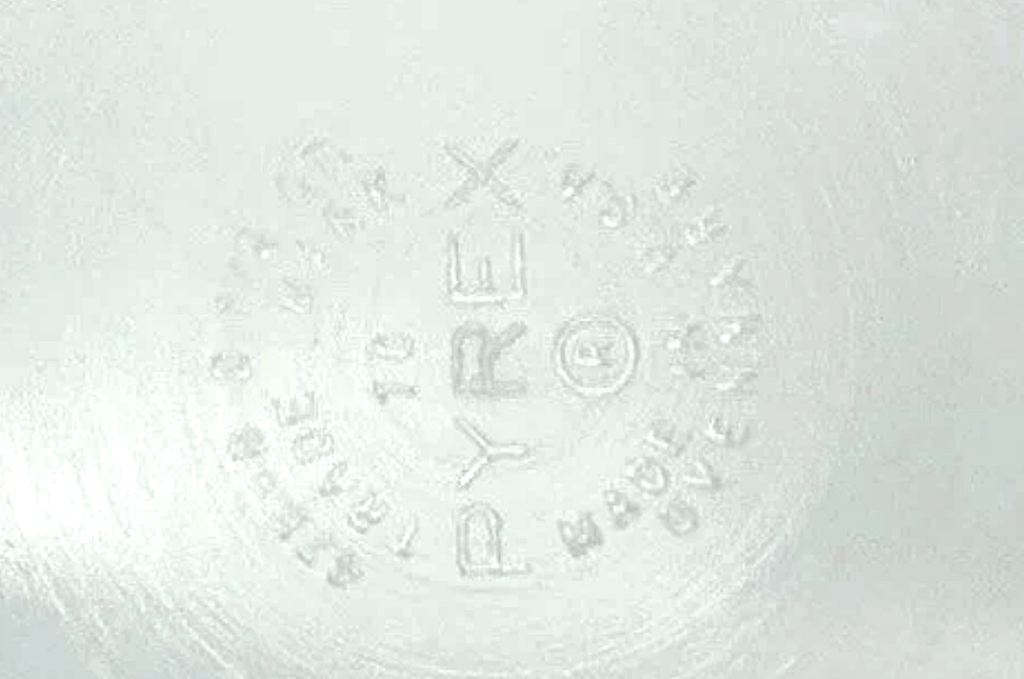
1940s to Early 1950s:
- “PYREX” in capital letters inside a circular stamp
- Older clear pieces may also carry Corning’s “CG” monogram above and below PYREX
- Some Corning opal pieces from before 1945 show a small figure blowing glass, a mark carried over from Macbeth-Evans
- Simple circle format with minimal additional text
1950s:
- Circular stamp with “MADE IN U.S.A.” added
- The registered trademark symbol ® appears below PYREX
- “TRADE MARK” text may be included
1960s:
- From the late 1960s, refrigerator dishes switched from a circular to a straight-line stamp
- “PYREX” in block capital letters
- Model number and capacity clearly marked
- “MADE IN U.S.A.” in straight text
1970s to 1980s:
- Usage instructions added, like “NO BROILER OR STOVETOP”
- Metric measurements appear alongside pints and quarts
- Some pieces include “by CORNING, Corning, NY, USA.”
- More detailed safety information on certain items
Pyrex Model Numbers and What They Mean
The numbers stamped on Pyrex pieces identify the type and size. Understanding this numbering system helps you date pieces and identify specific items.
Here are some of the most common series numbers:
- 400 Series (Mixing Bowls) – 401, 402, 403, 404
- 440 Series (Cinderella Bowls) – 441, 442, 443, 444
- 470 Series (Round Casseroles) – 471, 472, 473, 474
- 500 Series (Refrigerator Dishes) – 501, 502, 503
How to Read the Numbers?
- Numbers starting with “0” can be ignored (such as 0401 or 0502)
- The last digit often points to the size within a series. Check the capacity marked on the base too: the 475 casserole in item 2 below, for example, holds 2.5 quarts.
- Lids match their base number but add “-C” or “-CU” at the end. For example, a 502 dish will have a lid marked 502-C or 502-CU
- Sometimes bowls are marked with “-B” and lids with “-C.”
Note: Some promotional items and early pieces use different numbering systems. This is normal and adds to the challenge of identification.
The Glass Type: Clear Borosilicate vs Opal Ware
The glass itself helps you date Pyrex, but clear pieces and colored pieces were made from two different kinds of glass:
Early clear Pyrex used borosilicate glass, starting in 1915. This glass is completely clear, with no color tint, when viewed along the edge or side of the piece. And it’s heavy.
The colored and patterned pieces collectors chase are a different glass: opal glass (opal ware), a milky white glass Corning used from the Primary Colors bowls of 1945 onward. This glass also has a substantial weight.
Clear Pyrex sold in the US today is mainly tempered soda-lime glass, and many later Corning-era clear pieces are too. This glass has a noticeable bluish-green tint, especially visible along the edges. Place a modern piece next to a vintage one, and the color difference is noticeable.
Don’t mix up Pyrex with CorningWare, Corning’s white Pyroceram cookware: it has its own marks and its own list of rare patterns.
Vintage Pyrex Patterns and Colors by Year
The colors and patterns on Pyrex changed with each decade. This makes dating pieces relatively simple once you learn the timeline.
1945 to 1950:
Primary colors dominated this period. Bold reds, bright yellows, sky blues, and grass greens were standard. These solid-color mixing bowls launched the colored Pyrex line.
1950s:
Pastels became popular during this decade. Soft pinks, turquoise, and pale yellows appeared. The first printed patterns also emerged, including Pink Daisy and Snowflake. These patterns marked a major shift toward decorative kitchenware.
1960s:
This decade saw warmer tones and bolder designs. Town and Country (1963 to 1967) paired solid brown, orange, and yellow pieces with white dishes decorated in brown, such as a starburst or a stylized snowflake, as the Corning Museum of Glass describes it. Earth tones started appearing alongside brighter colors.
1970s to 1980s:
Harvest gold became ubiquitous. Avocado green appeared in countless kitchens. Brown tones ranged from caramel to chocolate. Popular patterns from this era include Butterfly Gold and Spring Blossom Green. Both also appeared on matching Corelle dinnerware.
If you find pieces with primary colors or pink and turquoise patterns, you likely have items from the most collectible period of the 1950s and early 1960s.
20 Most Valuable Vintage Pyrex Patterns and Their Values
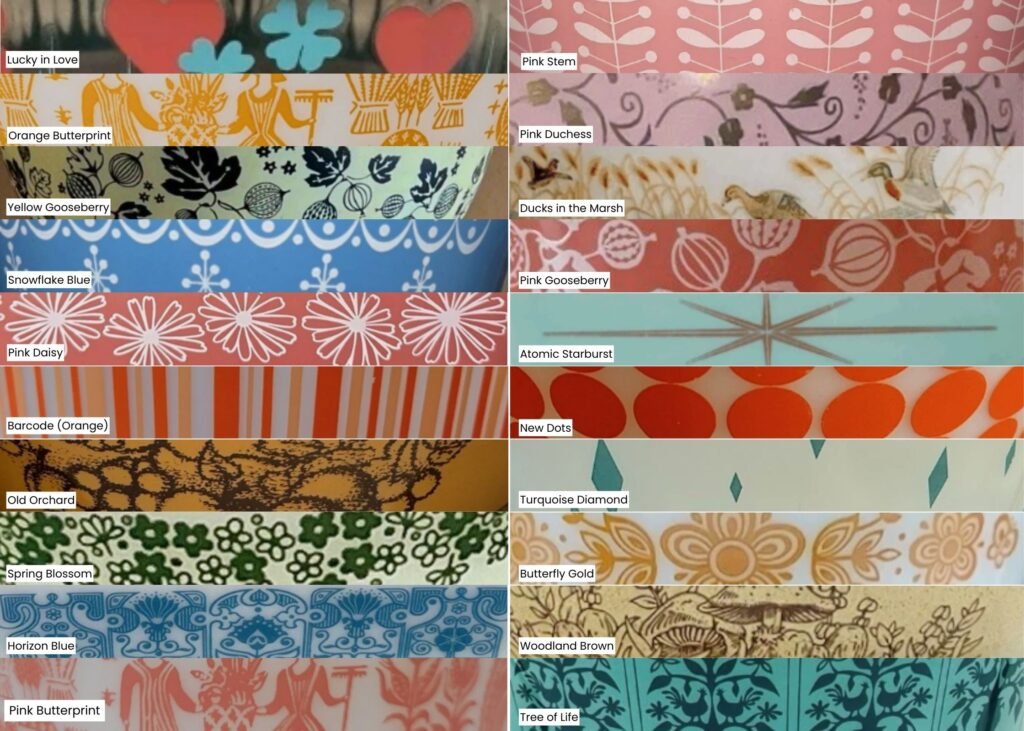
Below are 20 popular and valuable Pyrex patterns, along with their estimated value ranges. The same ranges are listed in the table under the chart.
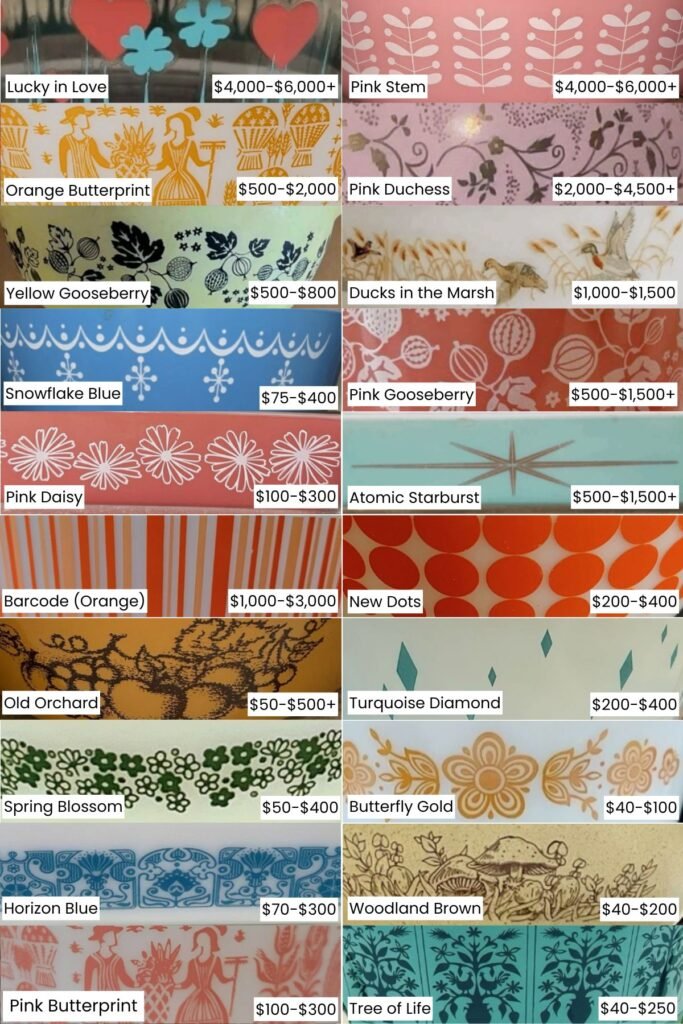
| Pattern | Estimated value (from the chart) |
| Lucky in Love | $4,000–$6,000+ |
| Pink Stem | $4,000–$6,000+ |
| Pink Duchess | $2,000–$4,500+ |
| Barcode (Orange) | $1,000–$3,000 |
| Orange Butterprint | $500–$2,000 |
| Ducks in the Marsh | $1,000–$1,500 |
| Pink Gooseberry | $500–$1,500+ |
| Atomic Starburst | $500–$1,500+ |
| Yellow Gooseberry | $500–$800 |
| Old Orchard | $50–$500+ |
| Snowflake Blue | $75–$400 |
| New Dots | $200–$400 |
| Turquoise Diamond | $200–$400 |
| Spring Blossom | $50–$400 |
| Pink Daisy | $100–$300 |
| Pink Butterprint | $100–$300 |
| Horizon Blue | $70–$300 |
| Tree of Life | $40–$250 |
| Woodland Brown | $40–$200 |
| Butterfly Gold | $40–$100 |
What Determines the Value of Old Pyrex Dishes?
In general, several factors influence the value of vintage Pyrex. A plain bowl might cost $5 at a thrift store, while a bowl of the same shape in a rare pattern can bring hundreds of dollars. The difference comes down to specific characteristics.
Rarity and Production History
The scarcest Pyrex patterns command the highest prices. For example, the Corning Museum of Glass dates “Lucky in Love” to 1959 and calls it most likely a test piece or a limited release, printed on the one-quart round casserole. It is one of the hardest Pyrex designs to find, and the museum notes online sales of over $4,000.
What Makes Pyrex Rare?
- Short Production Runs: Patterns manufactured for only one or two years are harder to find. The Blue Stripe (Barcode) pattern was produced for just one year in 1966.
- Limited Distribution Channels: Some patterns were offered through S&H Green Stamps or other trading programs, collectors say. Orange Butterprint on white was released as a promotional set in the late 1950s and early 1960s. Collectors consider it much rarer than the standard turquoise version sold in stores.
- Employee Gifts: Corning is said to have given some pieces to employees as gifts, and these never reached retail stores. The rare gold-on-beige Gooseberry may be one of them: the Corning Museum of Glass says it is unclear whether it was a promotional item, a market test, or an employee appreciation item.
- Test Patterns: Some pieces were prototypes that never went into full production. These test pieces sometimes ended up in employee homes.
- Third-Party Promotional Items: Corning made special pieces as hostess gifts for home-party companies such as Stanley Home Products (Pink Duchess is one example) and, collectors say, Dainty Maid. These were not sold in regular stores, which is part of why they are hard to find today.
Pattern Popularity and Demand
Rarity alone does not determine value. Collector interest plays an equally important role. Some rare patterns generate little interest, while certain common patterns sell for premium prices because everyone wants them.
Some of the highly sought patterns are: Pink Gooseberry, Turquoise Butterprint, Snowflake Blue, and Atomic Eyes/Starburst. These patterns are favorites with buyers, so even common pieces in them tend to sell well.
Condition
The condition is critical because a Pyrex piece in excellent condition can be worth several times more than the same pattern with damage.
Below are the main value reducers:
- Dishwasher Damage: Repeated dishwasher use fades colors and removes the glossy finish from Pyrex. Even minor fading cuts the value sharply.
- Chips and Cracks: A chipped rim takes away most of the value. Cracks are worse. Even hairline cracks make pieces nearly worthless to collectors.
- Surface Scratches: Minor scratches from normal use are acceptable on common patterns. Deep scratches that damage the design reduce value significantly. For rare patterns like Lucky in Love or Orange Butterprint, collectors expect near-perfect condition.
Completeness and Original Sets
Complete Pyrex sets usually sell for more than individual pieces. A full set of four Cinderella mixing bowls in excellent condition brings a higher total price than selling each bowl separately.
Besides, original lids add substantial value. A casserole with its matching lid sells for clearly more than the same dish without one: Hunker puts a common Blue Stripe casserole at about $70 to $100 with its lid and $45 to $50 without. Generic replacement lids don’t count: it must be the original lid.
Original packaging is also rare. Most buyers discarded boxes and instructions after purchase. So, when you find a piece still in its original box with paperwork, it adds noticeably to its value.
5 Valuable Vintage Pyrex Dishes Sold on eBay
1. Pink Duchess Pyrex Casserole with Cradle
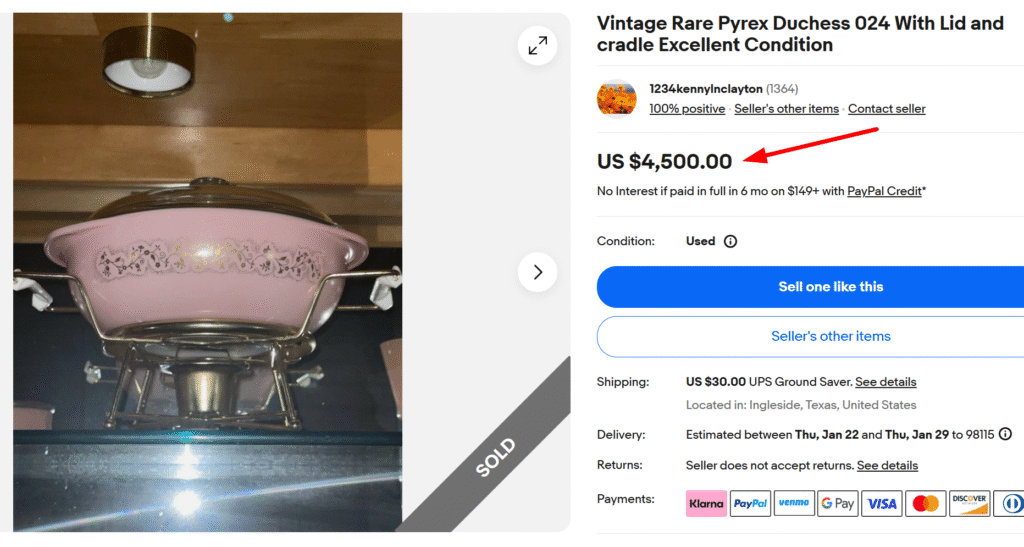
The “Pink Duchess” pattern is extremely rare and was never widely distributed. A complete set of a lidded casserole with the original cradle can be valuable, and more so with the box.
2. Orange Barcode Stripe Pyrex Dish
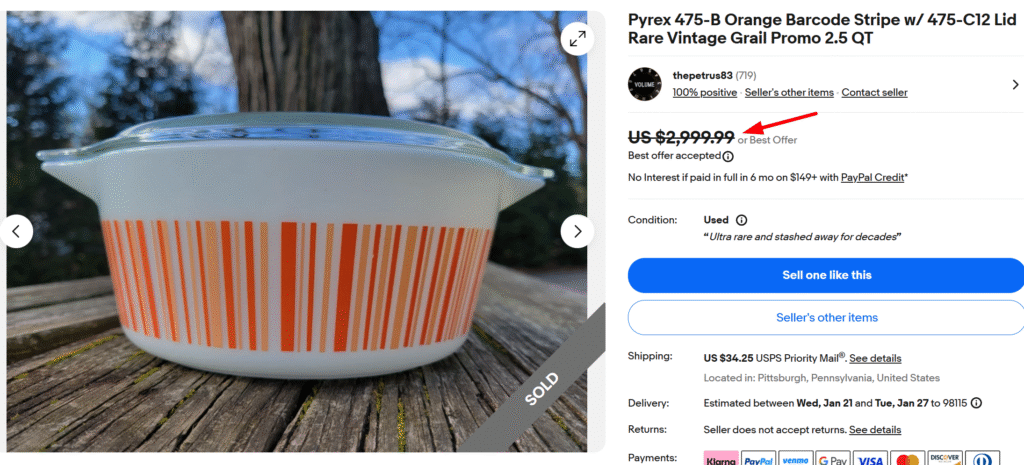
The Orange Barcode pattern is a rare color variation of the Blue Stripe design. Collectors usually describe it as a promotional or test colorway of the 1966 design that never reached regular production. Finding a complete casserole set with a matching lid is valuable.
3. Pyrex Delphite Bluebell (401-404) Mixing Bowl Set
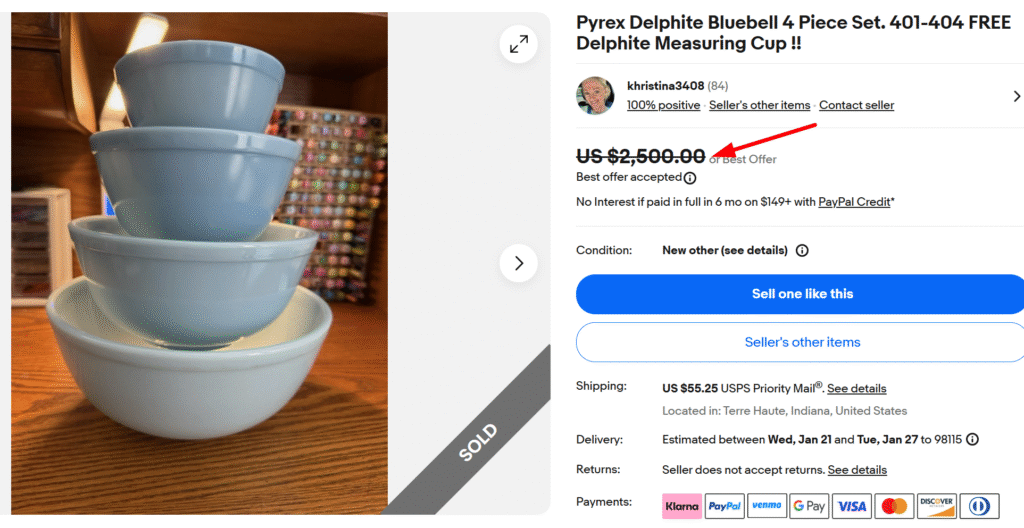
Collectors usually describe Delphite Bluebell as a pattern made for the Canadian market, which is why it is rare to find in the USA. The nesting mixing bowl set (401-404) in this pattern and color is particularly rare.
4. Orange Butterprint Cinderella Bowls
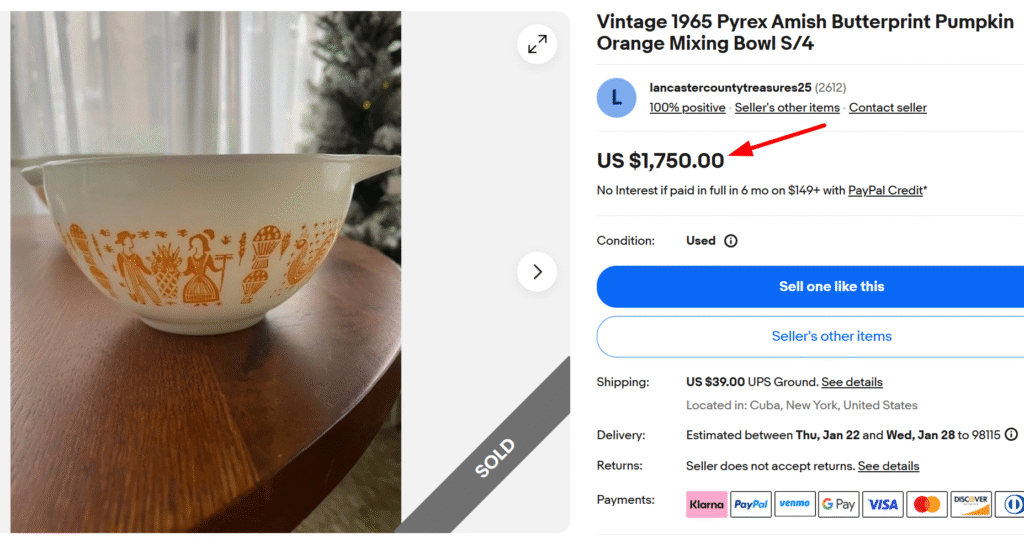
Orange Butterprint was a promotional set rather than part of the regular line, and collectors often say it was offered through S&H Green Stamps. The farm scene pattern in orange on white is much rarer than the standard turquoise version. A complete Cinderella bowl set is extremely hard to find.
5. Atomic Eye/Starburst Casserole Dish with Cradle
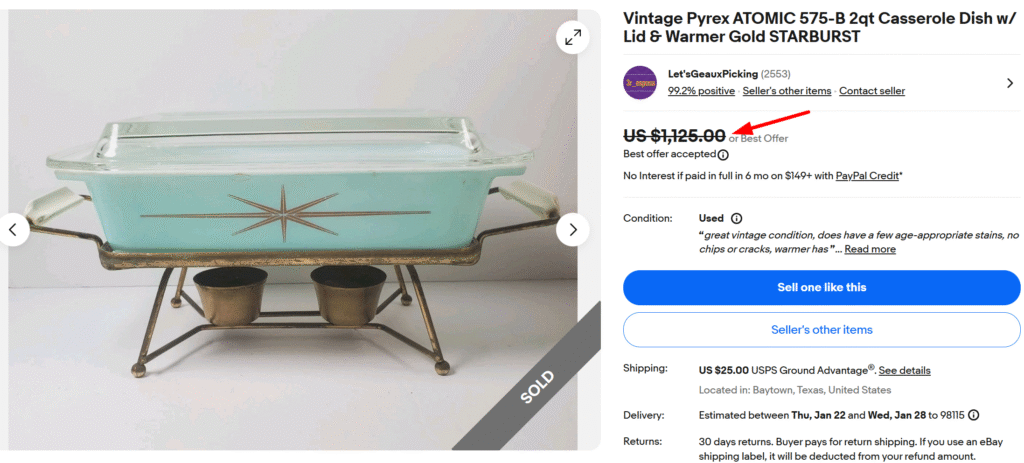
The Atomic Eyes pattern in turquoise features the unique mid-century golden starburst design. This 2-quart casserole includes both the original lid and the metal warming cradle stand. Complete sets, with all three components, are rare and valuable.
How to Price and Sell Vintage Pyrex
To price your own Pyrex piece, search eBay’s sold listings for the pattern and model number, since asking prices run high and best-offer sales hide the final price. eBay, Etsy, and Pyrex collector groups on Facebook are the usual places to sell rare patterns; common patterns also sell well at local antique malls.
Found this guide useful?
Save it for later
Share it with someone
Keep the old finds coming
New guides and finds worth looking for, delivered to your inbox.
Keep exploring
More guides in Vintage Glass
 13 finds13 Old Glass Bowls Worth Money: Top Makers, Patterns & ValueTop sale $797
 11 findsOld Libbey Glassware: How to Spot Rare Vintage PiecesTop sale $595
 12 findsCollectible Red Glass: 12 Rare Vintage Pieces to Look For TodayTop sale $550
 9 finds9 Types of Vintage Tea Cups That Are Highly Collectible TodayTop sale $289