
Most Royal Doulton figurines you’ll see at an estate sale sell for under $30. But every so often, one rare piece comes to fetch $500, $2,000, or more at auction. It’s hard to tell the two apart if you don’t know the signs that determine their values.
From the HN number, the backstamp era, and the designer signs, this guide walks through simple steps to identify Royal Doulton figurines and discover the most valuable pieces ever made.
History of Royal Doulton Figurines
Royal Doulton started in 1815 as a stoneware factory in Lambeth, London. It then introduced bone china figurines in 1913 with the “Darling” figurine, which was designed by Charles Vyse and given the number HN1.
This started the HN series, which got its name from Harry Nixon, who led the painting department from 1900 on. Between the 1930s and 1990s, the Royal Doulton figurine catalog grew huge because of talented designers like Leslie Harradine, Peggy Davies, and Charles Noke.
In 1969, when Royal Doulton acquired Beswick, the catalog gained Beatrix Potter and Bunnykins figurines, too.
The Burslem factory in Stoke-on-Trent finally closed in 2005, and production moved overseas. That’s why the date matters. Pieces made in England before the closure carry the highest collector interest and value.
How to Identify a Genuine Royal Doulton Figurine?
The base of every authentic Royal Doulton figurine carries most of the answers. You’ll find a backstamp, an HN or DB number, the piece name, and, often, a designer’s signature or the painter’s initials.
Once you know what each mark looks like across eras, dating the figurine becomes a lot easier.
Reading the Backstamp
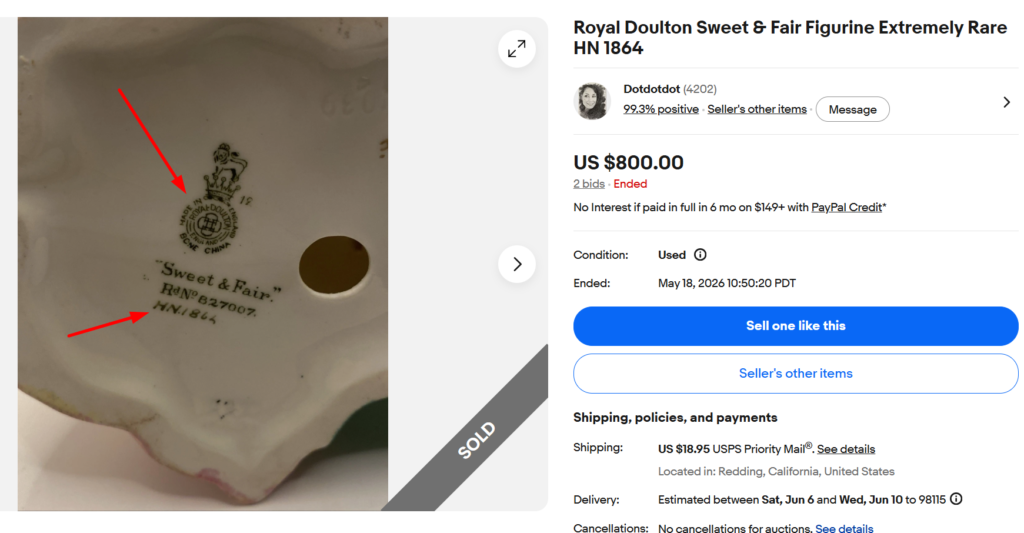
The standard Royal Doulton mark usually has a lion sitting on top of a crown, with the words “Royal Doulton” written below it. That mark has changed in small but useful ways over the years.
The earliest 20th-century figurines use a hand-painted green stamp where the letters look slightly uneven. From 1932 onward, the printed green or black backstamp became the norm, often with “Made in England” added underneath.
Run your finger across the backstamp. On pre-1970 pieces, you can feel the printed ink sitting slightly proud of the porcelain. In the 1970s and later, the marks look cleaner and are level with the glaze.
Also, if the words “Royal Doulton” are inside a circle around the crown, then it’s from the 1970s or later.
Handy Tip: If the mark says “Doulton & Co Limited” then the piece was made before 1973. After that year, the company name was shortened on backstamps.
Understanding HN Numbers
Every Royal Doulton figurine produced since 1913 has an HN number printed or impressed on the base. The HN code identifies the model and the colorway.
The original colorway is usually the lowest HN number in the family. Variants in different colors get their own HN numbers. For example, HN1834 (red dress) and HN1833 (green and blue dress) are for the same Top o’ the Hill model.
Bunnykins figurines use DB numbers instead, starting in 1972, short for Doulton Bunnykins, and run from DB1 onward. Brambly Hedge uses DBH numbers from 1983.
To find your figurine’s full production dates, search the HN or DB number on specialist databases like the Royal Doulton Collectors Club archive or the Company’s catalog. HN/DB/DBH numbers combined with the backstamp era can help narrow production to a single decade.
Artist Signatures and Designer Marks
When you look at most Royal Doulton figurines made from the 1920s to the 1990s, they’ll have the designer’s name on the bottom.
Look for “L. Harradine” (Leslie Harradine, who designed over 100 figures), “M. Davies” or “P. Davies” (Peggy Davies, designer of the Pretty Ladies range), “C.J. Noke” (Charles Noke, art director from 1936 to 1953), and “E.J. Griffiths” (Eric Griffiths, designer of the Princess of Wales pieces).
Pieces signed by Michael Doulton, the great-great-grandson of the founder, were typically signed at in-store events. These pieces command a premium because the signature ties the figure to a specific date and event.
Dating Your Royal Doulton Figurine
Once you’ve tracked all three signs, combine them to date the figurine accurately.
First, the backstamp era gives you a range of about 20 years. Second, the HN number tells you the latest possible production year. Third, the painter’s monogram, two initials in script most often on the base, can sometimes further narrow it when cross-referenced with painter records.
If the backstamp reads “Bone China” and not just “Royal Doulton,” then your piece is likely post-1970. If you see “Handmade and hand-decorated in England,” you are usually looking at the 1970’s to 2005 production.
What Makes a Royal Doulton Figurine Valuable?
If you’re thinking age alone drives the price, it does not. A 1990s limited edition can outsell a 1940s mass production piece by ten times. That’s because apart from age, the following six factors decide a Royal Doulton figurine’s worth.
- Rarity – Short production runs, prototypes, limited editions, and specific colorways are the biggest single driver. A piece made for one year sells for far more than one made for forty.
- Condition – Chips on fingers, hat brims, parasols, and balloons are extremely common and slash value by 60 to 80 percent. Even hairline cracks visible under a strong light affect the price.
- Withdrawn Status – A retired model becomes finite, and prices rise once its availability dries up in the secondary market.
- Designer – Pieces by Charles Noke, Leslie Harradine, and Peggy Davies attract steadier collector demand than pieces by less famous designers.
- Original box and Certificate – For limited editions, especially, the original box adds 30 to 50 percent to the sale price. The certificate of authenticity adds more.
- Color Variation or Factory Error – Off-color glazes, prototype paint schemes, and pieces that escaped quality control as factory seconds can be the rarest of all.
Most Royal Doulton lady figurines from the 1960s to the 1990s are worth $30-$100 today. Common Bunnykins pieces usually go for $25 to $75. Pretty Ladies series figurines from late production years often go for under $50.
Then, there are rare pieces. Limited editions in original boxes usually start at $200 and can easily exceed $600. Prototype and factory errors can fetch over $40,000. For example, the prototype tableau “Celebration Time” sold for a whopping £35,500 (around $47,686) on Potteries Auctions in 2024.
13 Rare and Valuable Royal Doulton Figurines
From the classic lady figurines and character figures to royal limited editions and Bunnykins pieces, below are the most valuable and collectible Royal Figurines with their current values.
1. Guy Fawkes Figurine (HN98)

Sold for $1,500
Guy Fawkes is one of Royal Doulton’s earliest character figures. It’s 10.25 inches tall, wearing a long red cape, a tall black hat, and carrying a lantern. The design is linked forever to the 1605 Gunpowder Plot.
Charles J. Noke created him in 1918, and they made the piece until 1949. Later, smaller versions came out in 1989, HN3271, and HN4784; the early HN98 commands much higher prices today.
- Estimated Value: $800 to $2,000
- Production Years: 1918 to 1949 (HN98)
- What to Check: Lantern detail, cape paint, hat finial
- Quick Notes: Early “Potted by Doulton” stamp confirms age
2. Sweet and Twenty Figurine (HN1649)
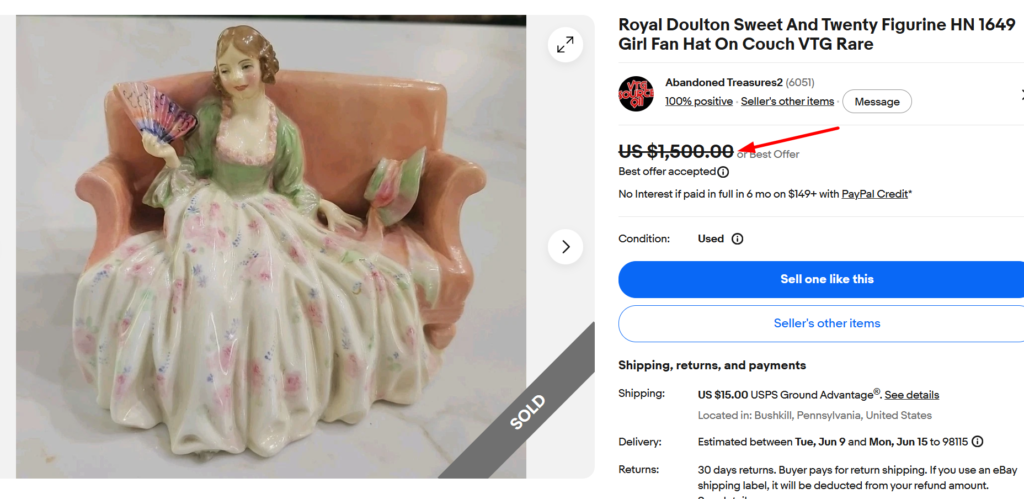
Sold for $1,500
The Sweet and Twenty figurine shows a young woman seated on a small sofa holding an open fan. It has multiple HN colorways, all designed by Leslie Harradine.
The figure’s name comes from a song in Shakespeare’s Twelfth Night. HN1649 ran for only three years, from 1934 to 1936, making it the rarest of the Sweet and Twenty family. The HN1298 version, by contrast, was made from 1928 to 1969 and is more common.
- Estimated Value: $700 to $1,800
- Production Years: 1934 to 1936 (HN1649)
- What to Check: HN number, fan paint, couch color
- Quick Notes: Rarer than other Sweet and Twenty colorways.
3. Yeomen of the Guard Figurine (HN2122)
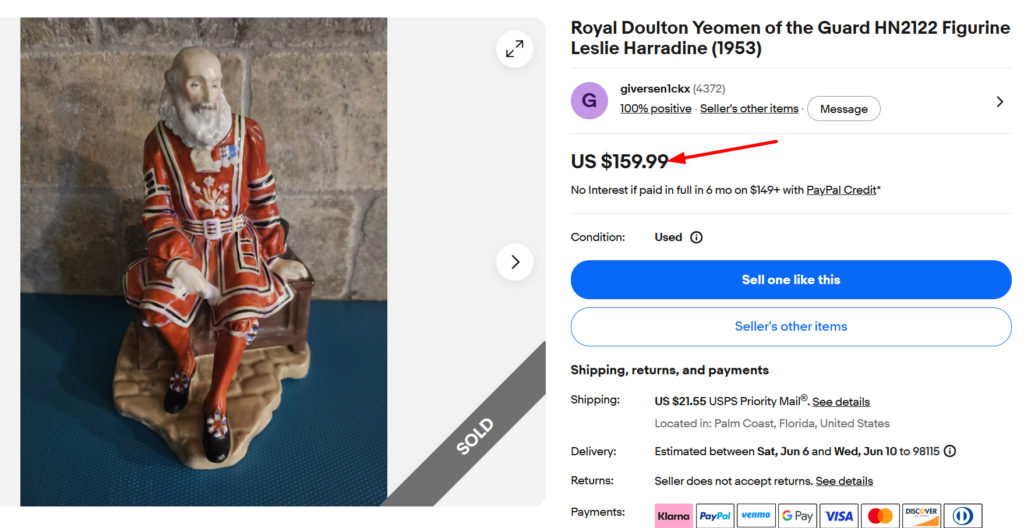
Sold for $160
Yeoman of the Guard features a seated Beefeater, a Tower of London warder modeled by Leslie Harradine in 1953. It was produced from 1954 to 1959—five years only, which makes it rarer than many other Royal Doulton pieces.
The figure is 5.75 inches tall, wearing a red and gold Tudor uniform with black trim, and sits on a textured tan base. Originally, it was meant to be a pair with A Chelsea Pensioner HN689.
- Estimated Value: $100 to $275
- Production Years: 1954 to 1959 (HN2122)
- What to Check: Uniform trim, base color, halberd presence
- Quick Notes: Short 5-year run boosts collector value
4. Diana Princess Limited Edition Figurine (HN5066)
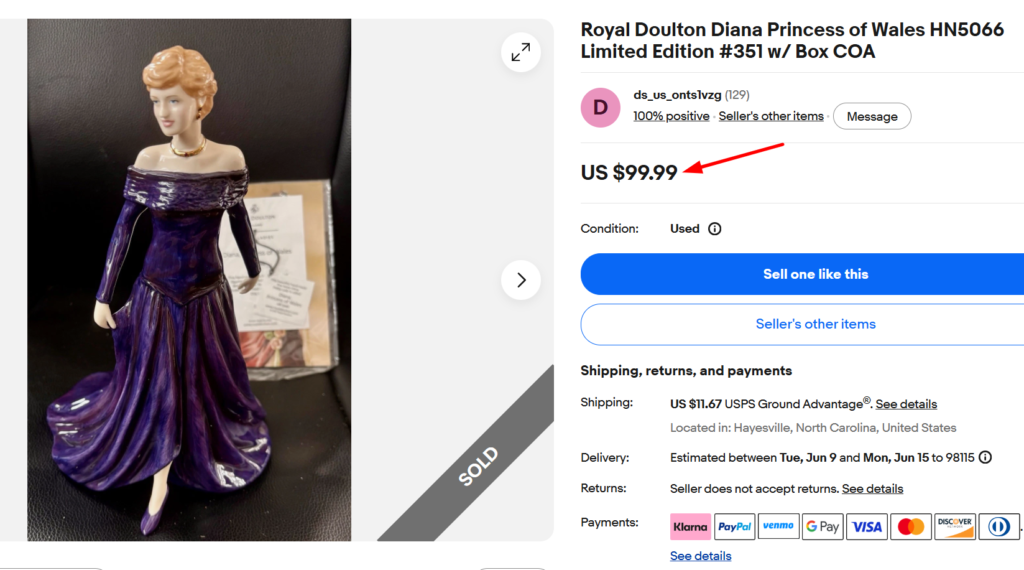
Sold for $100
This is the second HN figurine of Diana. Tim Potts modeled her in 2007 for the 10th anniversary of her death, in an edition of 10,000. She stands 9 inches tall in the off-shoulder purple crushed velvet gown Bruce Oldfield designed for her 1987 visit to Portugal.
The piece was made in Thailand after Burslem closed, so it lacks the English production premium of the earlier HN2887 wedding figurine.
- Estimated Value: $80 to $200
- Production Year: 2007 (edition of 10,000)
- What to Check: Edition number, certificate, gown color
- Quick Notes: Thailand-made, COA, and box add value.
5. Autumn Breezes
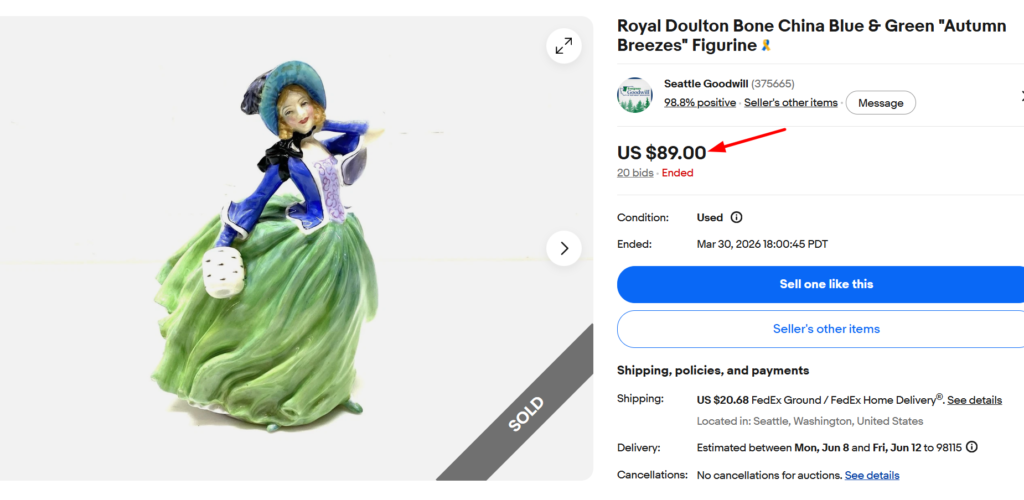
Sold for $90
This figurine shows a lady in a long blue and green dress caught by the wind, with her skirt and sleeves flaring back. It was modeled in 1939, but the full production started in 1940 until 1997.
The standard red colorway is the most common, but Doulton issued several variations in different dress colors across the production years, including a more desirable multicolor red and purple version.
A rare early “two-footed” version, where both feet show below the skirt, sells for a notable premium over the standard release.
- Estimated Value: $50 to $250
- Production Years: 1940 to 1997
- What to Check: Feet visibility, dress color, finger condition
- Quick Notes: Two-footed early edition worth significantly more.
6. The Old Balloon Seller Figurine (HN1315)
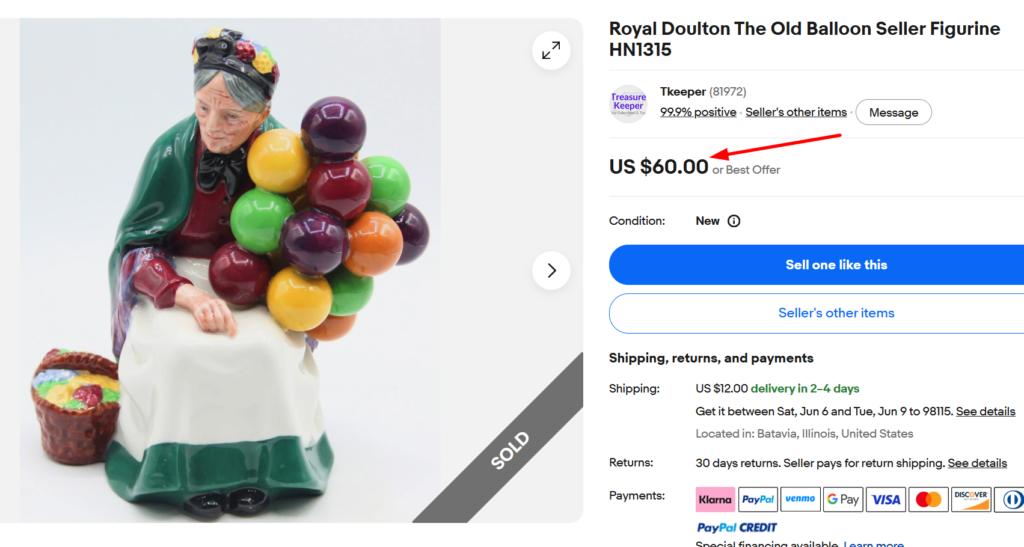
Sold for $60
The Old Balloon Seller is the most recognized Royal Doulton figurine of all time. Leslie Harradine created her in 1929, and she was produced till 1998; one of Doulton’s longest runs ever.
This figure sits with a basket of flowers on one side and holds a bunch of colorful balloons. Plus, she wears a dark green shawl and skirt with a white apron.
Since the figurine was made almost 70 years ago, the value relies mostly on when exactly the balloon animal was made and its condition.
- Estimated Value: $40 to $200
- Production Years: 1929 to 1998
- What to Check: Balloon condition, backstamp era, painter initials
- Quick Notes: Earlier “Doulton & Co Limited” stamps bring a premium.
7. Top o’ the Hill Figurine (HN1834)
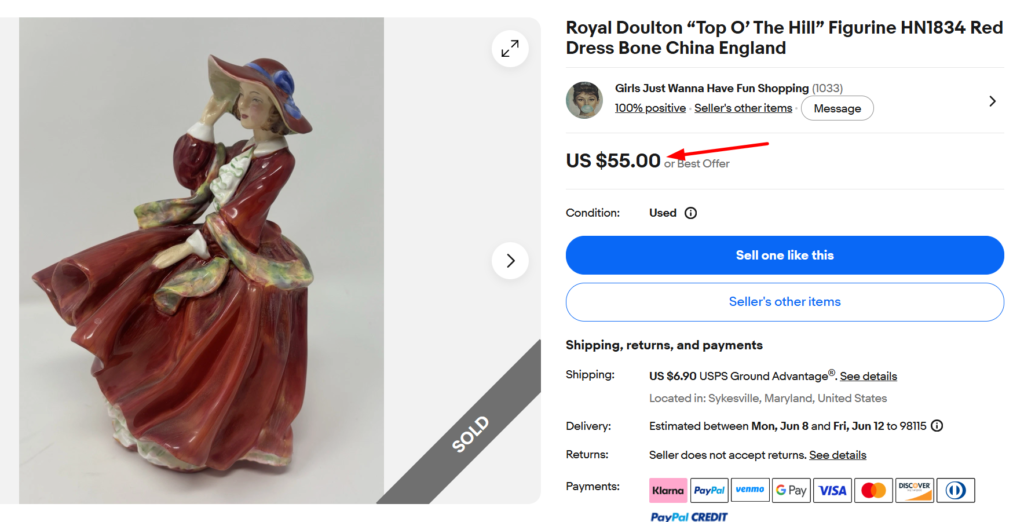
Sold for $55
Top o’ the Hill is widely considered Royal Doulton’s best-selling figurine ever. She was also designed by Leslie Harradine in 1937 and produced until 2004. She wears a flowing red dress and a wide-brimmed hat, mid-stride as if walking into a strong breeze.
The base reads “Top O’ The Hill” in script with the HN1834 number for the red dress. Two other colorways exist. HN1833 in green and blue is harder to find and brings stronger prices.
- Estimated Value: $40 to $250
- Production Years: 1937 to 2004
- What to Check: Hat brim chips, color of dress, hand-painted HN
- Quick Notes: Pre-1950 examples with hand-painted numbers are worth more.
8. Fair Lady Figurine (HN2193)
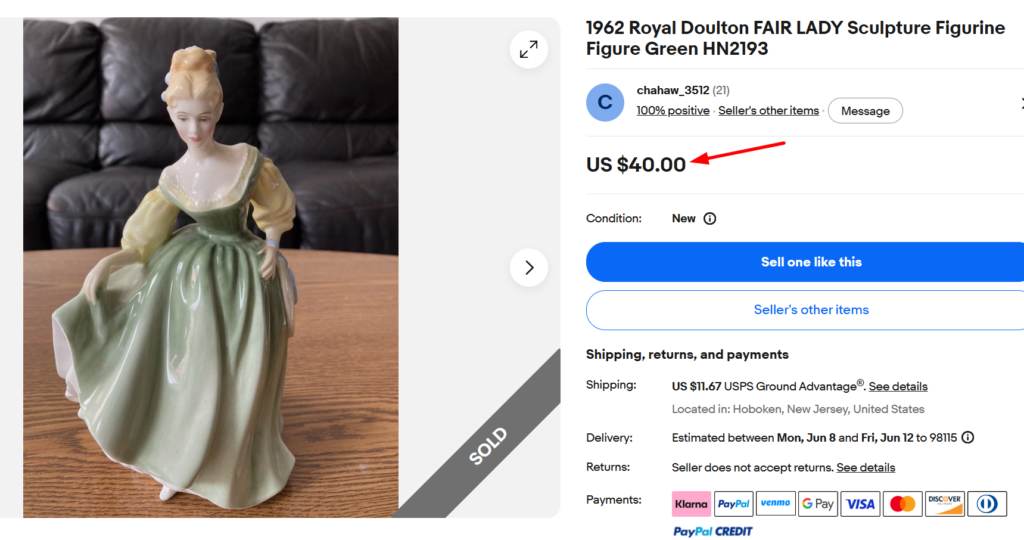
Sold for $40
Fair Lady, from the Pretty Ladies series, remains one of the most cherished figurines. Peggy Davies designed her in 1963, inspired by the heroine of My Fair Lady.
This Fair Lady is 7.25 inches tall and wears a really long green dress with white trim on it. There are two versions of this figurine, which are HN2832 and HN2835, with different colors for their dresses; the green one is the most common of all.
- Estimated Value: $25 to $120
- Production Years: 1963 to 1996
- What to Check: Dress color, hand condition, box presence
- Quick Notes: Green is common; original box adds to value.
9. Southern Belle Figurine (HN2229)
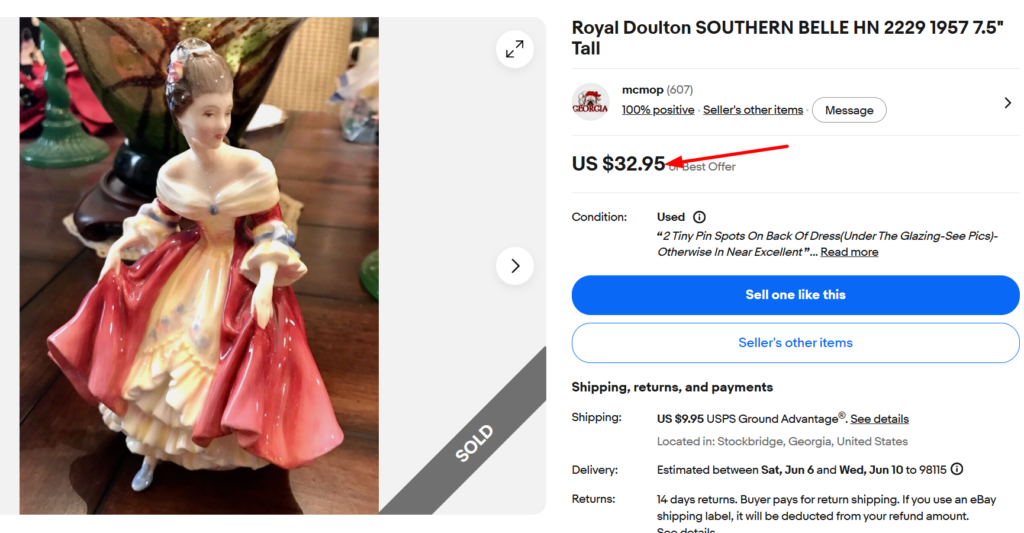
Sold for $33
Southern Belle is another Pretty Ladies doll created from 1957 to 1997. This 7.5-inch beauty wears a layered red and cream ball gown and has tiny red flowers in her hair. Plus, she might carry a parasol or fan.
After 1972, the bottom of the doll had the “Royal Doulton Tableware Limited” mark. Also, check out the flowers, parasol, and gown trim; they add a lot to the appeal. But damaged trim can really lower the value of the doll.
- Estimated Value: $25 to $175
- Production Years: 1958 to 1997
- What to Check: Hair flowers, gown trim, base mark wording
- Quick Notes: Mint examples with a box bring top prices.
10. Biddy Penny Farthing Figurine (HN1843)
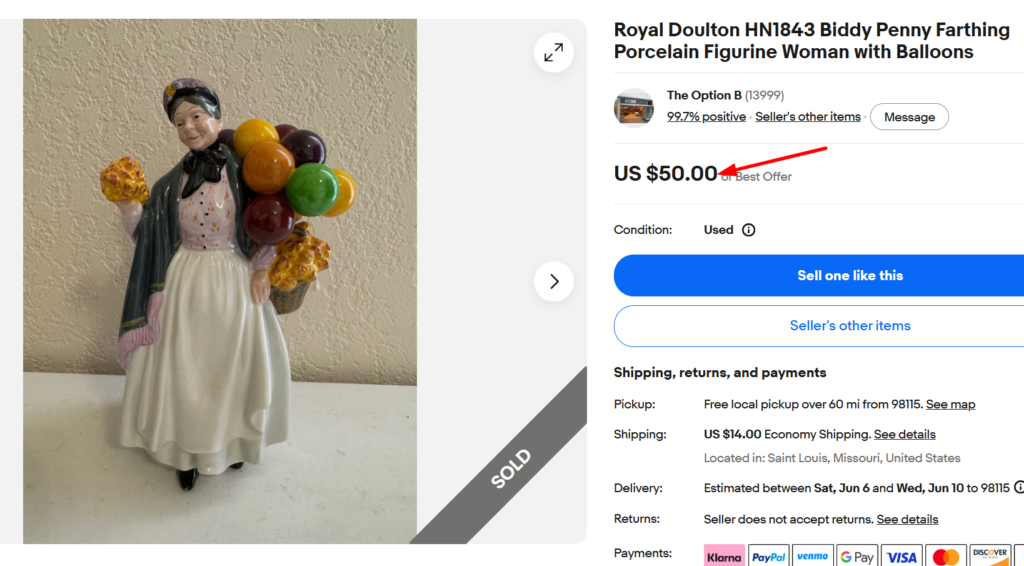
Sold for $50
Biddy Penny Farthing from the Balloon Characters series was created by Leslie Harradine in 1938. She was made until 2009, which is more than 70 years of production.
The Biddy Penny Farthing figure is about 9 inches tall. She has on a dress and a grey and lavender shawl. The lady holds balloons of many colors in one hand and yellow flowers in the other.
The figurine is easy to find, but the balloons chip quite easily. Pristine examples with all balloons intact and bright colors are where the most value lies.
- Estimated Value: $30 to $200
- Production Years: 1938 to 2009
- What to Check: Balloon chips, shawl color, painter monogram
- Quick Notes: Balloon damage cuts value by half.
11. Poppy Eyebright Figurine (DBH1)
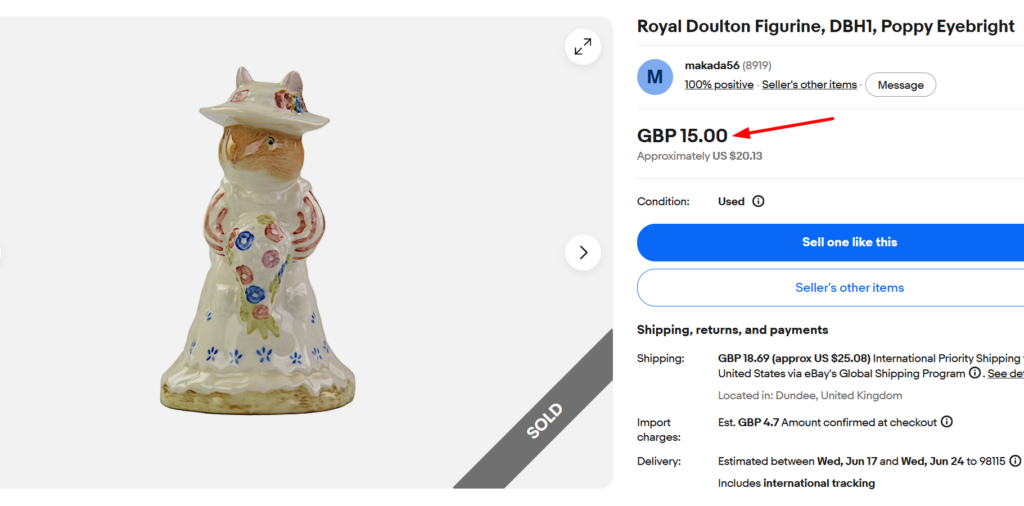
Sold for $20
Poppy Eyebright is the very first figurine in Royal Doulton’s Brambly Hedge series, based on Jill Barklem’s illustrated books. Harry Sales designed her in 1982, with full production starting in 1983 and ending in 1997.
The figure stands about 4 inches tall as a mouse holding a basket and wearing a pink dress and a white apron.
Boxed examples with the original packaging from the 1980s production are the ones collectors hunt. The cardboard sleeve authenticates the early issue.
- Estimated Value: $15 to $120
- Production Years: 1983 to 1997
- What to Check: Original box, basket detail, base mark
- Quick Notes: First Brambly Hedge piece, boxed adds 40 percent
12. Tally Ho! Bunnykins Figurine (DB78)
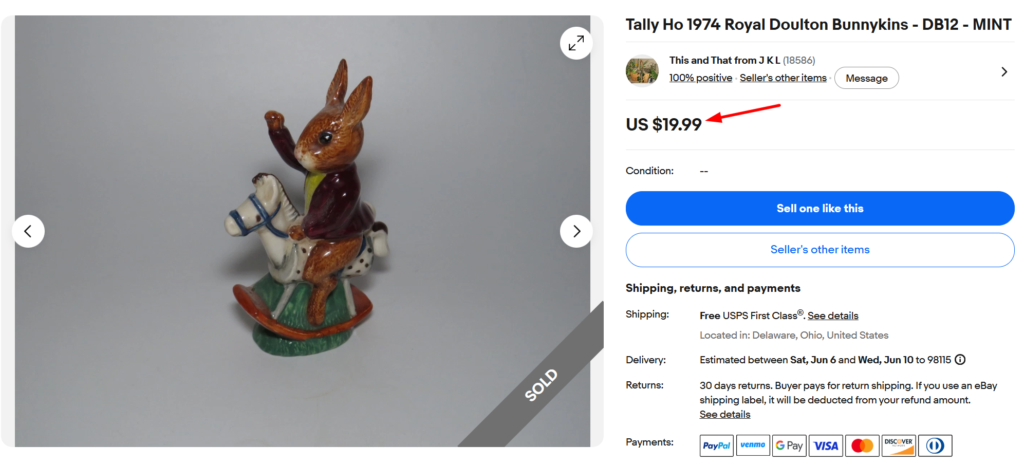
Sold for $20
DB78 is one of the most sought-after Bunnykins figurines. Albert Hallam modeled this special USA market colorway in 1988, with a light blue coat and a white rocking horse. It was launched and discontinued in the same year, which makes finding one in good condition quite difficult.
The common Tally Ho DB12, in a red coat with a brown rocking horse, is everywhere on eBay and sells for $15 to $115. The DB78 version routinely brings 4-6 times that price.
- Estimated Value: $15 to $115 (common); 400 to $800 (rare)
- Production Year: 1988 only
- What to Check: Light blue coat, white rocking horse, DB78 mark
- Quick Notes: Year-only release makes this rare.
13. Falstaff Figurine (HN2054)
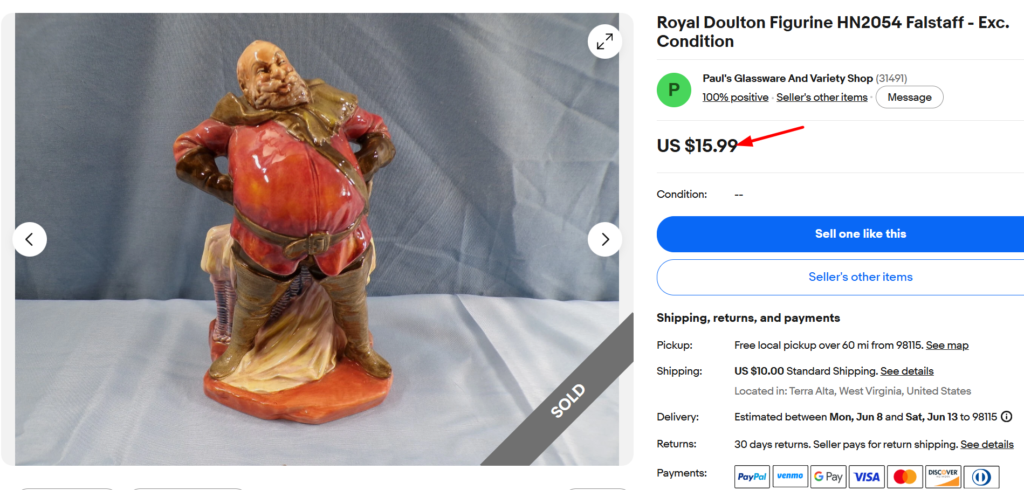
Sold for $19
Falstaff is one of Royal Doulton’s iconic character figures designed by Charles J. Noke. The figurine stands 7 inches tall, modeled after Shakespeare’s roguish knight, wearing a pink shirt, brown gauntlets, thigh-high boots, and a cape caught by wind, with a wicker theatre chest behind him.
His size, costume detail, and the long production span mean condition is the main value driver. The cape and sword catch damage easily.
- Estimated Value: $10 to $80
- Production Years: 1950 to 1992
- What to Check: Cape chips, sword presence, hat condition
- Quick Notes: Earlier stamps with a green backstamp are worth more.
Royal Doulton identification can be done in three steps. Read the backstamp, write down the HN or DB number, and cross-check the production years on a database. Do that for any piece you find, whether it’s a $40 figurine or a $400 one.