
Lefton was a Hungarian designer of sports clothing who moved to Chicago in 1939. He had no professional knowledge of China, but only an attraction to porcelain. In 1940, he established the Lefton Company, which became a ceramics wholesaler.
The actual history begins after Pearl Harbor. Lefton helped his Japanese-American friend Nunome board up his shop during the looting. After the war, Nunome introduced him to Japanese ceramic manufacturers in Occupied Japan.
The first “Made in Occupied Japan” Lefton pieces hit U.S. shores in 1946. In the 1960s, the Lefton product line had spread to more than 10,000 outlets in America.
The founder of the firm, George Z. Lefton, passed away in 1996, and in 2005, the business was sold to OMT Enterprises in 2005, where production continues today.
How to Identify Vintage & Antique Lefton China?
Most items are stamped on the bottom or come with a paper/foil sticker, or both. The stamp on the bottom is the best indicator for dating Lefton China and determining its worth.
The stamps evolved through time, and the stickers were used together at times, so it’s just a matter of experience. This guide will tell you all you need to know about reading the bottom of a Lefton item.
The Lefton Crown Marks
The Lefton China crown mark is the brand’s most recognized signature. It features a small crown placed above the phrase “Lefton China,” arched above, while below the phrase “Hand Painted” appears in script.
This crown backstamp came into use in 1955 and is still being utilized to date; therefore, the existence of a crown alone cannot indicate the period. The text around the crown is what dates it.
A few common variations:
- Crown with “Lefton China / Hand Painted” — used from 1955 onward, the most common version
- Crown with “Reg. U.S. Pat. Off.” beneath — usually points to 1955–1960
- Crown with “Trade Mark” beneath — generally after 1960
- Crown with “MADE IN JAPAN” added — Japan-made pieces, before the mid-1970s
Earlier scripts also exist, including “Lefton’s” arched above “Occupied Japan” (1946–1952), plus “G.Z. Lefton” and “G.Z.L.” signatures on various items.
Dating Your Lefton by Mark Type
Lefton used paper and foil labels alongside fired stamps. The labels are easier to date than the stamps because they changed by era and place of manufacture. If a sticker is still attached, you have a strong dating clue.
Here’s a quick reference for Lefton marks and labels by date:
- 1946–1953: Large crimson paper label with gold or silver trim, reading “Lefton’s Exclusive Japan.” Pieces were also stamped “Made in Occupied Japan.”
- 1953–1971: Red foil label with gold or silver trim, reading “Lefton’s Reg. U.S. Pat. Off. Exclu. Japan.”
- After 1960: Stickers often add “Trade Mark” instead of “Reg. U.S. Pat. Off.” (these overlapped for several years).
- Mid-1970s onward: Production shifted out of Japan. Labels start showing Taiwan, then Malaysia, and China.
- 1986 onward: “Lefton Trademark Exclusives Taiwan” labels are common.
- 1999 onward: Labels list “China” as the country of origin.
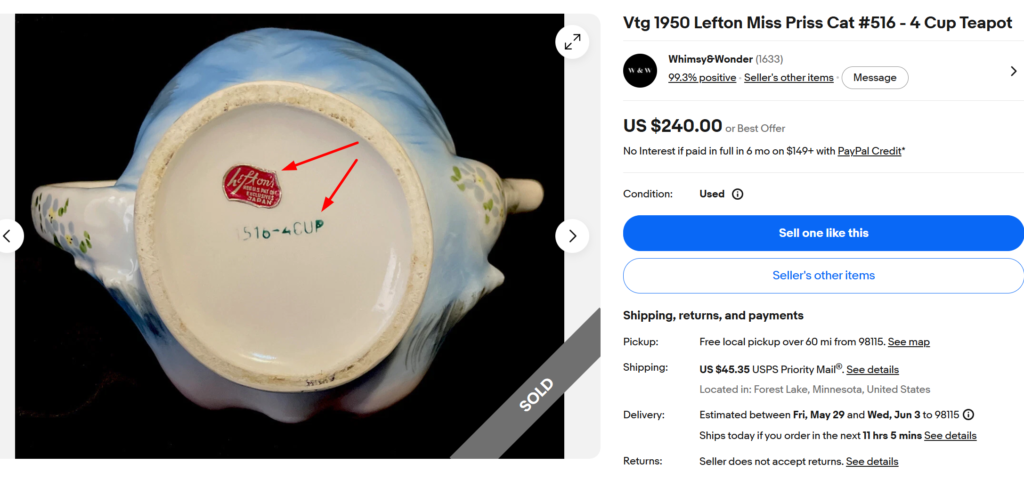
You could also see the copyright date on the base, such as “© 1957 Geo. Z. Lefton” or “© 1985 Geo. Z. Lefton.” It is the year when the mold was made, not necessarily the year of manufacture, but this is the closest you can come to dating it.
Quick Tip: Pieces with both a fired crown stamp AND an intact foil sticker tend to sell for more. Most stickers got peeled or worn off decades ago, so collectors will pay extra when one survives.
Hand-Painted vs Decal
Most Lefton vintage pieces were hand-painted, notably Japan-produced figurines, head vases, and flower-themed dinnerware from the 1950s and 1960s. This craftsmanship is a huge value driver, so it’s important to spot.
Touch the paintwork with your finger. Hand-painted Lefton will have small bumps because the brush laid the paint on top of the glazing. Colors look slightly uneven, and the brush direction is visible under angled light. No two pieces match exactly.
Decaled or transfer-printed pieces feel completely flat and uniform. The color is perfectly even, the edges are razor-sharp, and any twenty pieces of the same pattern will look identical. Newer Lefton (post-1980s) uses more decals than the vintage stuff did.
Watch out for misattributions. Lefton was widely copied, and competitors like Napco, Norcrest, and Relpo made very similar figurines. Always cross-check the bottom for “Lefton” wording or the crown. Without those, you don’t actually have Lefton.
What Makes a Lefton Piece Valuable?
Naturally, not every Lefton piece is worth real money. A 1985 figurine with crisp printed flowers might sell for $8, while a 1956 hand-painted head vase with original sticker can hit $250. The difference comes down to the following factors.
- Mark Age – Older Lefton is always worth more. Occupied Japan (1946–1952) and Reg. U.S. Pat. Off. era (1953–1960) pieces are the strongest sellers. Once production moved to Taiwan and Malaysia in the mid-1970s, values dropped sharply.
- Pattern Rarity & Popularity – Some Lefton categories simply command top dollar across the board. Anthropomorphic Bluebird kitchenware, Miss Priss kitty cat line, Lady head vases (1950s & 1960s), Birthday angels of the month, and Christopher nativity sets are a few examples.
- Condition – Being hand-painted porcelain, lefton’s condition is very important. Chipping of flowers, missing rhinestones, paint fading, and crazing (tiny surface cracking of the glazing) can drastically decrease the value.
- Completeness – Sets are worth far more together than apart. A full 9-piece Christopher Collection nativity in its original styrofoam box can hit $250–$400. The same set with one shepherd missing might fetch $80. Original boxes, original spoons (for jam jars), and matching lids all add real money.
- Original packing & Stickers – Pieces that still have the red foil Lefton sticker sell better than their counterparts without any such marking at all. This sticker verifies their authenticity, and that is what buyers want.
12 Valuable Vintage Lefton Finds Recently
Let’s take a look at some of the valuable vintage Lefton china pieces, ranging from decorative figurines to kitchenware pieces.
1. Pink Poodle Chef Anthropomorphic Cookie Jar
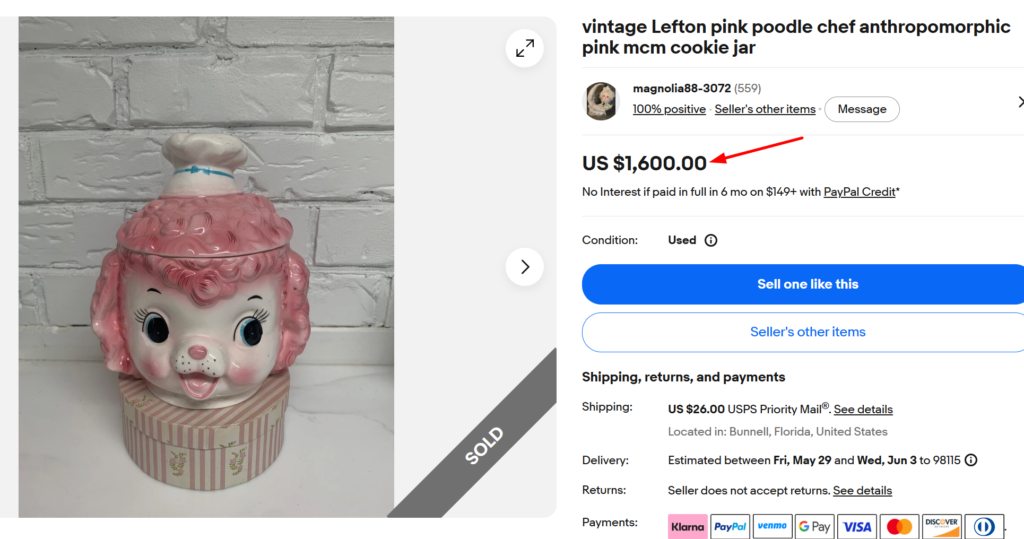
Sold for $1,600
Released during the 1950s, this cookie jar features a pink poodle sporting a jaunty white chef’s hat that also makes the lid. The design shows oversized eyes, long, dramatic lashes, and a charming, open-mouthed smile.
Because cold-painted details on these pieces tend to flake over the years, a Pink Poodle Chef with its original paint intact is a rare and valuable find. Confirm the ESD Japan mark on the base.
- Estimated Value: $800-$1,650
- Production Year: Mid-1950s
- Characteristics: Anthropomorphic poodle head, glossy pink glaze, cold-painted facial features, integrated white chef’s hat lid.
- Quick Notes: Cracks and chips can significantly drop the value.
2. Miss Priss Set
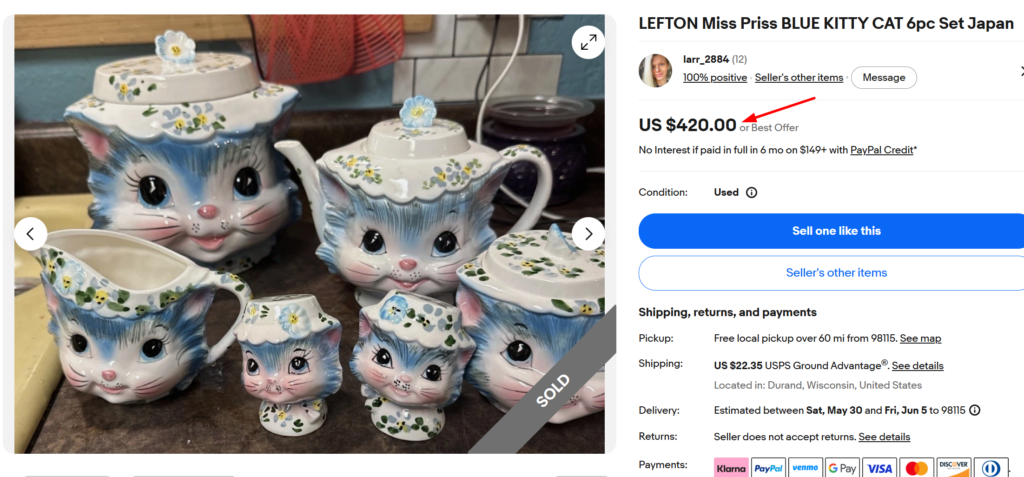
Sold for $420
The most collectible Lefton teapot is the Miss Priss kitty cat #1516 4-cup, with her oversized rosy cheeks, painted whiskers, and a daisy-topped scalloped lid. Mint examples with original sticker regularly hit the $200–$250 range.
Floral hand-painted teapots in patterns like Brown Heritage (#1866) and Heritage Green (#4579) are the formal end of Lefton tea, selling steadily but at lower prices than the figural pieces.
- Estimated Value: $150–$250+ (Miss Priss #1516); higher for yellow Miss Priss
- Production Year: 1950s–1970s
- What to Check: No chips on spout or lid, daisy finial intact on Miss Priss, no hairline cracks
- Quick Notes: The condition of the lid finial affects the value.
3. Marika’s Original Figurine
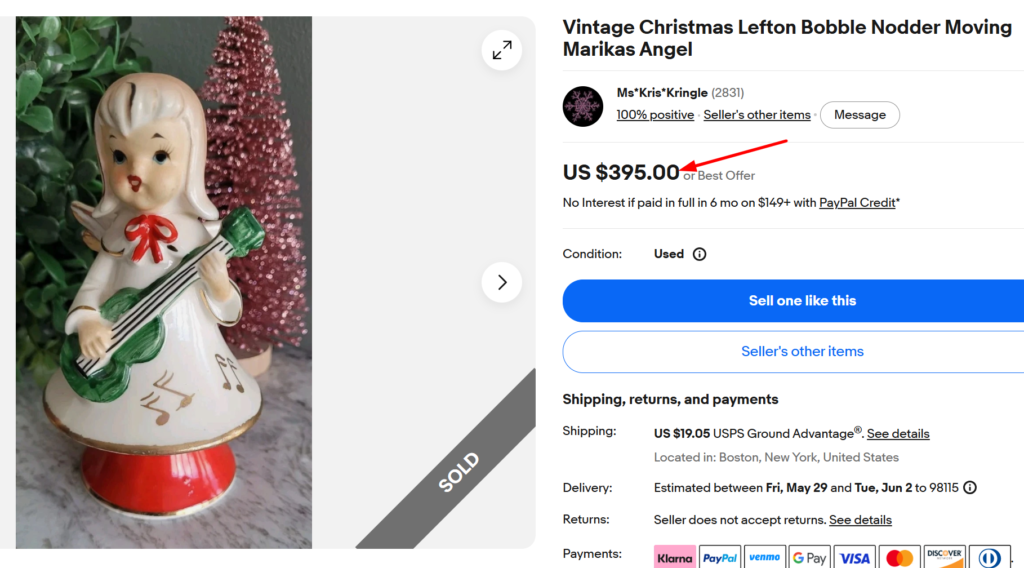
Sold for $395 (single)
Christmas Lefton is huge. The Holly Berry design is that green-leaf and red-berries motif found on candy dishes and dishware. The Christopher Collection dates from 1983 and consists of the iconic porcelain nativity scenes.
The most collectible and valuable finds are Marika’s Original bobble-head angels, spring-mounted music figurines. Examples like the Christmas Marika’s Bobble Nodder Angel with a green guitar can fetch up to $300 in good condition.
- Estimated Value: $10–$50 (common); $300–$500 (Marika’s angels)
- Production Year: Holly Berry 1950s–1990s; Christopher Collection 1983 onward
- What to Check: Spring mechanism still bobs freely, no broken instruments, original box on nativity
- Quick Notes: The 1983 Christopher nativity & Marika’s angels are most valuable.
4. Lady Head Vase
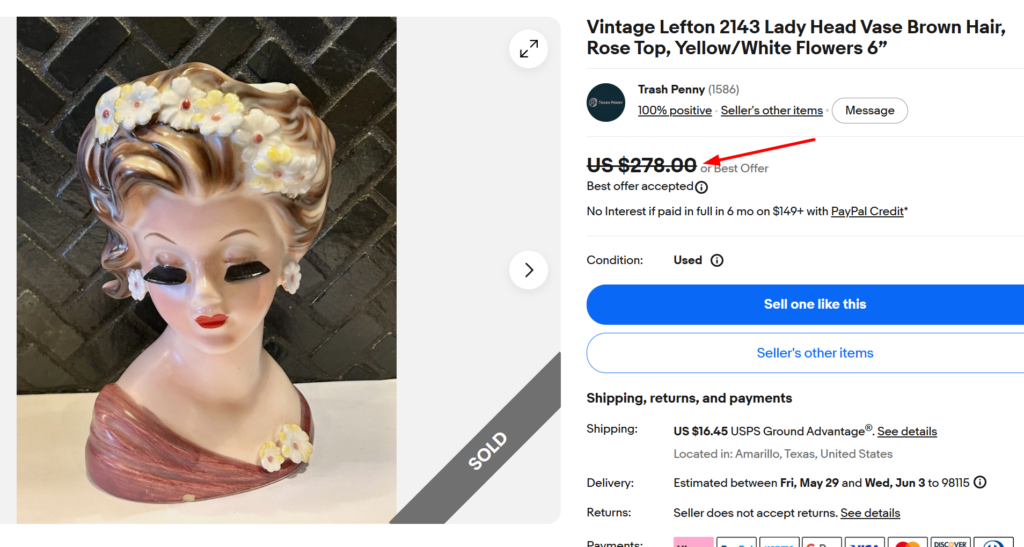
Sold for $280
These ceramic ladies were originally sold by florists to display small bouquets. Now, these Leftons are among the most sought-after Lefton pieces, featuring a woman’s portrait of her head and shoulders, often adorned with a hat, pearl earrings, and gloves.
Popular Lefton models include #2705, #2706, and #2143. Pristine examples with original pearls still attached are the most valuable ones.
- Estimated Value: $50–$200 (common); $250+ (rare versions like #2143)
- Production Year: 1950s–1960s mostly
- What to Check: Original pearls/earrings present, no chips on hat brim, intact foil sticker
- Quick Notes: Bisque matte finishes are rarer than glossy glazed ones.
5. Anthropomorphic Bluebird Musical Teapot
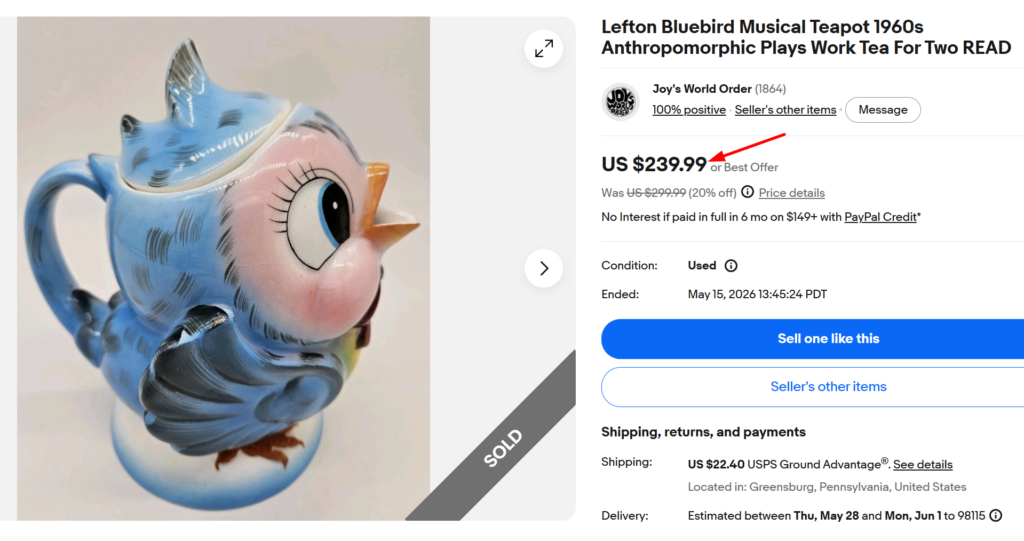
Sold for $240
This Bluebird Musical Teapot is one of the most fascinating and collectible Lefton pieces. It features the bird with large lashed eyes, pink cheeks, and a musical base that sings “Tea For Two.”
Some other Bluebird objects include sugar bowls, creamers, salt and pepper sets, and wall plaques, all featuring a handle formed by feathered tails. Teapots with a working musical base are worth the most.
- Estimated Value: $40–$100 (Singles); $200–$300+ (musical teapots); $400+ (full tea set)
- Production Year: 1950s–1960s
- What to Check: Beak chips, tail feathers intact, music box plays at proper speed.
- Quick Notes: Check the condition before paying premium prices.
6. Colonial Village Collection Buildings
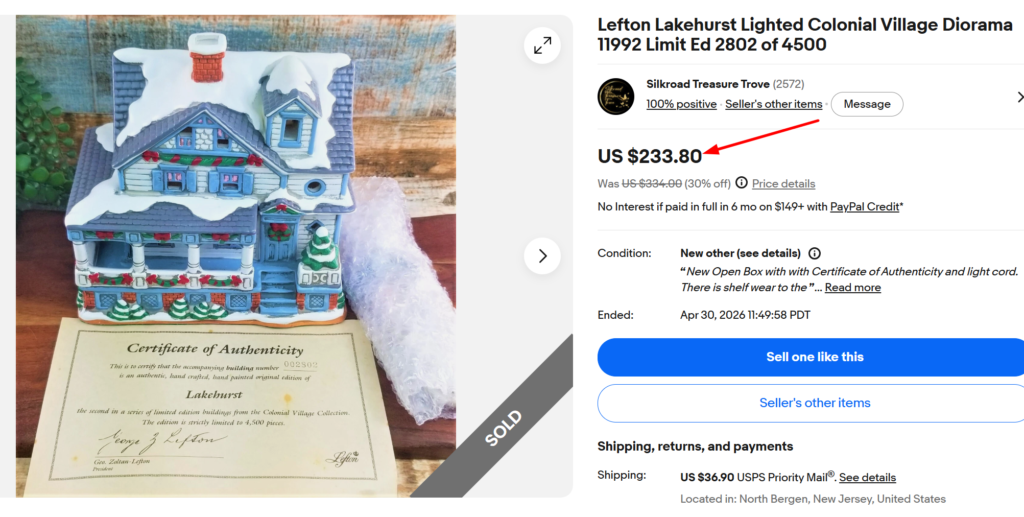
Sold for almost $235 (single)
The Colonial Village Line was founded in 1987 and became one of Lefton’s longest lines. This is a collection of porcelain Christmas villages featuring light-up buildings such as churches, shops, manor houses, fire stations, and inns.
This one is the Lakehurst (#11992, edition of 4,500). It is a two-story Victorian mansion with a snow-capped roof and Christmas garlands. With its certificate, it routinely tops $200. Collectors mostly chase such numbered limited editions.
- Estimated Value: $25–$80 (common); $150–$280 (LE with COA)
- Production Year: 1987 onward
- What to Check: Working light cord, certificate of authenticity present, original box, no chipped trim
- Quick Notes: The certificate of authenticity can double the value.
7. Rose Chintz Lunch Plates
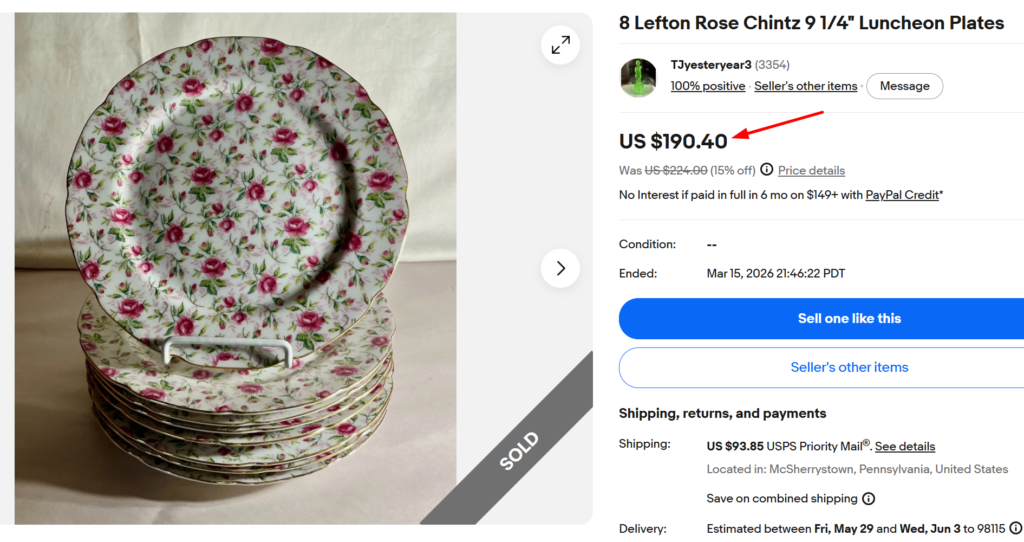
Sold for $190 (set)
Rose Chintz is among the most favored dinnerware patterns by Lefton. Also known as Pattern #637, it’s adorned with an all-over design of small pink roses and green leaves on white with gold trim on the scalloped edges.
These large, 9¼” luncheon plates are collectible because of their size and the design. Larger sets of 12 or more plates can fetch up to $220 or more.
- Estimated Value: $18–$25 (singles); $180–$220 (set of 8-12)
- Production Year: 1953–1971 (matches the Reg. U.S. Pat. Off. sticker era)
- What to Check: No worn gold trim, no hairline cracks, matching backstamp on every plate
- Quick Notes: Set values depend heavily on completeness.
8. Mr. Toodles Cookie Jar
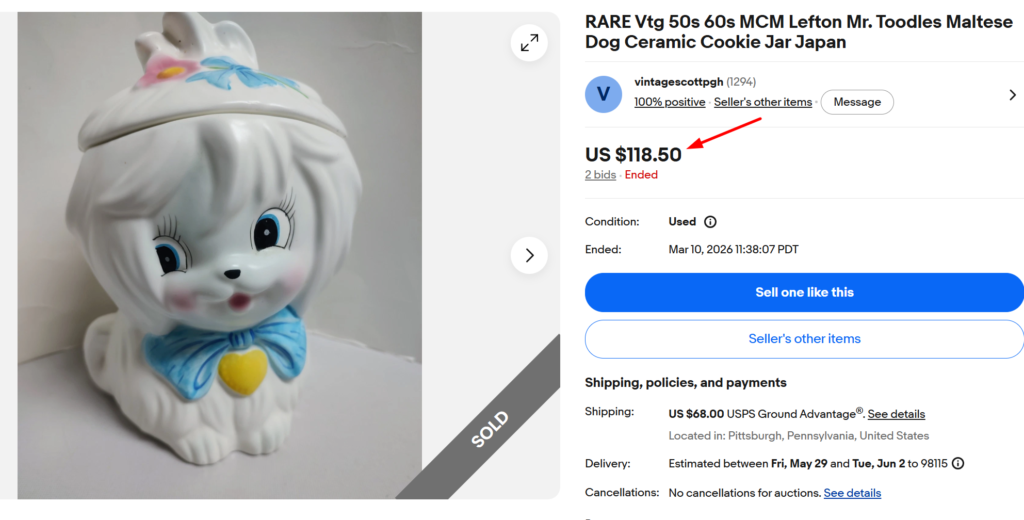
Sold for almost $120
The “Mr. Toodles” line is one of Lefton’s most recognizable and expansive designs. It shows a fluffy white Maltese puppy wearing a signature blue bow tie and a matching blue ribbon.
The series included smaller tableware items like salt and pepper shakers, planters, and teapots, and the full-sized biscuit/cookie jar (#3236) is one of the hardest variations to find today, hence quite valuable.
- Estimated Value: $80–$150
- Production Year: Late 1950s – Early 1960s
- Characteristics: Maltese dog form, white base glaze, blue accent bows, large black eyes, airbrushed pink cheek details.
- Quick Notes: Check the model number on the base for authenticity.
9. Americana Rose Canisters
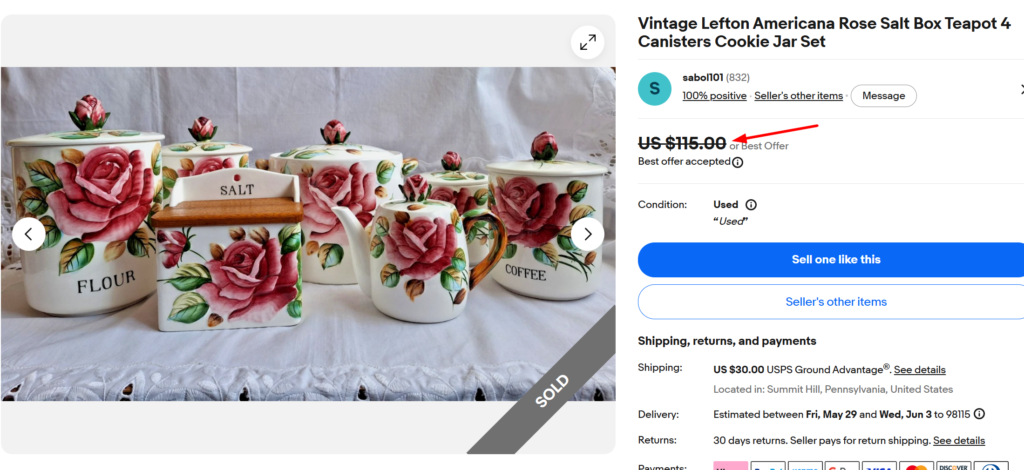
Sold for $115
The Lefton Americana Rose kitchen set features large pink cabbage roses with deep green leaves on white. The brushwork is heavy and almost three-dimensional.
A full set can include four graduated canisters, a wooden-lid salt box, a teapot, and a cookie jar. Each lid has a raised pink rosebud finial. The value lies in the completeness of the set, and of course, the condition of each piece.
- Estimated Value: $100–$200 (multi-piece set); $25–$50 (singles)
- Production Year: 1950s–1970s
- What to Check: All rosebud finials intact, salt box wooden lid present, no missing canister lids
- Quick Notes: Sun-fading on the display side can drop value by 30–40%.
10. Thumbelina Sugar & Creamer Set
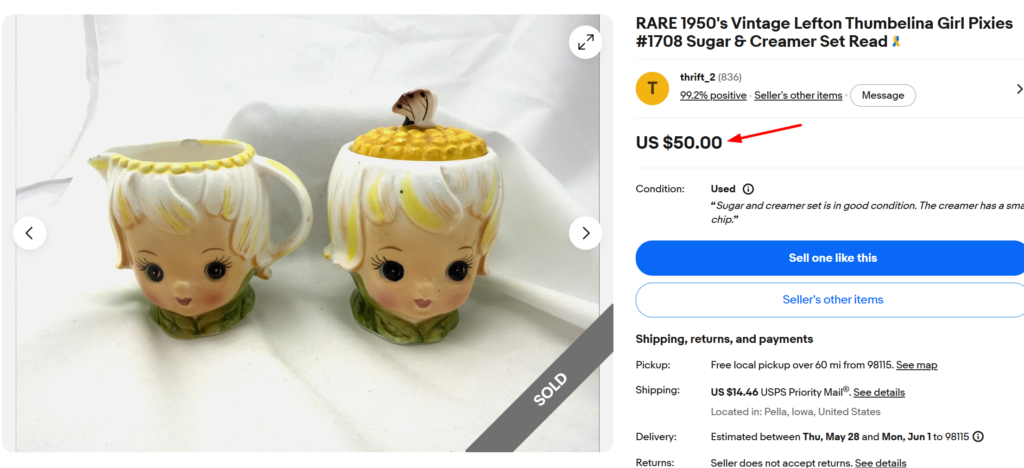
Sold for $50
Thumbelina #1708 Lefton Sugar and Creamer Set is one such rare duo. The figures have been molded into the head of a girl; each has blonde hair, sleepy eyes that are half shut, pink cheeks, pink lips, and green collar petals. The lid of the sugar bowl has a yellow corn-cob surface with a handle.
Salt and pepper shakes shaped as Thumbelina and her companion, Honeybun, are also quite collectible.
- Estimated Value: $50–$100 (pairs); $25–$40 (singles)
- Production Year: 1950s
- What to Check: Both pieces present, mouse finial intact on sugar lid, no chips on creamer spout
- Quick Notes: Check for matching paint and stamps on both pieces.
11. Carousel Collection Piece
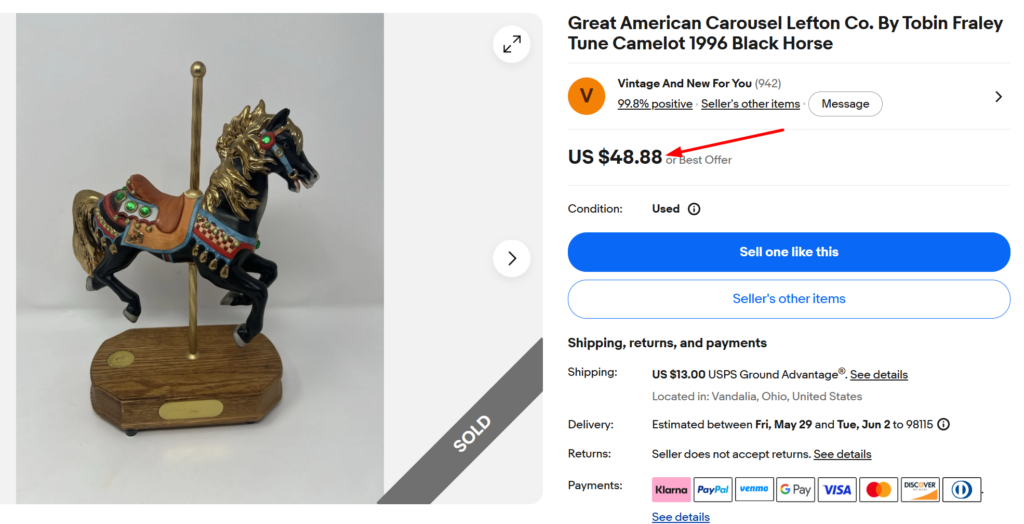
Sold for $45+
Lefton’s Great American Carousel Collectibles were introduced in 1995 in collaboration with Tobin Fraley, a carousel artist. They are limited edition porcelain carousel horses that have been hand-painted using rhinestones and gold.
Most are numbered editions with the number printed on the base. Names like “American Spirit Southern Belle” and “Camelot Black Horse” are common, while larger 12-inch carousels are rarer and more valuable.
- Estimated Value: $50–$180 (common); $150–$300+ (large, musical)
- Production Year: 1995 to early 2000s
- What to Check: All rhinestones present, edition number visible on base, music mechanism working
- Quick Notes: Original box & certificate of authenticity add a lot of value.
12. Birthday Angel of the Month
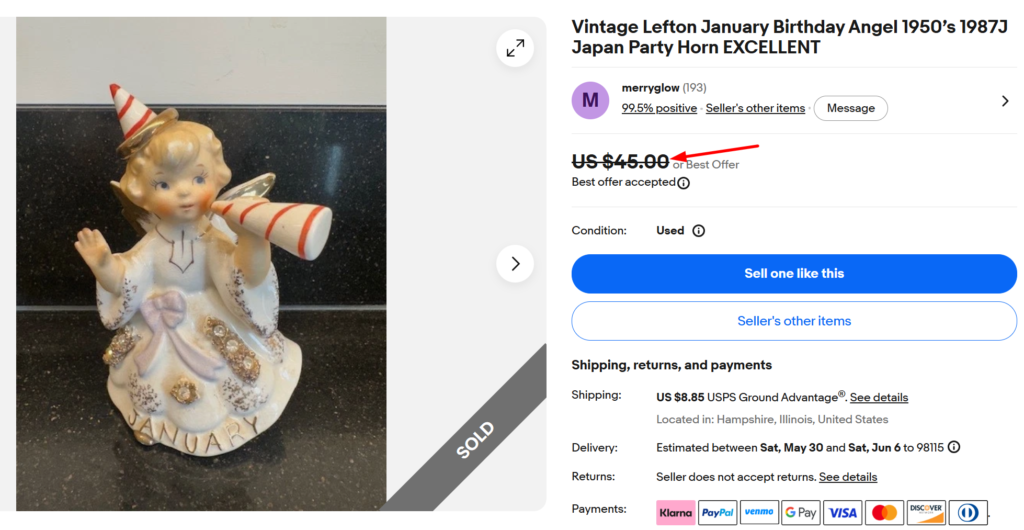
Sold for $45
Lefton’s “Angel of the Month” is a set of twelve figurines, one for each birth month. Each figurine holds certain symbols for each month, such as horns for January, hearts for February, and shamrocks for March. And the model 1987J marks the girl angels.
The January angel comes with her striped party horn, gold halo, and rhinestone-dotted dress, and is one of the most recognizable. Lefton reissued the series in 1987 using the same molds, but it’s the 50s pieces that are worth collecting.
- Estimated Value: $20–$50 (singles); $250–$400 (complete 1957 sets)
- Production Year: 1957 originals; 1987 reissues
- What to Check: “1957” date stamp, rhinestones present, spaghetti trim unbroken, red foil sticker
- Quick Notes: Confirm the year (1957 or 1987) before buying or selling.
Clearly, certain Lefton pieces are worth a lot of money today. The key is to identify them rightly. Start with the crown mark and foil stickers, the model number, and the copyright date. The rest is knowing which categories are trending in the market.