
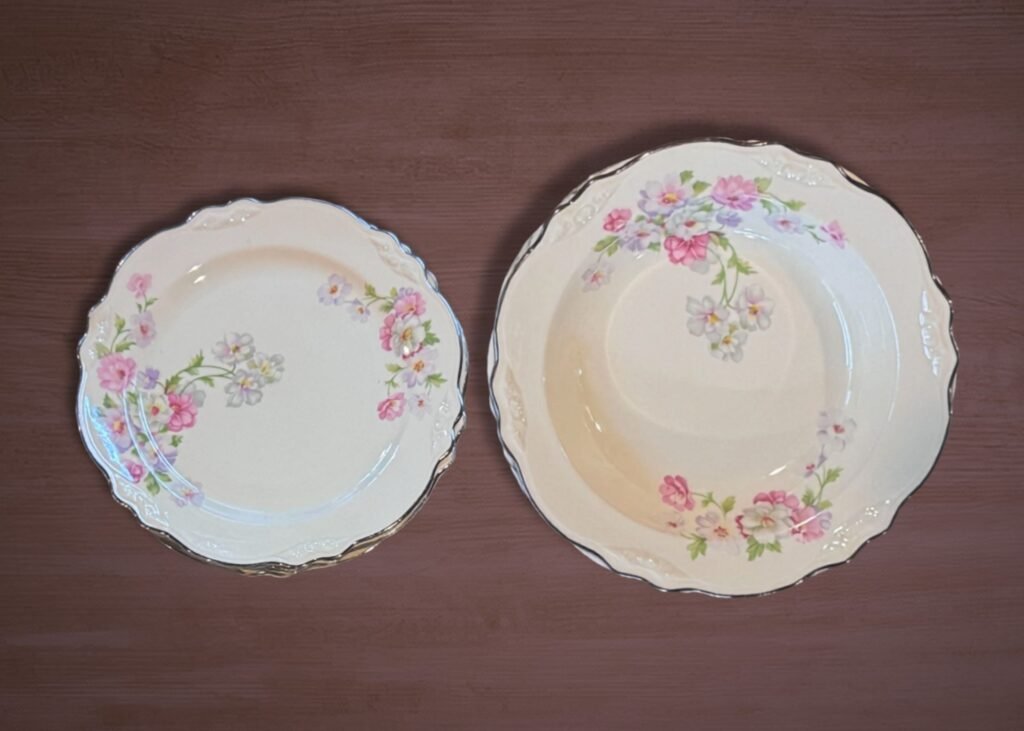
You got a box full of floral dishes from an estate sale haul for $5. They have a small mark on the back, a name like “Virginia Rose” or “Nautilus,” and now you want to know what it is.
That’s how most people end up looking at Homer Laughlin china patterns. The company made hundreds of millions of pieces across a hundred-plus years, so most are common. But some can pull serious money.
In this blog, let’s learn more about Homer Laughlin china: how to identify vintage pieces, what determines their value, and which patterns are valuable.
Quick History of Homer Laughlin China Company
The company was founded by Homer and Shakespeare Laughlin brothers, who were residents of East Liverpool, Ohio, in 1871. This happened after the two received an award of $5,000 from the local authorities, who wanted the two to manufacture the white ware.
Shakespeare left in 1877, but Homer kept building. It was rebranded as the Homer Laughlin China Company in 1896, and Homer retired the next year, selling to W.E. Wells and the Aaron family. Production moved across the Ohio River to Newell, West Virginia, in 1903.
Production of pieces per year reached 10 million by 1948. Pieces are common currently, but Art Deco shapes, Frederick Rhead’s pieces from the 1930s, and rare decals fetch huge amounts for collectors. The company was finally renamed as Fiesta Tableware Company in 2020.
How to Identify Homer Laughlin China?
Identification can be a bit confusing because the Homer Laughlin backstamp almost never tells you the pattern name. It tells you when and where a piece was made, and that’s it. The pattern is something you figure out separately.
Here’s the order that works: read the backstamp, decode the date stamp, identify the shape, then identify the decal or decoration. Each step will narrow things down quickly to date and identify.
1. Reading the Backstamps
- Pre-1900 (East Liverpool era) – The original mark showed an American Eagle standing on top of a British Lion. If you find this eagle-over-lion mark without any date code, you’re looking at early East Liverpool production, likely before 1900. These are among the most historically significant Homer Laughlin pieces.
- 1900–1920s – Marks transitioned to text-based stamps. Some used “H.L.Co.” while others spelled out “Homer Laughlin” along with “Made in USA.” The exact wording and style changed across plants and years.
- 1930s–1960s – The most common vintage marks use the full “Homer Laughlin” name in a banner or oval design, usually with “Made in USA” and a date code. The Eggshell shapes (Nautilus, Georgian, Cavalier) had their own shape-specific backstamps with the shape name (e.g., “Eggshell Nautilus” or “Eggshell Georgian”).
- Restaurant Ware Marks – Homer Laughlin restaurant ware marks differ from household dinnerware. They typically show “Best China” or “American Restaurant China” and are heavier vitrified pieces. Some restaurant ware was custom-marked with hotel or railroad names; these are especially desirable.
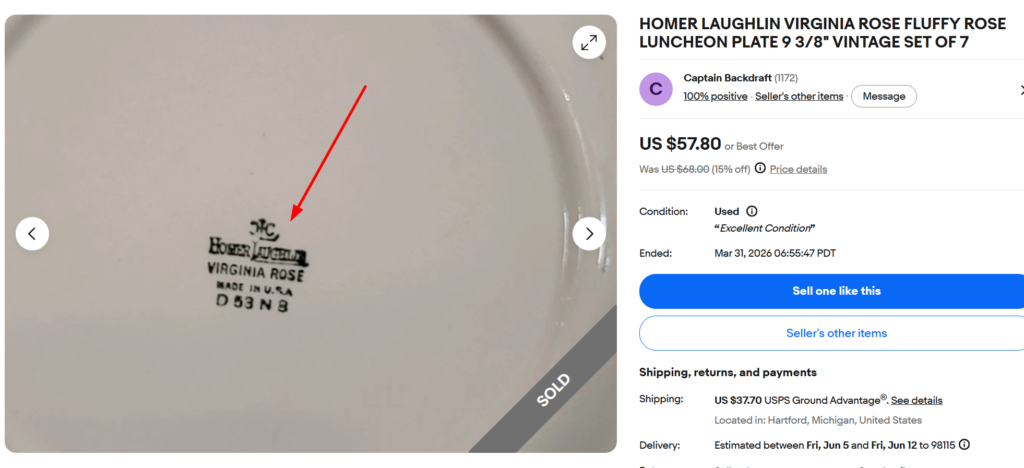
2. Understanding the Date Code
Homer Laughlin used a special date coding system, which is super useful in dating its vintage pieces. From 1900 onward, nearly every piece tells you the production month, year, and factory.
Here’s how the Homer Laughlin date code system works:
| Era | Code Format | Meaning |
| 1900–1910 | Number + Letter (e.g., “76L”) | Second digit = last digit of year; letter = plant |
| 1910–1920 | Three numbers (e.g., “1 16 N”) | First = month, second = year’s last digit, third = plant |
| 1921–1930 | Letter + two numbers (e.g., “C 22 N”) | Letter = month (A=Jan, B=Feb…), numbers = year + plant |
| 1931–1959 | Letter + two-digit year + Letter (e.g., “E44N8”) | Month, year, plant location, plant number |
| 1960 onward | Letter + Letter (e.g., “AA”) | First letter = year in sequence, second = month |
So, a mark reading K53N8 translates to K – November, 53 – 1953, N – Newell, 8 – Plant 8. This was the most common production site for Virginia Rose.
The plant code matters too. “N” is Newell, West Virginia. “L” was East Liverpool, Ohio. Early Homer Laughlin with L marking precedes the year 1929.
Good to Know: Some larger-sized pieces, like platters, lids of casseroles, and creamers, sometimes bear a separate pattern number code, for example, VR-128, or N1670. That’s the actual pattern identifier. Plates and bowls usually only show the date code.
3. Identifying the Shape
Shape and pattern are two separate things, and the difference matters. The shape is the form of the dish: the rim style, the embossing, the silhouette.
The pattern is the decal or decoration on top. One shape often carried hundreds of different patterns. Here are the major shapes worth recognizing on sight, since most listings are sold by shape name.
- Empress (1907 onward) – A clean, simple form with a softly scalloped rim and light embossing. Made for almost forty years in dozens of decal versions.
- Hudson (1908 onward) – Modeled after a Haviland French china line. Ornate rim with floral-and-ribbon embossing. Best known for the Hudson pitcher.
- Republic (1915 onward) – Heavy rope-like embossed rim, borrowed from another Haviland shape. Bolder than Empress and coarser than Virginia Rose.
- Yellowstone (1926) – Octagonal plates with no embossing, paired with angular geometric hollowware. A defining Art Deco shape.
- Wells and Century (1930-1931) – Wells has industrial tab handles. Century is a flat octagon with cut corners — later used as the body for Riviera, Mexicana, and Hacienda.
- Virginia Rose (1932) – Designed by Rhead. Scalloped rim with embossed rose-and-leaf swags. Made through 1968 with over 250 different decals.
- Nautilus and Eggshell Nautilus (1935/1937) – Fan-shaped, scalloped rim. Eggshell Nautilus is the lighter, thinner version with a creamy ivory body.
- Georgian and Eggshell Georgian (1933/1937) – Plain round dishes with a dotted rim design. Eggshell Georgian is made to look like English china.
4. Identifying the Pattern
The pattern is the decal, color, or hand-painted treatment on top of the shape. Homer Laughlin used internal codes, like “VR-128” for Fluffy Rose, “JJ-59” for Moss Rose, and “N1670” for various Eggshell Nautilus treatments.
However, these codes are almost never marked on the piece itself. That means pattern identification happens visually.
The two best resources are the searchable pattern database, like Replacements (over 400 Homer Laughlin china pattern names indexed by image), and the Homer Laughlin China Collectors Association forum, where members can identify a decal from a clear photo.
A few decals are reliable visual anchors. For example, Fluffy Rose has big, blousy pink roses with mauve shadows. Moss Rose has tighter pink roses with green moss accents. Mexicana shows southwestern pots and cacti.
What Makes Homer Laughlin China Rare & Valuable?
The majority of Homer Laughlin pieces sell for $5-$20; the rare ones, which sell at $100 or more, have some distinctive features. Below are the five key factors you need to consider to spot the valuable exceptions:
- Rarity of the Production Run – Short-run patterns (Riviera from 1938-1948, Harlequin Spruce Green from 1936-1942) are less common than long-run patterns. The greatest premiums go to decals that have short production runs or were available from just a few retailers.
- Condition – Factors such as crazing, hairlines, chipping, and gold-trim wear reduce the value significantly. A piece that’s worth $80 in mint condition can be reduced to $20 just by a few surface scratches. Crazing alone cuts Homer Laughlin dishes’ value roughly in half.
- Completeness – This matched group of 40-plus pieces is valued much higher than just the value of its components added up. Items such as covered pieces (tureens, gravy boats with lids, butter dishes, sugar bowls with lids, and ladles) are rarer than the dinner plates.
- Decoration Type – Hand-painted decoration is rarer and more valuable than transfer decals. Gold or platinum trim adds value only if intact — worn gold actually reduces value. Unusual decals (Mexicana, Hacienda, Conchita, Priscilla, Fluffy Rose) command more than common floral sprays.
- Shape Desirability – Art Deco shapes like Yellowstone and Century pull premiums from mid-century collectors. The plain Nautilus shape and most 1950s shapes don’t carry the same demand, even in attractive patterns.
12 Collectible Homer Laughlin Patterns & Shapes to Look for
The following Homer Laughlin pieces feature the company’s most notable patterns and shapes from the 1900s to the 1950s that regularly turn up in sales.
1. Riviera – Red Batter Jug
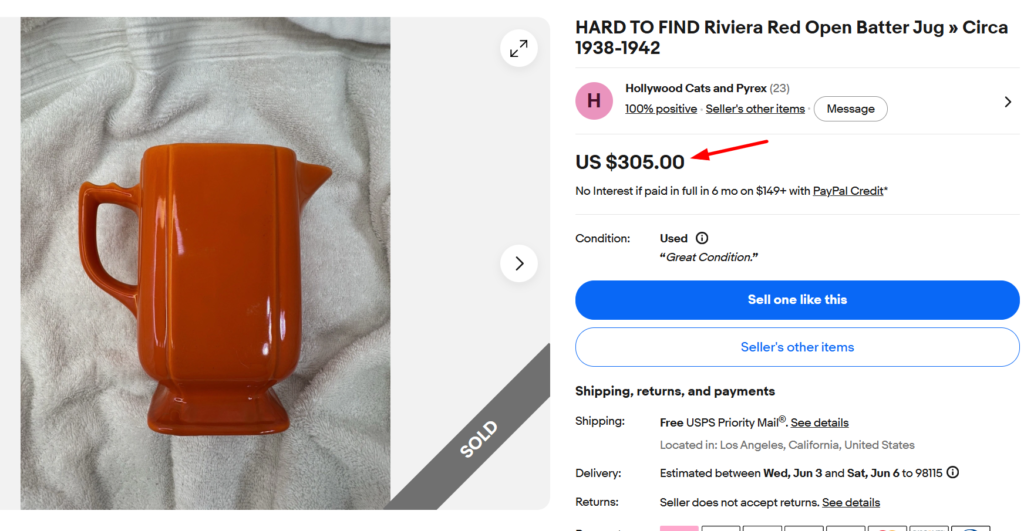
Sold for $305 (single jug)
Riviera was a solid-color line dipped on the Century shape, basically an unmarked, lighter-weight cousin of Fiesta sold through Murphy’s five-and-dimes. Colors were mauve blue, ivory, red, yellow, and light green.
The same body carried the Mexicana and Hacienda decals.
The ten-year run makes Riviera scarcer than Fiesta, even though it’s less famous. Also, pieces chip on the underside because the body is thinner than Fiesta. Rare butter dishes, batter jugs, and casseroles in mauve blue or red are most collectible.
- Estimated Value: $25 to $400+
- Production Year: 1938 to 1948
- What to Check: Solid color glaze, Century shape with cut corners
- Quick Notes: Mauve blue and red are the desirable colors.
2. Pastoral – Dinner Plates
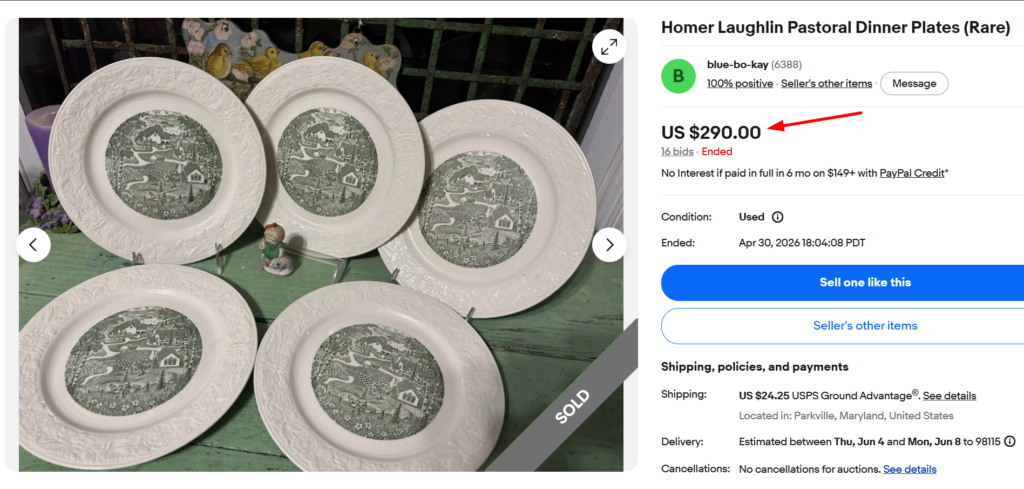
Sold for $290 (set of 5)
Pastoral was a Quaker Oats premium pattern from the mid-1950s — you’d pull a piece out of the oatmeal canister, each shape with a different green farm scene. Country church, barn with silo, harvest. HLC and Taylor Smith & Taylor shared production.
The 9-inch dinner plate is a rare size collectors hunt for, since most premium pieces were smaller plates and saucers. Each piece is marked with the company that made it, so HLC and TS&T are easy to differentiate.
- Estimated Value: $5 to $60 per piece
- Production Year: mid-1950s
- What to Check: Green farm-scene transfers, cream body
- Quick Notes: The 9-inch dinner plate is a rare size.
3. Harlequin – Yellow Butter Dish
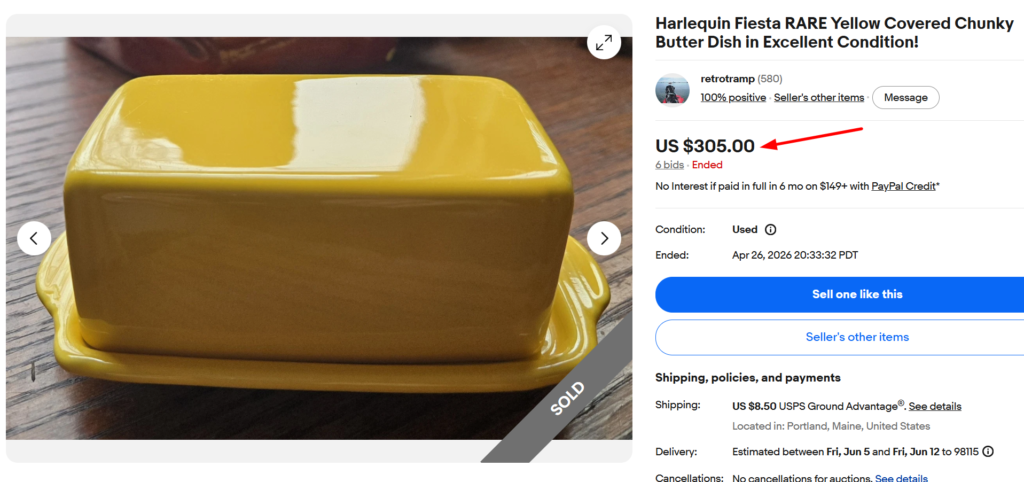
Sold for $305
Harlequin was designed by Rhead and sold exclusively through F.W. Woolworth’s. The shape has concentric rings like Fiesta, but with sharp, angular handles. Original colors in 1938 were spruce green, maroon, mauve blue, and yellow.
The short-run colors are the valuable ones. Spruce green and maroon were discontinued by 1942. Medium green came late in 1959 and was made in small quantities; it’s the most expensive color. Yellow and turquoise are affordable.
- Estimated Value: $30 to $500+ (high for rare colors like Medium Green)
- Production Year: 1938 to 1964 (revived 1979-1982)
- What to Check: Concentric ring design, angular Art Deco handles
- Quick Notes: Medium green is the holy grail color
4. Cavalier Eggshell – Dinner Set
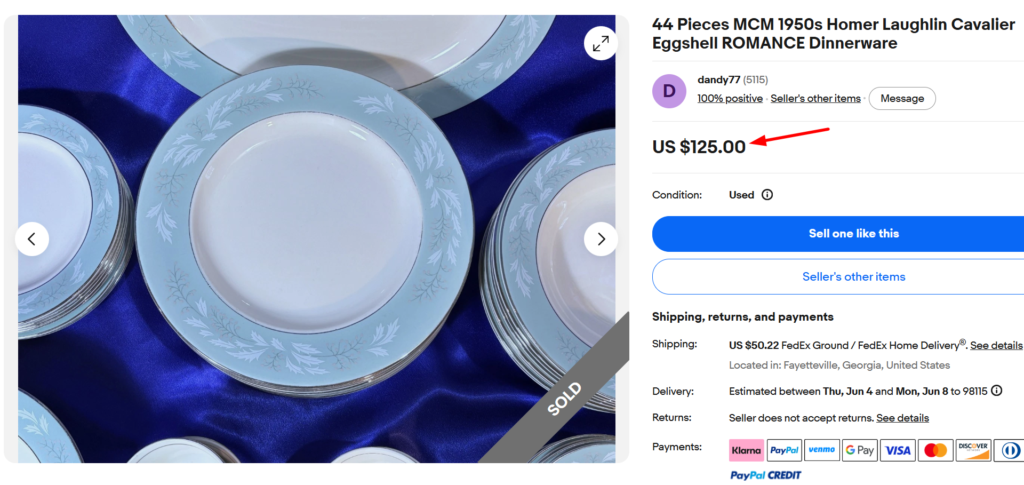
Sold for $125 (set of 44 pieces)
Cavalier was the last of the Eggshell lines, also designed by Don Schreckengost. It uses a flat rim instead of the embossing on Georgian or the scalloped rim of Nautilus, giving it a more formal, modern look.
Cavalier Eggshell Berkshire (gold rim with a teal band and floral center) and Turquoise Melody are the patterns that push the prices high. Complete sets bring strong money, but make sure the gold trim is sharp.
- Estimated Value: $15 to $200+
- Production Year: 1953 to early 1970s
- What to Check: Flat rim, lightweight eggshell body
- Quick Notes: Berkshire and Turquoise Melody are most desirable.
5. Hudson – Pitcher
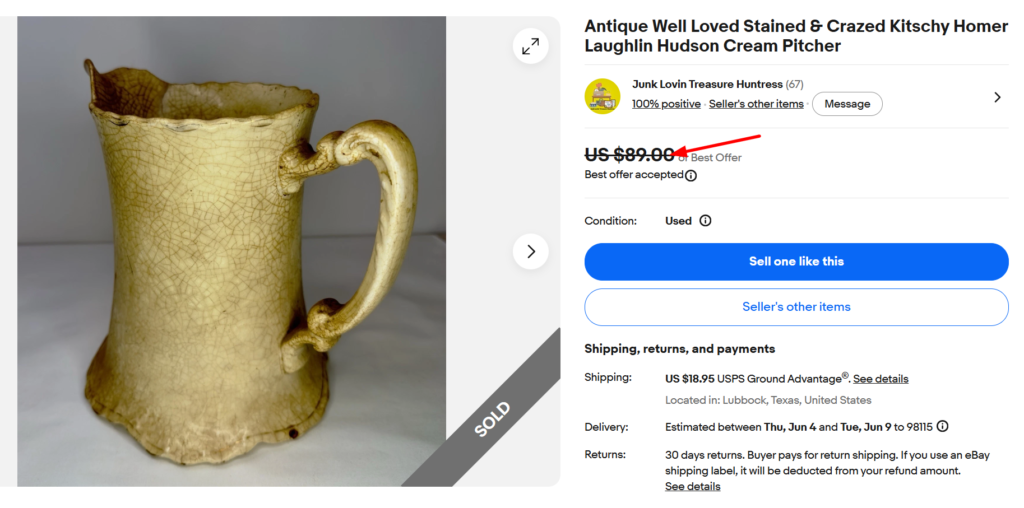
Sold for $90 (pitcher alone)
The Hudson cream pitcher is the smaller dairy version of the shape, about 4 to 5 inches tall, with a scalloped, wavy rim and a tightly scrolled handle. As an antique design, most surviving examples show heavy crazing, especially the cream ones.
Nonetheless, even pitchers with severe crazing and stains may sell well because the early Hudson shape stays in demand. Pristine examples with crisp gold trim and pre-1922 marks further add a premium.
- Estimated Value: $40 to $150+
- Production Year: c. 1908 to mid-1920s
- What to Check: Scrolled handle, scalloped rim, ivory body
- Quick Notes: Even heavily crazed examples still sell
6. Mexicana – Cups & Saucers Set
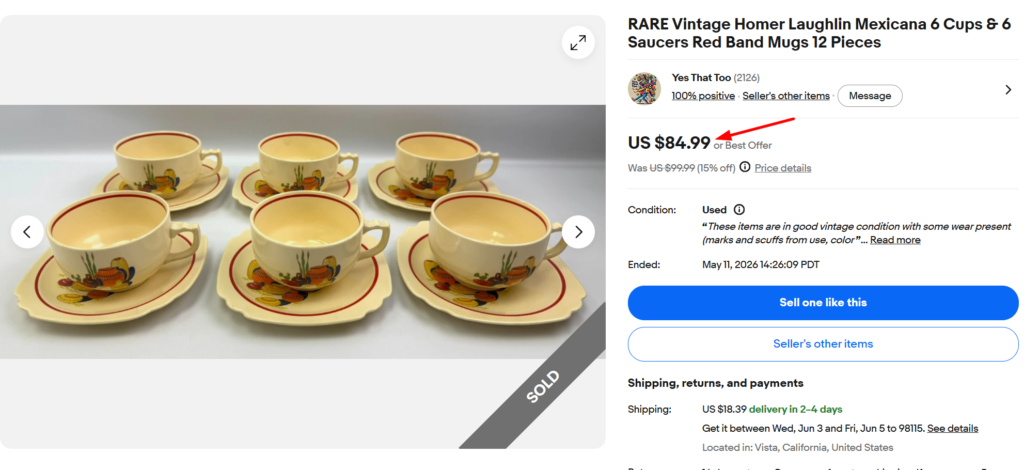
Sold for $80 (set of 16 pieces)
The Mexicana cup and saucer set is one of the tougher forms to find complete. Cups break, saucers chip, and matching pairs get separated. Saucers are square with cut corners and a hand-painted red border, since the Century shape carried the line.
A full set of six cups and six saucers in original condition is a rare find for Mexicana collectors. The red banding wears first under handles, so check the hand-painted stripes on every piece before paying a premium.
- Estimated Value: $60 to $300+ (for full six-place set)
- Production Year: 1938 to 1945
- What to Check: Square scalloped saucers, red band, Century shape
- Quick Notes: Matched pairs get separated over decades
7. Eggshell Georgian Cashmere – Square Plates
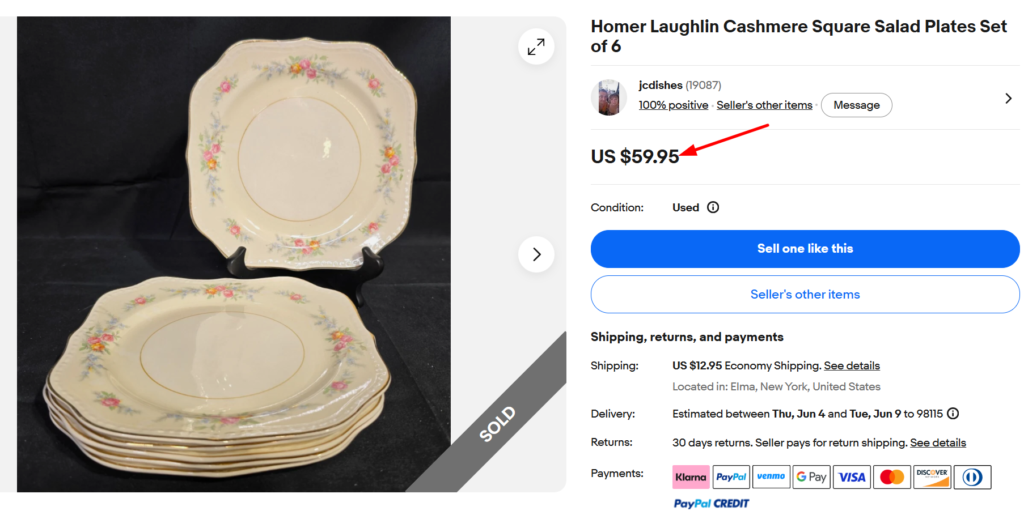
Sold for $60 (set of 6)
Eggshell Georgian was Homer Laughlin’s lightweight answer to European porcelain. The body is thinner than standard china, with a creamy ivory glaze and a subtle dash-and-dot embossed rim. Rhead described the style as “typically English.”
Over 70 decals were used on the shape. Cashmere (pink and gold bands), Countess (pink florals with mustard stripes), and Heather Rose are the patterns that fetch high values, especially as complete services with serving pieces.
- Estimated Value: $15 to $200+
- Production Year: 1937 to 1959:
- What to Check: Dash-dot embossed rim, thin ivory body
- Quick Notes: Cashmere and Countess decals run highest
8. Golden Wheat – Place Setting
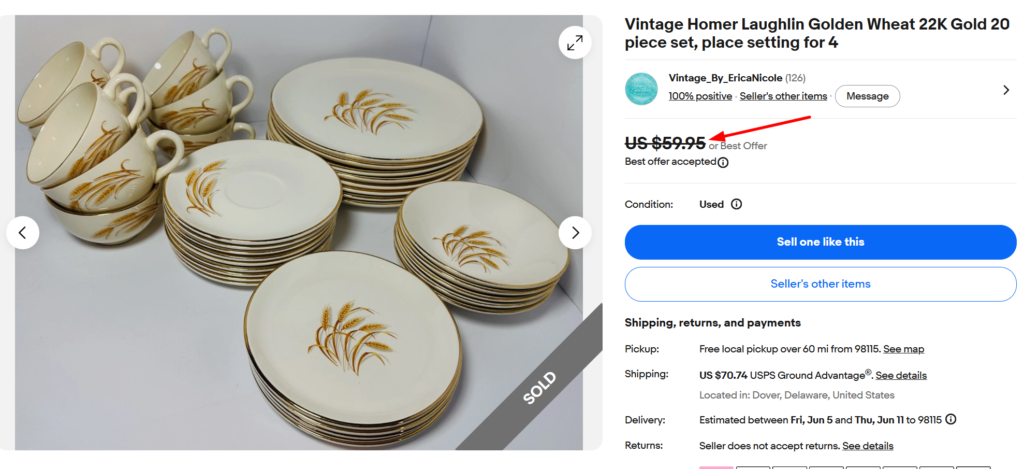
Sold for $60 (place setting for 4)
Golden Wheat (sometimes just called the “Wheat pattern”) was launched in 1949 as a Duz Detergent premium. You’d find a piece inside the soap box, so building a large set takes too many boxes and too much time, making them rare.
The value of this pattern lies in the 22k gold wheat sprays and rim. Pieces with crisp gold can pull $40 to $80 each. The same pieces with dishwasher-worn gold drop below $5.
- Estimated Value: $5 to $80
- Production Year: 1949 to mid-1960s
- What to Check: Gold wheat sprays, 22k gold trim, ivory body
- Quick Notes: Worn gold drops in value sharply.
9. Virginia Rose Fluffy Rose – Dinner Plates
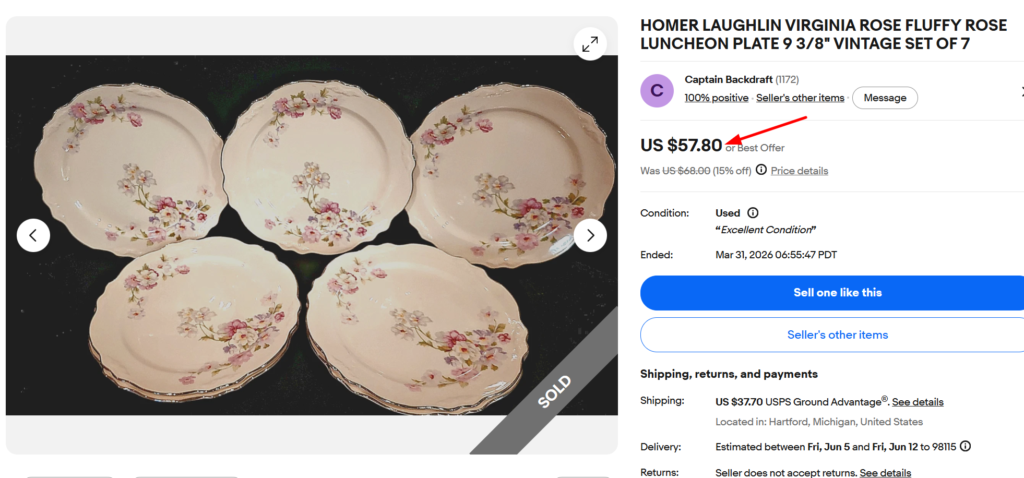
Sold for $57 (set of 7)
Virginia Rose is the shape, not the pattern. It features a scalloped rim with embossed rose swags, named after W.E. Wells’ granddaughter. It carried more than 250 decals. The Fluffy Rose treatment (factory code VR-128) is the most recognizable.
The lunch or dinner plates are the most common pieces, while covered serving pieces, soup tureens with lids, gravy boats with underplates, butter dishes, and ladles are rare and more valuable.
A complete Fluffy Rose tureen with its lid pushes a Virginia Rose set into the hundreds.
- Estimated Value: $20 to $400+
- Production Year: 1932 to 1968
- What to Check: Pink blousy roses, scalloped rim, gold trim
- Quick Notes: Covered tureens and ladles are rare.
10. Yellowstone – Bouillon Cup & Saucer Set
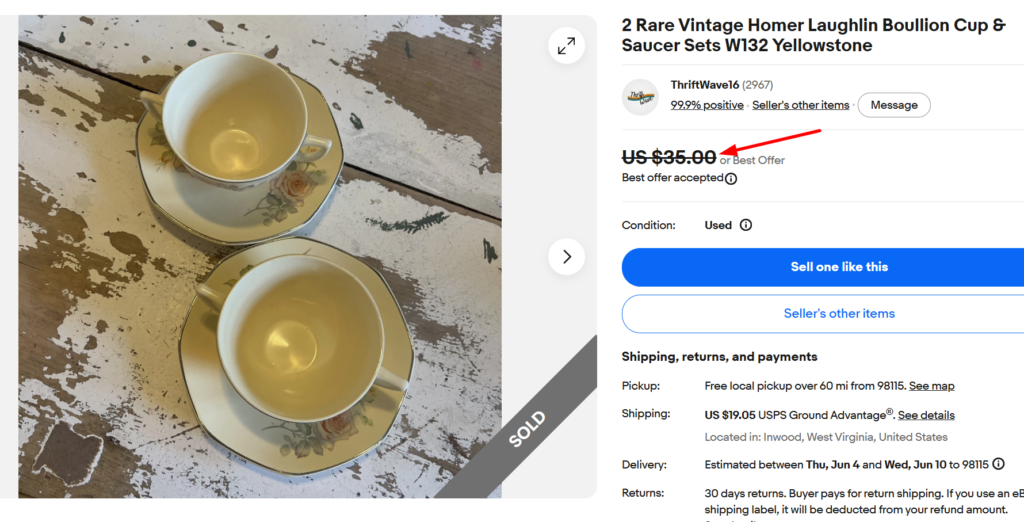
Sold for 35 (pair of two)
Yellowstone is one of the most distinct Homer Laughlin shapes ever made. It features octagonal designs with no embossing, paired with sharply geometric hollowware.
It was a hit in the late 1920s, with HLC running three plants full-time on Yellowstone production at peak. The design appeals equally to Art Deco enthusiasts and Homer Laughlin collectors, which keeps the values steady.
Coffee sets, tea sets, and covered casserole dishes are rare, while octagonal plates are common.
- Estimated Value: $30 to $250+ per piece
- Production Year: 1926 to mid-1930s
- What to Check: Octagonal plates, Art Deco geometric hollowware
- Quick Notes: Solid color and gold-decorated pieces top the market
11. Rhythm Rose – Platter
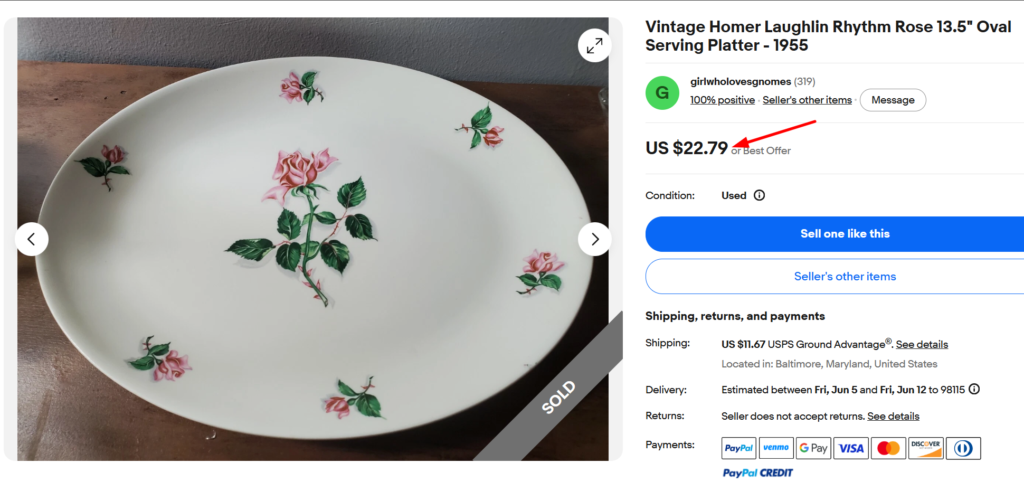
Sold for $22 (single piece)
Rhythm was a coupe shape introduced in September 1950 by Don Schreckengost (Rhead’s successor). It’s a sleek, rimless alternative to the older embossed lines. Rhythm Rose was the decal version, with pink and red roses on the plain coupe body.
The pattern is popular among both Homer Laughlin collectors and mid-century modern decor buyers. Serving pieces, like large platters, lidded casseroles, and the egg-shaped sugar bowl, are tougher to find and the ones to watch.
- Estimated Value: $10 to $150+
- Production Year: 1951 to 1958
- What to Check: Coupe (rimless) shape, pink rose decals
- Quick Notes: Large, rare serving pieces are more desirable.
12. Conchita – Serve Pie Plate
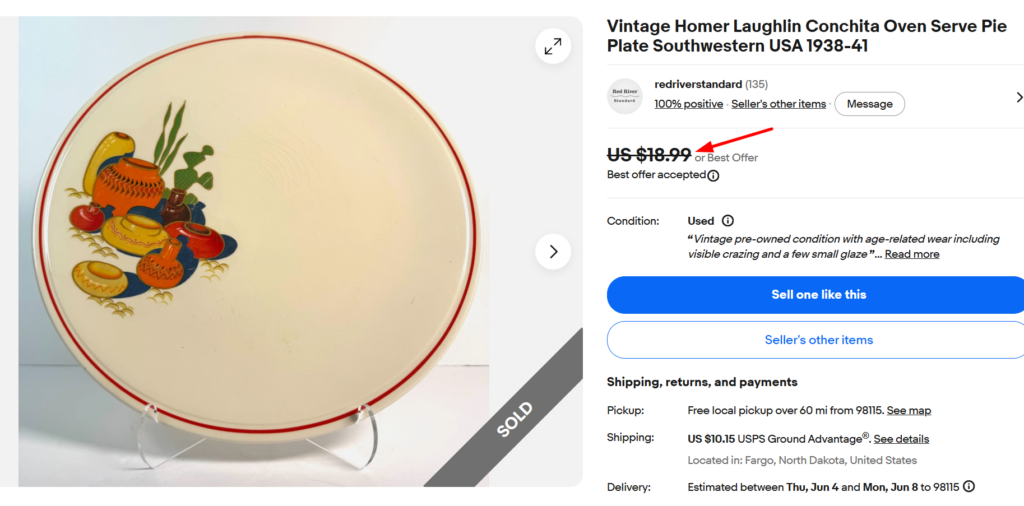
Sold for $19 (single plate)
Conchita is the third Rhead southwestern decal, the harder-to-find sister of Mexicana and Hacienda. The motif shows a yellow clay pot with a snake plant in a squat blue pot, a blooming cactus, and sometimes hanging fruit.
Production stretched from 1938 to 1941, even shorter than Mexicana, which makes intact pieces with crisp red banding tough to find. The Oven Serve pie plate is a common Conchita form, since the decal ran across multiple HLC shapes.
- Estimated Value: $20 to $200+
- Production Year: 1938 to 1941
- What to Check: Yellow pot, snake plant, cactus, fruit cluster
- Quick Notes: Scarcer than Mexicana or Hacienda
Most Homer Laughlin you’ll see today is common, worth $5 to $20 a piece. But the exceptions exist. So, if you’ve inherited a set, check the backstamp, read the date code first, identify the shape, and then match the decal to find out what you have.