
Old Ball jars are a common sight at a barn sale or in your grandma’s basement. While most people either donate them or sell them for a few bucks per lot, some rare Ball Mason jars are actually worth a few hundred dollars.
It’s worth knowing how to spot these special jars. So, save this guide to learn to identify an antique Ball jar, how to date it by the logo, what makes certain models valuable, and which ones actually sell.
History of the Ball Jar Company
The Ball Company’s history begins in 1880 when five brothers – Edmund, Frank, George, Lucius, and William – formed the Wooden Jacket Can Company in Buffalo, New York. The company was formally known as Ball Brothers Glass Manufacturing Company after its incorporation in 1886.
After the destruction of their Buffalo plant through fire, they relocated to Muncie, Indiana, in 1887 to exploit cheap natural gas. Glass production began in 1888.
From there, Ball grew fast. By the year 1900, the U.S. Census referred to it as the largest fruit jar factory in the world. This sort of domination is precisely what makes the presence of Ball jars so prevalent and why collectors care so much about the small details between an ordinary one and a rare one.
How to Identify an Antique or Vintage Ball Jar?
Ball made hundreds of jar variations over 100+ years. Identifying the old from the new comes down to a few clear signs. Here’s a detailed breakdown for each sign you need to check.
The Logo – How To Tell How Old a Ball Jar Is?
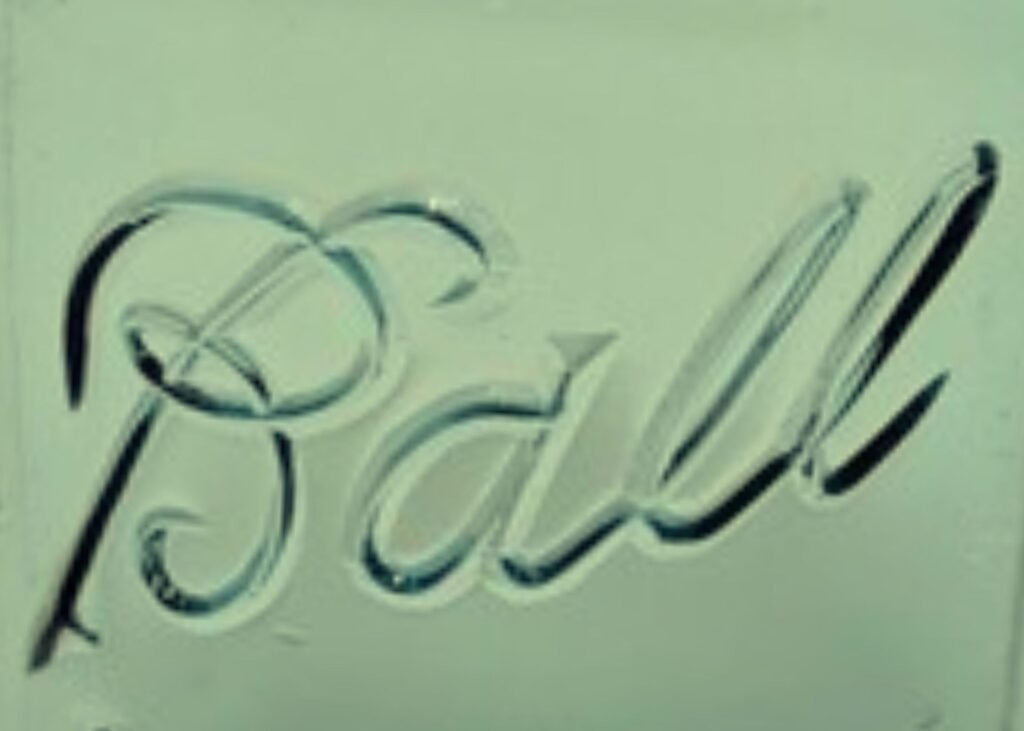
Ball changed its logo about eight times between the 1880s and today. Each version dates to a fairly tight window, so if you can match the script style on your jar, you can narrow the age to a decade or two.
Use this simplified Ball logo timeline:
- 1885 to 1886 (BBGMCo logo) – These are the “Buffalo jars,” made when the company was still called Ball Brothers Glass Manufacturing Company. They’re rare, and finding one is a big deal.
- 1892 to 1896 (Block letters) – Straight, capital-letter “BALL,” no cursive yet.
- 1895 to 1896 (First script logo) – The first cursive Ball logo, sitting flat instead of slanting.
- 1900 to 1910 (The “3-L” logo) – The last “L” has a decorative loop that looks like a third L. Collectors call this the 3-L logo, and it’s a great find.
- 1910 to 1923 (Underscore under Ball) – The word “Ball” has a straight line under it.
- 1923 to 1933 (No underscore) – The line is gone, but the loopy script stays.
- 1933 to 1962 (Looped B) – The B has a soft, connected loop at the bottom.
- Post-1962 (Modern block script) – Simpler letters, and after 1975, you’ll see the ® registered trademark symbol.
Handy tip: if you see the “®” symbol anywhere on the logo, your jar was made after 1975, no matter how old the design looks.
The “13” Myth – What Does the Number on the Bottom Mean?
There is a misconception that the number “13” on the bottom of Ball jars indicates rarity and value. Let’s clear that up.
The numbers on the bottom of the jars, often ranging from 0 to 15, are actually mold numbers. Nothing more. They just tell you which mold cavity in the jar-making machine produced that piece. They do not indicate the year, and they do not add value.
The “13 = unlucky, therefore rare” story is just a myth. The value of a “13” ball jar is about the same as any other mold number, depending on age and color. If you are being quoted a high price for a “13 jar,” don’t buy it.
Another fact that will help you out is the number of jars that have the inscription “Pat’d Nov 30th 1858” or “Pat’d July 14, 1908.” These are not dates when the jars were manufactured, but patents.
Jar Types and Model Names Ball Used
The Ball Jar Company didn’t just make one jar. They ran several different lines, and the model name embossed on the front is another big dating clue. Here are the most common embossings you will come across:
- Ball Perfect Mason (c. 1913 to 1960) – The most common Ball jar ever made, with over a billion produced. Standard screw-top with the zinc lid or two-piece band. The 1913 to 1914 versions have offset “PERFECT” lettering because Ball added the word to older MASON molds.
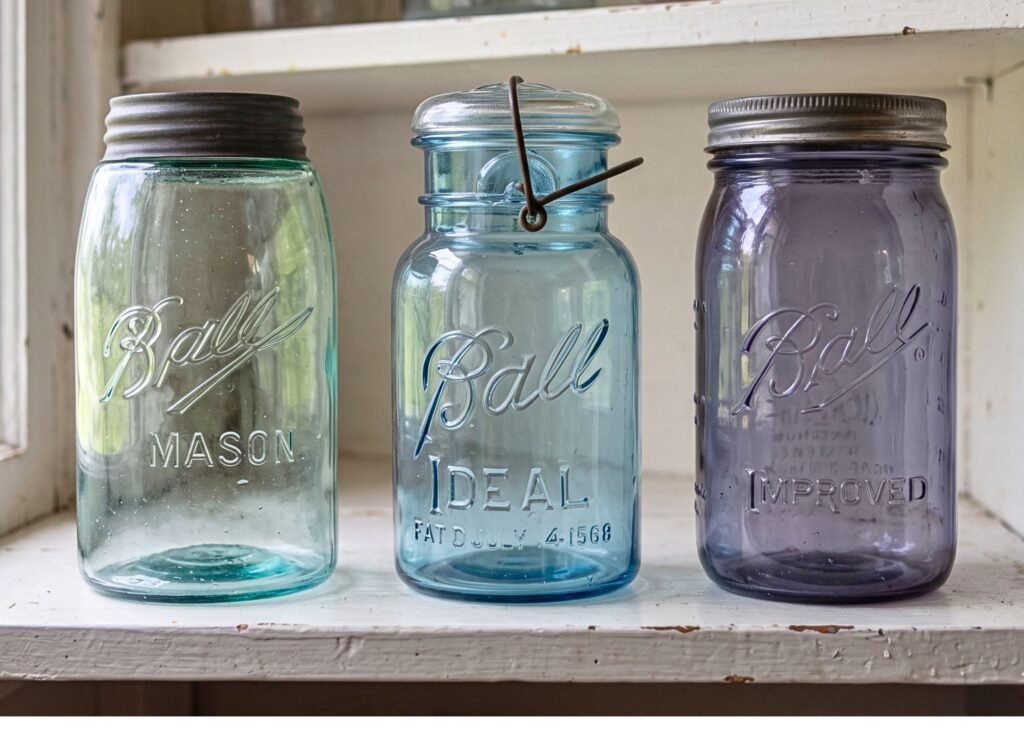
- Ball Ideal (c. 1915 to 1962) – The wire-bail jar with a glass lid. You’ll usually see “PAT’D JULY 14, 1908” embossed on it. That’s the patent for the wire clamp, not the production year.
- Ball Improved – Uses a screw band plus a glass lid disc. Wide variety of sub-types.
- Ball Sanitary Sure Seal – Wide-mouth jar with a wire clamp closure.
- Ball Special – Made only briefly in the early 1900s to 1910s. Has “SPECIAL” embossed on the front.
- Ball Eclipse – Made from about 1926 to 1952, with a lightning-style wire closure.
- Ball Bicentennial (1976) – Made for America’s 200th birthday. Embossed with “1776–1976” and a Liberty Bell.
Each of these designs comes with its own style of closure and design, meaning that just by identifying the model name, you can tell the era.
Closure Type: Zinc Lid, Glass Lid, or Modern Two-Piece
The closure tells you almost as much as the logo does. Most Ball jars have one of the following types of closures:
- Wax seal groove – The earliest closure system. Look for a shallow ring around the top instead of screw threads. These jars are usually pre-1900.
- Zinc lid with milk-glass liner – Common on jars pre-1930s. If the original zinc cap is still there, that adds meaningful value.
- Glass lid with wire bail – The Ideal jar’s setup. A matching, unbroken glass lid boosts the price a lot.
- Two-piece dome lid – The standard flat lid plus screw band we still use today. This came in around 1915 and is what most modern jars use.
Original closures matter more than many people realize. A jar with its matching original zinc cap or glass lid and wire bail can be worth 20% to 30% more than the same jar with a replacement.
Shape, Seams, and Manufacturing Method
The shape and seams let you know whether a jar is hand-blown or machine-made. Until around 1905, most glass was blown by mouth. Jars show a seam that does not extend to the top, along with a coarse, ground-off top.
These are normally the oldest and most unusual.
After 1905, the Owens automatic bottle machine changed everything. Machine-made jars have seams that run all the way up and over the rim. The base often has a circular “Owens scar,” a round mark left by the machine’s suction cup.
Shape matters too. Round jars dominated for decades. Square jars, like the Ball Square Mason, showed up in the 1930s. So if your jar is square with corners, it’s not one of the earliest.
7 Collectible Ball Jars That Sell Fast Today
Let’s take a look at some of the most collectible Ball jars that are actively collected today, along with their key features and their real values.
1. Sun-Purpled Ball Perfect Mason
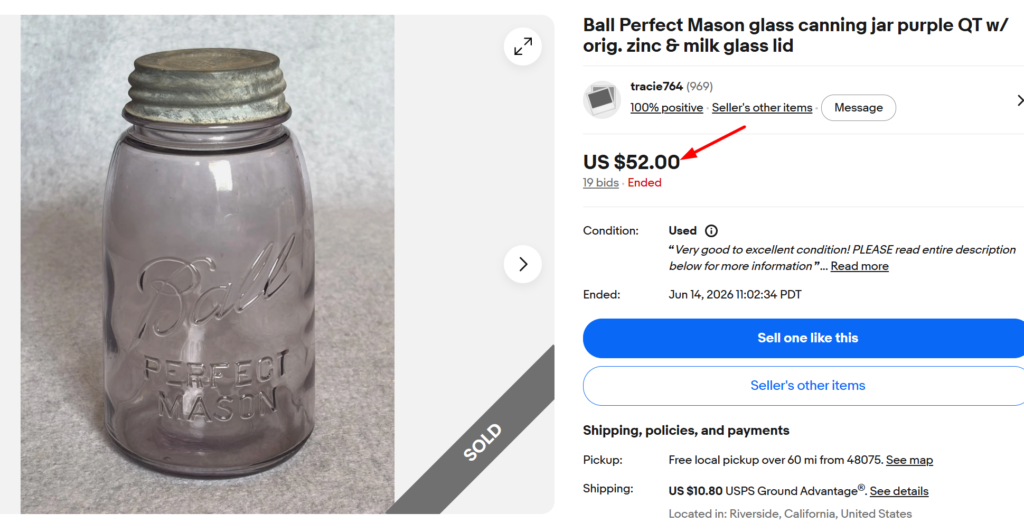
Sold for $52
Real amethyst Ball jars started life as clear glass with manganese added to keep them colorless. But decades in the sun turned that manganese amethyst. And since manganese was replaced after WWI, a soft purple Perfect Mason usually dates to before 1915.
However, it can be tricky to spot real sun-purpled jars from artificially irradiated ones. So, check this – natural amethyst tends to look uneven and softer; irradiated purple is dark, uniform, and almost too rich.
- Estimated Value: $50 to $325+
- Production Years: Before 1915 (manganese era)
- What to Check: Soft uneven purple, pre-1915 logo style
2. Amber Ball Perfect Mason Quart
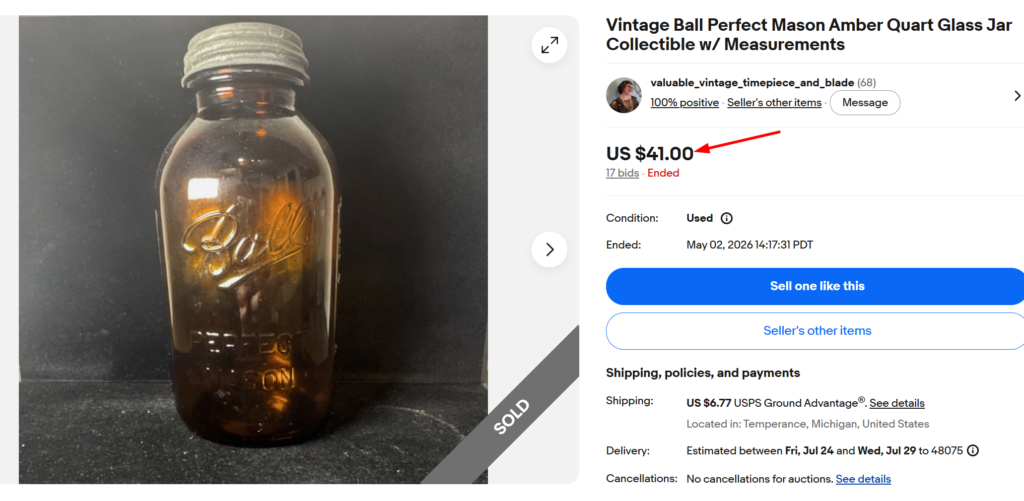
Sold for $41
Genuine antique amber Ball jars are uncommon and highly collectible. The rich caramel-brown color came from adding manganese and carbon to the batch, and it was meant to protect food from light.
Plus, most were made between 1890 and 1910. But be careful. Ball’s modern Elite Collection includes 32-oz amber wide-mouth jars from around 2015.
- Estimated Value: $50 to $300
- Production Years: c. 1890 to 1910 (antique era)
- What to Check: Logo era, ® symbol absent
3. 3-L Ball Logo Jar
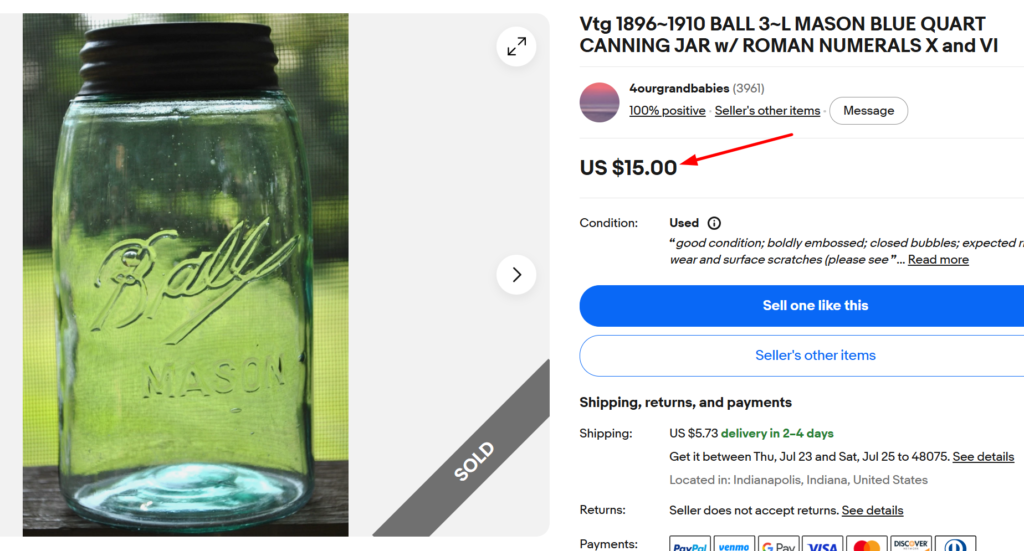
Sold for $15
The 3-L logo is easily one of the most fun Ball jar finds. Look at the last “L” in “Ball,” if it has a decorative curl that looks like a third L, you’ve got a 3-L jar from between 1900 and 1910. Collectors love this variant because the window was so short.
Also, since these predate machine production, many were still hand-blown or semi-automatic. So, bubbles, irregular seams, and a slightly wavy body are common.
- Estimated Value: $10 to $150
- Production Years: 1900 to 1910
- What to Check: Third “L” loop in Ball script
4. Ball Improved With Matching Glass Insert Lid
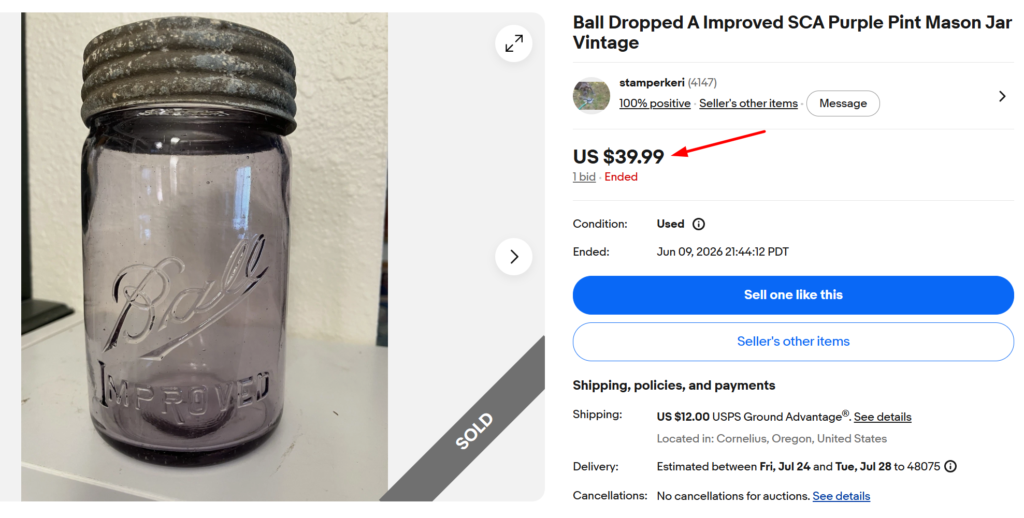
Sold for $40
The Ball Improved line used a two-part closure system, a glass insert lid held down by a metal screw band. When the original glass insert is still there, and it fits properly, the jar is worth a lot more.
You’ll find Improved jars in aqua, clear, and sometimes purple and green. Sizes range from half-pint to half-gallon. Large, colored Improved jars hold more value.
Rare BBGMCo Improved amber examples from the Buffalo era are among the most valuable of all.
- Estimated Value: $20 to $250 (rare amber examples much higher)
- Production Years: Late 1890s to 1930s
- What to Check: Matching glass insert, band condition
5. Ball Perfect Mason With Offset Embossing
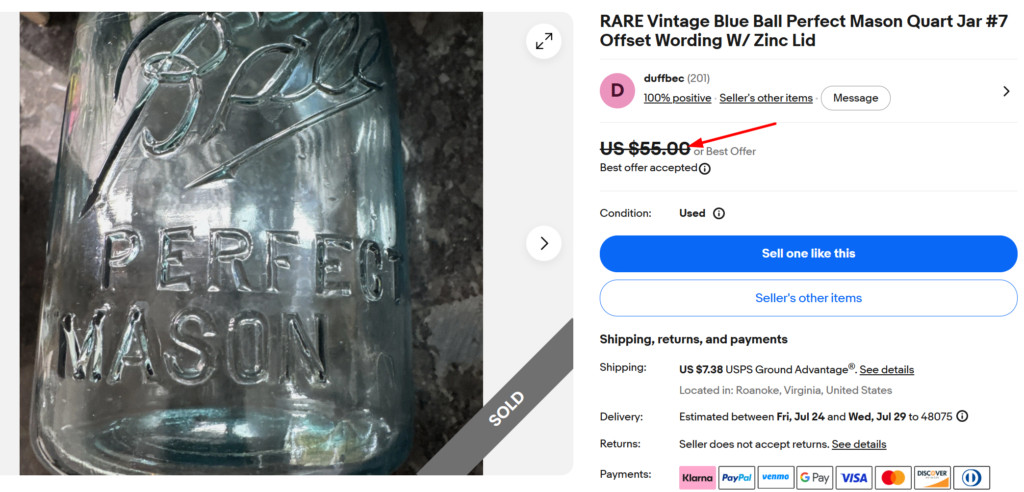
Sold for $55
These are actually first-year Perfect Mason jars, not errors. When Ball introduced the Perfect Mason in 1913, they added the word “PERFECT” to their existing MASON molds. So, the word “PERFECT” is jammed in wherever it would fit, sometimes off to the side.
By 1915, Ball cut new molds with centered embossing. So any offset Perfect Mason is easily dated to 1913 to 1914. They’re not super rare, but still collectible.
- Estimated Value: $10 to $60
- Production Years: 1913 to 1914 only
- What to Check: PERFECT offset from center on front
6. Green Ball Perfect Mason
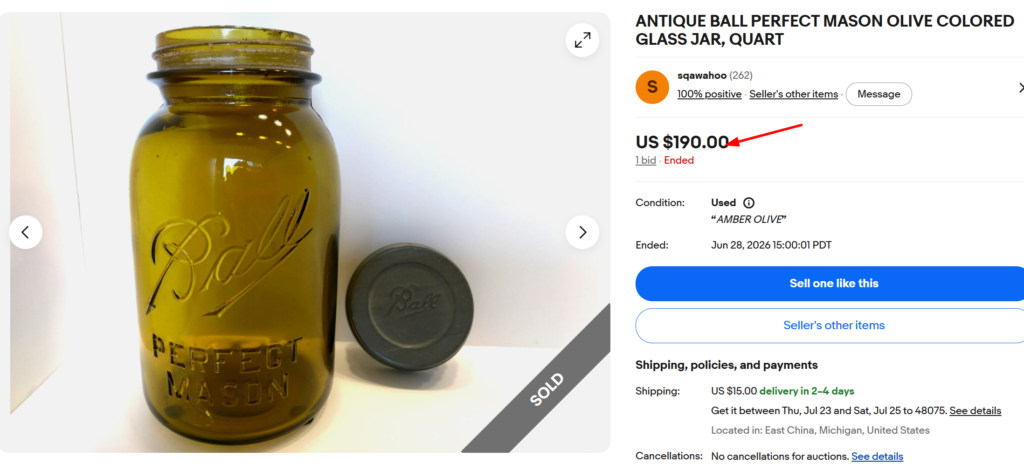
Sold for $190
Green Ball jars aren’t as famous as blue ones, but they’re much scarcer. Shades range from a light olive to a deeper forest green. Really vibrant emerald and deep olive green examples are the ones collectors chase.
Half-gallon sizes and jars in deep green shades with strong embossing usually bring the top prices.
Handy Tip: Make sure the color runs through the whole jar and isn’t painted or dyed.
- Estimated Value: $80 to $300+
- Production Years: Various, mostly 1913 to the 1930s
- What to Check: Green color (Deep Olive to Forest)
7. Ball Bicentennial Jar
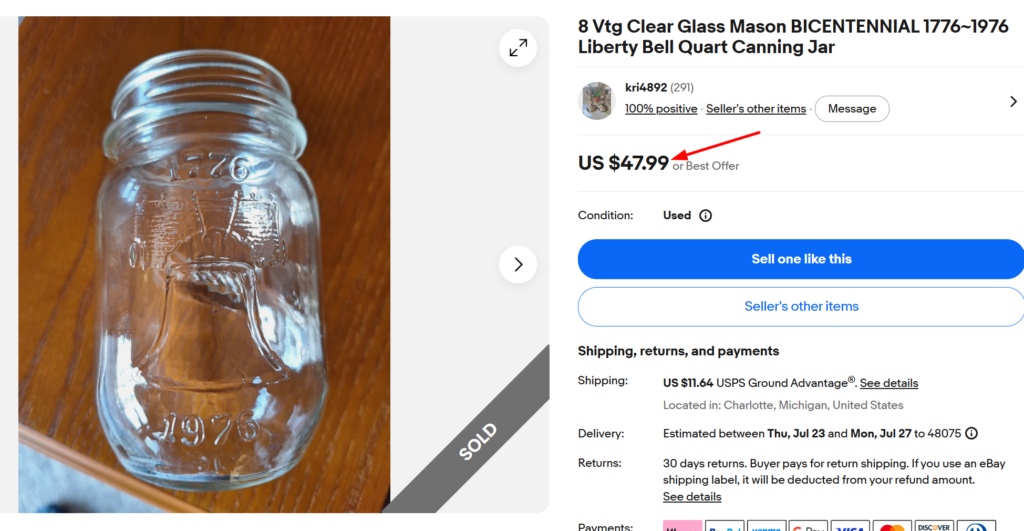
Sold for $48
Made for America’s 200th birthday, the Ball Bicentennial jars feature “1776–1976” and the Liberty Bell on the front. Most were produced in clear or aqua glass, and they’re widely available, so common ones sell in the $5 to $20 range.
Some Milk-glass Bicentennial versions also exist and are much scarcer. These can be worth way more than clear ones.
- Estimated Value: $5 to $80+ for milk glass
- Production Years: 1976 only
- What to Check: Liberty Bell, “1776–1976” embossing
What Makes Vintage Ball Jars Valuable?
As you saw above, the value of antique Ball Mason jars can range from $20 to $500 or even more, depending on several aspects. The key factors that are responsible for a Ball jar’s value are:
Colors
The color of a Ball Mason jar moves the price more than almost anything else, so learn to spot the rare tones on sight. Here’s how the shades stack up, from most common to seriously rare.
- Aqua / “Ball Blue” (Common) – The classic pale blue-green. It comes naturally from iron in the sand. Beautiful, but common.
- Cornflower Blue and Deep Sapphire (Uncommon) – A much richer, deeper blue than standard aqua. Harder to find and fetch a premium.
- Amber (Uncommon) – Made mostly between the 1890s and 1910 to protect contents from light. Genuine antique amber is desirable. Just watch out for the modern Elite Collection amber jar (2015).
- Green (Uncommon to Rare) – Much scarcer than aqua. Shades run from soft olive to deep forest. Unusual shades (emerald and dark olive) go higher.
- Purple / Amethyst (Rare) – These jars were made around 1913 to 1915, using Manganese to keep the glass clear, but decades in the sun turned it a soft amethyst. So real sun-purpled Ball jars almost always date to before 1915, since manganese use ended after WWI.
- Pink (Very Rare) – Genuine pink Ball jars are unicorns. Rare, but any true pink jar needs close authentication.
- Olive, Black, Yellow, Milk Glass (Extremely Rare): – These barely show up. When they do, they can push into the hundreds or even thousands.
Size
The jar’s size matters more than you think. Half-pints and half-gallons often bring more than pints and quarts, which are the most common sizes. Anything unusually large, like a 5-gallon display jar, or unusually small, gets serious collector attention too.
Condition
This can make or break the value of a Ball jar. Chips, cracks, hazing, and “sickness” (interior white haze from mineral buildup) all pull value down fast, while sharp embossing and clean glass push it up.
Good to Know: Bubbles, irregular seams, swirls, and a slightly wavy body are common signs of age and hand-made production, not condition issues.
Embossing errors
Manufacturing errors like the famous 3-L logo, misspellings, or offset lettering can add real value. The 1913 to 1914 offset “PERFECT MASON” jars are common, but true typos and one-off errors are collector prizes.
Original closures
A jar with its original closures can be worth 10% to 30%, sometimes more on scarce jars, than those without the lid. Also, a matching zinc lid with its milk-glass liner, or a wire bail with the original glass lid, always beats a replacement.
Ball jars are historic. Some are worth a few dollars, some are worth a small fortune. So, take your time with the logo, look at the color in real daylight, check the closure, while sorting your old jars.