
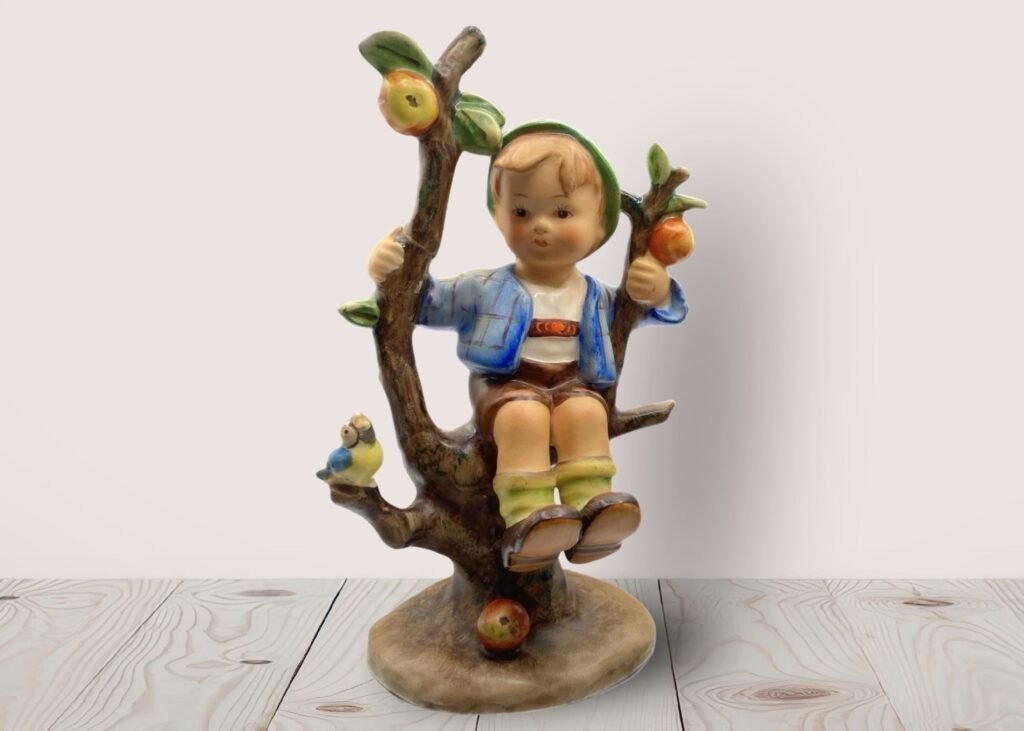
If you’ve ever seen these adorable childlike porcelain figures that look straight out of a painting, there’s a high chance it’s a Hummel figurine. Hummel figurines are common at estate sales. The pigtailed girl and the violinist boy show up everywhere and mostly sell for $20 to $40.
But there are some Hummel pieces that have also sold for as much as $25,000. And this value gap is where most collectors get lost.
This guide walks through easy steps to spot valuable Hummel figurines, what the bottom marks mean, how to spot fakes, and which Hummels are worth looking at today.
What are Hummel Figurines? (Brief History)
The Hummel figurines are childlike porcelain figures, based on Berta Hummel’s drawings, an art student from Bavaria who joined the Convent of Siessen in 1931. She later changed her name to Sister Maria Innocentia.
Her round-face drawings attracted the attention of Franz Goebel, the head of W. Goebel Porzellanfabrik of Oeslau, Germany. They entered into a licensing agreement in 1934, with the first doll figures unveiled at the Leipzig trade fair in 1935.
Puppy Love was the first figure to be released from the line. Her sister, Hummel, retained control over all designs.
After Sister Maria’s death from tuberculosis at the age of 37 in 1946, American GIs stationed in Germany sent tens of thousands of Hummels back home, initiating the Hummel craze in America. Hummels were made by Goebel until 2008; they are now being made by Manufaktur Rödental since then.
How to Identify a Genuine Hummel Figurine?
Each and every authentic Hummel will reveal its date of manufacture and mold origin, providing that you know how to decipher it. Virtually all such data is printed on the bottom of the figurine.
The trademark stamp indicates the age of the figurine; the mold number shows the model, while the size identifier shows the particular version. Knowing how to read these three marks will enable you to assess the value of virtually any Hummel within one minute.
The Hummel Trademark Stamps (TMK-1 to TMK-9)
The Goebel factory changed its trademark stamp nine times between 1935 and today. Each change marks a different production era, and earlier marks usually mean higher value.
For example, a Crown Mark piece can sell for ten to twenty times what the same mold fetches in a 1980s mark.
Some figures even have two stamps simultaneously, which indicates that the figure was molded in one time period and then painted in another. These items are referred to as “transitional” pieces and are always more valuable than single-stamp pieces.
Here’s a quick reference to all nine Hummel TMK marks:
| TMK | Name | Years | Description |
| TMK-1 | Crown Mark | 1935–1949 | Crown with intertwined “WG” initials. |
| TMK-2 | Full Bee | 1950–1959 | Detailed bee inside the “V.” (variations exist) |
| TMK-3 | Stylized Bee | 1960–1972 | Bee (dot+triangle wings) inside the “V.” |
| TMK-4 | Three Line Mark | 1964–1972 | Stylized bee + 3 lines: “© by W. Goebel W. Germany.” |
| TMK-5 | Last Bee / Goebel Bee | 1972–1979 | Small bee on “Goebel.” |
| TMK-6 | Missing Bee | 1979–1990 | “Goebel W. Germany.” |
| TMK-7 | New Crown / United Goebel | 1991–1999 | “W.” dropped. + Small crown |
| TMK-8 | Millennium Bee | 2000–2008 | Modern bumblebee above “Goebel” |
| TMK-9 | Manufaktur Rödental | 2009–present | Yellow-black bee on an oval with “Original M.I. Hummel Germany.” |
A Handy Tip: Anything marked just “Germany” (not “W. Germany” or “West Germany”) and carrying a Crown stamp likely predates 1945, which is the rarest possible window.
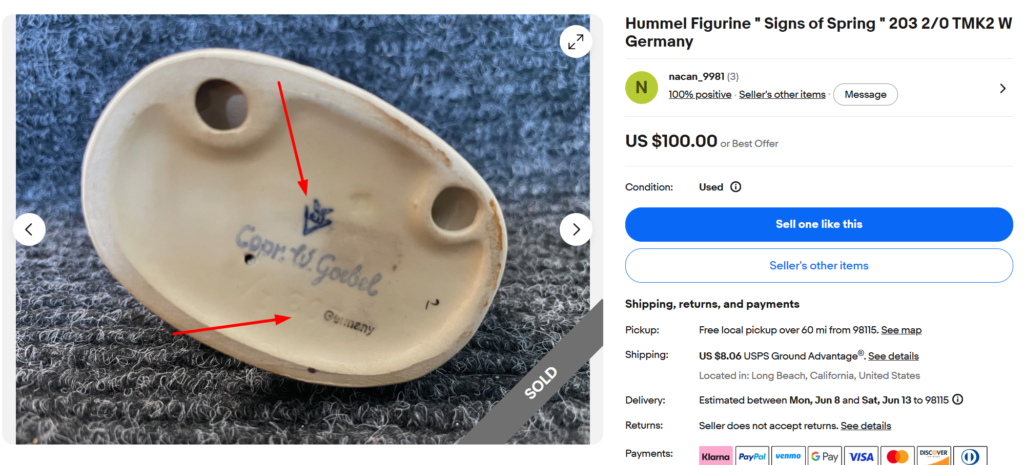
Other Bottom Markings
The base of a real Hummel is busy. There are usually four or five things stamped or incised into the porcelain, and every one of them tells you something. If a piece is blank or has only a single mark, slow down before buying.
Here’s what to look for on the underside, apart from the TMK marks described above:
- Mold number – This is the “HUM” number. An incised number like “7” for Merry Wanderer or “47” for Goose Girl. It identifies the design.
- Size designator – A slash followed by a number or Roman numeral, like “/0,” “/I,” “/II,” or “/X.” Bigger numbers mean bigger figurines, and “/X” is jumbo.
- M.I. Hummel signature – An incised signature in script, usually on the side or back of the base. Required on every authentic piece.
- Painter’s mark – It refers to a small marking consisting of letters or numbers that indicates the name of the artist.
- Copyright line – Something like “© by W. Goebel” or just “© by Goebel,” often with a year that refers to the mold’s original design date.
The most confusing of these marks is the design year of the mold. For instance, if an item is marked “1957,” it doesn’t necessarily mean that it was made in that year; rather, it indicates the year that the mold was created, and the piece could be from anywhere between 1957 and today.
Real vs Fake Hummel Figurines
Hummel reproductions date back as far as the genuine pieces themselves. There was an influx of fake pieces from Japan and Taiwan in the late 1950s until the 1970s. But these are generally easy to spot.
Here are the authentication signs you should look for:
- Crisp, clearly incised M.I. Hummel signature in cursive script
- A Goebel trademark on the base (any of the TMKs listed above)
- An incised mold number, not painted or stickered
- Hand-painted details with subtle color variation, not flat machine-printed color
- Substantial weight for the size, with a smooth, slightly glassy glaze
In contrast to this, fakes and reproductions usually show the following signals:
- “Hummel style” or “Designed by Hummel” instead of the signature
- Made in Japan, Korea, or Taiwan marks on the figurine
- Paper-label signature that comes off easily
- Too bright, solid, uniform colors with no shading
- Bottom that is smooth without any signs of decoration
- Proportions that seem incorrect (too large eyes, too rosy cheeks, etc.)
The Berta Hummel line from the late 1990s and 2000s, marked “BH” followed by a number, is another point of confusion. These are licensed but were made in Asia, not Germany, and are worth a fraction of true Goebel-made Hummels.
13 Rare & Valuable Hummel Figurines to Look for
Not every old Hummel is worth big money. Below are the pieces that consistently sell for hundreds (or sometimes thousands) of dollars on eBay and auctions.
1. Puppy Love (HUM 1)
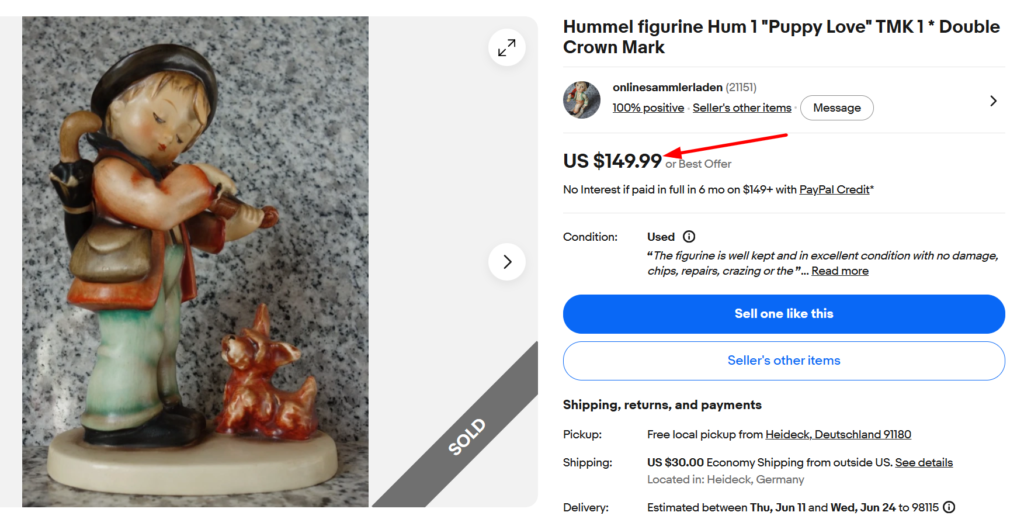
Sold for $150
Puppy Love was the first Hummel ever made. It shows a young violinist with a small dog at his feet. Finding an example with a real Crown Mark is one of the rarest finds in collecting.
Also, Goebel discontinued the piece during the TMK-6 era with a “Final Issue” backstamp in 1988, making it highly desirable. There’s also a rare prototype “no tie” variant, with the head tilted differently. These pieces were sold as factory samples and can reach $1,500 to $5,000.
- Estimated Value: $150 to $5,000 (depending on variant)
- Production Years: 1935 to 1988
- What to Check: Crown Mark, “no tie” prototype variant
- Quick Notes: First Hummel ever produced.
2. Adventure Bound (HUM 347)
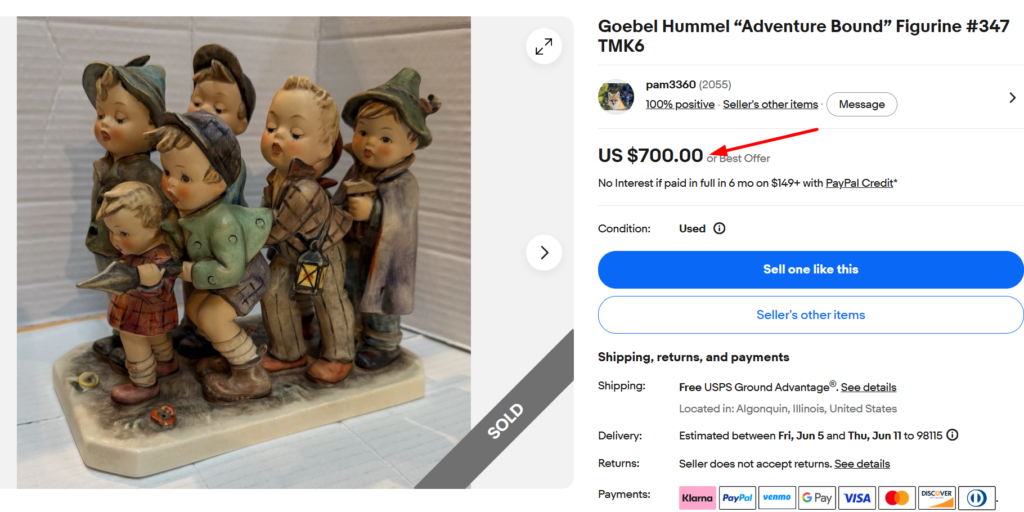
Sold for $700
Adventure Bound shows seven boys hiking together, which is why it’s also called “Die sieben Schwaben” (The Seven Swabians). Theo Menzenbach designed this figure around 1955, and Goebel released it to the U.S. market in the early 1970s.
The value depends almost entirely on the trademark. Later marks bring a few hundred dollars, but rare TMK-2 Full Bee examples have hit $6,000 to $9,000 at auction.
- Estimated Value: $250 to $9,000 (depending on TMK)
- Production Years: Modeled 1955; released early 1970s onward
- What to Check: TMK, all seven figures present
- Quick Notes: Multi-figure groups command high premiums.
3. Large Nativity Set (HUM 260)
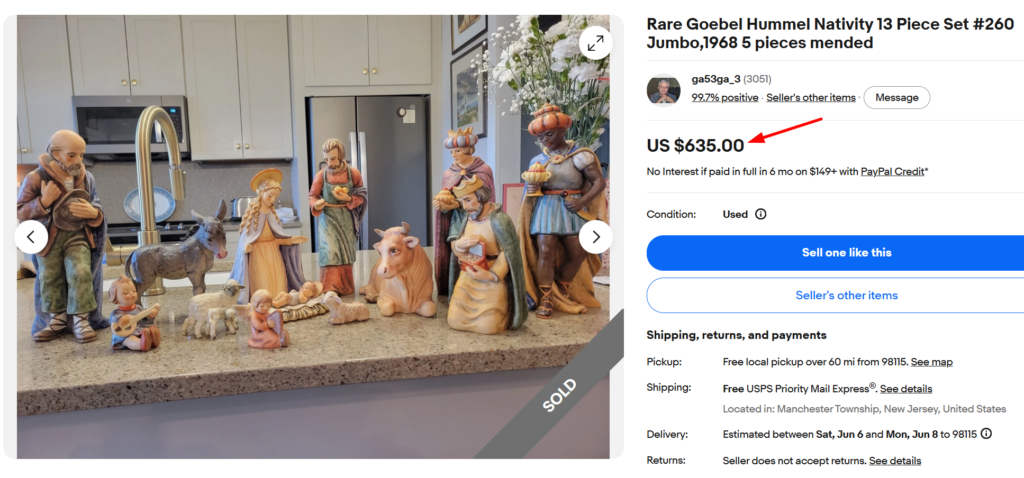
Sold for $635
Gerhard Skrobek modeled the large Nativity Set in 1968, and Goebel began selling it in the early 1970s. It has 16 separate pieces ranging from the 5-inch Infant Jesus to the 12.75-inch Moorish King.
The value of these pieces lies in complete sets, since Goebel temporarily withdrew the set in December 1989. A complete set with TMK-4 Three Line Mark can sell for over $5,000 in pristine condition today; individual pieces can fetch $80 to $380+.
- Estimated Value: $1,200 to $6,300+ (as a complete set)
- Production Years: Early 1970s to 1989
- What to Check: All 16 pieces, wooden stable included
- Quick Notes: Complete sets are very hard to find
4. Apple Tree Boy and Apple Tree Girl
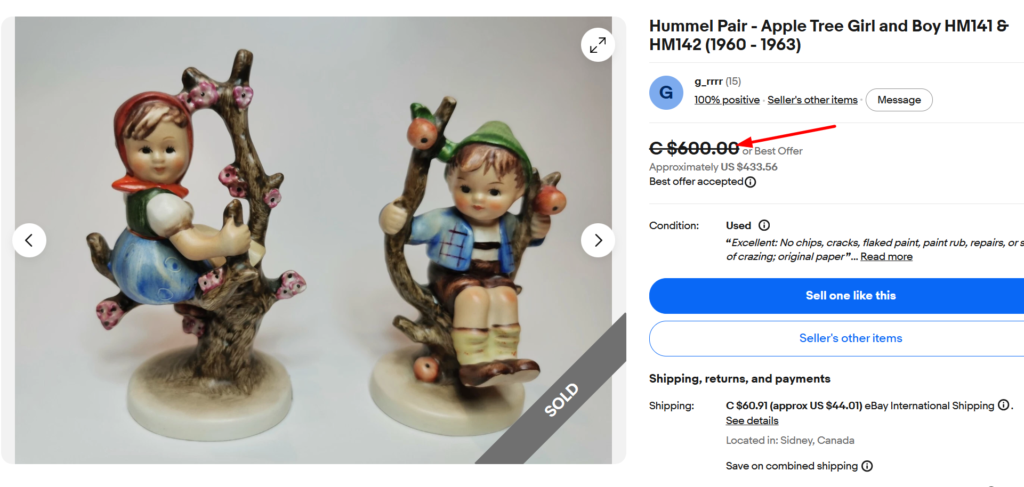
Sold for $600 (pair)
Apple Tree Boy and Apple Tree Girl figurines consistently land near the top of every “most valuable Hummels” list. The figurines show the children sitting on apple tree branches.
Arthur Möller modeled both in 1940. They come in five sizes, from the 3.5-inch baby version up to the jumbo 32-inch 142/X size.
Thanks to their popularity, even a 30-inch TMK-5 variant can fetch up to $2,000; Large Crown Mark examples have documented sales above $26,000.
- Estimated Value: $40 to $2,500 (by size and TMK); $20,000+ (large crown)
- Production Years: 1940 onward
- What to Check: Mold number /X, bird in tree
- Quick Notes: Matching pair commands premium.
5. Merry Wanderer Large Variant
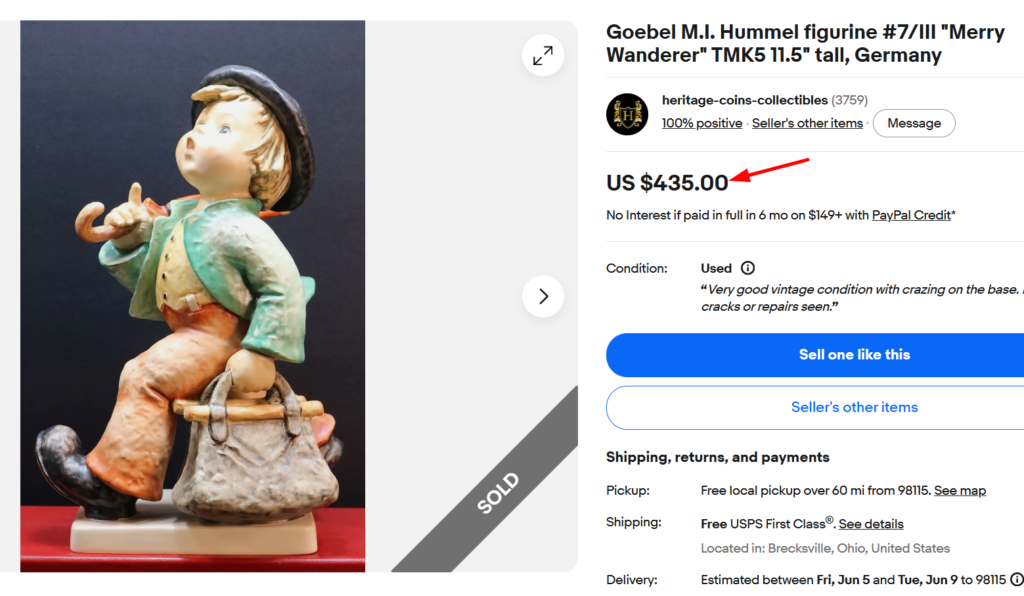
Sold for $435
The little traveler with an umbrella and a suitcase is the unofficial mascot of the M.I. Hummel brand. Small variants (7/0 and 7/I) of this Hummel are common and worth $30-$150.
Larger variants, like 7/II and 7/III, are worth more, while the jumbo 32-inch 7/X is the most valuable variant. The 7/X example has been listed at $25,000 retail, and a TMK-6 jumbo from the Donald Deeks Collection sold at Blackwell Auctions in 2021.
- Estimated Value: $30 to $25,000+ by size
- Production Years: 1935 to present
- What to Check: Size designator after the mold number
- Quick Notes: Jumbo 7/X is the most expensive variant.
6. Goebel Anri Four Seasons Music Box
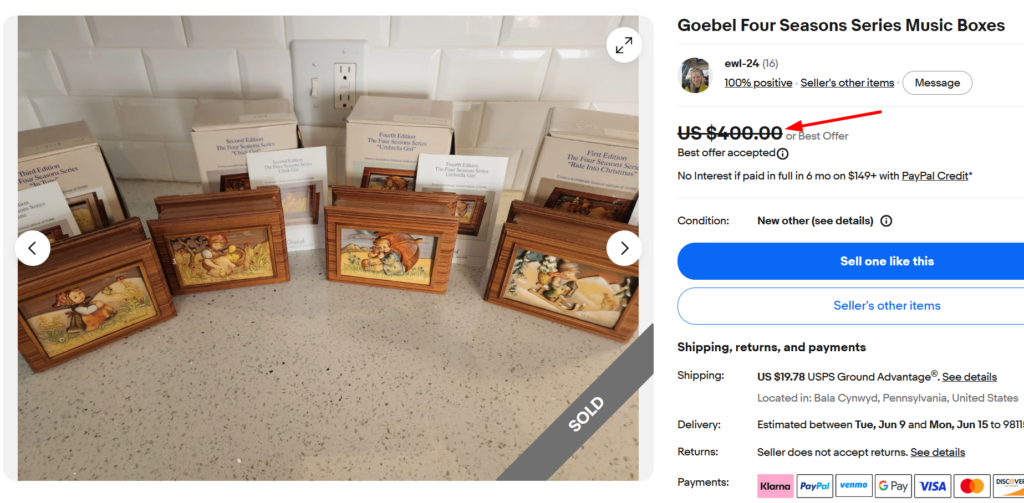
Sold for $400 (set of 4 boxes)
The Four Seasons music boxes are a 1987 to 1990 collaboration between Goebel (porcelain plaque), Anri of Italy (hand-carved wood box), and Reuge of Switzerland (the 36-note movement).
The line had four releases: Ride Into Christmas, Chick Girl, In Tune, and Umbrella Girl. Each was a worldwide limited edition of only 10,000, making each one rare on its own. The first issue, Ride Into Christmas (plays Winter Wonderland), is the most sought after.
A full set of all four music boxes is what collectors pay the most for.
- Estimated Value: $400 to $1,000 (all 4 boxes)
- Production Years: 1987 to 1990
- What to Check: Numbered medallion, Reuge movement works
- Quick Notes: Ride Into Christmas box is worth the most; sets of 4 are rare.
7. Flower Madonna (HUM 10)
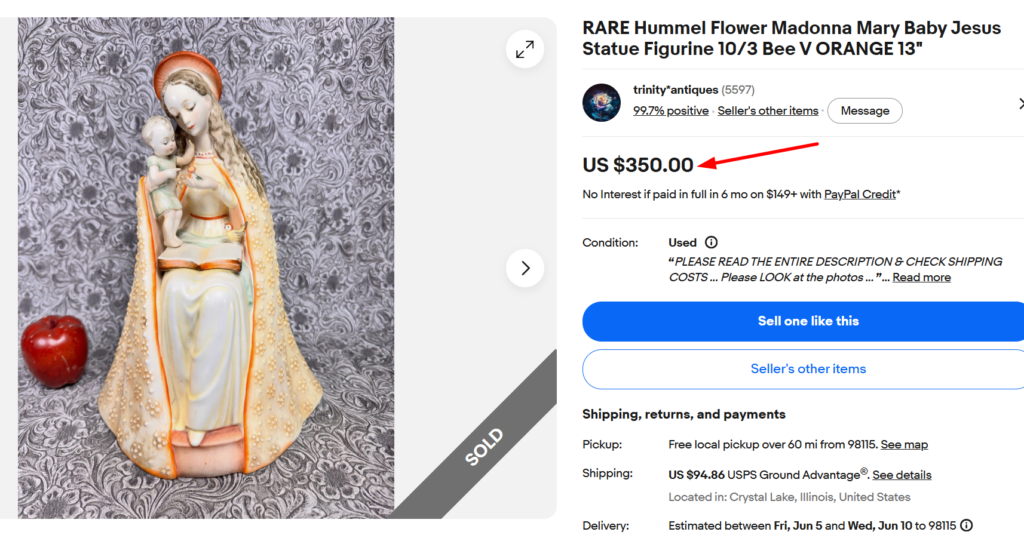
Sold for $350
Flower Madonna was made by Reinhold Unger in the late 1930s; it was redesigned by Theo Menzenbach in 1956 using a closed halo. It is available in three sizes and various cloak colors, such as white overglaze, pastel blue, blue, brown, ivory, and rare pastel yellow.
Color is everything for this figurine. Crown Mark examples in dark red, orange, light red, or brown cloaks can pull up to $2,500, while common white versions sell modestly.
- Estimated Value: $100 to $3,500 by color and TMK
- Production Years: Late 1930s to 1990s
- What to Check: Cloak color, open or closed halo
- Quick Notes: Rare colors are more valuable than white.
8. Little Fiddler (HUM 2)
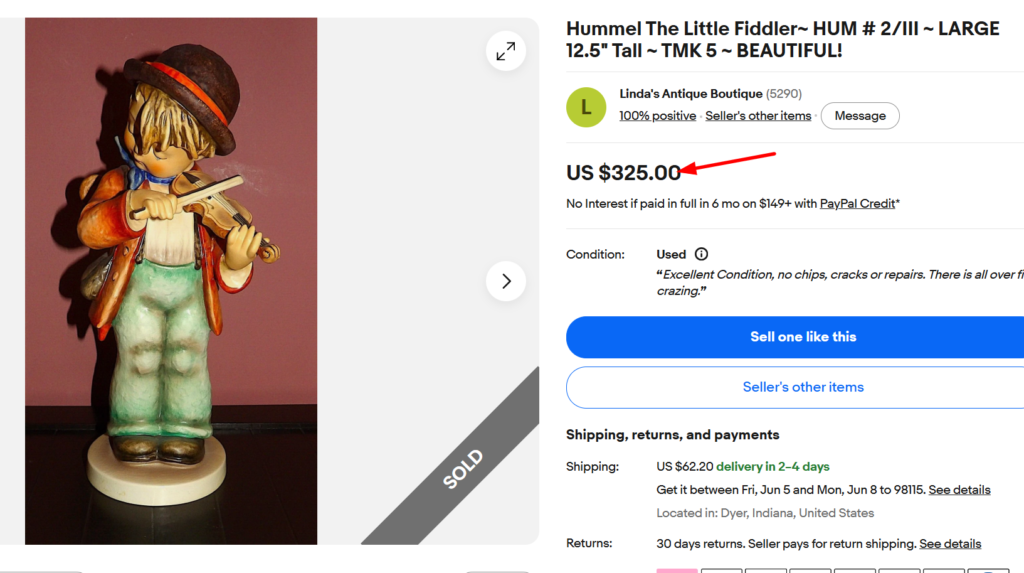
Sold for $325
Little Fiddler shows the same boy from Puppy Love but without the dog, and with a more focused expression as he plays the violin. Arthur Möller modeled it in 1935 as one of the original Leipzig Fair pieces.
This figure can be found in sizes of 4.75 inches 2/4/0 and up to 12.75 inches 2/III jumbo. An 8-inch TMK-1 stamp example can reach up to $1,300 in pristine condition today. The 1985 50th Anniversary versions are more collectible and valuable.
- Estimated Value: $100 to $7,500
- Production Years: 1935 onward
- What to Check: US Zone Germany stamp, anniversary edition
- Quick Notes: Anniversary editions are more valuable than standard.
9. Ring Around the Rosie (HUM 348)
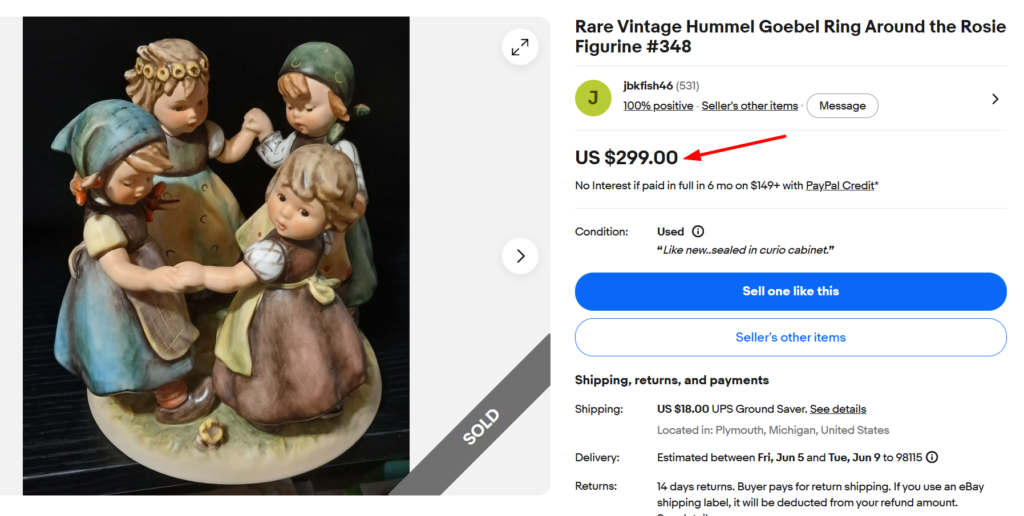
Sold for $300
This figurine shows four little girls in a ring holding each other’s hands like in the game. Gerhard Skrobek sculpted this figurine back in 1957, which was then introduced by Goebel in 1960 for the 25th anniversary of the trademark.
Against the overall fall in the price of Hummel figurines, this piece holds higher collector value than many others. A TMK-3, especially in excellent condition, can fetch between $500 and $800.
- Estimated Value: $400 to $1,500+
- Production Years: Released 1960; modeled 1957
- What to Check: All four girls, hands joined, TMK mark
- Quick Notes: Anniversary piece holds value strongly.
10. Chapel Time Clock (HUM 442)
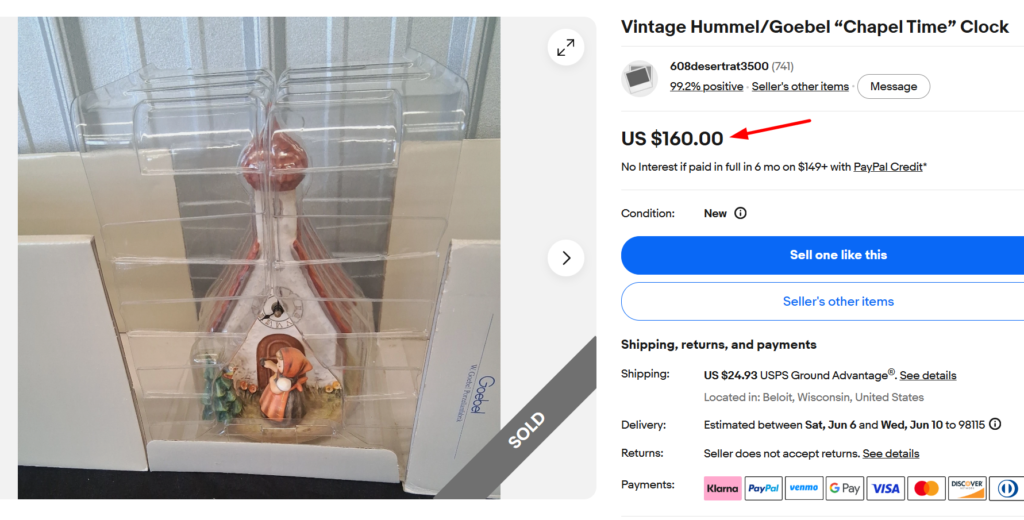
Sold for $160
The Century Collection started in 1986 with Chapel Time. The series ran with one idea: each piece was produced for one year only during the 20th century, then retired. This makes the Century Collection pieces quite desirable.
The Chapel Time was designed by Gerhard Skrobek. Standing about 11.5 inches, it actually contains an operating clock inside the tower of the chapel. With a working clock mechanism, this piece can fetch $100-$400.
- Estimated Value: $100 to $400
- Production Years: 1986 only
- What to Check: Clock functioning, original box, and COA
- Quick Notes: First Century Collection release ever.
11. Stormy Weather (HUM 71)
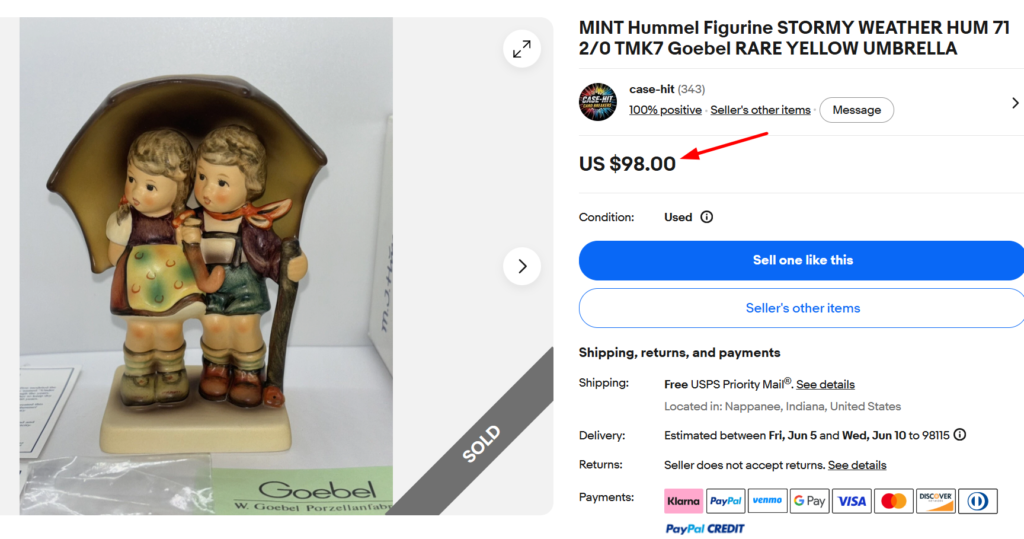
Sold for $98
Stormy Weather shows a boy and girl huddling under a shared umbrella, sometimes sold under the older name “Under One Roof.” Arthur Möller modeled it in 1937, and it has run through almost every TMK since.
Crown Mark examples, especially the “Double Crown” variant with both incised and stamped marks, draw the strongest collector interest and value.
- Estimated Value: $50 to $700 (depending on TMK)
- Production Years: 1937 onward
- What to Check: Double Crown mark, umbrella intact, “Under One Roof” text
- Quick Notes: Older trademarks are more valuable.
12. Heavenly Angel (HUM 21)
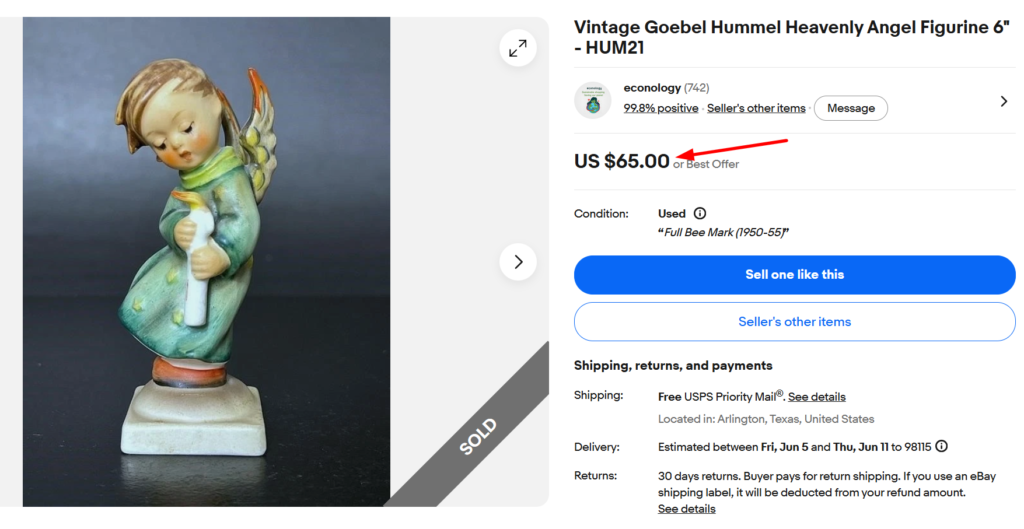
Sold for $65
Heavenly Angel is among the first 46 figurines from 1935. She was sculptured by Reinhold Unger as an angel holding a candle. Goebel released it in various sizes, including the tree topper size.
In 1994, the first officially licensed Hummel tree topper, HUM 755, was created. Production stopped on the topper in 1999. She also appeared on the very first Hummel annual plate in 1971.
While the original green version is the most popular one, there’s a rarer red variant, which is way more valuable.
- Estimated Value: $10 to $1,500 (by size and TMK; rare red color)
- Production Years: 1935 to present (topper 1994 to 1999)
- What to Check: Size designator, original tree topper box
- Quick Notes: First-ever annual plate motif.
13. Chimney Sweep (HUM 12)
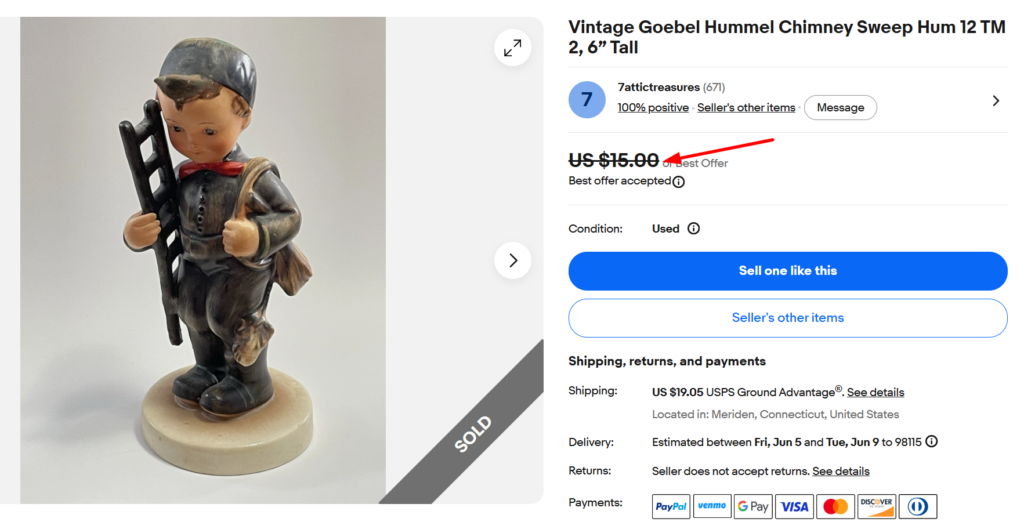
Sold for $15
Originally known by the name “Smoky” during its debut at the Leipzig Trade Fair in 1935, the Chimney Sweep belongs to the set of the 46 original Hummel figures.
The piece was sculpted by Arthur Möller, and it is available in 12/4/0 (3″), 12/2/0 (4″), 12 (6″), and 12/I (5.5″) versions. The rare edition of 1995 features a gilt base and was released in Germany only in an edition of 500 pieces.
- Estimated Value: $15 to $450 (by size and TMK)
- Production Years: 1935 to present
- What to Check: Size, gilded base variant
- Quick Notes: No Crown Mark 4-inch version exists
Hummel Figurines Price Guide: What Determines Value?
Two figurines with the same name and design can vary by a factor of ten in price. The reason almost always comes down to a small handful of factors that experienced collectors check in a specific order. If you’re trying to value a piece, work through these top to bottom.
- Trademark Era (TMK) – This is the biggest value driver. TMK-1 Crown Mark and TMK-2 Full Bee pieces command the highest premiums because they predate the 1960s production. Anything stamped just “Germany” without “W.” or “West” suggests a pre-1945 piece.
- Mold Number (HUM number) – Some designs are more desirable than others. Look up the HUM number on a reference site to gauge baseline desirability before buying. Multi-figure compositions like Adventure Bound usually outprice single-figure pieces.
- Size Designator – For Hummels, bigger usually means more valuable, with jumbo /X versions of common designs reaching the $2,000 to $25,000. But there are exceptions. Certain rare small sizes, like discontinued miniatures, can be worth a lot if production was limited or short.
- Painter Signatures and Master Sculptor Initials – Pieces signed by master painters like Markus Paetzold, Gunther Neubauer, or Annette Renner carry a small premium. The same goes for pieces with master sculptor initials from artists like Gerhard Skrobek visible on the base.
- Condition – Any chip, crack, or repaint can lower a Hummel figurine’s value by 50% to 80%. Crazing in the glaze is common on old pieces since they happen due to age. However, on young pieces, crazing may be damage.
- Color Cariations and Special Editions – Unusual cloak colors on the Madonna line, factory sample pieces marked with a red line around the base, “PFE” prototype stamps, Anniversary releases, and limited edition runs all boost value.
- Original Box and Paperwork – A piece with its original Goebel box, certificate of authenticity, and included paperwork generally adds 20% to 50% to the value. This applies especially to 1980s and later pieces.
Hummel figurines are common, especially the examples from the 1970s and 1980s. But the early marks, the jumbo sizes, the Internationals, and the multi-figure compositions can indicate a thousand-dollar piece. So, make sure to check the right signs before buying or selling your Hummel.