
Known for its unique Chinese landscape featuring a large willow tree and a pagoda (treehouse), the Blue Willow china pattern is everywhere. But only a few know that certain pieces are rare and more valuable than they appear.
If you also think that antique Blue Willow china is just a matter of a few bucks, this guide is what you need. It’ll help you identify the genuine Blue Willow pattern, its history, variants, and real values that you might be overlooking.
What Is Blue Willow China – The Backstory
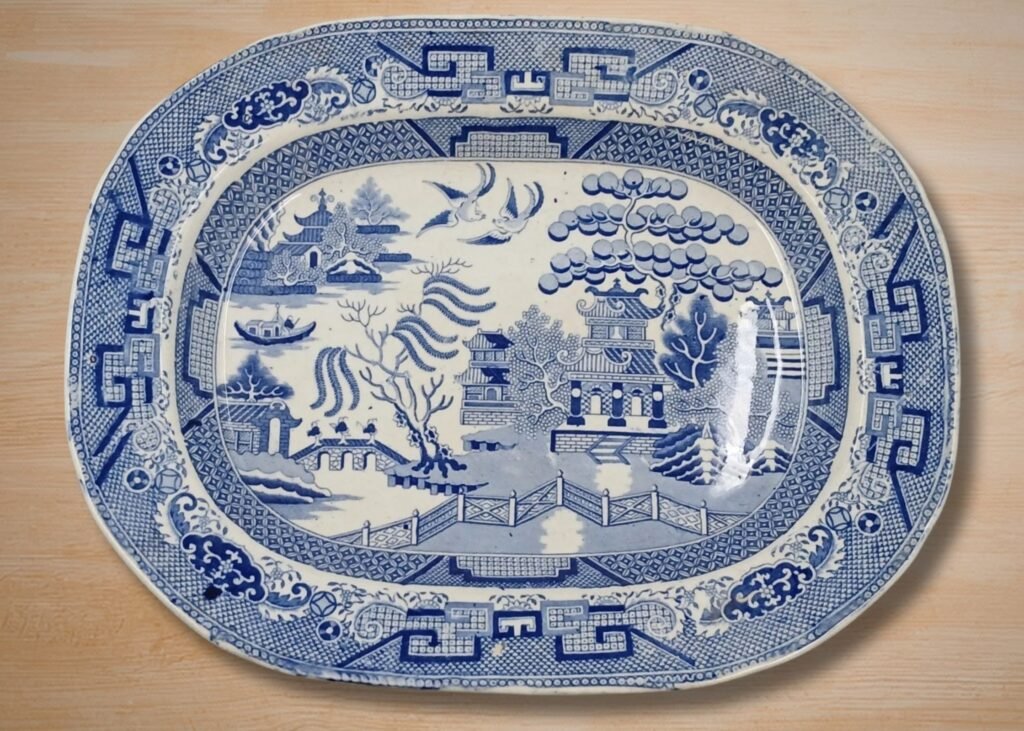
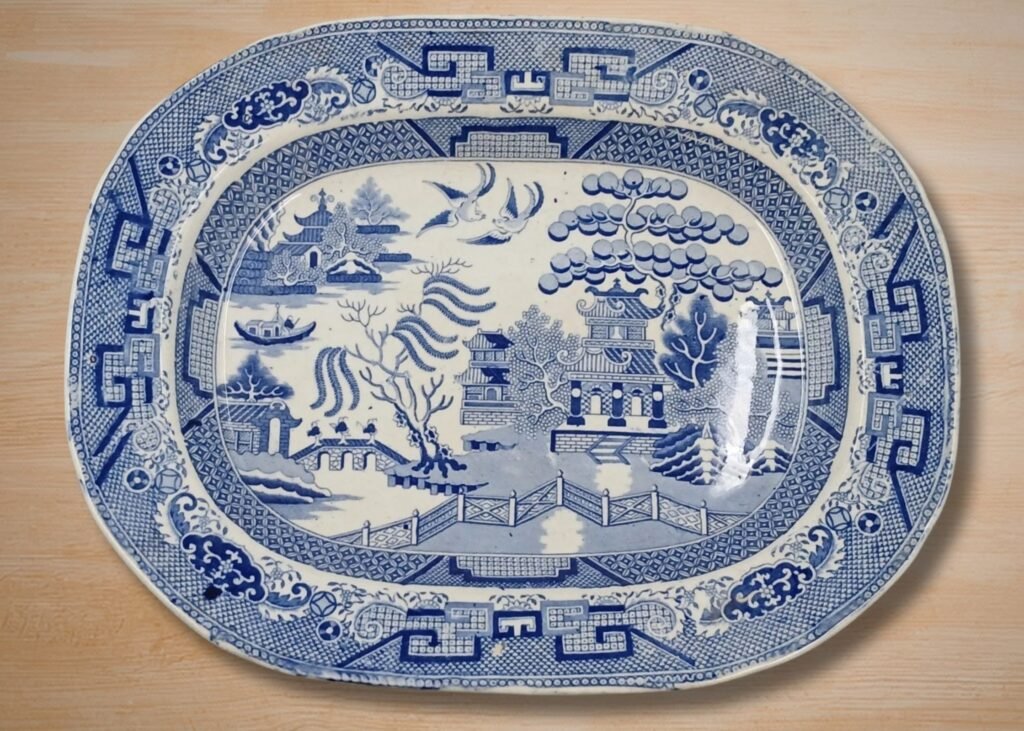
Blue Willow is a blue and white transferware pattern that portrays an oriental setting with a willow tree, an arched bridge with three people, a boat, a teahouse, and a pair of doves above. This looks Chinese, but the design is actually British.
The Willow pattern was created in 1780 by potter Thomas Turner and engraver Thomas Minton at the Caughley factory in Shropshire, England. It was essentially a knock-off, designed to look like the expensive Chinese porcelain, but made cheaper through transfer printing.
The romantic legend of star-crossed lovers Koong-se and Chang came later as a marketing hook. Once Josiah Spode picked up the pattern around 1790, it spread fast. The International Willow Collectors lists over 400 documented makers in Great Britain and around 500 worldwide.
How to Identify Valuable Blue Willow China? 5 Signs
Most Blue willow china pieces you come across today will likely be factory-made items from the 20th century, worth just a few dollars each. The valuable ones share certain features. Go through these five steps before you identify your piece.
The Maker’s Mark
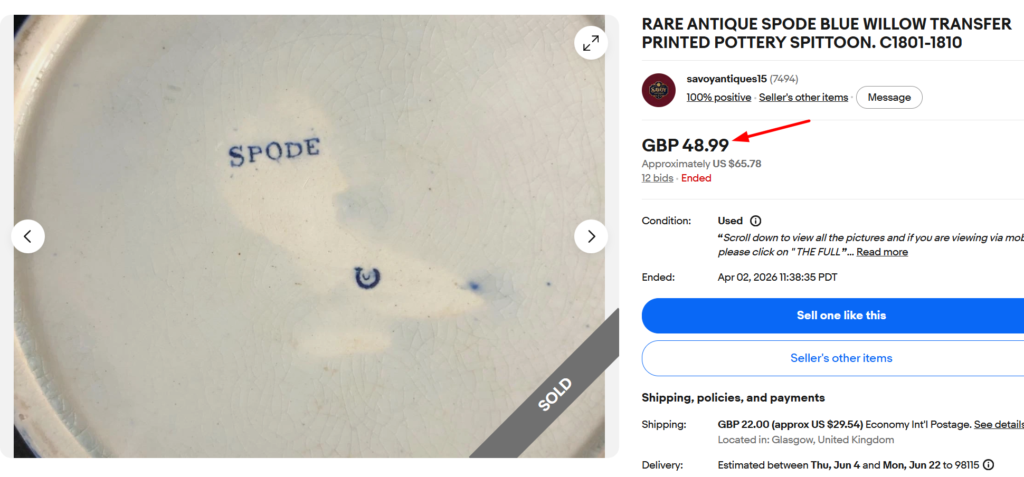
The backstamp will be the most reliable indicator, so turn the item over initially. Almost any piece created after 1842 carries some type of printed mark. Any piece manufactured prior to 1842 does not carry a mark.
Here are the major blue willow makers and marks worth knowing:
- Spode / Copeland Spode – “SPODE” in block capitals or a crown with “Copeland” below it. The date is usually written with a letter above two digits, in red or black. Spode has been making willow since the 1790s.
- Booths – “Booths” in script with a crown above, sometimes “Real Old Willow.” Later pieces add “Made in England.” This is the gold-edged, bow-knot-bordered version that collectors hunt for specifically.
- Johnson Brothers – Either “Johnson Bros” or “Johnson Brothers,” along with either a crown or a shield. The country designation is more helpful in determining the time period than the trademark design.
- Allerton’s – A printed circular mark reading “Allerton’s” with “England” added after 1891. Famously, the brand Laura Ingalls Wilder owned, which gives Allerton’s its own dedicated fan base today.
- Buffalo Pottery – A printed buffalo logo with “Buffalo Pottery” and, very helpfully, a date right in the mark. The first American maker to produce willow began in 1905.
- Wedgwood, Royal Doulton, Adams, Burleigh, and Mason’s Ironstone – All produced their own willow lines with distinct printed company-name backstamps that are easy to look up.
Good to Know: An unmarked piece isn’t always fake. It might just be older than the practice of marking, especially if it predates 1842. That’s where the next four signals matter.
Country of Origin Wording & What It Means
The country line is one of the best dating clues for antique china. It exists because the U.S. McKinley Tariff of 1890 forced importers to mark their country of origin. That single rule created a date code on the back of nearly every imported piece.
Here’s how to decode them:
- No country at all – likely pre-1891 (older, often more valuable)
- “England” alone – roughly 1891 to about 1914
- “Made in England” – 20th century, very common from the 1920s onward
The same logic applies to Japanese pieces. “Nippon” was used prior to 1921. “Japan” alone signifies the period around the early 1920s. “Made in Japan” signifies after 1921. “Made in Occupied Japan” identifies the piece from 1945 to 1952, the postwar occupation years.
Pattern Completeness
The standard Blue willow pattern has a fixed cast of characters. If something’s missing, you might be looking at a willow variant (still potentially valuable, but a different category) or a knock-off entirely.
An authentic standard willow always includes all of these elements:
- The willow tree drooping over the scene
- A teahouse or pagoda, usually with an orange (apple) tree nearby
- An arched bridge (with three figures crossing it)
- A boat with a single figure
- Two birds in flight at the top
- A fence in the foreground
Three figures on the bridge are the classic Spode-style willow. Booths’ Real Old Willow has no fence, three branches on one side of the tree and six on the other, with gold trim and the bow-knot border.
Burleigh’s version has five people and no orange tree. And, the Mandarin variant has no bridge at all and a single person in the boat, framed by a dagger border.
Knowing the variant matters because Booths, Burleigh, and Mandarin willow often significantly outprice standard willow when the conditions and age are the same.
Pattern Colors
Most willow is blue, but blue isn’t the only color it comes in. The most common color is cobalt blue, but you may also find Willow in colors like:
- Pink
- Red
- Brown
- Mulberry
- Green
- Gold
Some willow designs even have many colors; this is called Gaudy Willow.
Next, the way the pattern was applied to the piece says a lot about how old it is. Early willow was made using a method called transfer printing. Makers took an engraved copper plate, put ink on it, and transferred the design onto thin tissue paper. Then, they put the tissue paper onto the piece before it was fired in the kiln. This was done as an underglaze.
On older examples, you will notice a faint seam line from the joining of the paper around the curve.
Modern reproductions are usually screen prints or decals, which have clean, sharp edges without any smearing. Original antique transferware always has some level of irregularity or tear.
Body, Weight & Condition Clues
Examine the physical features closely. Early English willow from the period 1780 to the mid-1800s was produced on pearlware or soft-paste porcelain, which was relatively lighter in weight and had a slight bluish tinge to its white.
One could easily feel the difference after dealing with a few pieces.
Later 19th-century pieces changed to ironstone and more durable pottery, which is heavier in weight and has a creamier white body. “Crazing,” the fine crackling pattern in the glaze, is common in older examples since the original glazes were softer and shrank differently than the body underneath.
Some crazing on an antique piece is a credibility marker. A perfectly clean, no-crazing surface on a piece claimed to be from 1820 is suspicious. Modern reproductions almost never show crazing because modern glazes are more stable.
How Old Is Your Blue Willow? (Dating Your Piece)
Once the maker is known, you can normally narrow down the age within 20-40 years based on the mark and the body of the piece. This is how eras are distinguished by those who collect blue willow china with any dedication.
Early Period (1780–1840) — Hand-Engraved Transferware – Golden era, pieces from Caughley, Spode, Adams, Davenport, Clews, and Leeds. Pearlware or early bone China bodies with a bluish tint to their glazes. Early Spode pieces are most collectible.
Victorian Era (1840–1900) – The British diamond stamp mark came in 1842 and lasted up to 1883. There is a Roman numeral IV written on the top of the diamond with the year, month, day, and parcel number in the four corners. Replaced by “Rd. No.” after 1884. Post-1891 pieces show “England” on the mark.
Early 20th Century (1900–1945) – The first mass-produced era of willow pattern china. Japan entered the export market after about 1920, and Japanese willow became almost as common in the U.S. as Staffordshire. Buffalo Pottery introduced the first American willow in 1905, and their dated marks from 1905–1916 are especially sought after today.
Mid-Century to Modern (1945–Present) – “Made in Occupied Japan” (1945–1952) pieces are easy to spot. From the 1960s onward, Churchill, Royal Stafford, and modern Johnson Brothers (Wedgwood Group after 2003) still produce willow.
Is Vintage Blue Willow China Worth Anything?
Most blue willow china will be valued anywhere from $5 to $30 per piece. Yet particular makers, eras, and designs will raise some items’ value up to $200–$1,000 or even more, while exceptionally rare pieces might sell for several thousand dollars.
What separates a cheap piece from a cabinet-piece is the combination of several factors below, that work together to determine old blue willow china value:
- Maker – English makers usually outvalue American or Japanese. They range from $10 to more than $1,000, with old English pieces selling for the highest prices and modern American or Japanese ones fetching the lowest. Spode, Booths’ Real Old Willow, Mason’s Ironstone, and early Caughley are the highly priced items.
- Age – The older the age, the higher the price. Pre-1840s items are worth the most, followed by items from 1780 to 1820, then Victorian Era (1840 to 1900), followed by early 20th-century items, and finally mid-century.
- Form – Large or unusual forms outsell flat plates. So, large platters, lidded tureens, covered dishes, meat dishes, teapots, coffee pots, garlic pots, butter dishes, salt and pepper shakers, and rolling pins, all can fetch premium prices.
- Condition – Crazing is acceptable on antique pieces. Chips, cracks, hairlines, and repaired breaks slash value by 50–80%. Worn gold trim on Booth’s pieces hits the price hard. A pristine antique piece is genuinely rare and priced accordingly when one does turn up.
- Completeness – Matching sets with serving pieces outvalue assembled lots. A complete tea service or full dinner set typically sells for more than the sum of its individual pieces. Original lids on tureens and coffee pots especially matter, and a lidless piece can drop in value by 60%.
- Pattern Variant – Standard willow is common and not particularly valuable in itself. Gaudy Willow, Mandarin, Booths bow-knot, and unusual border versions are scarcer and price meaningfully higher across nearly every form they come in.
- Marks Present & Legible – Unmarked pieces are harder to attribute and usually sell for less, even when they’re genuinely old. A clean, legible Spode, Booths, or Buffalo Pottery mark adds both confidence and value to any piece.
Here’s a quick and easy chart of Blue Willow china value based on the era, makers, forms, and variants.
| Era/Tier | Typical Pieces | Average Values |
| Modern (post-1960) | Churchill, modern Japanese | $5–$30 |
| Vintage (1900–1960) | Johnson Brothers, Buffalo, early Churchill | $20–$100 |
| Antique (1840–1900) | Booths, Wedgwood, Doulton | $80–$500 |
| Early Antique (pre-1840) | Spode, Minton, Davenport | $200–$2,000+ |
| Rare variants (any era) | Coloured, polychrome, unusual forms | $300–$5,000+ |
10 Rare & Valuable Blue Willow Pieces & Variants to Know
Below are some of the most collectible antique and vintage Blue Willow pieces, in different pattern variants and colors, from notable makers. These pieces often turn up at the resale market and fetch decent values.
1. Copeland Blue Willow Chocolate Pot, Creamer & Cups
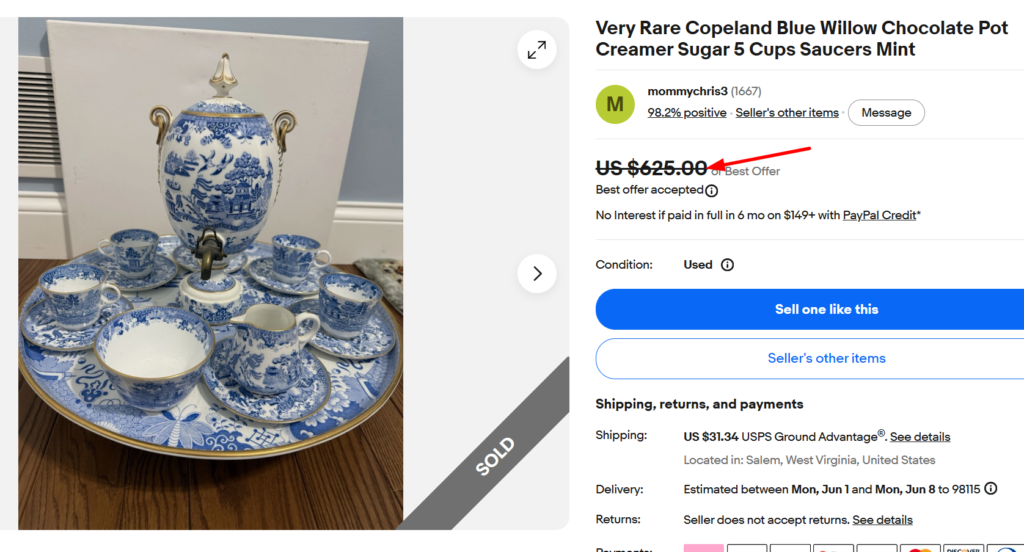
Sold for $625 (complete set)
This is a rare chocolate pot set by Copeland (the maker that came after Spode), designed to be small. It consists of a pot with a lid placed on top of a tap spout, along with a creamer, sugar bowl, cups, and saucers, all resting on an accompanying tray.
The value here is all about completeness. A full multi-piece set is far rarer than the individual pieces, and a matching tray seals it. Complete sets sit at the high end of the willow market.
- Estimated Value: $500–$650 (complete set)
- Production Year: Late 19th to early 20th century
- What to Check: Copeland/Spode backstamp, intact gold trim, matching and undamaged pieces.
- Quick Notes: Completeness drives the price for such sets.
2. Booths’ “Real Old Willow” Serveware
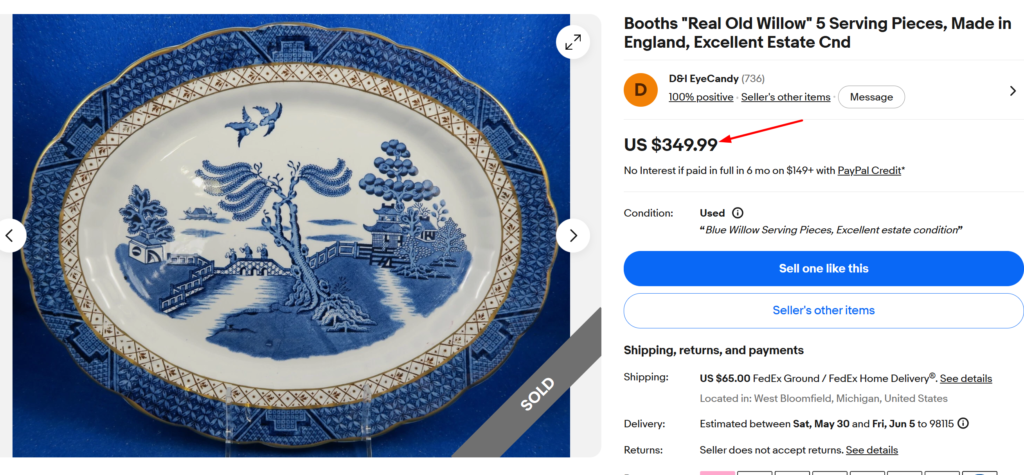
Sold for $350
A group of 5 serving pieces in Booths’ “Real Old Willow,” made in England, in excellent estate condition. The pattern is instantly recognizable: gold-trimmed scalloped edges, the bow-knot-style border, and the willow tree’s distinctive branch arrangement.
Booths Real Old Willow is one of the most collected willow lines, and serving pieces outsell flat plates. The value lies in the gold edging, English origin, and completeness of the set.
- Estimated Value: $300–$375 (5-piece serving lot)
- Production Year: Mid 20th century (Royal Doulton acquired Booths in the early 1970s)
- What to Check: Booths’ crown mark, gold-edge wear, scalloped rims for chips, matching pattern across all pieces
- Quick Notes: Booths’ gold-trimmed willow is a top-tier line.
3. Johnson Brothers Blue Willow Lidded Tureen
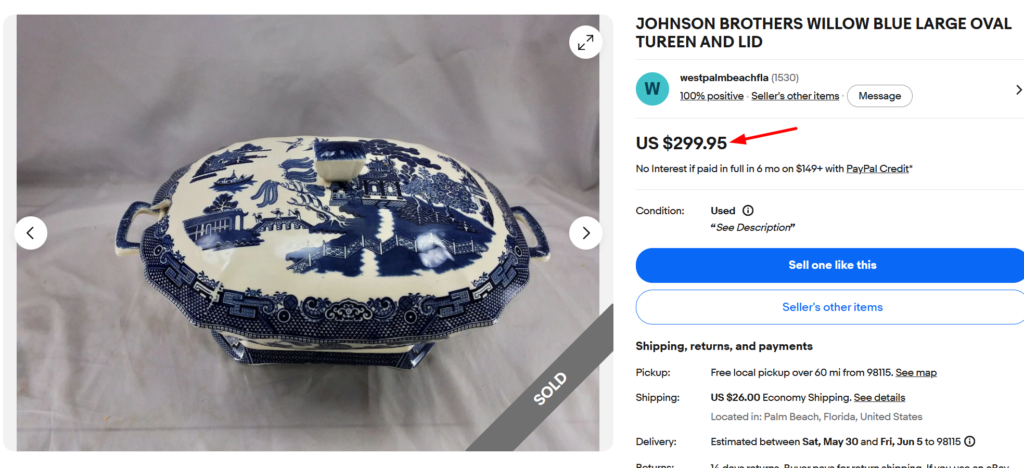
Sold for $300
This is a Johnson Brothers’ covered oval tureen with twin handles and a matching lid, in the classic deep-blue willow pattern. The form is a serving centerpiece, and the original lid is the detail that matters most.
Lidded serving pieces in blue willow are worth the most. A tureen with its original lid can be worth several times what the base alone brings, since lids were easily broken or lost over the decades. So, complete examples can reach mid-hundreds.
- Estimated Value: $250–$325 (with original lid)
- Production Year: Mid 20th century
- What to Check: Original matching lid, Johnson Brothers mark, “England” vs “Made in England” wording, hairline cracks inside the base.
- Quick Notes: A missing lid can drop the value by half or more.
4. Blue Willow Teapot with Gold Trim
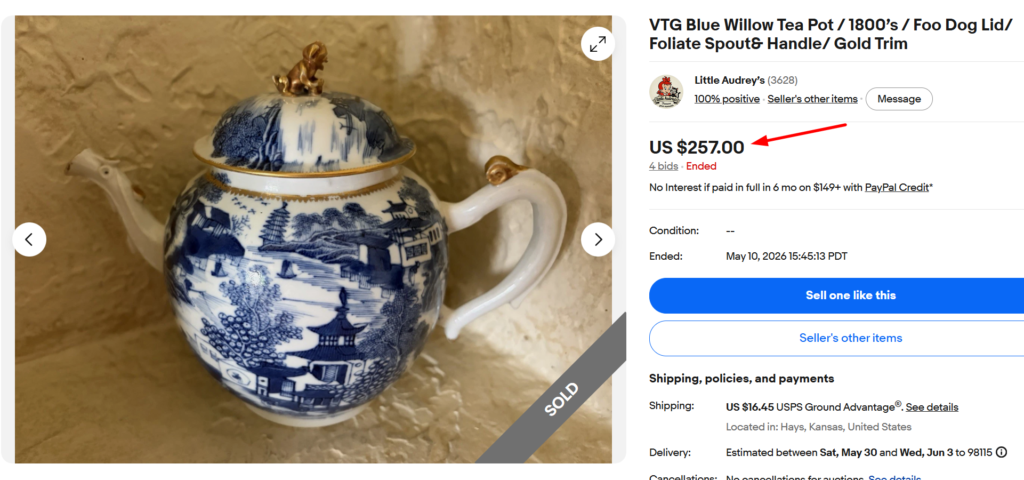
Sold for $255+
This Chinese teapot features a globular willow-shaped body and a finial with a golden foo dog on its lid, a spout and handle that feature foliate moldings, and is decorated with gold all over. Gold trim variants of blue willow are slightly more desirable than standard ones.
Plus, the foo dog finial is the standout, an unusual feature not found on ordinary willow teapots. Combined with the gold trim and age, this type of piece becomes a rare find in the Blue Willow market.
- Estimated Value: $225–$300
- Production Year: 19th century (consistent with the form and gilding)
- What to Check: Intact foo dog finial, gold trim wear, hairlines around the spout and lid rim, any maker’s mark on the base
- Quick Notes: Unusual finials and gold trim add real value. Damage to the foo dog would hurt it badly.
5. Spode Copeland “Two Temple” Blue Willow Plates
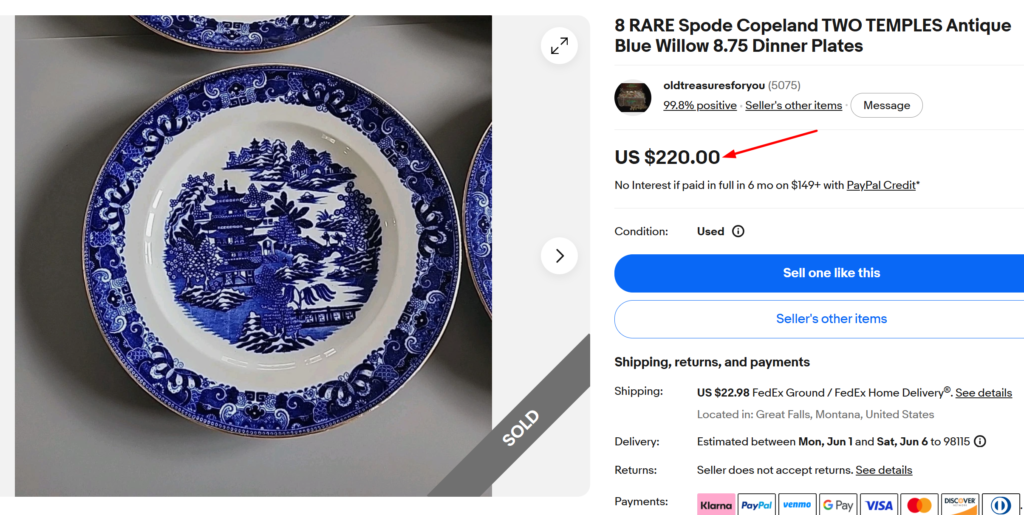
Sold for $220
A set of 8 antique Spode Copeland dinner plates in the Two Temples pattern, around 8.75 inches each. Two Temples II is a willow variant, not standard willow, with a different temple layout and no bridge figures.
Knowing the variant is what makes this set valuable, since the two are often confused. Genuine Spode Copeland Two Temples plates, as a matching set of 8, brought $220. The Spode name, age, and variant all add value here.
- Estimated Value: $200–$250 (set of 8)
- Production Year: Late 19th to early 20th century
- What to Check: Spode/Copeland mark, Two Temples layout (two pavilions, no bridge figures), matching size and pattern across the set
- Quick Notes: Two Temples is a variant, not the standard willow.
6. Shenango Red Willow Ware Plates
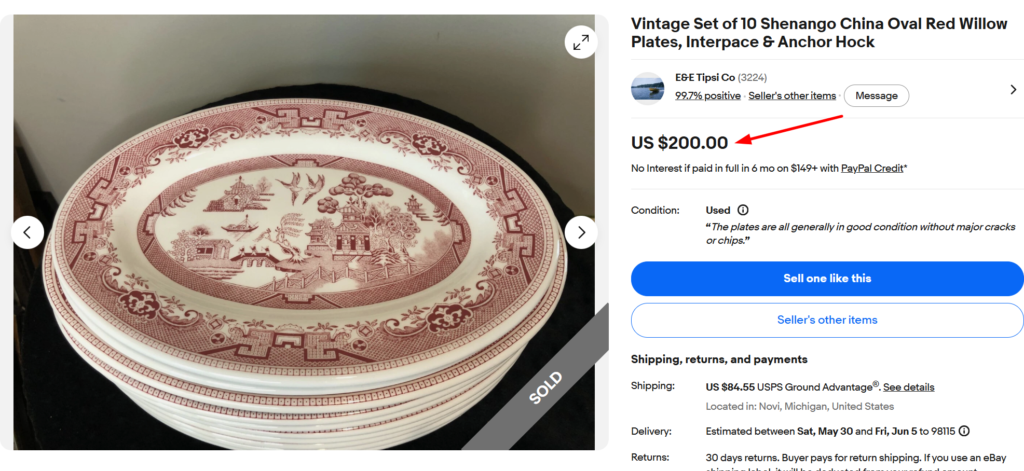
Sold for $200 (set of 10)
These are oval red willow plates by Shenango China, an American maker known for heavy-duty restaurant ware. Red (sometimes called pink) is one of the scarcer willow transfer colors, carrying the full standard willow scene in red on white.
Two things drive the value of these pieces: the non-blue color and the condition. Red willow runs noticeably higher per plate than common blue.
- Estimated Value: $15–$25 (singles); $150-$250 (partial sets)
- Production Year: Mid 20th century
- What to Check: Shenango backstamp, consistent red color across all plates, chips on the heavily-used rims
- Quick Notes: Red/pink willow is scarcer than blue.
7. Buffalo Pottery Nymph Blue Willow Washing Set
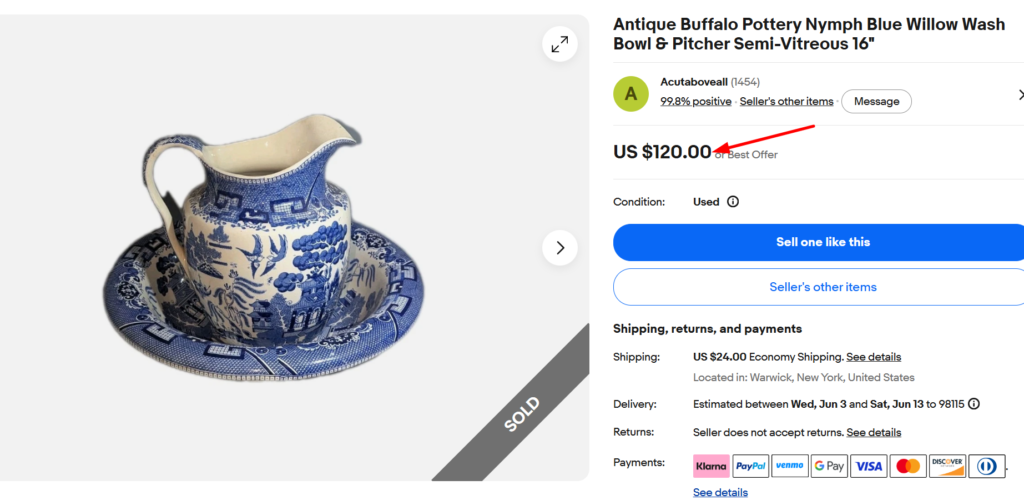
Sold for $125 (single)
Buffalo Pottery is the American maker that introduced willow to the U.S. in 1905. This is a large semi-vitreous wash bowl and pitcher set in Buffalo Pottery’s deep-blue willow design.
Buffalo’s willow is one of the easiest to date, because the backstamp usually includes the year. The early dates (1905-1916), the huge wash set style, and its matching bowl and pitcher sets give it an edge over other Buffalo plates.
- Estimated Value: $100–$175 (bowl + pitcher set)
- Production Year: 1905–1916 (dated Buffalo Pottery semi-vitreous mark)
- What to Check: Buffalo Pottery buffalo-logo mark with a date, both pieces matching, hairline cracks, and rim chips.
- Quick Notes: Buffalo’s dated marks make age easy to confirm.
8. Moriyana Occupied Japan Blue Willow Plate
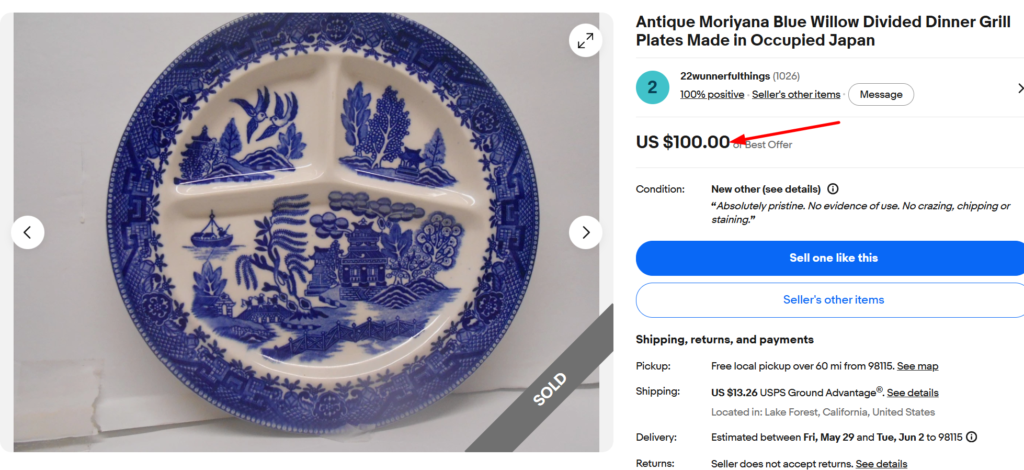
Sold for $100
This is a divided “grill” plate with three compartments in deep flow-blue willow, marked Moriyama and “Made in Occupied Japan.” That stamp dates it to 1945–1952, and Moriyama is a recognized maker of this restaurant-style willow.
Most Occupied Japan willow is everyday utility ware in the $5–$30 range. What lifts a piece like this is the named Moriyama mark, the less common grill form, and clean condition, since few survive 70-plus years without crazing or staining.
- Estimated Value: $40–$100 (clean, marked Moriyama)
- Production Year: 1945–1952 (Occupied Japan)
- What to Check: “Made in Occupied Japan” + Moriyama mark, divided grill format, crazing or staining that lowers value
- Quick Notes: Occupied Japan willow is usually cheap, until the maker & condition are top-tier.
9. Burleigh Polychrome Blue Willow Plates
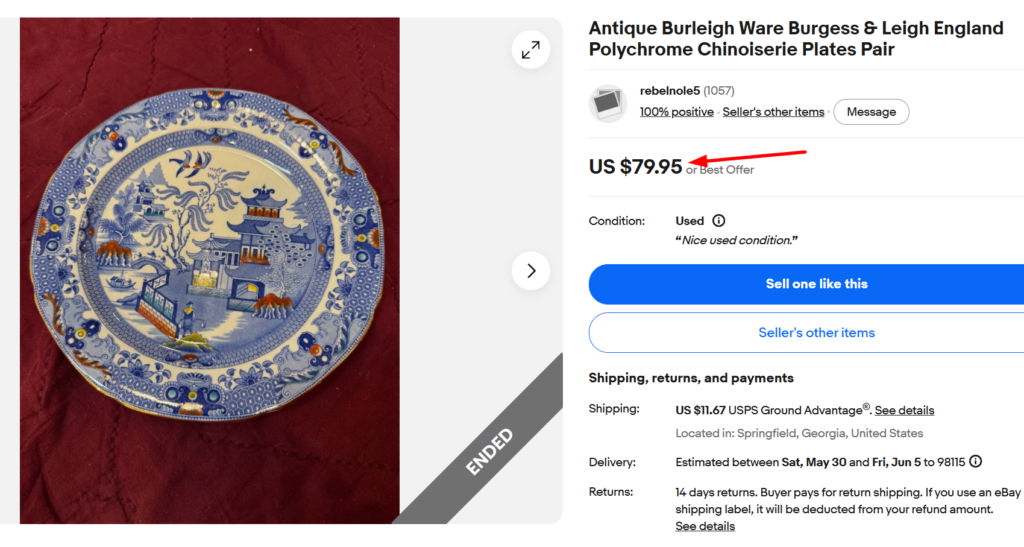
Sold for $80 (pair of two)
Polychrome willow is the classic blue pattern highlighted with rust orange, green, and yellow glazes. This multicolored variation is also known as Gaudy Willow. This example features two vintage Burleigh (Burgess & Leigh) plates in polychrome.
Polychrome willow is genuinely scarce next to standard blue, and Burleigh’s hand-applied color adds to it. Burleigh also used its own scroll-and-floral border. The polychrome treatment commands a clear premium over plain blue plates.
- Estimated Value: $70–$100 (pair)
- Production Year: Late 19th to early 20th century
- What to Check: Burleigh / Burgess & Leigh mark, hand-applied enamel colors, wear to the painted accents
- Quick Notes: Polychrome (Gaudy Willow) is far rarer than plain blue.
10. Mason’s Ironstone Blue Willow Hexagon Tray
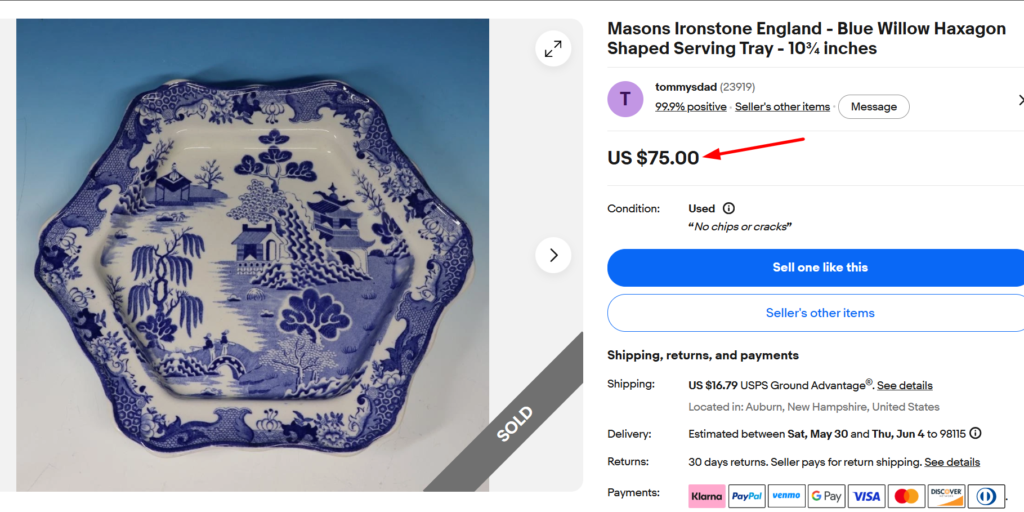
Sold for $75
This 10¾ inch hexagon serving tray is Mason’s Ironstone ware, marked “Masons Ironstone England.” It features a deep cobalt willow scene inside a dense floral-and-fretwork border typical of Mason’s heavier ironstone willow.
Mason’s is prized for the durability of its ironstone body, which survives in clean condition more often than softer earthenware. The hexagonal shape and “England” mark (post-1891) make this more collectible than a plain round plate.
- Estimated Value: $60–$90
- Production Year: Early-to-mid 20th century (post-1891 “England” mark)
- What to Check: “Masons Ironstone England” mark, no chips or cracks, crisp border detail
- Quick Notes: Shaped forms beat round plates. Ironstone resists damage better than earthenware.
Finding valuable antique blue willow china is all about spotting the right details. The mark tells you the maker, the country wording brackets the decade, the body type confirms the era, and the pattern variant signals the piece’s value tier. Make sure to check all these aspects before you put a price tag on any blue willow piece.