
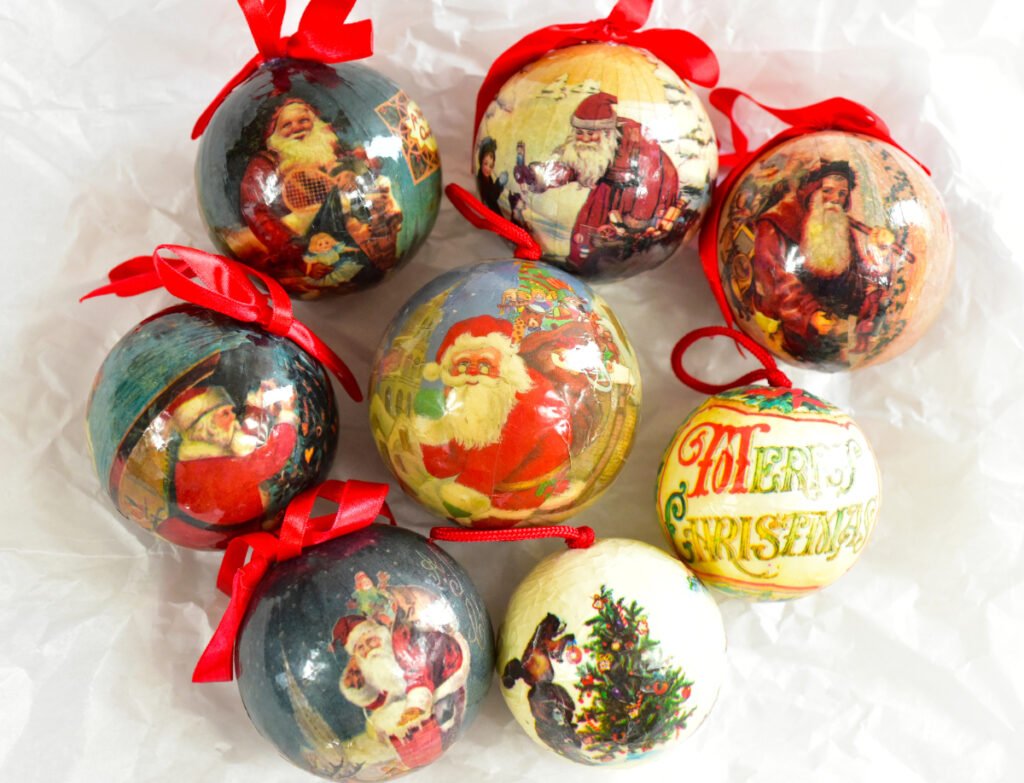
For most people, when they think about opening Grandma’s Christmas box, all they see is a pile of ornaments that have not been used in years. However, there are times when such ornaments can cost up to $400. Or a $1,000 Dresden cardboard reindeer. Or a Kugel from the 1880s that collectors hunt for year-round.
The key is knowing how to identify valuable ornaments. This article goes through 15 unique antique and vintage Christmas ornaments that sell well today, plus the things that make these old ornaments valuable.
What Makes Vintage Christmas Ornaments Collectible?
Old Christmas decorations hold both nostalgia and collector value. People grew up with these things on the tree every year, and that nostalgia creates a steady, loyal collector base.
But it’s not just sentiment driving the prices. A few real factors make antique and vintage Christmas ornaments worth money:
- They’re fragile – Most pieces were thin glass, paper, or cardboard. Survivors from before WWII are genuinely rare because so few made it through 80+ years intact.
- Production Was Disrupted – WWI cut off German imports. WWII shifted everything to American makers like Shiny Brite, often with paper caps and no silvering. Short production windows = collectible.
- Makers and Styles Changed Fast – Kugels, Dresdens, Czech beaded ornaments, mid-century blow molds, each era had its favorite items, outdating previous ones, making them rarer.
15 Valuable Antique Christmas Decorations Worth Real Money
Below are 15 specific antique and vintage Christmas ornaments and pieces that consistently bring strong prices. Some you might already own.
1. 1920s German Cardboard Dresden Ornaments
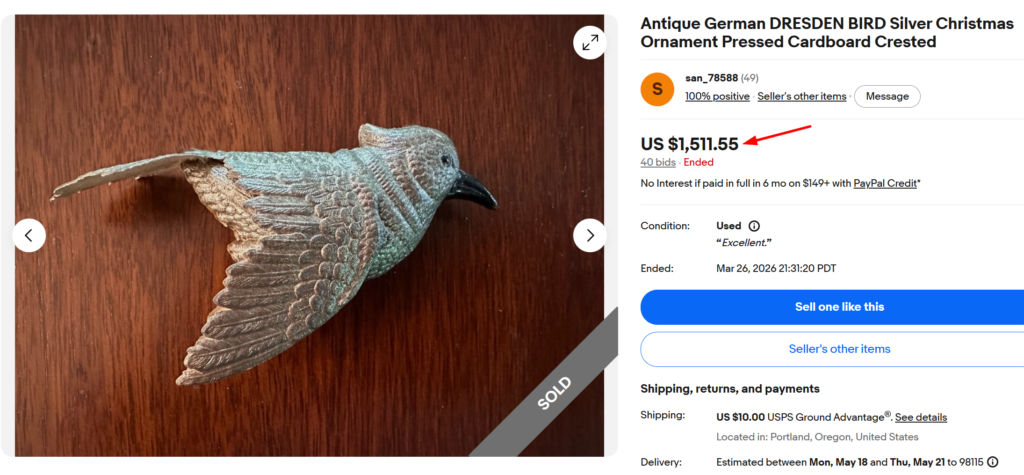
Sold for over $1,510
These are one of the high-end ornaments on the list. Dresdens were made in the Dresden-Leipzig-Furth area of Germany from about 1880 until WWII.
They’re embossed, hand-painted, and gilded cardboard ornaments, often three-dimensional and shaped like animals, birds, vehicles, or figural objects.
Rare items regularly sell for $100-$500, while rare pieces like this Silver-crested bird can sell for $1,000. Some pieces have sold for over $5,000, as well.
- Estimated Value: $50-$200 (common, small); $500–$1,000 (rare 3D forms)
- Production Year: 1880s–early 1940s
- Characteristics: Pressed, embossed cardboard with metallic gold or silver paint; three-dimensional construction
- Quick Notes: Original Dresdens have visible gilt wear, slightly faded paint, and softer cardboard.
2. Pre-1900 German Kugel Ornament
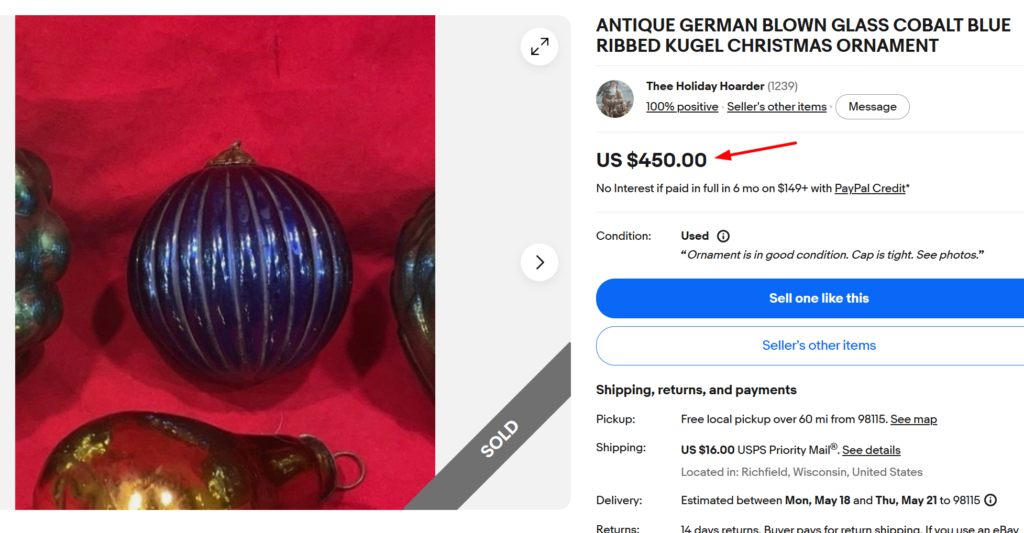
Sold for $450
Kugels are the most renowned of all the glass Christmas ornaments. They originated in Lauscha, Germany, back in the 1840s, when they were made as heavy and thick glass balls (or grapes, pears) that were so heavy they could only be hung from the ceiling, rather than tree branches.
It was F.W. Woolworth who imported them to America in the late 1800s and made a fortune on them.
Antique kugels are easily identifiable: heavy glass, brass caps, which appeared back in the 1850s, and a smooth surface near the neck hole. Rare colors like pink, purple, orange, and red can sell for a few hundred dollars.
- Estimated Value: $100–$500+ (rare colors and large sizes)
- Production Year: 1840s–1910 (German), 1920s–early 1930s (French)
- Characteristics: Thick, heavy mercury-silvered glass; brass cap with hanging ring.
- Quick Notes: Originals have a smoother neck; new ones have a rough, cracked-off neck.
3. 1940s Shiny Brite Box Set
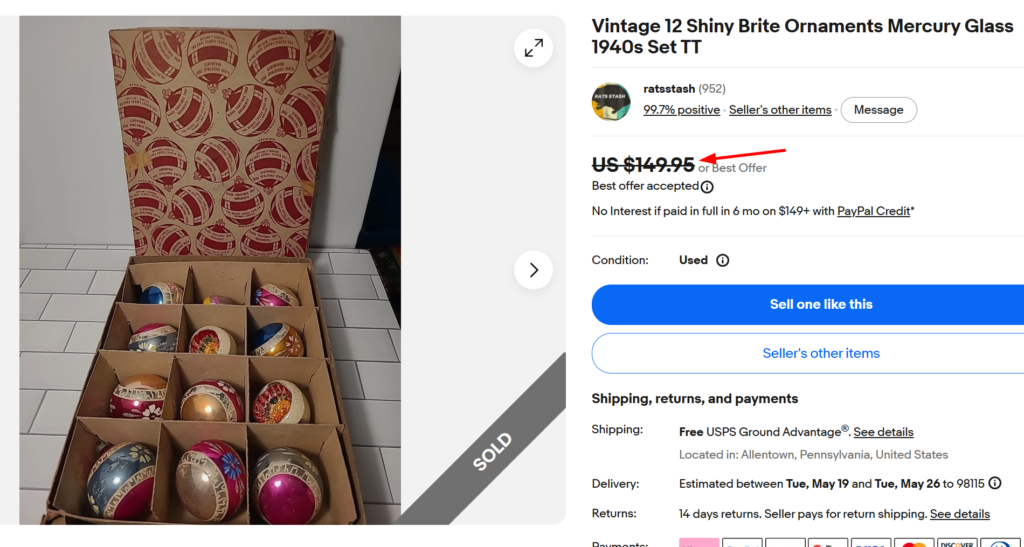
Sold for $150
Vintage Shiny Brite ornaments are probably the most recognizable American vintage Christmas brand. Max Eckardt launched them in 1937, and Corning Glass produced the blanks.
The iconic 1940s boxes feature Uncle Sam shaking hands with Santa. It was a wartime marketing move that played up the “American-made” angle while German imports were cut off.
Loose 1940s Shiny Brites are easy to find for a few bucks each. The top value lies in complete sets with intact original boxes, especially the Uncle Sam graphic ones.
- Estimated Value: $50–$250 (12-piece set in good box); $500+ (large lots)
- Production Year: 1937–1962 (1940s boxes, most valuable)
- Characteristics: Crimped metal cap stamped “Shiny Brite Made in USA”; original cardboard divider box with Uncle Sam/Santa artwork
- Quick Notes: Water-stained or torn boxes drop value fast.
4. Unsilvered Shiny Brite
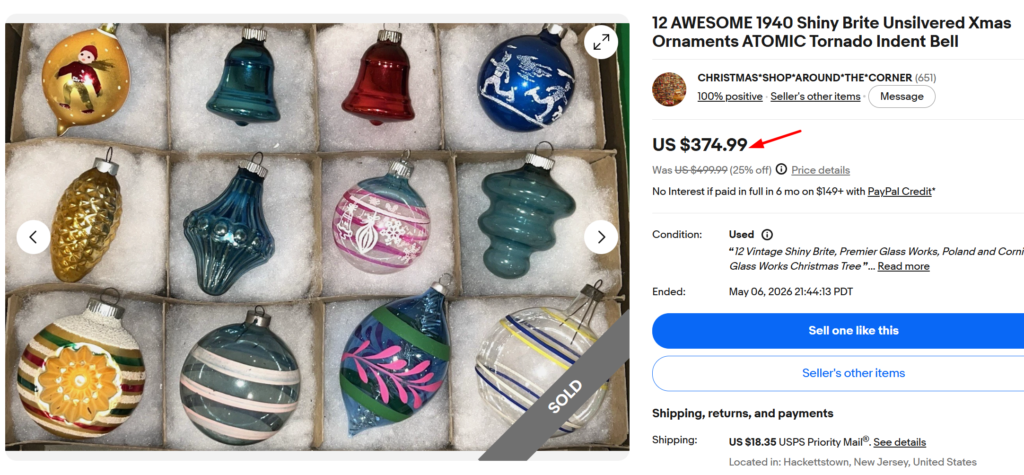
Sold for $375
In 1942, the United States War Production Board designated “silver nitrate” as non-essential, which prevented Shiny Brite and all other U.S. manufacturers from applying a silver coating to the inside of their ornaments.
They started shipping transparent ornaments with just hand-painted stripes or designs on the outside. By 1943, even metal was rationed, so the caps became cardboard or paper, with a string hanger.
These wartime ornaments only got made from 1942 to about 1946. And since very few survived since then, these decorations are highly collectible today.
- Estimated Value: $15-$30 (common stripes); $50–$155+ (paper-cap sets)
- Production Year: 1942–1946
- Characteristics: Clear or transparent glass body; hand-painted decoration on the outside; cardboard or paper cap with cord hanger (most valuable) or metal cap
- Quick Notes: Tinsel or “angel hair” stuffed inside the clear ornament.
5. Early Christopher Radko Ornaments
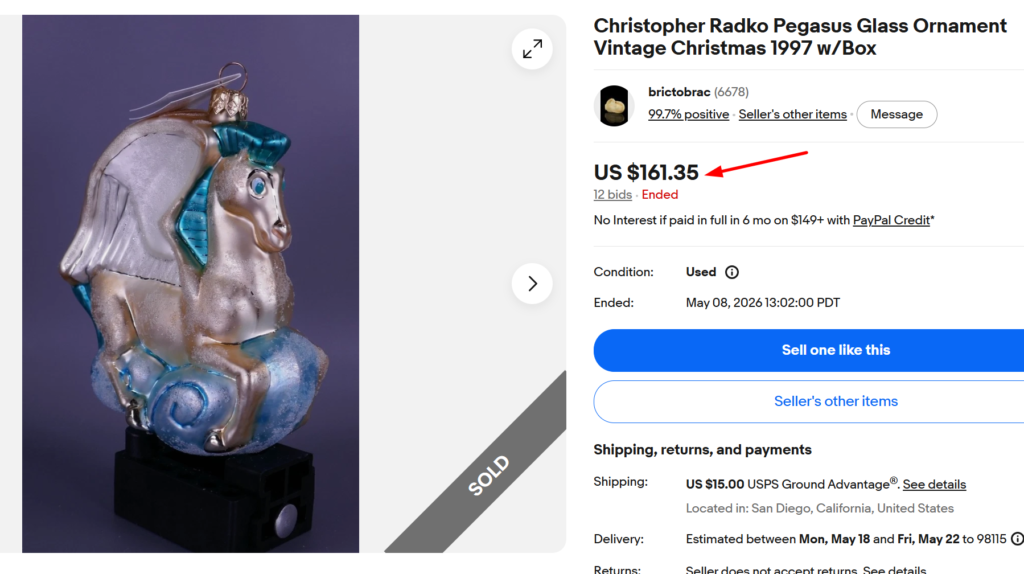
Sold for $160
Christopher Radko began his company in 1986 when his family’s Christmas tree knocked down the heirloom ornaments. He found no ornaments to replace them, so he commissioned glass blowers from Europe to produce them.
The early Radko ornaments, from the late ’80s to early ’90s, are quite collectible today due to limited production at that time. The true collectors’ interest lies in the limited edition sets having low edition numbers (from 500 to 2,500 in total).
- Estimated Value: $50–$300 (retired Radkos); $500–$5,000 (limited edition)
- Production Year: 1986–present (early years most valuable)
- Characteristics: Hand-blown glass, often Italian or Polish-made; gold Radko charm tag; signature on bottom; numbered limited edition tags
- Quick Notes: Mint-in-box with original tags is non-negotiable for top dollar — without the tag and box, even a real Radko drops significantly in value
6. Hand-Painted Czech Bird Clip-On Ornament
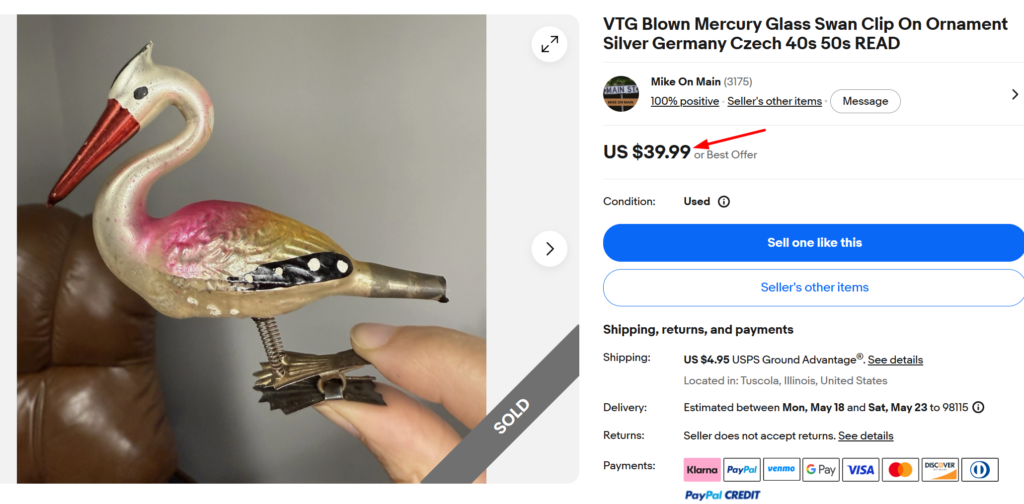
Sold for $40
Czech (Czechoslovakian) figural ornaments are a whole separate collecting category. The bird clip-ons from the late 1940s through the 1950s are especially loved. They have a little metal spring clip at the bottom, so they perch on tree branches like real birds.
The best ones have hand-painted details, a spun glass tail (not a feather), and a “Czechoslovakia” paper tag or cap stamp. Mercury-glass silvering inside the body, with hand-painted color over the top, is the classic look.
- Estimated Value: $25–$125 (common birds); $150–$400+ (elaborate figurals)
- Production Year: Late 1940s–1960s (Czechoslovakia marked)
- Characteristics: Metal spring clip at base; mercury glass body; hand-painted details; spun glass tail; “Czechoslovakia” mark on cap or paper tag
- Quick Notes: Original intact tail adds great value.
7. Mercury Glass Garland or Beading
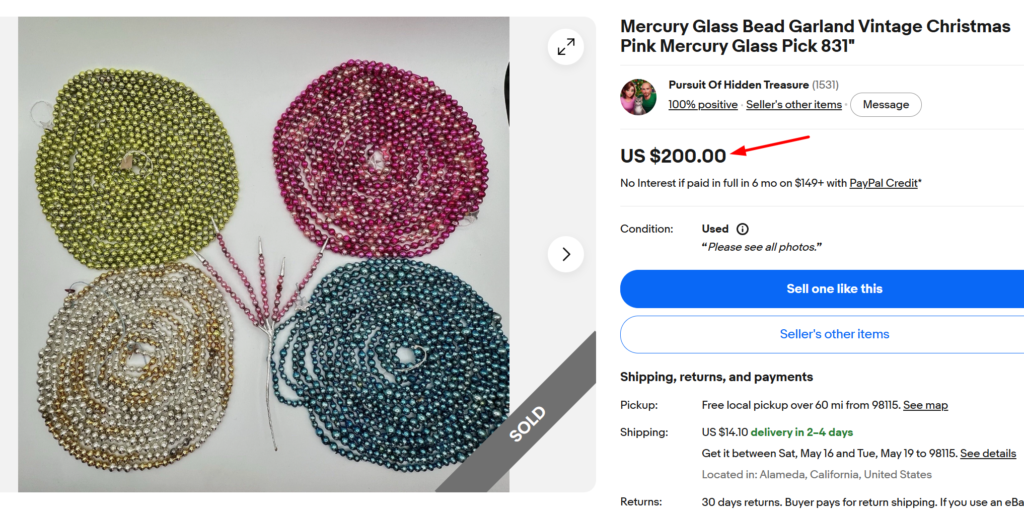
Sold for $200
These hand-strung glass bead garlands were everywhere on early 20th-century trees, then mostly disappeared after WWII when plastic took over. Most antique ones came from Czechoslovakia or Japan; the Czech versions are usually considered the finer made.
Length matters a lot for value. A short 3-foot piece is worth less per inch than a continuous 8-foot strand because collectors want enough to actually drape a tree.
Also, faceted, figural, and shaped beads offer more than ordinary round beads. Authentic paper labels stating “Made in Japan” or “Czechoslovakia” also add to the value of the beads.
- Estimated Value: $20–$80 (plain round beads); $100–$300+ (long figural or rare colors)
- Production Year: 1900s–1950s (Czech and Japanese imports)
- Characteristics: Hand-strung glass beads on cotton string; mercury-glass silvered interiors with painted color; small cardboard tabs at strand ends
- Quick Notes: The raised “lip” at each bead’s opening hints at originals.
8. Antique Ceramic Light-Up Christmas Tree (Atlantic Mold/Nowell’s)
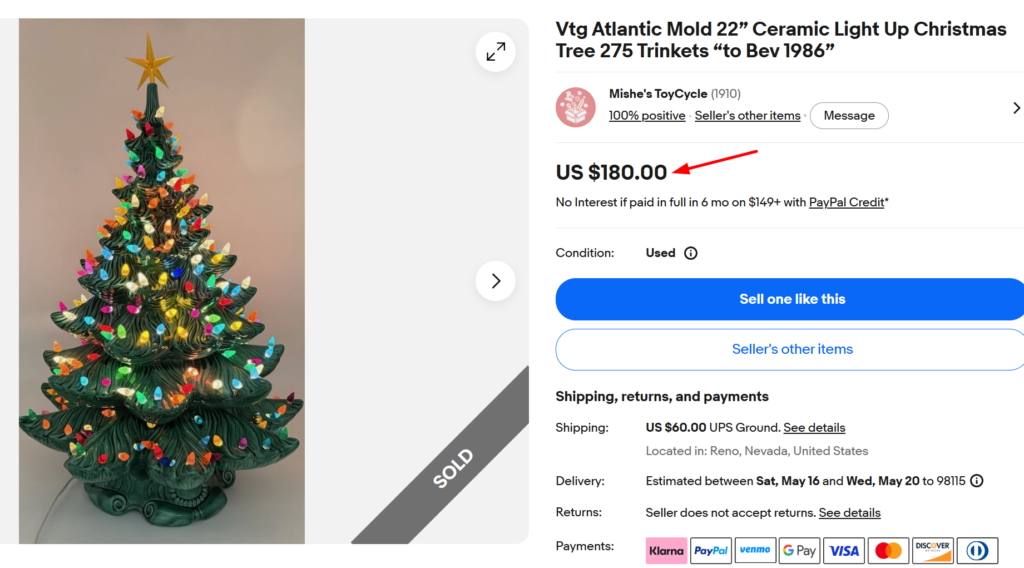
Sold for $180
These are everywhere on Facebook nostalgia posts, and they actually do sell well. Atlantic Mold copyrighted its famous ceramic tree mold in 1958. Nowell’s, Holland, and Arnel’s also produced popular versions.
These were mostly produced in home ceramics studios from the 1960s to the 1980s. But the 1958 stamp at the bottom is the mold copyright date, not the year your tree was made.
Atlantic sold thousands of copies of that mold to studios for 40+ years. A truly vintage tree usually has a hand-incised number from the studio, plus the painter’s initials.
- Estimated Value: $30-$150 (14-18″ trees); $300-$600+ (20″+ trees)
- Production Year: Late 1950s-1990s
- Characteristics: Hand-painted ceramic body; small plastic light bulbs inserted through pre-drilled holes; lit from a single base bulb in most versions
- Quick Notes: The earliest versions had individually-wired tiny glass bulbs
9. 1930s Glass Beaded Star Tree Topper
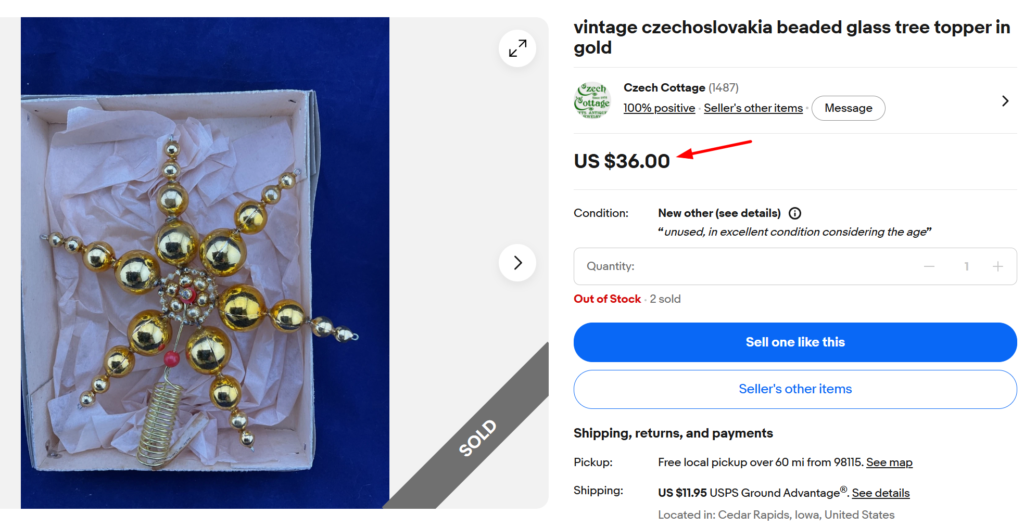
Sold for $35
Tree toppers are often forgotten in collecting talk, but the Czech glass-bead star toppers from the 1920s and 1930s have a real following.
They were made in the Gablonz region (now Jablonec, Czech Republic), wire-strung by cottage workers, and exported in huge quantities until WWII shut things down. Earlier (1920s) versions used three-dimensional construction with bangles and figural shapes.
The 1930s saw more elaborate star and starburst forms. Original paper tags reading “Made in Czechoslovakia” date them clearly to before WWII.
- Estimated Value: $40-$120 (common); $150-$350+ (large, pre-war)
- Production Year: 1920s–1930s (pre-war Czechoslovakia)
- Characteristics: Glass beads on fine wire; central star or starburst design; metal clip; often has “tails” of beaded strands hanging down
- Quick Notes: Wire corrosion and missing beads hurt value.
10. Antique Cast Iron Christmas Tree Stand
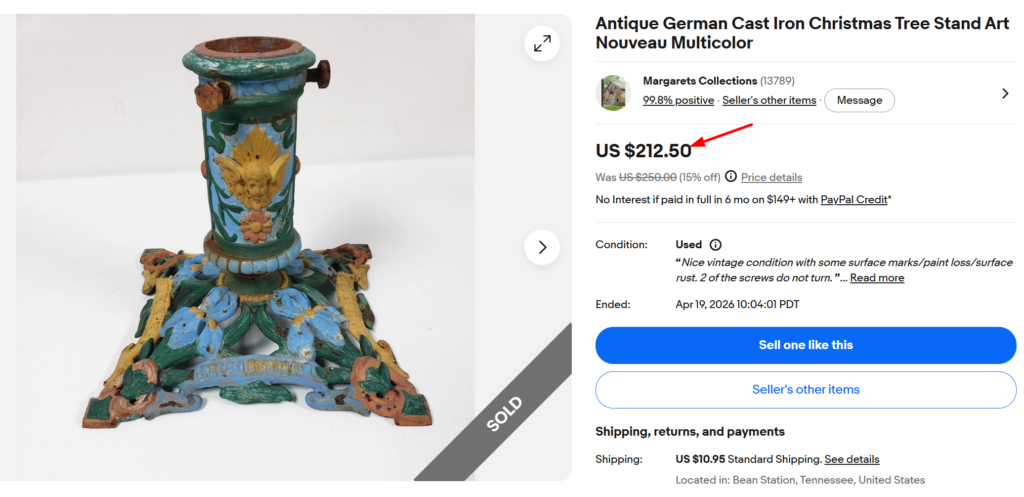
Sold for $210+
Cast-iron tree stands were the standard from the late 1800s through the 1930s, when lighter materials took over. The first U.S. patent for a Christmas tree stand was issued in 1876, and these early Victorian examples were often elaborately painted with flowers, reindeer, and Santa figures.
Tree stands don’t get displayed prominently, so even rare ones rarely break $250. The exceptions are German-made figural stands with Santa, angels, or detailed Victorian motifs in original paint; those occasionally fetch higher prices.
- Estimated Value: $50-$150 (plain); $150-$250+ (figural, painted)
- Production Year: Late 1800s–1930s (cast iron era)
- Characteristics: Heavy cast iron base; four legs or pedestal design; thumb screws to grip the trunk
- Quick Notes: Repainted stands lose almost all collector value.
11. Empire Plastic Blow Molds
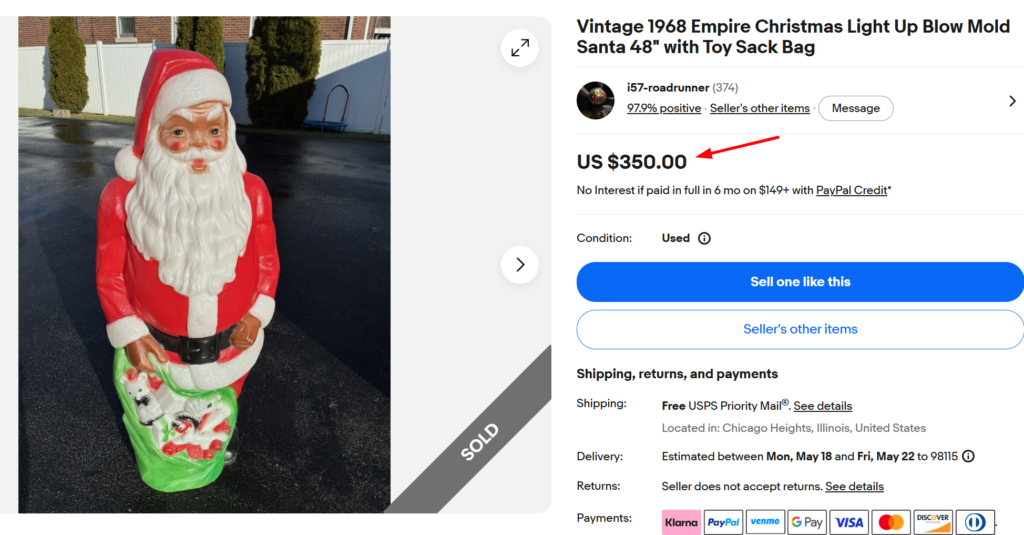
Sold for $350
These lawn ornaments were at their peak of popularity from the 1960s to the 1980s. Empire Plastic Corporation in North Carolina was the dominant maker, and their Santas, snowmen, and reindeer defined American suburban Christmas displays.
Empire was eventually absorbed by General Foam Plastics.
Today, most common vintage blow molds sell for $30-$60. But specific Empire pieces, especially complete Santa-and-sleigh-with-reindeer sets, oversized 4-foot Santas, and unusual color variations, can fetch up to $400 or more. In 2024, an Empire Santa sleigh with nine reindeer was auctioned for a price for $3,400!
- Estimated Value: $30-$150 (common singles); $200-$2,000+ (complete, rare)
- Production Year: 1960s–1990s (Empire’s prime years)
- Characteristics: Hollow plastic construction; manufacturer stamp embossed on the back or bottom (“Empire Plastic Corp” or later “Empire of Carolina”); internal light socket and original cord
- Quick Notes: Original paint, working light cords, stakes matter for top value.
12. Vintage Noel Candle Blow Mold
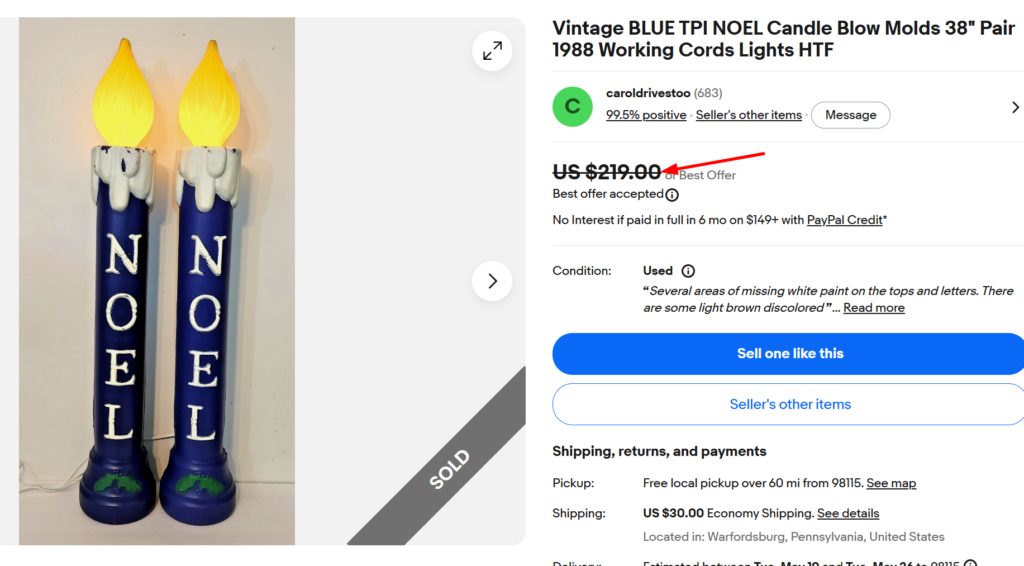
Sold for $220
A specific subcategory within blow molds: the tall Noel candles, usually sold in sets of four or pairs. Empire made the most familiar versions, with the 38-39″ tall red candles featuring white “NOEL” lettering and a yellow flame top. They were produced from the late 1960s through the 1990s.
Solo candles aren’t worth much. A complete matched pair or full “N-O-E-L” set of four with working cords and minimal paint loss is worth the most. TPI, General Foam, and Union Products also made these.
- Estimated Value: $50-$80 (singles); $100-250+ (pairs & sets)
- Production Year: 1968–1990s (Empire)
- Characteristics: 38-39″ tall red plastic candle; white “NOEL” molded lettering; yellow flame top; molded poinsettia decoration at base; original cord and bulb socket
- Quick Notes: The 1970 stamp inside the base hints at the original Empire.
13. Early Bubble Lights (NOMA)
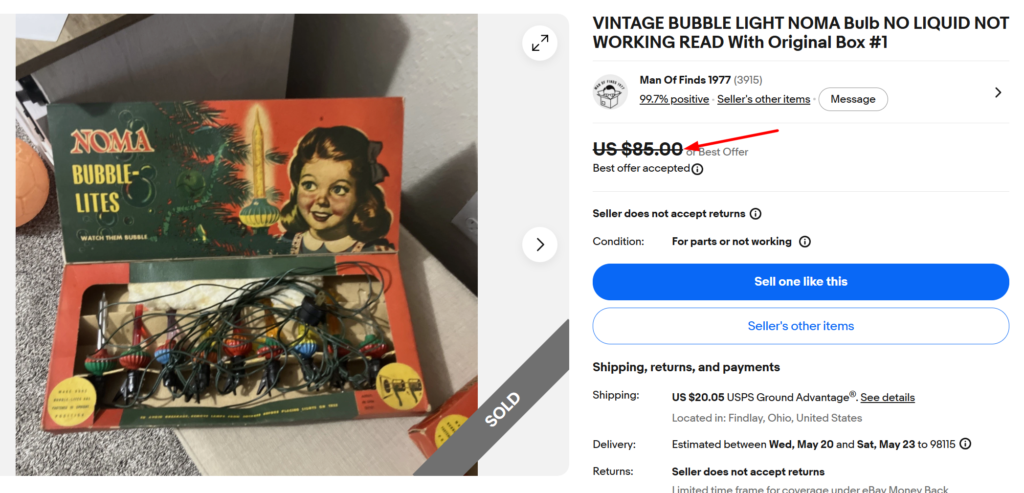
Sold for $85
NOMA Electric Corporation introduced commercial bubble lights for Christmas 1946 (they’d actually developed them in 1941, but WWII delayed release). The first NOMA “Biscuits,” sold in nine-light sets with a book-style box featuring the “NOMA Girl” graphic, is the founding piece.
The value lies in a complete original 1946-49 NOMA set in the book-style box, with all original brass-base bulbs and working tubes. Rare-color tubes (purple, dark blue, blood red) drive the price up further.
- Estimated Value: $100-$200 (common, boxed sets)
- Production Year: 1946–1960 (NOMA Biscuits)
- Characteristics: Bakelite or plastic base; glass tube filled with methylene chloride that bubbles when heated; brass-base C6 socket bulb
- Quick Notes: Early pieces have glass “slugs” inside the bubble tubes.
14. 1970s Hallmark Keepsake Ball Ornaments
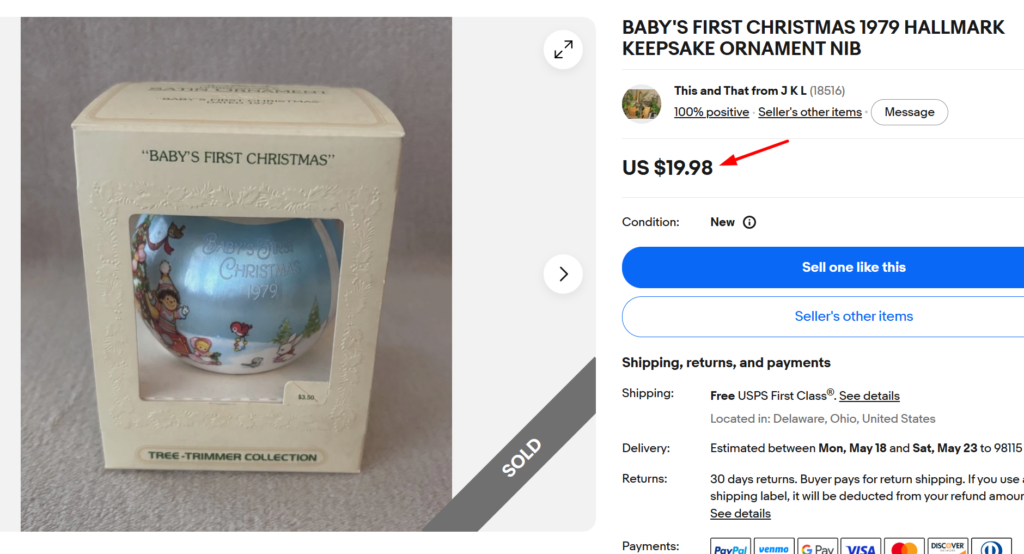
Sold for $20
Hallmark launched the Keepsake Ornament line in 1973 with six decorated glass ball ornaments and 12 yarn figures. The line has since grown to over 10,000 ornaments, but those original 18 pieces are most collectible.
The 1973 glass balls are dated and have specific designs, Betsey Clark, Manger Scene, Christmas Is Love, and others. With the original price tag and box, they can bring $200-$400, with rare event exclusives topping $1,000.
- Estimated Value: $20–$50 (common); $100–$400+ (rare early Keepsakes)
- Production Year: 1973 to Present
- Characteristics: Decorated glass ball with painted/printed design; original Hallmark cardboard sleeve box with year on the bottom
- Quick Notes: Mint-in-original-box is a must for top value.
15. German Cotton Spun Ornaments
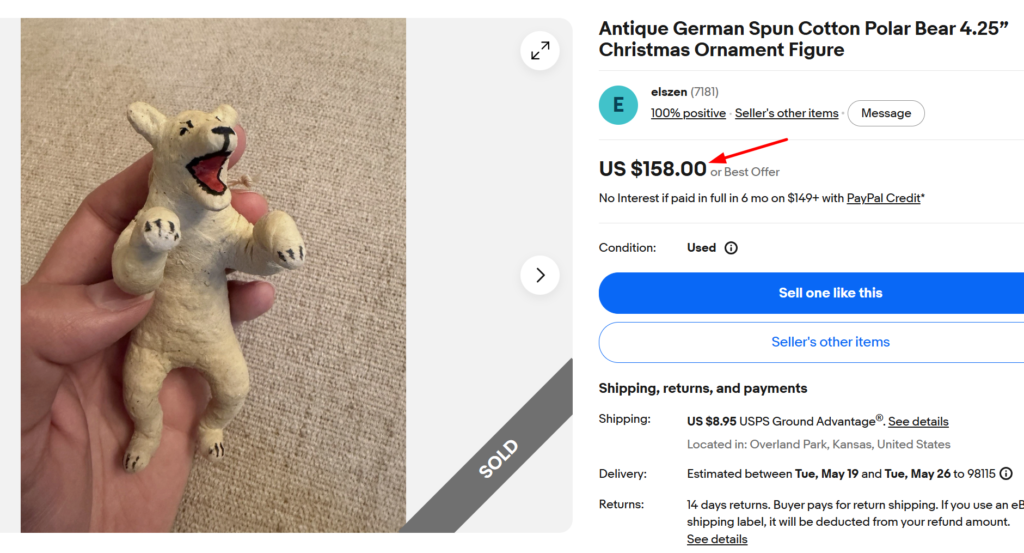
Sold for almost $160
Spun cotton ornaments are some of the oldest collectible Christmas decorations you can actually find. They go back to the mid-1800s, originally made as a non-breakable option that children could safely handle.
German cottage workers turned them out by hand, animals, fruits, Santas, snowmen, vegetables, using cotton batting wrapped over a wire armature, then hand-painted.
Today, well-preserved examples can sell for over $100. Those pieces that have hand-painted clay or composition faces (and not just hand-painted cotton pieces) usually sell better.
- Estimated Value: $30-$80 (common); $100–$300+ (rare, Santas)
- Production Year: Mid-1800s–1930s (German production)
- Characteristics: Cotton batting wrapped over a wire armature; hand-painted features
- Quick Notes: Condition is the biggest value driver with spun cotton.
If you’ve got a box of old ornaments in your cellar, the time to check is now, before you toss anything that looks “just old.” Check the caps, check the tags, check the boxes. You may have something worth a lot of money.