
Lladro figurines must be among the most overlooked porcelain collectibles. Although many items sell reasonably well, Lladro figurines that come with original boxes, wooden stands, certificates, and are in pristine condition can easily command thousands of dollars.
The following pages will detail the Lladro figurines’ values that are known for their consistently high market appeal and high prices, which include limited edition retired Lladro figurines, large display sculptures, and harder-to-find themes.
How Lladro Started?
In the early 1950s, three brothers, Juan, José, and Vicente Lladro, founded Lladro on a family plot in the small town of Almàssera near Valencia, Spain. The brothers established their own, old Moorish-type kiln in which they fired their early products, such as plates, vases, and jugs.
Their first figurines did not appear until 1955 or 1956. When sales increased, the brothers outgrew their backyard workshop, moving into larger premises in the town of Tavernes Blanques, which now houses the company’s main production facilities. In 1969, the company established its world-renowned “City of Porcelain,” which became the headquarters of Lladro International.
Another milestone in the history of Lladro was reached in the 1960s with the introduction of a new single firing instead of a more traditional three-stage process. It is the reason for the unique combination of soft pastel shades, including pink, blue, gray, and cream. Lladro entered the U.S. market in 1965.
Lladro Collector’s Society was formed in 1985, further enhancing its appeal within the secondhand market segment. The company still operates in Valencia; however, the old Lladro figurines from the 1960s to the 1990s are the pieces collectors watch most closely today.
How to Identify Genuine Lladro Porcelain Figurines
Knowing the marks, the materials, and the small details that separate a real Lladro from a knockoff (or a less valuable sister brand) is essential before you buy or sell one.
The Markings
Backstamp is the most significant factor for identification (the manufacturer’s logo at the bottom of the piece). There have been many changes in Lladro’s stamps over the years; dating according to the correct period allows you to both verify and date your figurine.
This is how they changed:
- Pre-1960 – Earliest pieces had no formal stamp or just a hand-etched signature. These are extremely rare. Most pieces from this era used phrases like “Porcelanas Lladró” or referenced “Valencia, España.” Any unstamped piece you suspect is pre-1960 needs professional authentication.
- 1960 to 1963 (first official mark) – Impressed (pressed into the porcelain) reading “Lladró” with the first “L” underlining the rest of the word, plus “Espanna” and “Made in Spain.”
- 1964 to 1970 (second mark) – Still impressed into the base, similar style, but the word “Espanna” was dropped.
- 1971-1974 (third mark) – It is during this period that the well-known blue bellflower stamp logo (erroneously considered to be a tulip) was introduced. The accent mark above the letter “ó” was deliberately omitted.
- 1974-1977 (fourth mark) – The accent mark was reintroduced, along with a trademark symbol.
- 1977-1984 (fifth mark) – The acronym “DAISA” was introduced. DAISA refers to Diseños Artísticos e Industriales, S.A., the overall copyright holder corporation of the Lladro family. Many consumers often confuse DAISA with a range name, whereas it only denotes that the piece is copyrighted.
- 1984 to 1989 (sixth mark) – Added a copyright date next to the DAISA acronym.
- 1990 to present (seventh mark) – The bellflower was simplified to the cleaner tulip-like design you see today, and the font for “Lladró” was updated.
Important: Lladro sometimes sold pieces that failed quality control as “seconds.” These have the bell-flower scraped off the backstamp. Seconds are still authentic but won’t fetch top-dollar prices.
Model Numbers
Each Lladro figurine comes with an individual model number consisting of four or five digits, which may be printed or stamped into the bottom of the piece.
From 1986, Lladro introduced a new system where such models are actually embossed directly onto the porcelain (the model number was usually found only inside the original packaging before then).
You can look up any model number using collectors’ online references (like LladroDB or A Retired Collection) to find information about the model name, the sculptor, year issued, and year retired. This will also give you an idea of what the approximate value of the item would be.
Style, Colors, and Shape
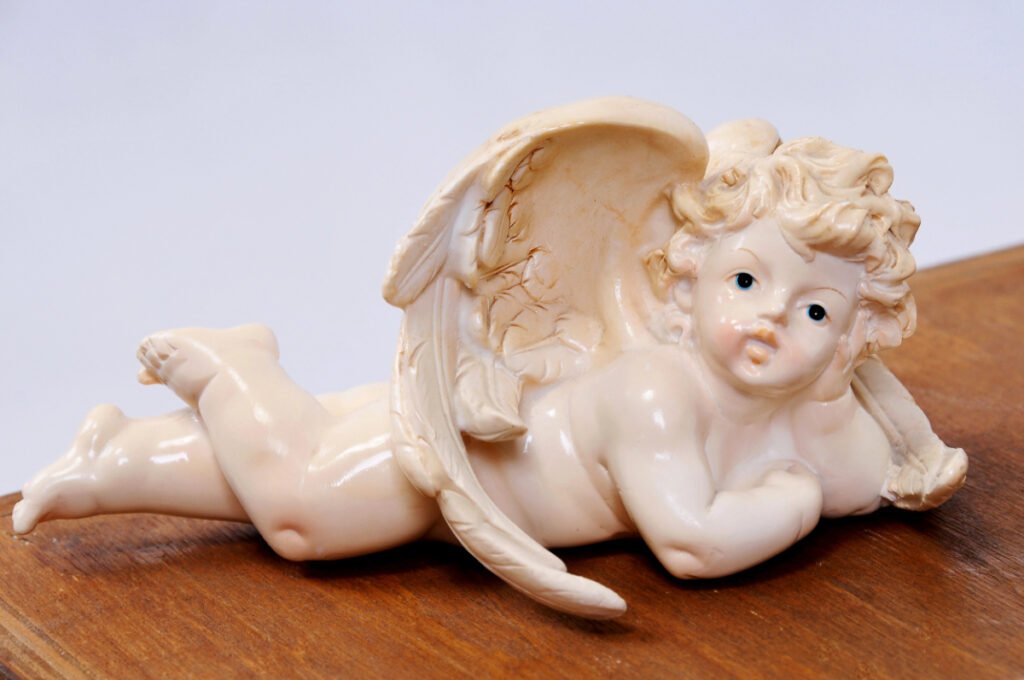
Real Lladro figures have their own distinctive style. Their bodies are elegant and tall with slender limbs and elongated necks; this design is typical for the Spanish Mannerist style of the 16th century. Colors are soft: pastel pinks, light blues, whites, and grays.
An easy way to spot counterfeit Lladro figures – this company never paints any black elements on the face of its dolls. If you notice sharp lines painted around the eyes, then most probably your figurine isn’t an authentic product.
Finish: Glazed, Matte, or Gres
Lladro produces figurines in three different finishes, and knowing them helps you confirm authenticity and value:
- Glazed (Glossy) – The most common finish, with a high-shine surface. Most pieces in this guide are glazed.
- Matte – A non-shiny finish, produced in smaller numbers than glazed. Often a bit more valuable because of its scarcity.
- Gres – A satin-like sheen with more colorful, earthy tones. Made with a different clay formula and appeals to a specific subset of collectors.
Quality and Weight
Genuine Lladro porcelain figurines aren’t heavy but rather feel solid; they should have a silky surface. Hand-painted elements must be very detailed, especially those on the face and on flowers.
Counterfeits usually lack precision and may look rough; they also tend to have less smooth porcelain or even a little chalky texture. Real applied flowers are made separately and put on the figurine manually.
Watch Out for Sister Brands
Lladro owns or has owned several related brands: Nao (a more affordable line made in the same workshops), Zaphir (a short-lived line from 1978 to the mid-’80s), Hispania, and Rosal.
Nao especially gets confused with Lladro because the figurines look similar and were sometimes made by the same sculptors. Nao pieces have their own red-brown backstamp with a ship logo and the words “by Lladró.” They’re not worthless, but they generally bring less money than true Lladro pieces.
12 Valuable Lladro Figurines Worth Big Money
Lladro figurines prices vary widely. Common small pieces may sell for under $100, while the most valuable Lladro figurines are usually large, retired, signed, limited-edition, or complete-set examples in mint condition. This Lladro figurine price list includes some of the most notable pieces to look out for.
1. “Car in Trouble” Figurine
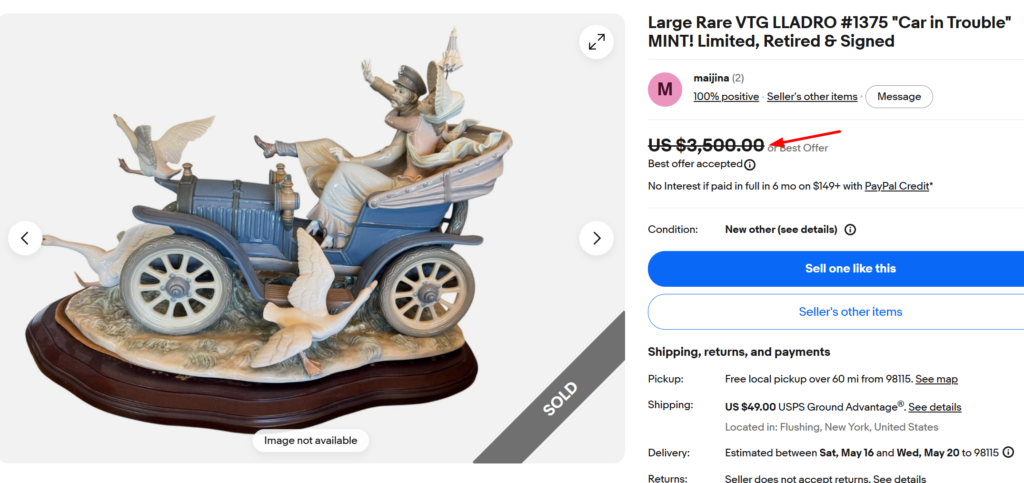
Sold for $3,500
A delightful and unusual Lladro piece, Car in Trouble shows a comic scene: an early 20th-century automobile with a man and a woman in fancy dress, surrounded by a flock of startled geese taking flight. Sculpted by Salvador Debón, it was produced as a limited edition of 1,500 pieces from 1978 to 1987.
This is a large, theatrical piece, around 16.5 inches tall and 26 inches wide, with a mahogany-stained base. The original retail price was around $4,100. Today, mint examples with the original box, base, and COA sell around $2,500 to $3,500+.
The wood base usually has the edition number (“X of 1500”) signed along the edge by Debón and the painter Julio Ruiz.
- Estimated Value: $2,500 to $3,500 (mint with base and COA)
- Production Year: 1978 to 1987 (retired, limited edition of 1,500)
- Characteristics: Glazed porcelain, vintage car with figures and geese, 16.5″ H x 26″ W, mahogany base
- Markings: Fifth or sixth blue backstamp (DAISA acronym era), signed by Salvador Debón and Julio Ruiz, numbered edition
- Quick Notes: Count the geese, check details on the umbrella & the car
2. “Heaven and Earth” Angel Figurine
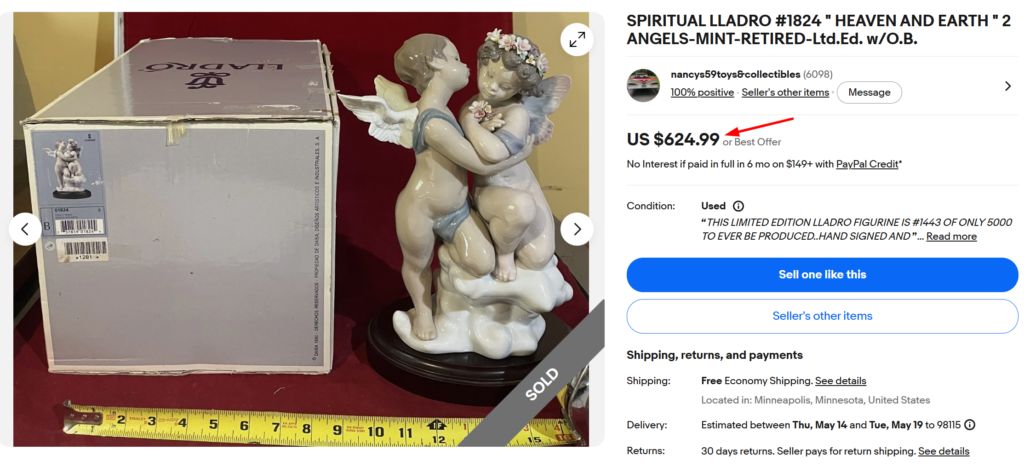
Sold for $625
This is a rare collectible and one of the rarest Lladro angel figurines you will find. Titled “Heaven and Earth,” this pair features two cherubs in a loving pose, with a boy angel featuring feathered wings for heaven and a girl fairy having butterfly wings for earth, as well as flowers in her hair.
The reason behind its high value is its scarcity. Lladro issued it in 1998 as a limited edition of only 5,000 pieces, and it was retired the very next year in 1999.
Sculpted by master artist Francisco Polope and hand-signed by both the sculptor and decorator, each piece carries a unique edition number stamped on the base. Mint examples with the original box have sold in the $600 to $900 range.
- Estimated Value: $600 to $900 (mint with box, base, and COA)
- Production Year: 1998 to 1999 (one-year run, limited edition of 5,000)
- Characteristics: Two embracing cherubs on a cloud base, wood base
- Markings: Modern blue tulip stamp (post-1990), DAISA 1998 copyright, model number 1824, hand-signed with edition number (X/5000)
- Quick Notes: The girl cherub’s flower crown is the most fragile feature.
3. “Christo De La Roca” Figurine
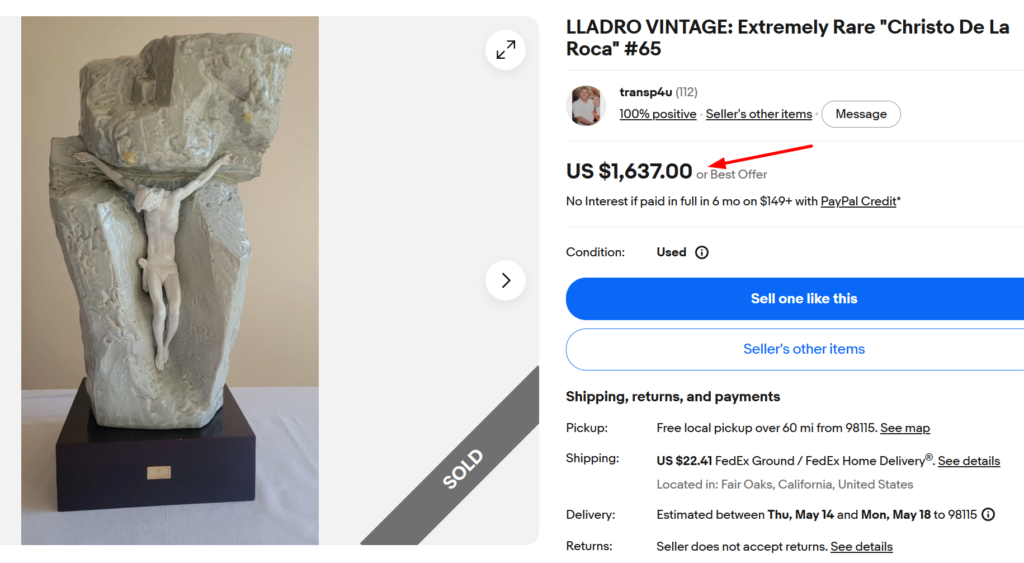
Sold for $1,640
Sculpted by Fulgencio Garcia, one of Lladro’s founding-era master sculptors, Cristo de la Roca (also known as “Jesus the Rock”) was produced as a limited edition of only 1,000 pieces. It was issued in 1989 and retired in 1995, a six-year window in which all 1,000 pieces were sold.
Each one came numbered and signed by both the sculptor and the painter, J. Ruiz. The piece measures 19.75 inches tall and depicts Christ on the cross integrated into a textured rock face, a bold and unusual composition for Lladro.
Today, this piece is worth $1,500 to $2,000+ in mint condition with the certificate of authenticity, wooden base, and original box still intact.
- Estimated Value: $1,500 to $2,000 (mint with COA and base)
- Production Year: 1989 to 1995 (retired, limited edition of 1,000)
- Characteristics: Glazed porcelain, 19.75″ H, comes with a wood base
- Markings: Modern blue tulip stamp (post-1990), DAISA copyright mark, numbered edition (X/1000), signed by sculptor and painter
- Quick Notes: Missing COAs can cut the value by 20% or more.
4. Nativity Figurines Set
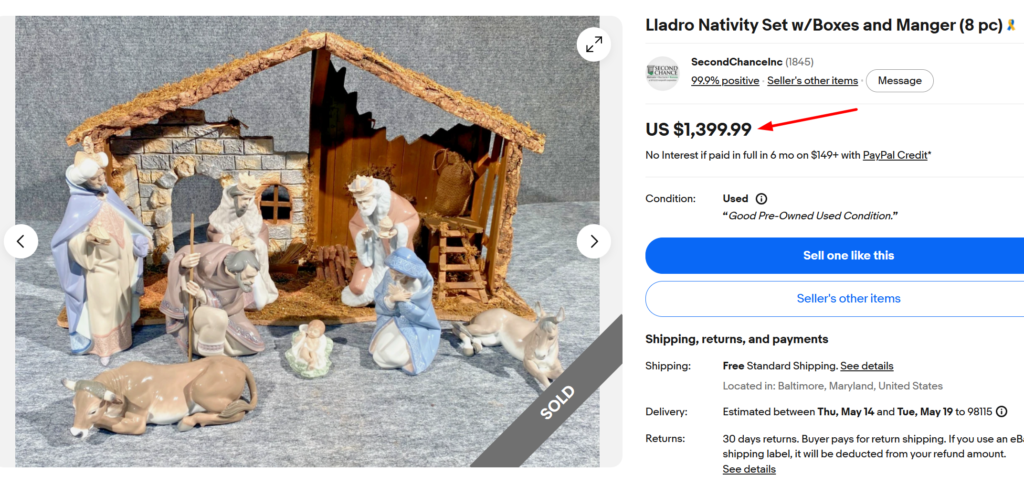
Sold for $1,400
Lladro’s Nativity set is an eight-piece collection, consisting of figurines of Mary, Joseph, the Baby Jesus, three wise men, Melchior, Gaspar, and Balthasar, the cow, and the donkey. Some collectors also add the shepherd boy, the shepherdess, the camel, and the angel to the set.
The most sought-after Nativity set is the glazed version of the figurines made from 1981 until its retirement in 2007. Complete sets of eight or ten items can fetch $1,300-$1,800 today.
- Estimated Value: $1,300 to $1,800 (full 8-piece set, mint)
- Production Year: 1981 to 2007 (retired)
- Characteristics: Multiple glazed figurines, sizes vary from 3.5″ (Baby Jesus) to 14″ (King Balthasar)
- Markings: DAISA marks ranging from 1981 to 2007 (as per production year)
- Quick Notes: The Gres-finish Nativity set is more valuable than the glazed.
5. “Springtime in Japan” Figurine
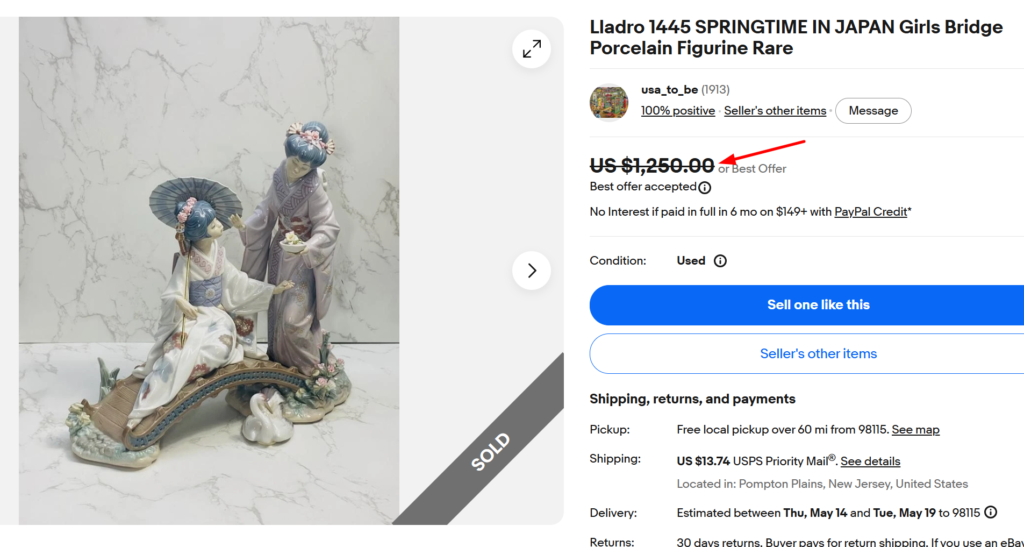
Sold for $1,250
The last piece on our list is one of the most popular Asian-themed items of the Lladro range. It’s known as “Springtime in Japan” (Spanish title: “Japonesas en el Puente”).
The figure depicts two figures of geishas wearing traditional kimonos standing on the bridge, among cherry blossoms, and having a parasol resting on the shoulder of one of them. This sculpture was made by Salvador Debón, lasting from 1983 to 2019.
At about 13 inches tall and 14.25 inches wide, it includes applied flower decoration, painted kimonos, and hair decorations. While the original retail price was around $2,550, new-like examples today sell for $700 – $1,500. Parasol loss and damaged hair flowers tend to affect their value most adversely.
- Estimated Value: $700 to $1,500 (mint with base)
- Production Year: 1983 to 2019 (retired)
- Characteristics: Glazed porcelain, two geishas on bridge, 13″ H x 14.25″ W, wood base included
- Markings: Sixth or seventh blue backstamp, DAISA mark with copyright date, model number 1445
- Quick Notes: The parasol is a separate piece that detaches and is frequently lost.
6. Don Quixote Figurine
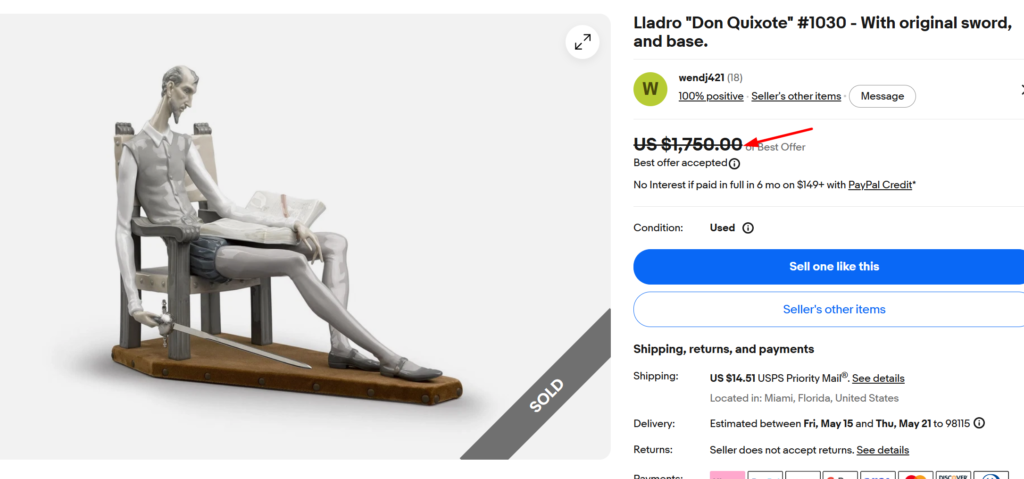
Sold for $1,750
Don Quixote is that one Lladro figurine almost every collector recognizes. Sculpted by Salvador Furió and first issued in 1969 or 1970 (sources vary slightly), this piece has become one of the brand’s signature works.
Measuring about 15.75 inches tall with the base, it depicts the famous literary character seated in a chair, leg outstretched, reading a book with his long sword resting at his feet. The piece had a long initial production run, was retired, and was later reissued.
Modern catalog versions are still produced today. But the early matte and gres versions from the 1970s and early 1980s are the most desirable pieces. Vintage examples in mint condition have crossed $1,500; pieces with the early backstamps (third or fourth marks) command the highest premiums.
- Estimated Value: $800 to $1,800 (matte/gres versions)
- Production Year: 1969/1970 onwards; vintage early versions retired 1992; reissued and currently in catalog
- Characteristics: Available in glazed, matte, and gres finishes; 15.75″ H with base
- Markings: Vintage versions have third through sixth backstamps (1971-1989)
- Quick Notes: A loose or missing sword can cut the value by $200 to $400.
7. “Swans Take Flight” Figurine
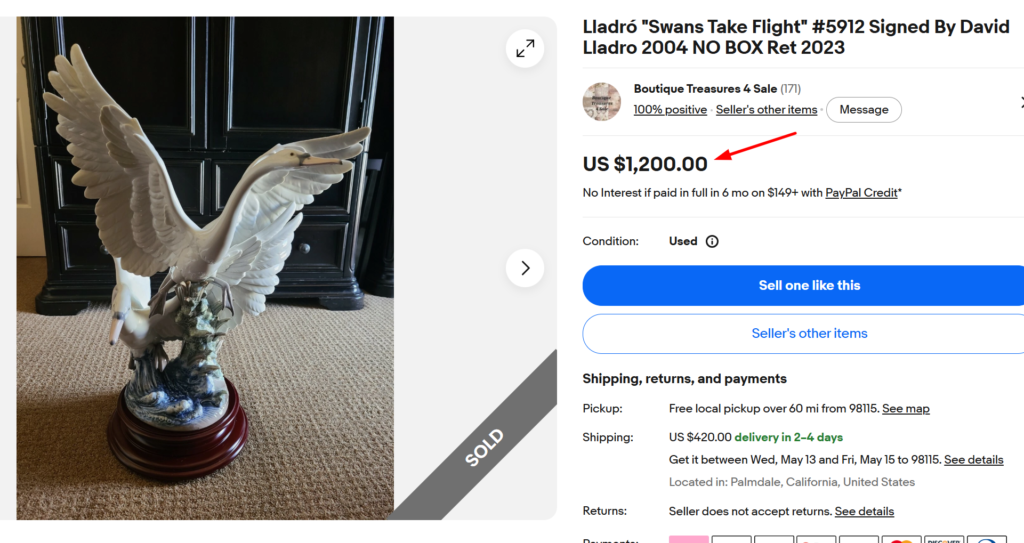
Sold for $1,200
One of the largest and most dramatic pieces in the Lladro catalog, Swans Take Flight is a massive sculpture, over 25 inches tall and 27 inches wide, depicting two swans rising from the water mid-takeoff.
Sculpted by Salvador Debón and first issued in 1992, the piece falls into Lladro’s “Prestige” category of large, complex display sculptures. It was retired around 2023.
Because of its size and complexity, this is one of the few Lladro pieces that requires its own dedicated wooden base, which is a crucial value factor. Also, the applied details on the swans’ feathers and the base flora are extremely fragile. Mint examples with the original wood base in place have sold for $1,000 to $1,500.
- Estimated Value: $1,000 to $1,800 (mint with base)
- Production Year: 1992 to circa 2023 (retired)
- Characteristics: Glazed porcelain, two swans taking flight, 25.5″ H x 27″ W
- Markings: Modern blue tulip stamp, DAISA mark, model number 5912; some pieces signed by David Lladro
- Quick Notes: The original wood base with the Lladro plaque is essential for top value.
8. “Graceful Ballet” Figurine
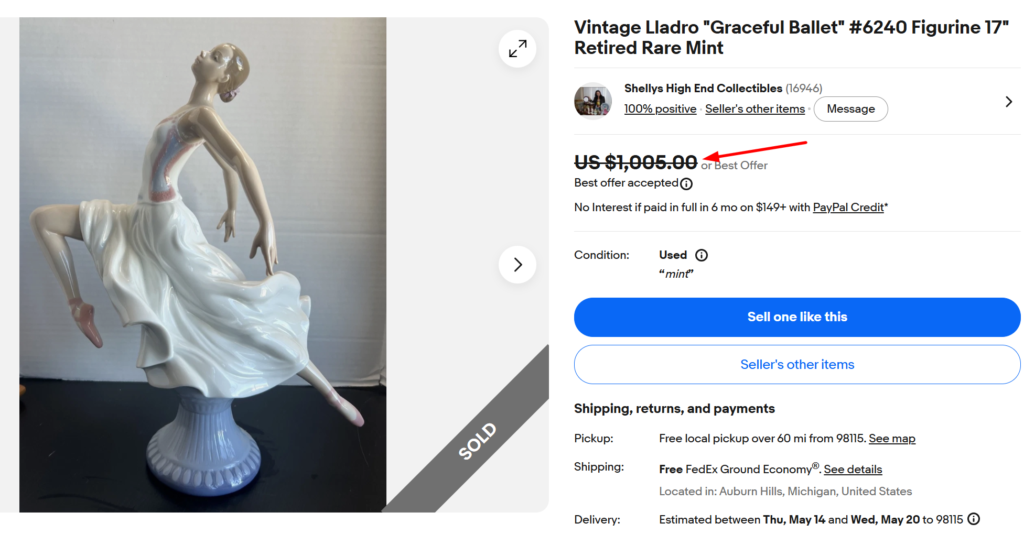
Sold for $1,000
Graceful Ballet only lasted for three years of production from 1995 to 1998. This is why it is among the Lladro ballet figurines with one of the shortest production periods.
This figurine is a representation of a ballerina caught mid-dance, complete with arms stretched backward, bent body, and elegant tulle skirt. Owing to its elaborate tulle skirt designs and striking pose, the Graceful Ballet is among the most sought-after ballet figurines of Lladro.
Some of the recently sold examples have fetched prices of over $1,000. Any damage to the fingers and pointed toes reduces the value significantly.
- Estimated Value: $700 to $1,200 (mint condition)
- Production Year: 1995 to 1998 (retired)
- Characteristics: Glazed porcelain, ballerina with arched back and flowing skirt, 17″ H
- Markings: Modern blue tulip stamp (post-1990), DAISA mark, model number 6240
- Quick Notes: Condition of fingers and pointed toes impacts value.
9. Bird Figurines (Toucan)
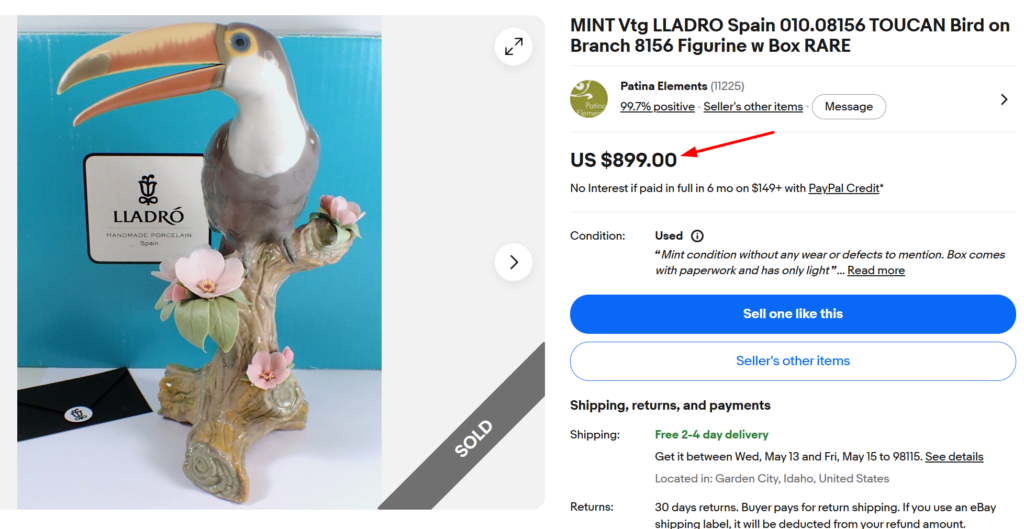
Sold for $900
This figurine presents a solitary toucan resting on a tree branch that has porcelain flowers placed at its base. Made by artist Regino Torrijos, one of Lladro’s most productive designers, the toucan has been painted in bright colors and depicts the signature large orange bill of a toco toucan.
With a height of slightly under 11 inches, the figurine is one of the many bird sculptures made by Lladro. What pushes the value up is its retirement. Lladro discontinued it in 2011, and pieces in mint condition with the original box have been selling consistently in the $800 to $1,400 range on eBay.
- Estimated Value: $700 to $1,400 (mint with box)
- Production Year: circa 2004 to 2011 (retired)
- Characteristics: Bird perched on a branch, applied pink flowers
- Markings: Modern blue tulip stamp (post-1990), DAISA mark with copyright date, model number 8156
- Quick Notes: Flower work damage drops the value.
10. “Bride & Groom” Figurine (Cake Topper)
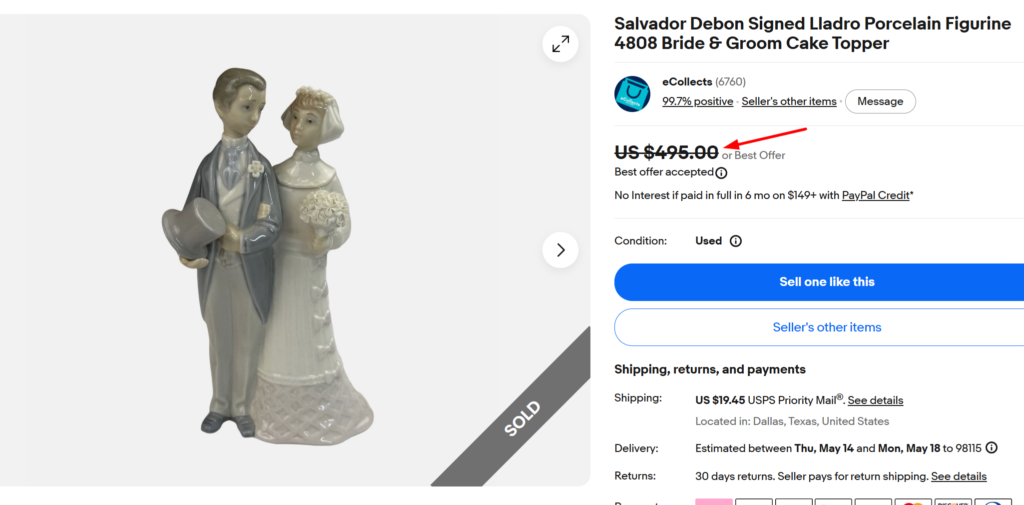
Sold for $495
This figurine is both a valuable collectible and a much-loved wedding cake topper. The Bride & Groom figurine has been manufactured for almost 34 years, from 1972 to 2005; however, only the early versions with a matte finish command high prices.
The figure features a groom dressed in a tuxedo, top hat, and bow tie standing beside a bride wearing a dress and carrying a bouquet. One of the smallest figurines on the list at 7.75 inches, it is among the most popular designs available.
In mint condition, this figurine generally fetches between $200 and $500 today, with the more elusive matte versions selling for even more.
- Estimated Value: $200 to $500 (mint with box)
- Production Year: 1972 to 2005 (retired)
- Characteristics: Glazed bride and groom couple (matte version also exists)
- Markings: Varies by production year.
- Quick Notes: Check for hairline cracks & bride’s bouquet details.
11. “Circus Show” Figurine
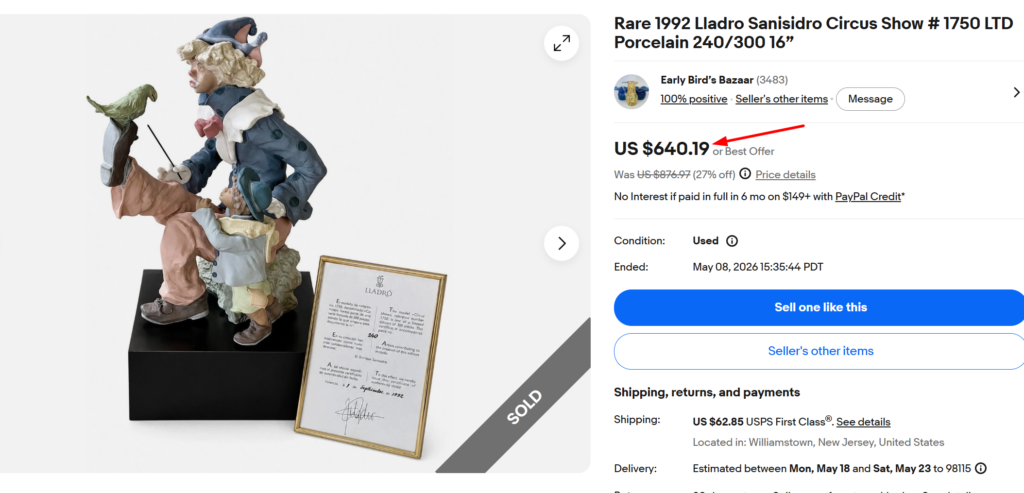
Sold for $640
This is one of the rarest figurines on the list. Enrique Sanisidro created and released this circus figurine in a limited edition of 300 pieces in 1991 before it was discontinued in 1994. It portrays a clown holding a little boy and a parrot.
Belonging to the highly valued Goyesca series by Lladro, this piece was inspired by paintings by the 18th-century Spanish artist Francisco Goya. Unlike the usual Lladro porcelain, Goyesca has its unique finishing technique, where a more malleable clay is used that allows the impressing of textile designs, and deeper carving and vivid coloring.
Each piece features an individual signature of Sanisidro and comes in a wooden display with an authentication certificate in a frame, which boosts value.
- Estimated Value: $700 to $1,800 (with base and COA)
- Production Year: 1991 to 1994 (retired, limited edition of 300)
- Characteristics: Goyesca finish, clown with child and parrot, 16″ H
- Markings: Modern blue tulip stamp, hand-signed and numbered edition
- Quick Notes: COA and original wood base add value.
12. Caballo “Arrogante Horse” Stallion Figurine
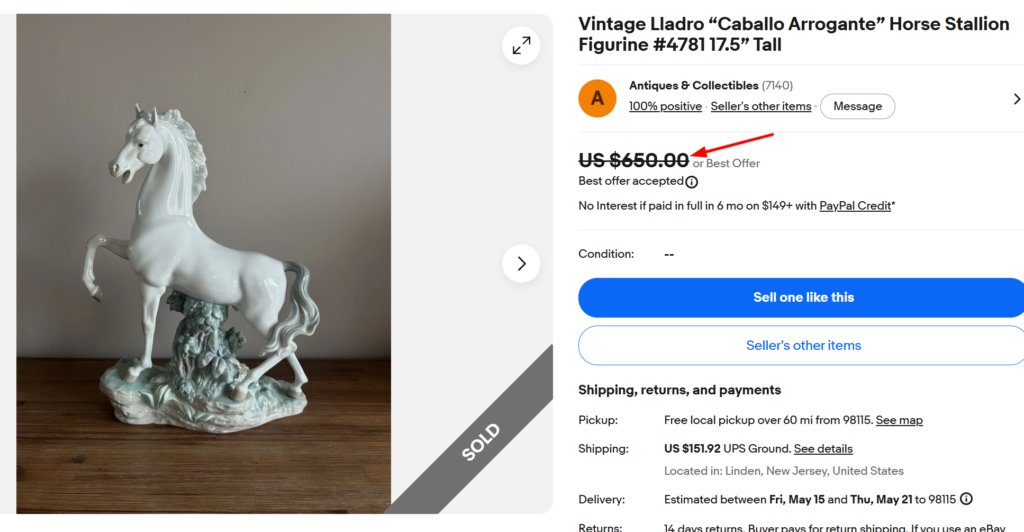
Sold for $650
The “Arrogant Horse” is one of the most recognized Lladro horses, sculpted by Vicente Martinez and produced from 1971 to 1981. That’s a relatively short 10-year run, which is part of why it’s so collectible today.
The piece shows a white stallion mid-prance, head turned slightly, mane and tail flowing. Its large size of 16.5 inches makes it a prominent piece.
Generally, it comes with a matte finish. Since Lladro created fewer matte figurines than glazed ones, the matte versions are highly valued by collectors. Rare Lladro horses in perfect condition can go up to $900.
- Estimated Value: $400 to $700 (mint condition)
- Production Year: 1971 to 1981 (retired)
- Characteristics: Matte finish, white stallion in prancing pose, 16.5″ H
- Markings: Impressed early Lladro mark or third/fourth blue backstamp (1971-1977 era)
- Quick Notes: Matte and glazed versions have different model numbers.
If you’re new to Lladro figurines, knowing the marks, the sculptors, and the retirement dates is a great starting point. These are the details that separate a $30 thrift store item from a $2,000 auction piece!