
Why Vintage Cast Iron Skillets Are Worth Money Today?
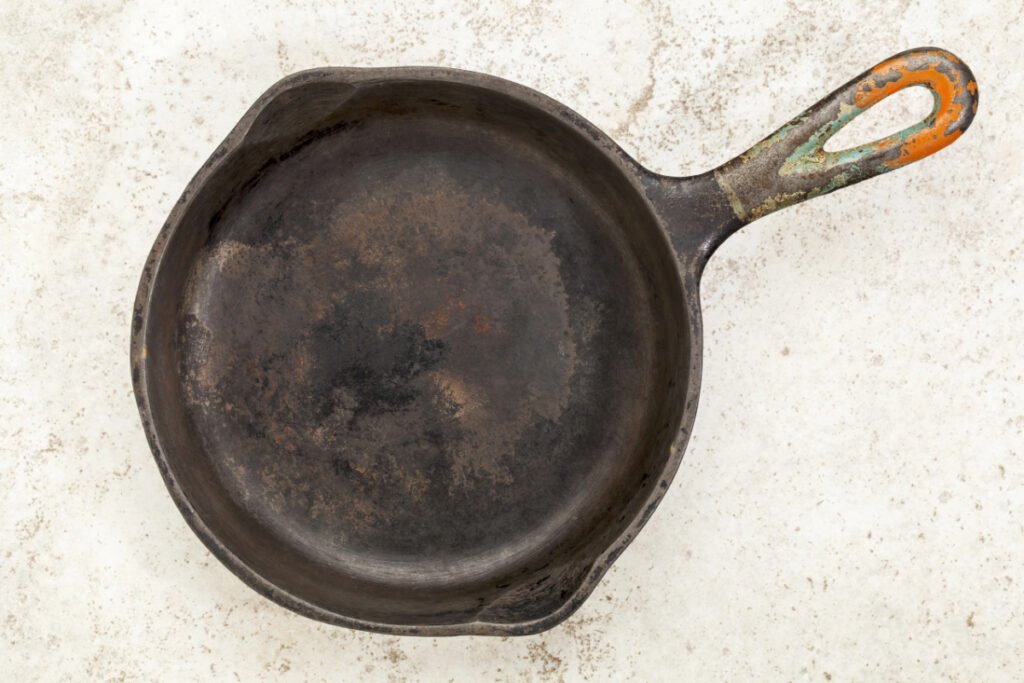
There are several reasons behind old cast-iron skillets being valuable and collectible today. First of all, the cooking surface of these vintage skillets is truly superior to that of most modern skillets.
Cast irons produced pre-1960s by the likes of Griswold and Wagner were highly polished to give them their characteristic glass-like smoothness. Mass-produced contemporary skillets have pebbled surfaces due to the sand-casting process, which does not smooth out even after years of seasoning.
Secondly, the foundries of these famous brands are now history. Griswold closed its Erie factory in 1957.
Wagner closed its Sidney foundry in 1999. Birmingham Stove & Range stopped production in 1989. There will be no more production of vintage cast irons, and what few are left in the market are being hoarded by collectors each year.
Limited production time makes for rarity. It’s easy to guess how rare a skillet made for only ten years, in only one size, and during only one logo period can be. The Wagner pie logo, Griswold medium block, Lodge no-notch, and Erie spider are all limited in production and, hence, collectible.
How to Identify a Vintage Cast Iron Skillet?
The bottom of the pan will tell you just about everything. Turn it upside down, examine the stamps, note whether there is a heat ring (or not), study the handle style, and feel the cooking surface. Each of these elements represents an independent age determination indicator, and together they will give you a pretty good idea as to when the pan was produced.
Marks for Collectible Brands
Most collectible cast iron originated from a few different American manufacturers. Over the years, their stamps evolved, and this provided the opportunity for collectors to estimate the year of manufacture.
Below are the most recognizable brands:
- Griswold (Erie, PA, 1865-1957) – Cross-in-double-circle logo with GRISWOLD across the horizontal arms. Italicized “slant logo” (1906-1929), bold “large block logo” (1920-1940), smaller “small block logo” (1939-1957). “ERIE, PA U.S.A.” or “ERIE, PA” sits below the cross.
- ERIE (pre-Griswold branding, 1880-1907) – Raised “ERIE” lettering with no cross logo. Six numbered series. The fourth series (1905-1907) used unusual “artistic” or “squiggly” lettering and was only made in sizes #5 and #9.
- Wagner Manufacturing (Sidney, OH, 1891-1959) – Early pieces marked “WAGNER” straight or arched, sometimes with “SIDNEY, O.” below. The stylized logo (around 1922 onward) shares one fancy “W” between “Wagner” and “Ware,” with SIDNEY and -O- underneath. After 1959, the “SIDNEY -O-” was dropped.
- Wagner Ware “Pie Logo” – Logo design with a wedge-shaped border around it, with “CAST IRON SKILLET” written curved at the bottom part of the design. Made for about ten years, mainly during the 1930s period.
- Lodge (South Pittsburg, TN, 1896-present) – From the 1940s through the 1960s, often unmarked except for a size number, with an inset heat ring carrying three notches at 9, 12, and 3 o’clock. “MADE IN USA” stamped during the mid-1960s; “SK” or “DO” lettering from the 1950s to the 80s.
- Birmingham Stove & Range / BSR (Birmingham, AL, 1902-1989) – Almost never marked with the BS&R name on cookware. Identified by series traits. Red Mountain (1930-1953) has hand-scribed-looking size numbers; Century (1954 onward) used a cleaner cast font.
- Martin Stove & Range (Florence, AL, 1917-1953) – The “hamburger logo” — an oval emblem reading “MARTIN STOVE & RANGE CO. FLORENCE, ALA.” Some later Martin pieces are unmarked but identifiable by the same handle and heat ring style.
- Vollrath Manufacturing Co. (Sheboygan, WI, 1884-1960s) – Fully marked pieces read “VOLLRATH WARE” with a size number (roughly up to the 1940s). Unmarked pieces with the distinctive teardrop-and-ridge handle date 1950s-60s.
Knowing these marks is the key to vintage cast-iron skillet identification. But even if you can’t find any mark at all, the pan may still be valuable; you just have to identify it by handle, weight, and heat ring style instead.
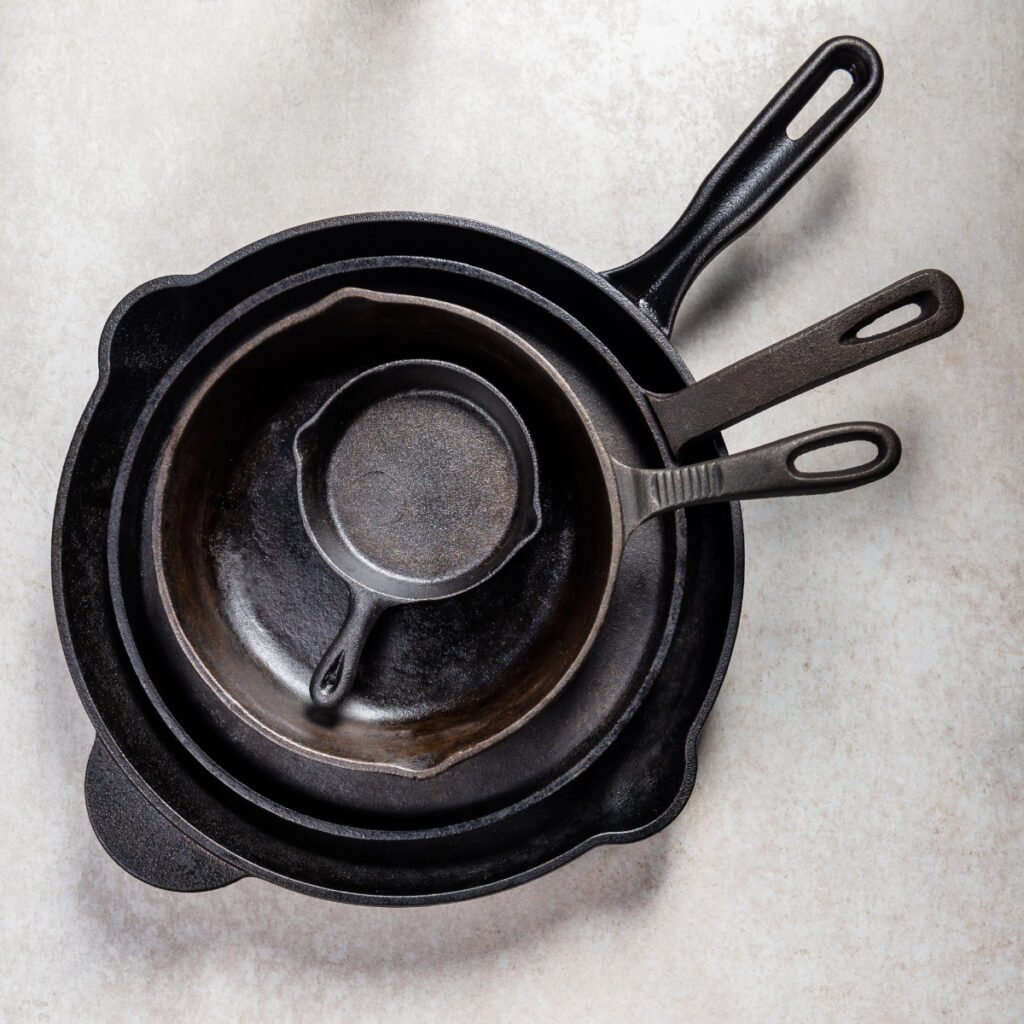
Handle Shape
Cast-iron skillet handle identification is the second step after spotting the bottom mark. Each foundry had distinct handle profiles, and those profiles changed over time.
Griswold handles have a teardrop-shaped hanging hole on most pre-1960 pieces, with a triangular reinforcement ridge on the underside where the handle meets the pan. Late small-block era handles have a rectangular hole with curved corners, and later ones have a grooved underside without the triangular reinforcement.
Wagner’s handles are slightly flatter and wider compared to Griswold’s, and also have a smaller hole for hanging. The handles on Lodge 3-notch skillets are square and heavier than those found on Griswold and Wagner pans.
Handles on Vollrath skillets are very distinct, teardrop-shaped with an upward hump. On the other hand, Martin handles are simpler and more rounded, without sharp reinforcement ridges.
For unmarked pieces, the handle profile combined with weight is often what tells you whether you’re looking at a Wagner, an early Lodge, a BSR, or a Vollrath.
Heat Rings for Dating
A heat ring is the raised circular rim on the bottom of a skillet, sitting just inside the outer edge. They were originally designed to seat the pan flat over the burner hole of a wood or coal stove.
But when gas and electric ranges took over in the 1940s and 1950s, heat rings became unnecessary, and most foundries dropped them. So, a heat ring usually indicated a pre-1940 pan. A smooth bottom usually means after.
However, there are exceptions. Griswold made some smooth-bottom slant-logo skillets, and Lodge kept heat rings on certain sizes well into the 1980s, but as a quick rule, heat rings mean an older piece.
The rings themselves tell a lot. For instance, early heat rings tend to sit at the very outer edge of the pan (outside heat ring). Later ones are inset slightly from the edge (inset heat ring). The shift from outside to inset is itself a dating clue; Griswold made the change between its third and fifth Erie series, around 1905.
Gate Marks vs. Sand Cast Texture
A gate mark is a raised line or scar running across the bottom of the pan. It’s the remnant of the “gate” in the sand mold where molten iron was poured in. Spotting this is important because a gate mark dates a pan to before 1890.
Foundries used bottom gating through most of the 1800s, then switched to side gating around 1890, which left no scar on the bottom. So gate-marked cast iron identification is straightforward: see a raised slash across the underside? You’re holding a pan that’s likely 130+ years old.
A sand cast texture is different. It’s the slightly pebbly, sandpaper-like finish you see on the cooking surface of modern mass-produced cast iron. It comes from the sand mold itself, not from a pour gate. Vintage pans usually had this texture machined or polished away after casting, which is why old Griswolds and Wagners feel almost glass-smooth inside.
Note: Bottom gate marks have been faked on recasts. If the gate mark is on a pan whose other features look 1920s or later, it’s probably a recast, not an antique.
11 Most Valuable Vintage Cast Iron Skillet Finds
Below are some of the most expensive cast iron skillets from the most notable makers, with their actual values and key features you must know.
1. Griswold Spider Logo #8
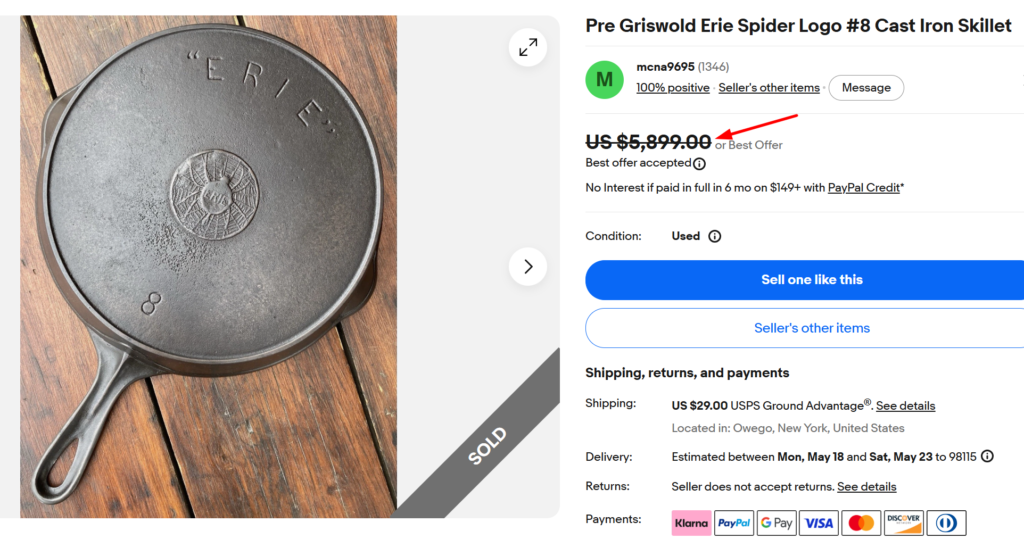
Sold for $5,900
The Erie Spider was made very briefly around 1890-1891, then pulled from production. The bottom carries a raised image of a spider in its web, the only Erie/Griswold piece ever to use that mark, and produced in only one size that bears features of both the 2nd and 3rd Erie series.
A clean #8 Pre-Griswold Erie Spider Logo skillet recently sold on eBay at $5,899 (best offer accepted from a $5,899 listing). Authenticated examples that come up at auction regularly cross $5,000, with the best-condition pieces approaching $10,000. Don’t confuse this with a generic three-legged “spider” pan — those are different and much older.
- Estimated Value: $4,000 to $8,000+ (clean examples)
- Production Year: 1890-1891 only
- Characteristics: Smooth bottom, thin walls, raised spider-in-web logo prone to wear
- Markings: Raised spider in web, incised “ERIE” in quotes, incised “8.”
- Quick Notes: The spider logo is raised, so it may flatten over time.
2. Griswold Cast Iron #13 (Block Logo)
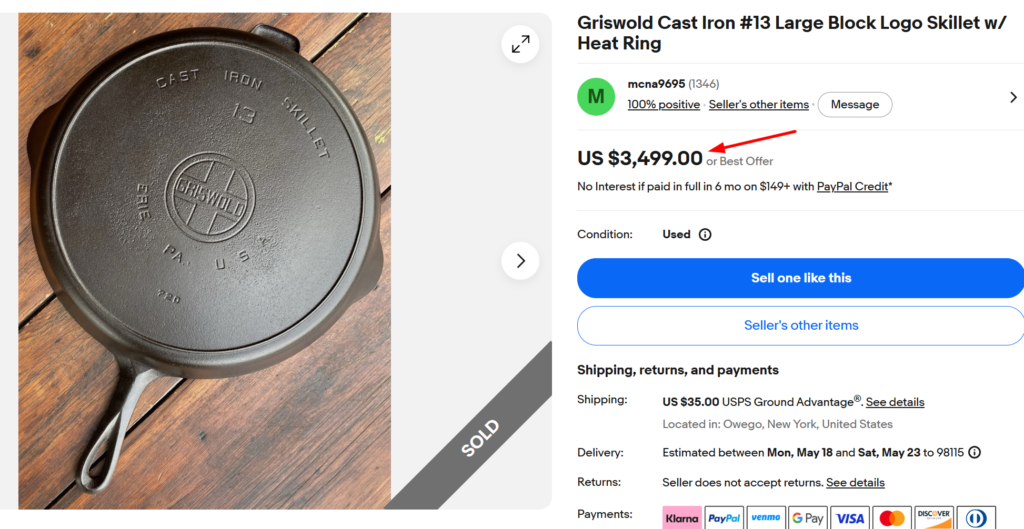
Sold for $3,500
Griswold manufactured skillets in sizes 0 to 14 and also made some very rare hotel skillets of size #20. The #13 is one of the rarest sizes manufactured by Griswold due to the superstition associated with the number 13 and the low demand for the product.
The #13, with pattern number 720, is one of the costliest Griswold skillets that you can purchase. A large block #13 with a heat ring is a serious four-figure piece, and slant logo versions in clean condition can climb even higher.
Watch out for post-1960 #13s and #14s made at the Wagner foundry without ERIE under the logo. They’re worth a fraction of what authentic Erie-marked Griswolds bring.
- Estimated Value: $3,000-$4,500+ (large block); $1,500-$4,000+ (#13 slant)
- Production Year: #13 and #14 roughly 1900 through 1950s; #20 in limited runs
- Characteristics: Heavy (~11 lbs for a #13), large heat ring on older pieces, smooth machined surface
- Markings: Full Griswold cross-and-circle logo, “ERIE PA. U.S.A.” on Erie-foundry pieces, pattern 720 for #13, 718 for #14
- Quick Notes: The original matching lid can add more value.
3. Griswold Erie #5 Skillet
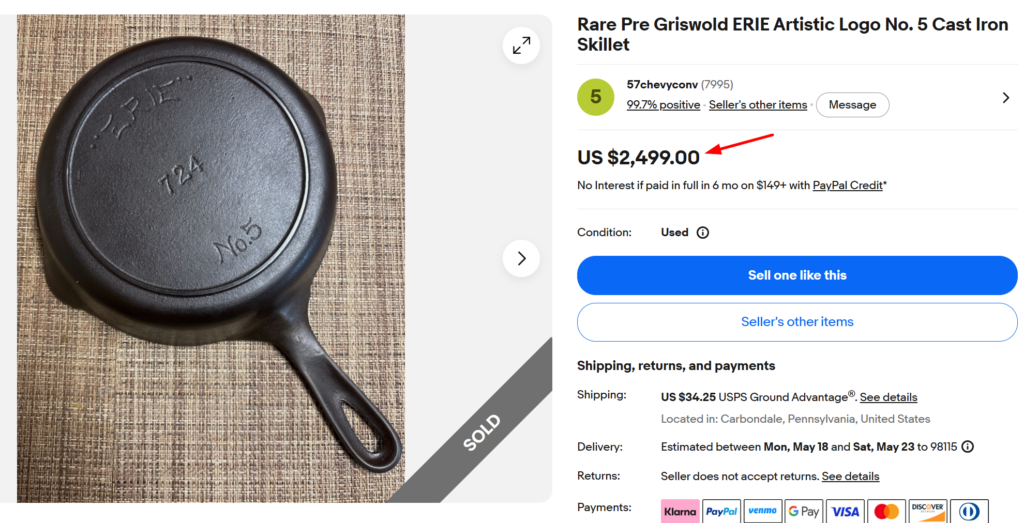
Sold for $2,500
This is one of the rarest pre-Griswold pieces a collector can find. The Erie skillet timeline is divided into six series, and the fourth series (made very briefly around 1905-1907) used unusual “artistic” or “squiggly” lettering for the word “ERIE.”
The artistic series was only produced in sizes #5 and #9; every other size skipped the artistic lettering entirely. The #5 in this series has the artistic ERIE marking at 12 o’clock, the pattern number 724, and “No. 5” at 6 o’clock. The “No.” abbreviation only appears on this series and no other.
Both outside and inset heat ring versions exist. This is a high-value collector piece, with clean examples routinely bringing four figures.
- Estimated Value: $1,800 to $3,000+ for clean marked examples
- Production Year: Roughly 1905-1907
- Characteristics: Thin walls, smooth machined surface, outside or inset heat ring, under 4 lbs
- Markings: Artistic/squiggly “ERIE” at 12 o’clock, “No. 5” at 6 o’clock, pattern 724 (rarely 3348)
- Quick Notes: Slight wobble is normal and doesn’t hurt the value.
4. Wagner Ware Square Skillet 1218
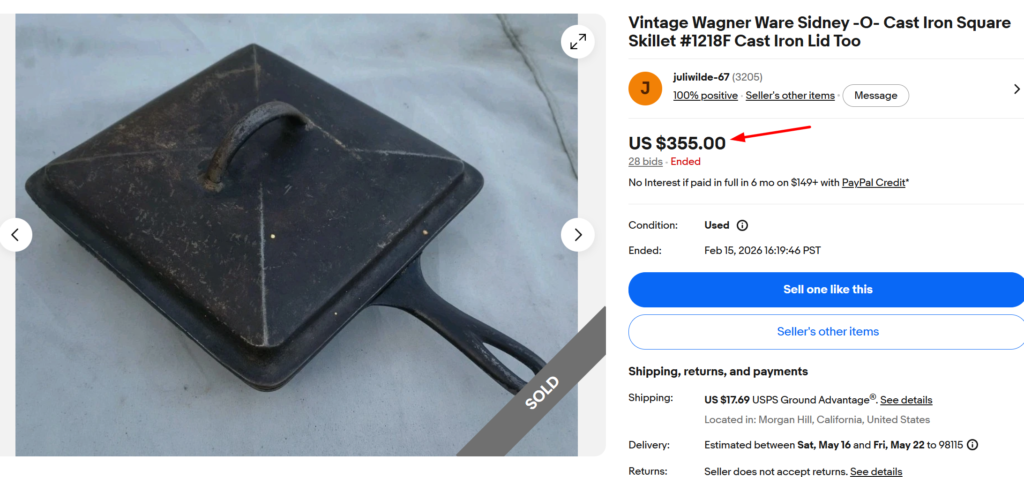
Sold for $355
The Wagner Ware Sidney square skillet 1218 is a 9-inch square pan made during the Sidney -O- era. Wagner introduced its square skillet line in the 1920s, and the 1218 is the most common size that comes up at estate sales.
The pan has the distinctive Wagner Ware logo at 12 o’clock, followed by “SIDNEY -O-” and then “SQUARE SKILLET” at the bottom of the pan. Early models with bold letters are from around the 1920s-1930s, while late versions with finer lettering lasted up until the 1950s.
The skillet itself is moderately priced, but the whole set with the original matching cast iron lid is worth much more.
- Estimated Value: $50-$120 (pan alone); $200-$400 (with lid)
- Production Year: Mid-1920s through about 1959 (Sidney -O- versions)
- Characteristics: 9-inch square, smooth machined surface, thumbprint detail on handle
- Markings: Stylized Wagner Ware logo, “SIDNEY -O-“, “SQUARE SKILLET,” “1218” plus pattern letter (B, D, E, or F)
- Quick Notes: The matching lid can double the value.
5. Vollrath Ware #11 Skillet
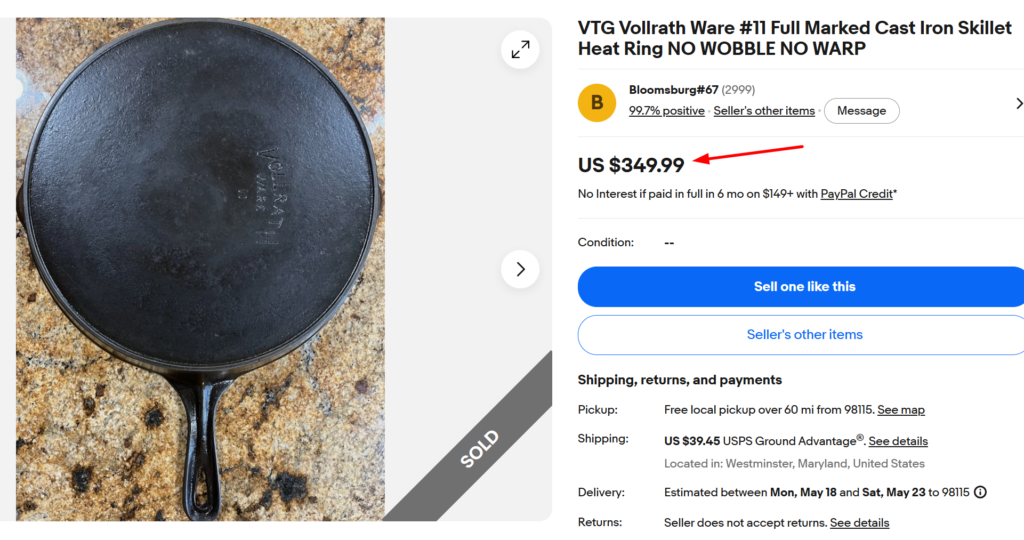
Sold for $350
The Vollrath Manufacturing Co. of Sheboygan, Wisconsin, started making cast iron in 1884 and ran into the 1960s. Vollrath cast iron is mostly overlooked compared to Griswold and Wagner, but fully marked pieces in less-common sizes are quite valuable now.
Most Vollrath skillets have an outside heat ring and the distinctive teardrop-with-ridge handle. This #11 example is an uncommon size, between the standard #10 and the much rarer #12. Fully marked #11 examples in clean, flat condition can easily fetch $300 or more.
Fully marked Vollrath (with “VOLLRATH WARE” cast on the bottom) dates roughly 1920s-1940s. Unmarked Vollrath skillets with the same handle profile date 1950s-60s and bring less.
- Estimated Value: $200-$400 (fully marked #11); $60-$150 (common sizes)
- Production Year: 1920s-1940s (Fully marked); 1950s-60s (unmarked)
- Characteristics: Outside heat ring, machined surface, teardrop handle with upper ridge, slightly heavier than Griswold or Wagner
- Markings: “VOLLRATH WARE” with size number on fully marked pieces; pattern numbers on some
- Quick Notes: Vollrath cast iron identification is done by handle ridge & outside heat ring placement.
6. Griswold Colonial Breakfast Skillet
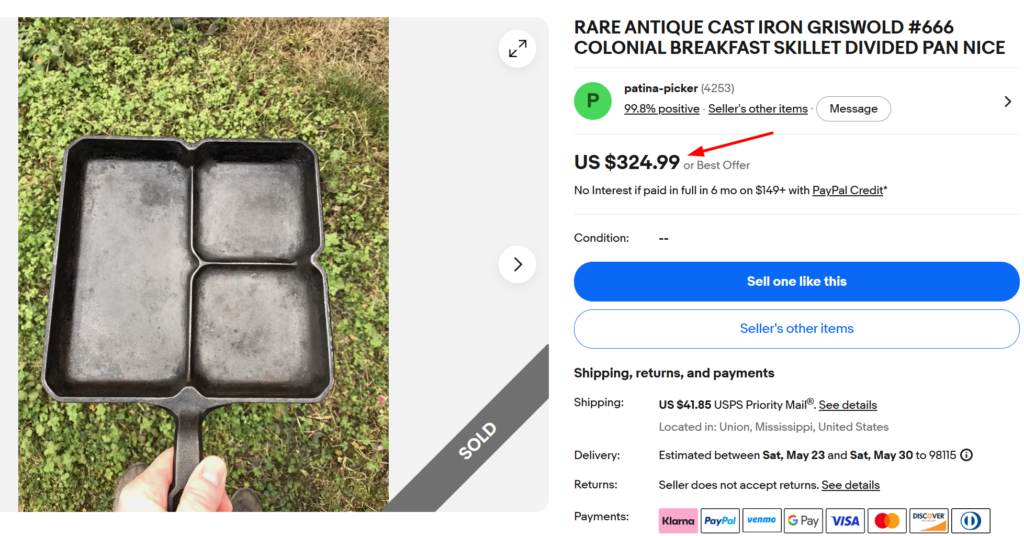
Sold for $325
The Griswold Colonial Breakfast Skillet is a three-compartment cast iron pan designed to cook bacon and two eggs at the same time. The pattern number is 666, and Griswold made it from the 1930s into the 1940s, mostly for small-town diners and counter restaurants.
The most desirable version is the large block logo with EPU, marked “COLONIAL BREAKFAST SKILLET” above the Griswold cross and “ERIE PA., U.S.A. PATENT APPLIED FOR 666” below.
There’s also a rarer red-enameled version (#566) from the 1930s and a 1950s white-enameled variant. The plain, bare iron 666 is what most collectors hunt for, and clean, flat examples bring solid prices.
- Estimated Value: $250-$400 (clean, block logo iron examples)
- Production Year: 1930s-1940s
- Characteristics: Octagonal outer rim, three divided compartments (one large, two smaller), single long handle
- Markings: “COLONIAL BREAKFAST SKILLET” above Griswold large block logo, “ERIE PA., U.S.A. PATENT APPLIED FOR 666” below
- Quick Notes: Enameled versions can fetch slightly more.
7. Griswold Cast Iron Corn Stick Pan
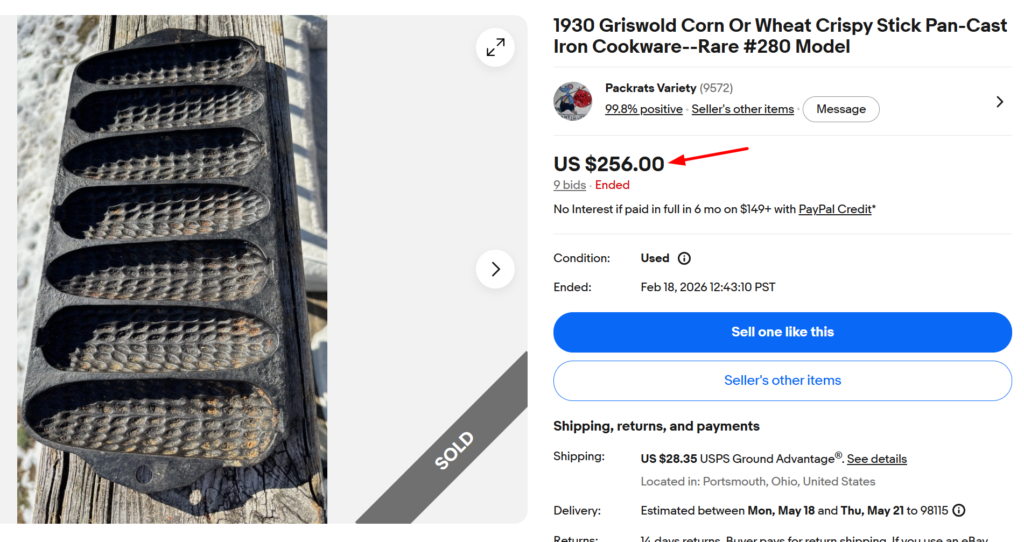
Sold for over $255
A vintage cast iron corn stick pan is a rectangular pan with cup-shaped molds in the form of ears of corn, for baking corn-shaped cornbread. The category is huge, but Griswold’s wheat-pattern stick pans are the most collectible.
The #280 is the larger, harder-to-find version of the common #273, measuring about 15 inches long with 7 alternating-direction cups featuring a wheat pattern instead of plain corn.
The much rarer #2800 wheat pattern variant is a top-tier collectible.
- Estimated Value: $200-$400 (clean, #280); $40-$90 (common #273)
- Production Year: #280 roughly 1920s; #273 roughly 1930-1957; #262 roughly 1932 into the 1950s
- Characteristics: Seven alternating-direction wheat or corn molds, rectangular outline, twin tab handles at the ends
- Markings: “No. 280 GRISWOLD CRISPY CORN OR WHEAT STICK PAN ERIE PA., U.S.A. PAT. NO. 73,326 637”
- Quick Notes: Slight corner-to-corner bowing is acceptable.
8. BSR Red Mountain Series Skillets
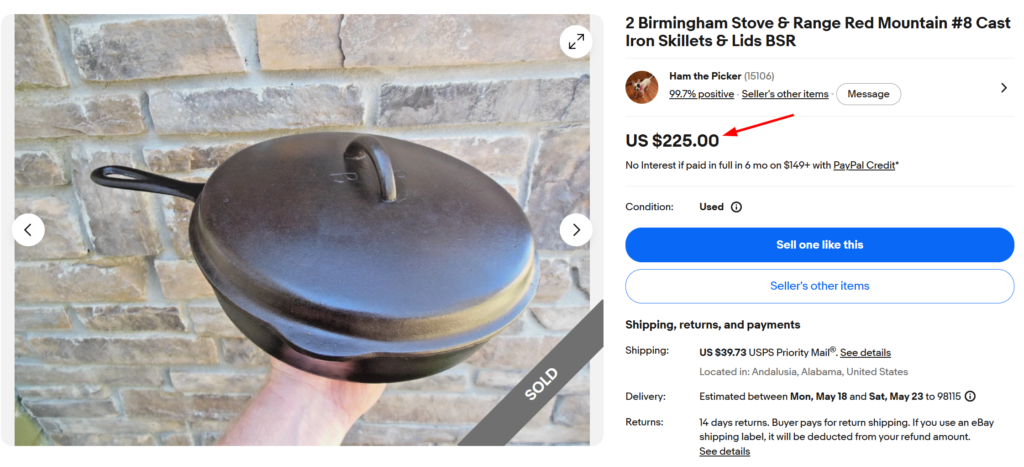
Sold for $225
The BSR Red Mountain dutch oven and skillet line is the southern collector’s favorite from Birmingham Stove & Range. The Red Mountain series was produced from 1930 to 1953 and took its name from the iron ore deposits surrounding Birmingham.
BSR rarely branded its cookware, making it possible for one to distinguish Red Mountain based on its features, which include thick sides compared to those of Griswold and Wagner products, hand-written style size markings in earlier models, and a unique heat ring design.
A BSR Red Mountain #8 skillet is a moderately valuable find on its own. But pair it with a matching lid and the value roughly doubles.
- Estimated Value: $90-$200 (with lid); $40-$80 (skillet alone)
- Production Year: 1930 to 1953
- Characteristics: Thicker walls, heat ring, smooth machined surface
- Markings: No brand name on most pieces; identified by size number, letter codes, and series traits
- Quick Notes: Confirm skillet and lid are from the same series.
9. Pre-1960 Lodge 3-Notch #8
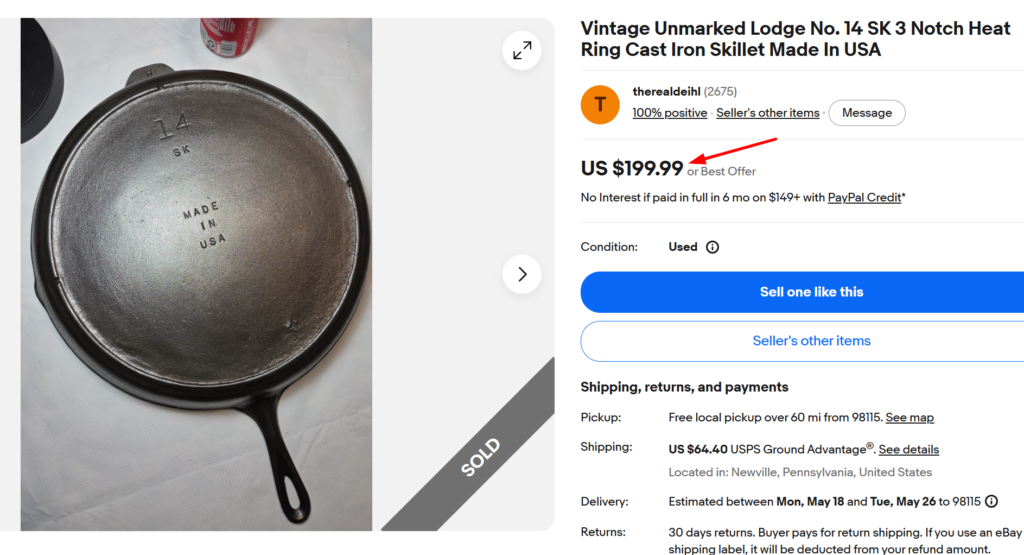
Sold for $200
The 3-notch Lodge cast iron skillet has a heat ring with three small breaks at the 9, 12, and 3 o’clock positions, which Lodge used from roughly the 1940s through the 1960s. The value lies in the big size; a #14 SK can be worth several times a #8.
Smaller 3-notch sizes (#5, #6, #7, #8) run $30-$80 in clean condition, but the #14 SK can cross $150 because of size. It’s 15 inches across, weighs a ton, and is one of the few oversized vintage skillets that’s still affordable enough for an actual cook to buy. Pre-1960 examples (no “Made in USA”) bring the strongest prices.
- Estimated Value: $150 to $250 (clean #14 SK); $35-$85 (#5-#8 sizes)
- Production Year: Roughly 1940s-1980s; #14 SK without “Made in USA” dates 1950s-mid 1960s
- Characteristics: Inset heat ring with three notches at 9, 12, and 3 o’clock; raised size number; thicker walls
- Markings: Often unmarked except size number; “SK” on most #14s; later pieces add “Made in USA”
- Quick Notes: Pre-1960 examples are usually worth more.
10. Martin Stove & Range #3 Skillet
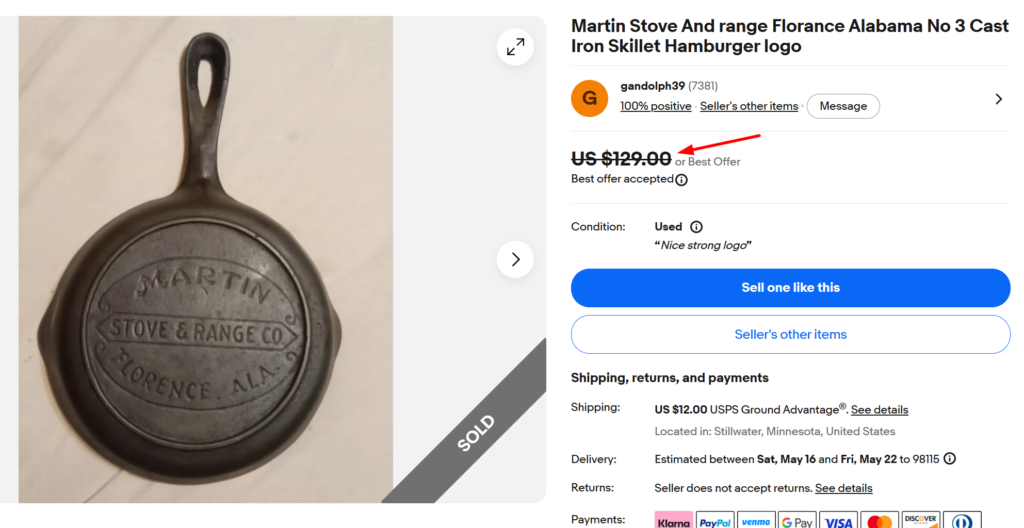
Sold for $130
The Martin brothers (W.H. and Charles) bought the Florence Stove Foundry in 1917 and ran the company until they discontinued hollowware in 1953. Martin Stove & Range cast-iron skillet pieces are identified by their distinctive oval “hamburger logo.”
It is an oval emblem reading “MARTIN STOVE & RANGE CO. FLORENCE, ALA.” that looks vaguely like a hamburger bun, hence the nickname.
The hamburger logo set runs in sizes 3, 5, 7, 8, 9, 10, 12, and 14. The #3 is a small egg-skillet size, about 6.5 inches across, and it’s one of the harder Martin sizes to find in a complete set. Larger Martin sizes with the hamburger logo are more common.
- Estimated Value: $90-$160 (#3, clean); $60-$80 (faded)
- Production Year: Roughly 1920s through 1953
- Characteristics: ~6.5 inches, heat ring on most, single pour spout on some, simple rounded handle
- Markings: Oval “MARTIN STOVE & RANGE CO. FLORENCE, ALA.” hamburger logo on underside; “No 3” or “3” near handle
- Quick Notes: Reproductions may have fuzzy logos and rough surfaces.
11. Wagner Hammered Nickel Cast Iron Skillet
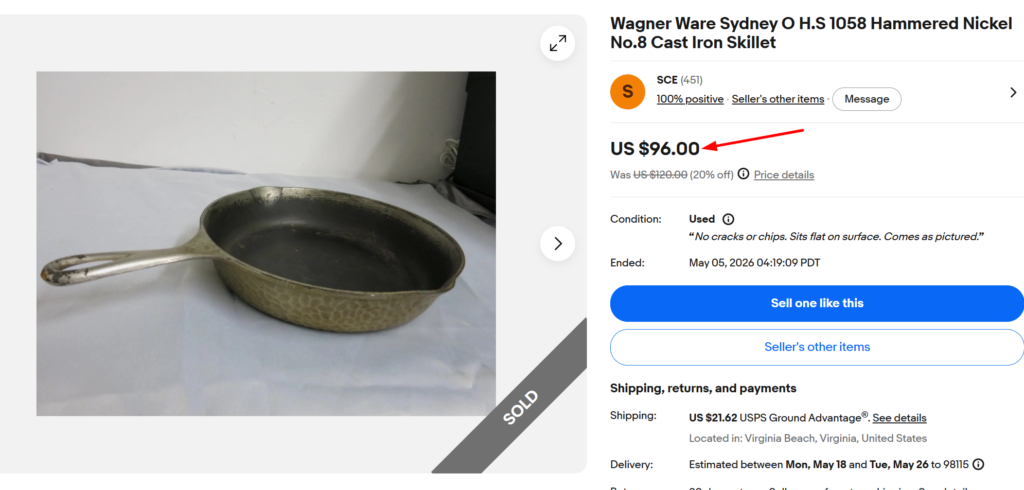
Sold for $95+
Hammered cast iron was Wagner’s premium offering in the 1920s and 1930s. The pans come with a textured, dimpled exterior that mimics hand-hammered metal. The interior cooking surface stays smooth; only the outside is hammered.
The Wagner hammered cast-iron skillet in this image is even more uncommon. It’s a hammered piece with nickel plating, designated “H.S.” (hammered surface) in the Wagner catalog.
Nickel plating was applied to some Wagner hammered pieces in the 1920s-1930s as a higher-end finish that resisted reaction with acidic foods. The plating gives the pan a silvery exterior, contrasting with the dark interior. These are moderately collectible, not as pricey as a Griswold of the same era.
- Estimated Value: $80-$200
- Production Year: 1920s through late 1930s
- Characteristics: Dimpled hammered exterior on body and base, smooth machined interior, silvery nickel plating on H.S. variants
- Markings: Wagner Ware stylized logo, “SIDNEY -O-“, “1058” with pattern letter, “H.S.” on nickel-plated pieces
- Quick Notes: Flaked or worn nickel plating reduces value.
Finding the Vintage Cast Iron Skillet Value
These were the actual values of different antique cast-iron skillets. As you can see, there is a huge price difference in certain pieces. This difference comes from the following factors:
- Maker & Logo Era – A Griswold large slant logo #8 sells for 2-3x what a Griswold small block #8 from the same decade brings. A Wagner Ware Sidney -O- pie logo sells for 2-4x what a post-1959 Wagner without Sidney brings. The mark is half the value.
- Size and Demand – #8 and #10 (10.5″ and 12″) sizes are the most useful and have the highest collectibility. Rare sizes like #2, #13, #14, and #20 sell at extreme premiums because they were made in lower numbers. The middle sizes (#5, #6, #7) sit in between.
- Condition – A pan that sits flat (no warp, no spin) is worth significantly more than one that wobbles. No cracks. No serious pitting. No deep gouges in the cooking surface. A clean, flat pan brings full market value; a cracked one is worth maybe 30% of that, even if every other factor is identical.
- Completeness – A matching skillet and lid sell for more than the sum of the two pieces. Same for Dutch oven sets. A Wagner Ware 1218 square skillet brings $50-$120 alone, but $300-$400 with the matching lid.
- Original Packaging – A pan with the original Griswold or Wagner paper label still attached, or in original deadstock packaging, can bring 1.5x to 2x the normal value. Labels almost never survive use, so an intact one is real evidence of low handling.
- Beware of Recasts & Repros – Some pieces (especially small ones like the Griswold #262 corn stick pan, the Griswold Spider, and small Martin skillets) get faked. Recasts are noticeably rougher in texture, have fuzzy lettering, and sometimes show a bottom gate mark on a piece that should have a smooth side-gated bottom.
Knowing what kind of old skillet you have is the first step to valuing it. Always flip it over to spot marks and logos, feel the cooking surface, and check the heat ring. These are the things that differentiate a $2,000 pan from a $40 one.