
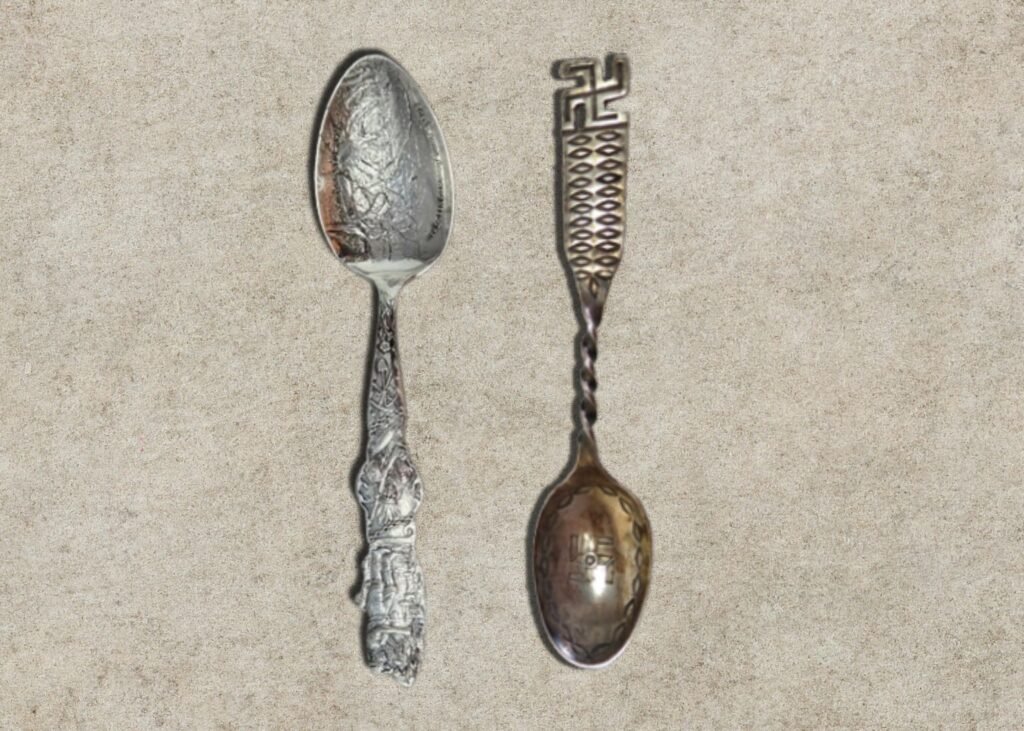
Souvenir spoons are a common sight at estate sales and flea markets. But most pieces you’ll see there are worth a buck or two. But people mostly see every souvenir spoon with the same eye, and that’s a mistake.
One of them could actually be a sterling silver piece from the 1890s that collectors will pay hundreds for.
This guide walks you through what makes some souvenir spoons valuable, shows rare finds actively collected today, and gives you a simple way to identify the originals.
How Souvenir Spoons Became Popular? Brief History
The popularity of the souvenir spoon began around 1890, when an American jeweler from Salem by the name of Daniel Low discovered enamel spoons while traveling in Germany and then returned with the concept to America.
The renowned Salem “Witch Spoon” was patented by his son Seth on January 13, 1891. The Witch Spoon sold several thousand copies and sparked a national obsession that lasted until World War I.
Within months, hundreds of patterns were being made for American cities, world’s fairs, presidents, and historical events.
That golden era from 1890 to about 1915 is where collectors find the real money today. After the 1920s, mass production took over, and most spoons stopped being interesting.
What Makes a Souvenir Spoon Actually Valuable?
When it comes to the value of antique and vintage souvenir spoons, six key things work together to determine how much they will be worth today.
- Material – Sterling silver beats silverplate every time. An ordinary silver-plated spoon generally retails for less than five dollars, whereas sterling may begin with twenty dollars but rise rapidly from there.
- Maker – Big names like Gorham, Tiffany & Co., Whiting, Shreve & Co., and Wallace command premiums over no-name producers.
- Age – Usually, pre-1920 spoons are the sweet spot. Spoons more than one hundred years old are considered genuine antiques.
- Theme – World’s Fair, Native American figure, dead country, and local places are better options than famous landmarks like Niagara Falls.
- Condition – Tarnish is fine and easy to clean. Dents, deep scratches, and engraved monograms hurt value badly.
- Documentation – Spoons that appear in collector books like Chris McGlothlin’s World’s Fair Spoons get a bump because collectors can verify them.
Handy Tip: A “1847 Rogers Bros” mark is NOT a 1847 spoon. That’s the year the company was founded. Most pieces with this mark are silver plate from the 1900s to 1950s and sell for one or two dollars.
12 Most Valuable Vintage Souvenir Spoons to Find Now
Here are 12 antique souvenir spoons that collectors consistently look for and pay for at online sales and auctions. From a notable maker mark to high-quality material and unique designs, each one comes with a unique feature that pushes the value.
1. Imperial Russian Cloisonné Enamel Spoon
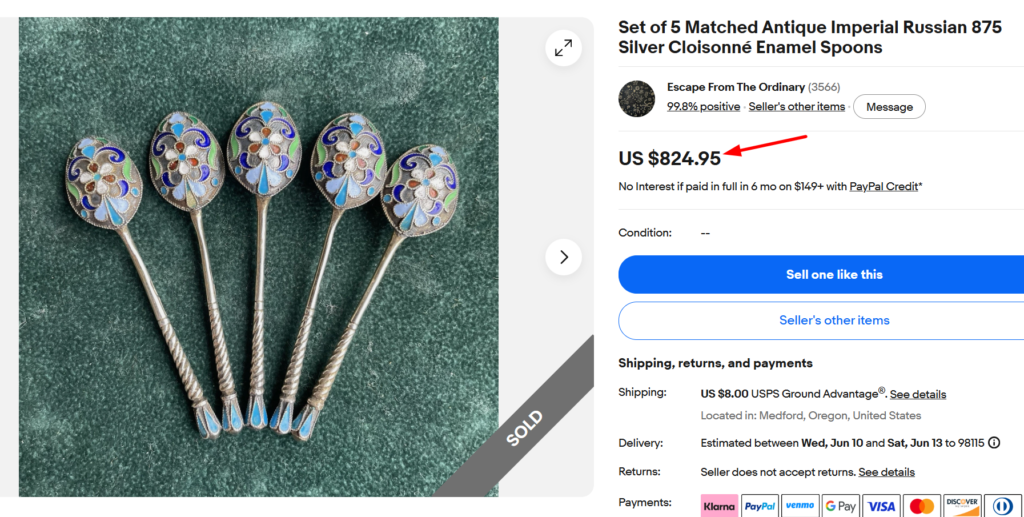
Sold for $825 (set of 5)
Russian pieces are the most colorful in any vintage spoon category. Pre-revolution era examples display polychromatic cloisonné enamel decoration on both surfaces of the handle and often on the bowl in floral and geometric motifs in many hues.
You can identify authentic Russian souvenir spoons by the 84 zolotnik stamp, equaling 875 parts per thousand silver content, and the Cyrillic maker’s hallmark.
Workshop attributions to Khlebnikov, Ovchinnikov, or anything Faberge-related also add value. Forgeries are common, so identify correctly or get expert verification.
- Estimated Value: $200 to $2,000+
- Production Years: 1880 to 1917
- What to Check: 84 zolotnik mark, Cyrillic stamp
- Quick Notes: Watch for modern replicas; check the stamp.
2. Gorham Apostle Spoons
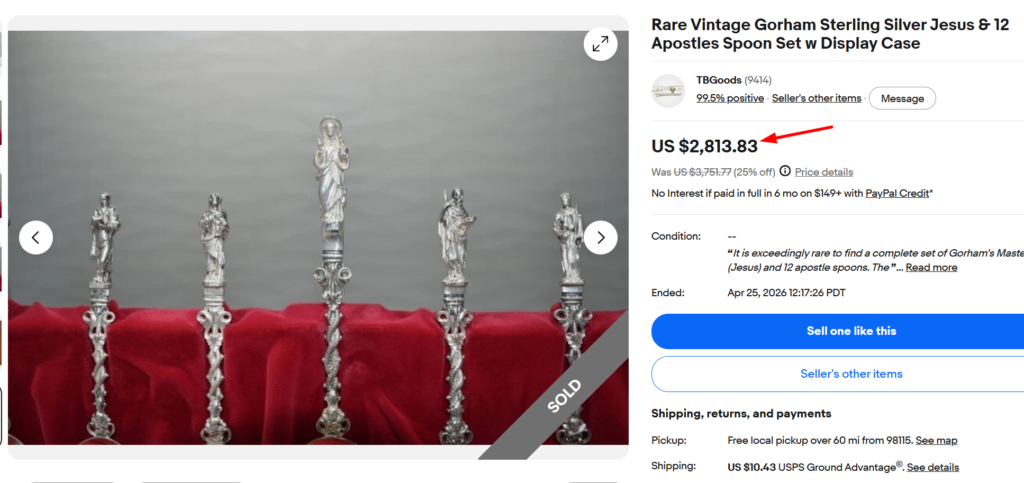
Sold for $2,815 (set of 13)
The handles of Apostle spoons have small figurines of the twelve apostles at the end, an ancient practice that dates back to the time when Apostle spoons were made in England during the 16th century.
Individual apostle spoons turn up fairly often and sell for modest prices. But a complete set, including the Jesus master spoon along with its case, is extremely rare.
Gorham designed Apostle spoons from pure silver in America. Complete 13-piece sets in their original display case can fetch up to $2,000+
- Estimated Value: $50 (single), $2,500 to $3,500+ (for full Gorham set)
- Production Years: Late 1800s to early 1900s
- What to Check: Gorham mark, 13-piece completeness, case
- Quick Notes: Master Jesus spoon must match the set.
3. The 1891 Daniel Low Salem Witch Spoon
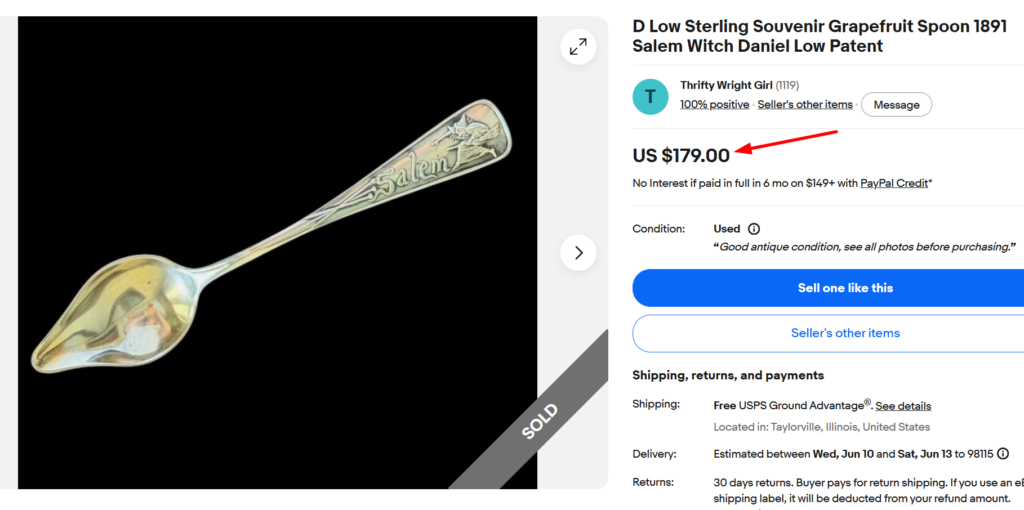
Sold for $180 (single)
This is the spoon that actually started the entire American souvenir spoon trend. Made in sterling silver by Durgin for Daniel Low & Co., it features a raised witch figure, the word Salem, and three witch pins copied from artifacts at the Salem Court House.
A second, more elaborate version came out in 1891 for the Witch Trials Bicentennial. It added a black cat, a broom, a rope, and a crescent moon to the design. That variant is also quite collectible.
- Estimated Value: $80 to $300+
- Production Years: 1891 onward
- What to Check: A witch figure, three pins, “Salem.”
- Quick Notes: First version is rarer than later reissues
4. Tiffany & Co. City Souvenir Spoon
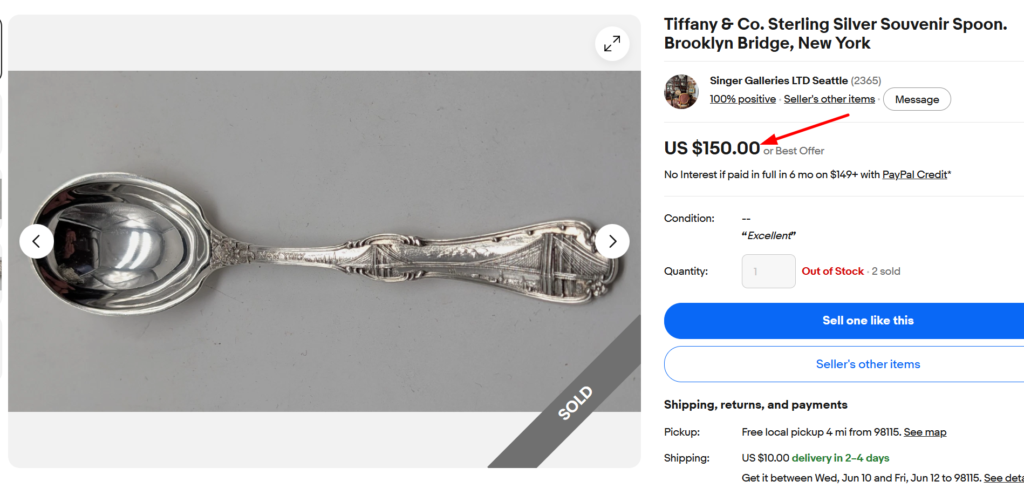
Sold for $150 (single)
A souvenir spoon marked Tiffany & Co. will surely attract attention. Only selected cities and occasions received souvenir spoons from Tiffany, and that too mostly between 1890 and 1915. So, these spoons are highly collectible.
Also, Tiffany souvenir spoons have superior quality, with sharp engraving and heavy silver. Always check for Tiffany & Co. Sterling with either M or C hallmark.
- Estimated Value: $150 to $600
- Production Years: 1890 to 1915
- What to Check: City designs, Tiffany mark with date letter
- Quick Notes: Heavier spoons than most makers.
5. Nude Figural Art Nouveau Spoon
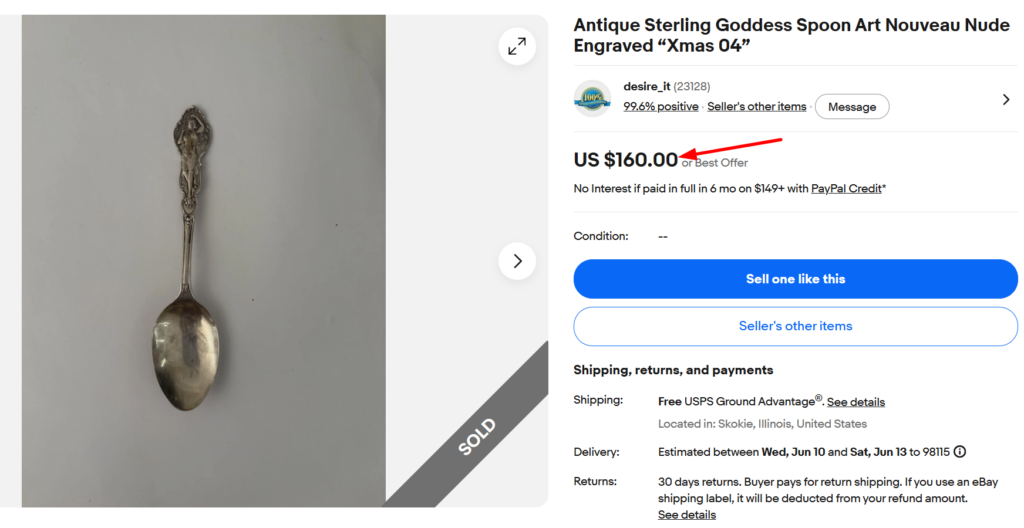
Sold for $160 (single)
Nude figures decorating silverware have been rare throughout history, and especially rare on souvenir spoons. Only a few makers of Art Nouveau silverware decorated the handles of their spoons with nude figures between 1890 and 1910, always accompanied by flowing hair, twisting vines, or floral elements.
Unger Brothers and George Shiebler made the standout examples. These wear down quickly because the raised figures become smoother each time someone polishes them, so condition is a major value factor.
- Estimated Value: $100 to $500+
- Production Years: 1895 to 1910
- What to Check: Raised nude figure, flowing details
- Quick Notes: Unger and Shiebler are top makers
6. Gorham Sterling Enamel State Spoon
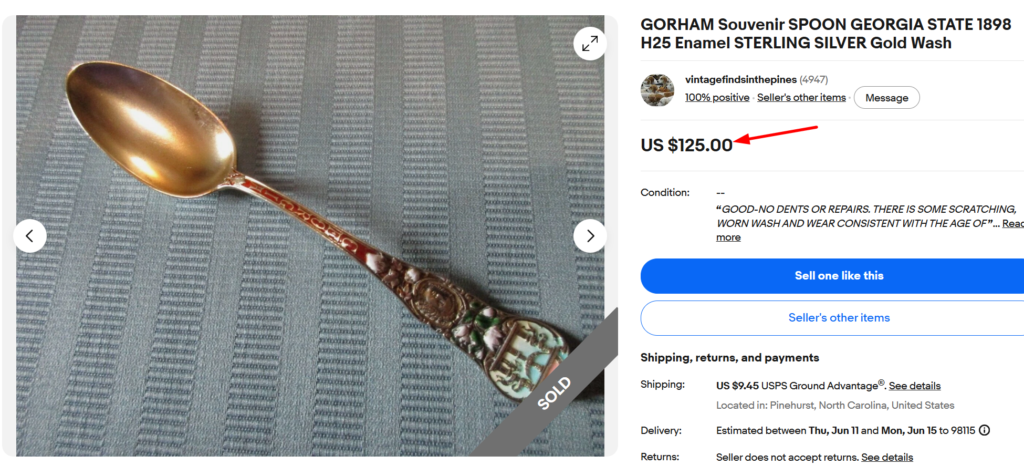
Sold for $125 (single)
Gorham created state spoons made of sterling silver with state emblems painted in enamel on either the bowl or handle of the spoon. The beauty of enamel cannot be achieved by simple engravings.
Common states like New York are easier to find, while smaller states or early statehood designs are scarcer. Enamel is another major value driver here; even a tiny chip can knock the price down by half.
- Estimated Value: $60 to $250
- Production Years: 1890 to 1915
- What to Check: Gorham anchor mark, enamel condition
- Quick Notes: Check enamel under the loupe for chips.
7. 1893 Columbian Exposition Spoons
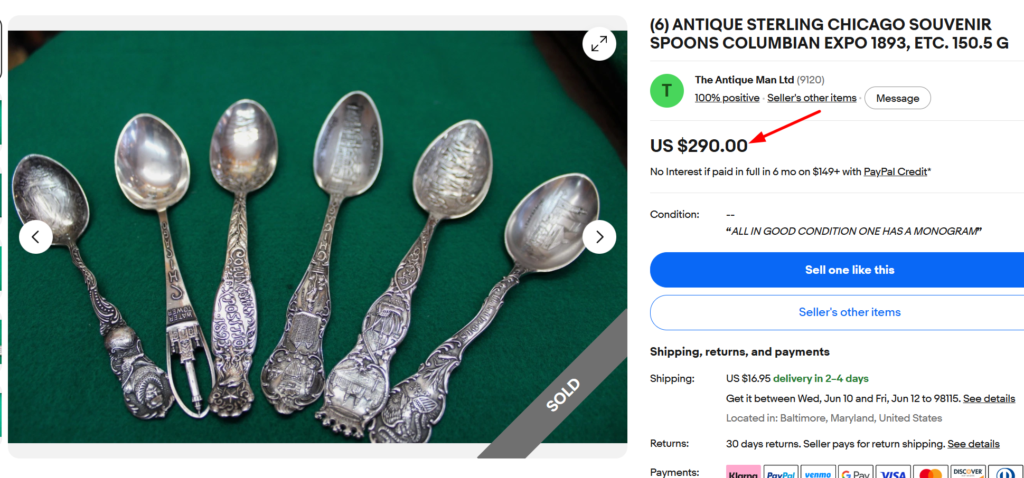
Sold for $290 (set of 6)
Several makers took part in the 1893 Chicago World’s Fair, producing sterling spoons with handles showing Columbus, the fair buildings, and Chicago landmarks like the Water Tower.
Over 300 varieties were created for this single fair, more than for any other single event in history. Tiffany & Co. also made a prized version for the fair, and those carry a serious premium when the maker’s mark is clearly visible.
These spoons are generally more valuable as a set of six or more, showing different landmarks.
- Estimated Value: $40 to $100 per spoon
- Production Years: 1892 to 1893
- What to Check: Columbus, 1492/1893 dates, fair buildings
- Quick Notes: Tiffany & Co. examples bring the highest premium.
8. David Andersen Norwegian Enamel Spoon
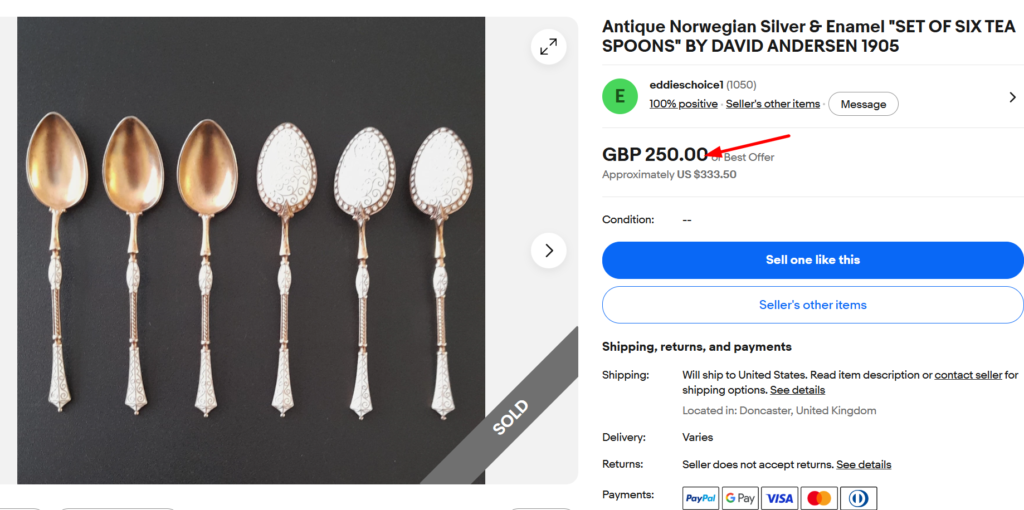
Sold for $335 (set of six)
The Oslo store of David Andersen was established way back in 1876, before Oslo was known as Christiania, and he soon gained fame for his cloisonné enamels that stand out even against Russian ones from that time.
The majority of souvenir spoons made by Andersen are inspired by Dragestil. You will find them painted in the colors of cobalt blue, emerald green, rich red, and yellow guilloche enamel, mostly with bowls that are gold-washed.
Complete cased sets of either six or eight demitasse spoons occasionally appear in auctions, but always fetch premiums.
- Estimated Value: $40 (single); $250 to $1,100+ (for sets)
- Production Years: 1890s to 1940s
- What to Check: “DA Norway Sterling 925” mark
- Quick Notes: Cased original boxes add big value.
9. Shreve & Co. San Francisco Bear Spoon
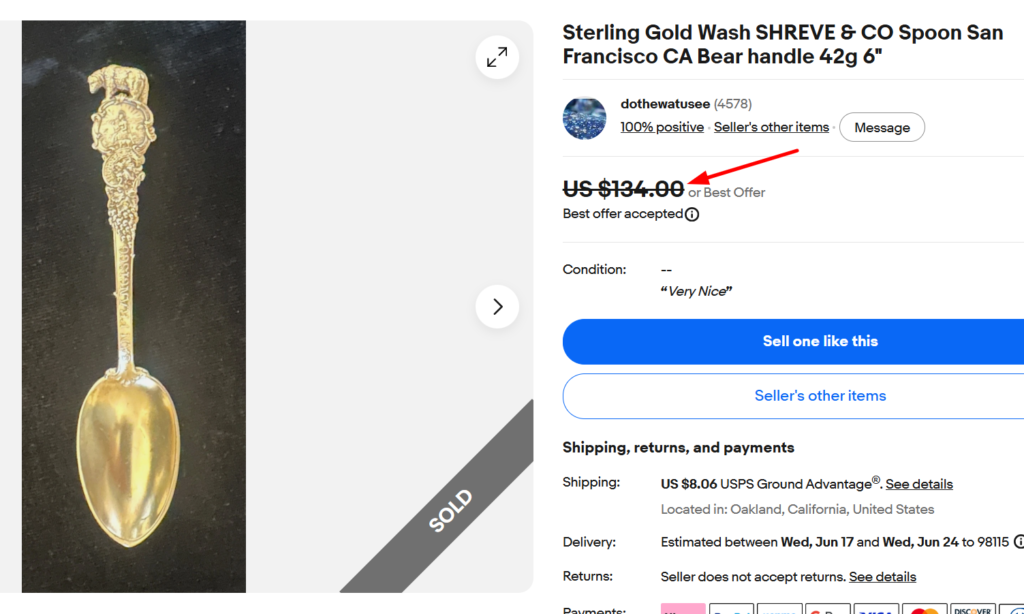
Sold for $135 (single)
The Shreve & Co. of San Francisco mainly produced California-style pieces featuring bears, seals of California, and mission scenes on the bowl.
The company also made some of the more difficult-to-find spoons during the 1894 California Mid-Winter International Exposition in San Francisco.
Another thing to note is that these have a built-in West Coast collector base. So, California silver tends to fetch higher prices from regional buyers than it might bring in Midwest or East Coast markets.
- Estimated Value: $75 to $350
- Production Years: 1890 to 1915
- What to Check: Shreve mark, bear, or Mission scene
- Quick Notes: West Coast demand drives prices up.
10. Native American Chief Figural Spoon
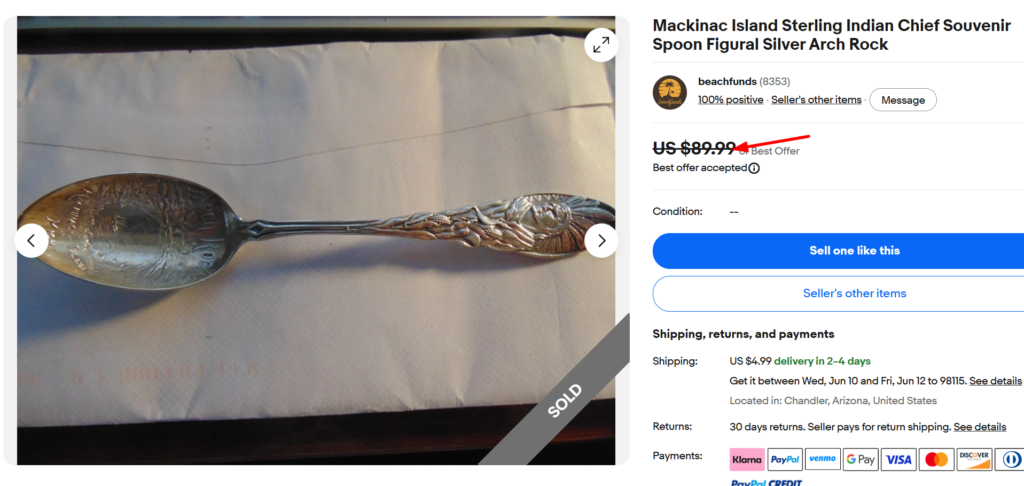
Sold for $90 (single)
These spoons feature a fully sculpted Native American chief on the handle, often in a headdress, with the bowl decorated with regional scenes or tribal motifs. Gorham and Watson made some of the best-known examples between 1895 and 1910.
Figural handles are harder to make than flat engraved ones, which is why they cost more back then and now, too. Chief Ouray of the Ute is one of the rarest named figures and brings strong prices when it appears.
- Estimated Value: $50 to $400+
- Production Years: 1895 to 1915
- What to Check: Sculpted chief, full headdress detail
- Quick Notes: Named historical chiefs are worth more.
11. 1904 St. Louis World’s Fair Spoon
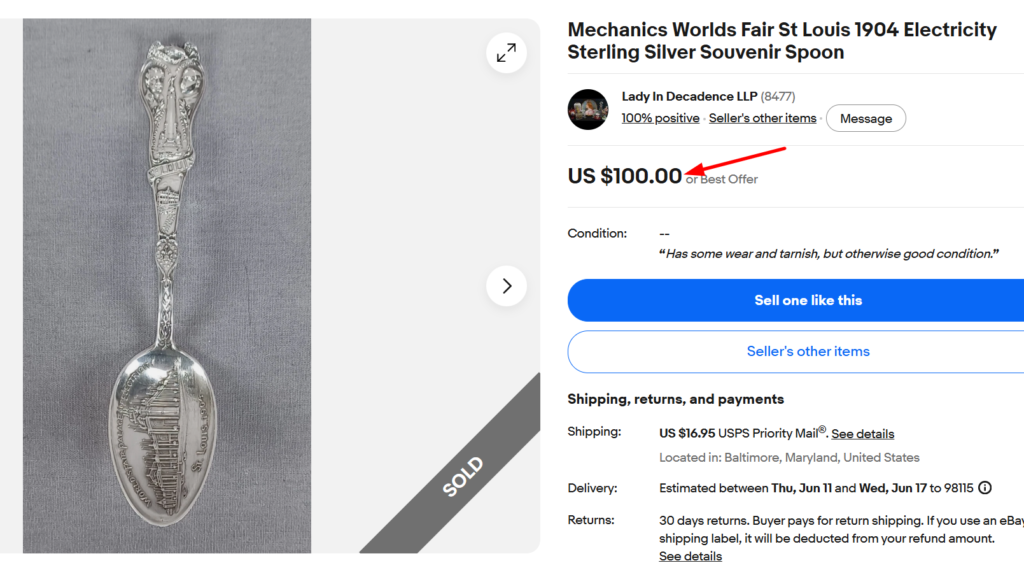
Sold for $100
The Louisiana Purchase Exposition issued almost as many spoon patterns as those issued in Chicago in 1893. The spoons have similar handles that link the purchase from 1803 to the exposition in 1903. They feature a buffalo hunter, covered wagons, and campfires, among others.
Always pay attention to which building shows up in the bowl. Festival Hall and Cascades Building bowls are more valuable and desirable than the plain seal designs.
- Estimated Value: $40 to $200
- Production Years: 1903 to 1904
- What to Check: 1803/1903 dates, buffalo or wagon
- Quick Notes: Building-scene bowls are more valuable.
12. Whiting Manufacturing Demitasse Spoon
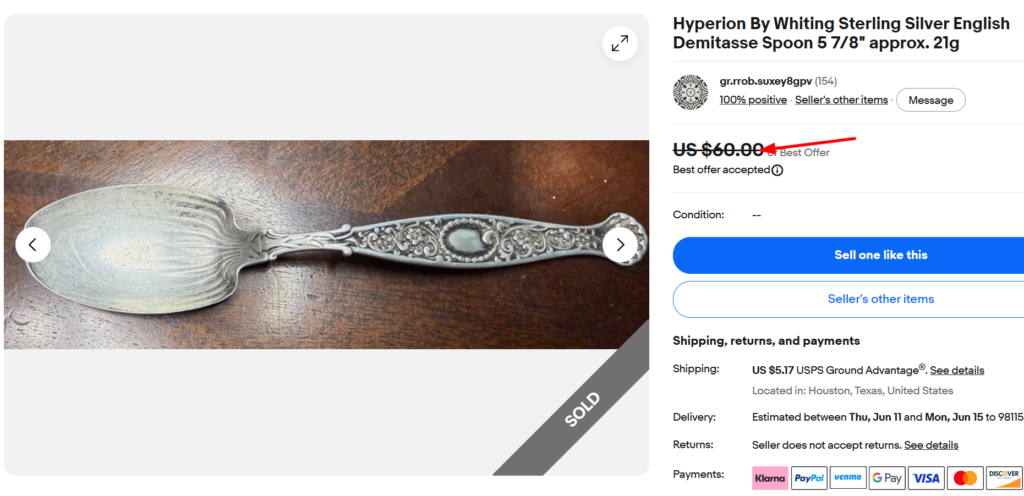
Sold for $60
Whiting Manufacturing made small demitasse spoons (the tiny ones for coffee) with figural handles featuring everything from city seals to historical figures. They’re shorter than tea spoons, usually about 4 inches, and were sold individually or in sets of six.
Boxed sets command much higher prices than single spoons. Also, check the Whiting Griffin mark on the back to confirm originality and authenticity.
- Estimated Value: $50 to $300
- Production Years: 1880 to 1924
- What to Check: Griffin mark, figural handle
- Quick Notes: Boxed sets can fetch 3 times the value.
5 Steps to Identify Genuine Souvenir Spoons
Now, before you decide to tag your old spoons as a souvenir, you must ensure it’s actually one. The following steps will help you identify authentic, valuable souvenir spoons easily.
Step 1: Look for the Material Stamp
The one hallmark that indicates what metal the spoon is made of. Sterling silver will be marked “STERLING,” “925,” or “Lion Passant.” Silver plate hallmarks include “EPNS,” “A1,” “TRIPLE PLATE,” or “QUADRUPLE PLATE.”
COIN SILVER spoons from before 1870 have been known to only carry the hallmark of “COIN” or “PURE COIN.”
Step 2: Find the Maker’s Mark
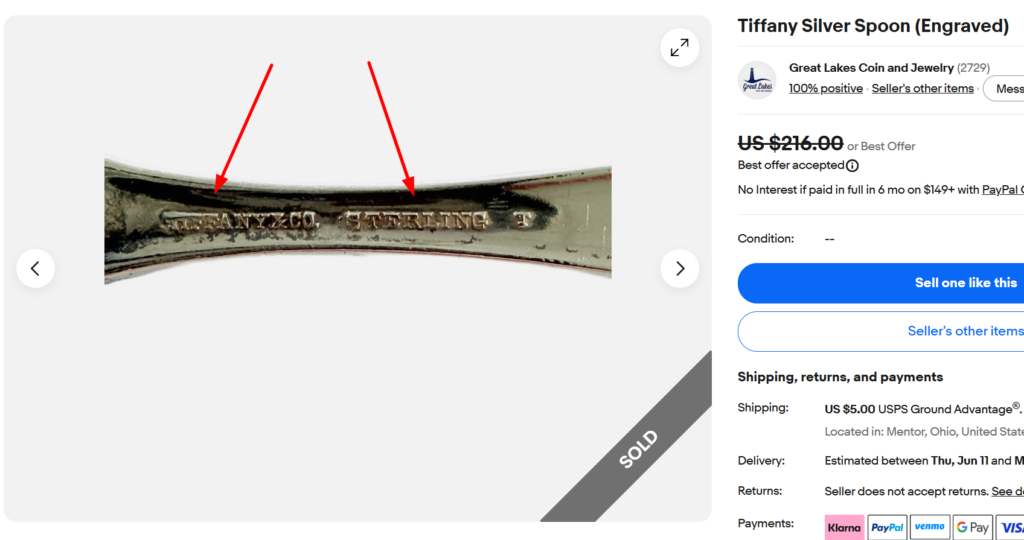
American makers stamped their logo alongside the material mark. Gorham used an anchor. Tiffany & Co. added an “M” or “C” date letter. Whiting used a griffin.
The American hallmarking system was not as strict as the one in Britain, meaning that mid-nineteenth-century items would bear only the words “STERLING” along with the company’s symbol.
I would recommend using a 10x loupe, since the stamps are small and often worn from polishing.
Step 3: Date the Spoon
British spoons carry a date letter, which is the easiest way to track the exact production year.
However, American spoons need a different approach. You need to look at the style of the handle, the depth of the bowl, and any dates engraved on the front. All these features work together to give you a narrow window of time, during which it could be made.
Good to Know: Be careful with these signs. Engraved dates sometimes mark an anniversary, not the year of manufacture. Also, forgers often add old dates to make plated spoons look like sterling antiques.
Step 4: Identify the Theme
Look at the bowl and the handle for a motif or design based on a city, building, person, or occurrence/event. The theme often matters more than the maker.
For example, an ordinary spoon made by Gorham depicting Niagara Falls is worth less than a rare small-town-based spoon by an unknown silversmith.
Step 5: Cross-check with Documented Examples
As a last check, go online, search for your exact spoon to find out the exact design or example. Once confirmed, you can research the name on sites like eBay or Etsy to see the current market value of “sold” souvenir spoons. It’s the most accurate market check you can do for free.
Next time you see a vintage spoon with figures or buildings on it, do not overlook it. Flip the spoon, find the mark, check the theme, and run a quick research online. This quick process can save you from leaving a $300 sterling Tiffany on a sale.