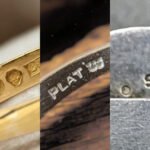

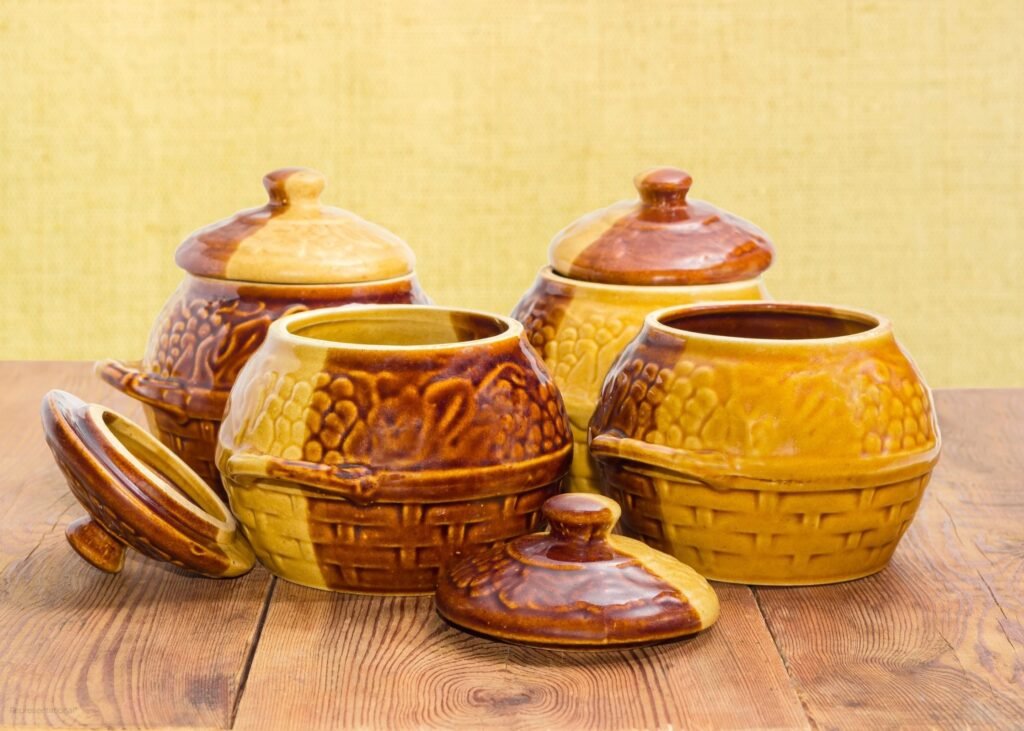
McCoy pottery started in Roseville, Ohio. Nelson McCoy Sr. and his father, J.W. McCoy, set up Nelson McCoy Sanitary Stoneware Company in 1910. It began making unadorned crocks and jugs and went on to make decorated items in 1933.
The business was changed to Nelson McCoy Pottery Company the same year. By the 1950s, the plant was producing 10 million items annually. After over four decades, the factory ceased production in 1990 after a series of owners, including Lancaster Colony and Designer Accents.
Vintage McCoy pottery is quite collectible nowadays. Antique planters, cookie jars, and figurines show up on platforms like Etsy, eBay, and farmhouse tours. Let’s take a look at some valuable pieces in this McCoy pottery price guide.
How to Identify McCoy Pottery – Genuine or Not?
It can be difficult to differentiate genuine and fake McCoy pieces. Everything that came out of their factories was not stamped, and from the ’90s onwards, plenty of forgeries have found themselves on the market.
Here’s what you need to see on your piece.
Check for the McCoy Mark
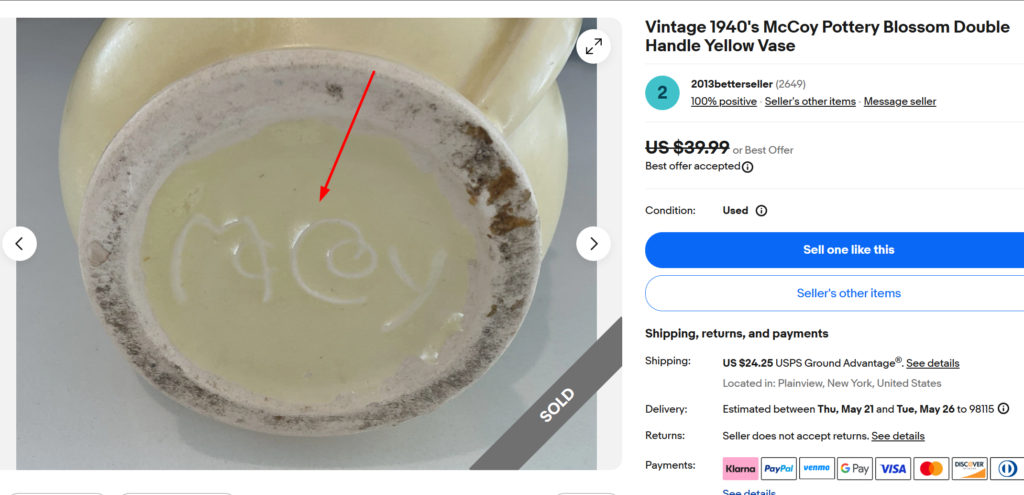
Turn the piece upside down and check the mark.
The company started using the mark on its pottery only after 1929; hence, older pieces of pottery are normally without any markings or with style numbers stamped into the bottom.
McCoy pottery marks by year follow a rough pattern.
- The mark used between 1929 and 1938 was “NM” or “NM USA” representing Nelson McCoy Pottery, with the letters overlapping each other.
- Since 1939, “McCoy” became the single mark that the company began to use, while “USA” often accompanied it below. This is the common mark of McCoy pottery known to all.
- The 1940s and 1950s used “McCoy” or “McCoy USA” in block or script. The 1960s introduced a circular “McCoy USA” logo. After 1974, you’ll spot “LCC” (Lancaster Colony Corporation) added to some pieces.
- There’s also a special “24K Gold” ink stamp used starting in 1957 for gold-finished items. It appears alongside the regular McCoy mark.
In a nutshell, anything stamped “McCoy LLC” or “McCoy Ltd” was made after 1991 by unrelated companies and isn’t authentic vintage.
Identifying Unmarked McCoy Pottery
There are many real McCoy pieces that are unmarked, in particular older Brush McCoy and younger Nelson McCoy pieces. Therefore, unmarked does not mean the piece is necessarily fake.
You will have to use other methods to determine authenticity, such as shape, glazing, and catalog numbers.
The best way to do it is to visit the official website of the McCoy Pottery Collector’s Society or use references such as Huxford or Hanson’s guide to McCoy pottery. If you find an exact match of your piece’s dimensions, then you have found a real McCoy.
Check the Clay Body & Glaze
Real McCoy pottery has real weight to it. The clay body is dense and substantial, usually buff, tan, or grayish when you peek at the unglazed foot ring. Bright white clay almost always means you’re holding a modern reproduction or look-alike.
Secondly, glazes on authentic McCoy are slightly uneven with natural variation. You’ll find that there is fine crazing (cracking of the glaze surface) on old objects as a result of age rather than anything else. The reproduction will usually have an excessively bright, flawless glaze.
And lastly, incised marks should have crisp, clean edges. If the McCoy pottery logo looks fuzzy, raised in weird ways, or oversized, that’s another warning sign. Genuine stamps were either pressed firmly into wet clay or applied with a clean ink stamp.
Common Lines & Patterns to Know
- Loy-Nel-Art (an early hand-painted line from 1908)
- Onyx (a swirled stone-like glaze)
- Blossom Time
- Brocade
- Stonecraft
Mid-century lines like Floraline (started 1960), Brown Drip, Pink and Blue Stonecraft, Strawberry Country, and Harvest are still common at estate sales. Some of these lines have unique marks, making them easy to spot.
The animal planters, figural cookie jars, and wall pockets are some of the most recognizable types made by McCoy. Generally, all the items will correspond to an official mold number listed in the McCoy books; thus, comparing the form and size is key.
Other ID Features
There are a few other features that give it away as genuine McCoy pottery.
- McCoy pieces often have what collectors call a “dry foot” or “dry ring” on the bottom. That’s the unglazed circle where the piece sat in the kiln. You can see the clay color and texture clearly there, which helps confirm authenticity.
- Look at the construction details too. The Real McCoy cookie jars have some manufacturing imperfections that could only be found in mass production, like small glaze leaks, mold lines, and minute pinholes in the ceramic. A perfect finish is likely a recent forgery.
- A cold-painted appearance (painting over glaze without firing) is another distinctive trait of McCoy cookie jars. Cold paint tends to wear out in time naturally; therefore, any worn but original cold painting is an indicator of age.
14 Valuable McCoy Pottery Pieces Sold Recently
Below are some highly collectible McCoy pottery pieces, ranging from cookie jars to vases and household pieces that consistently bring strong prices in sales and auctions.
1. Miniature Witch Brown Figurine
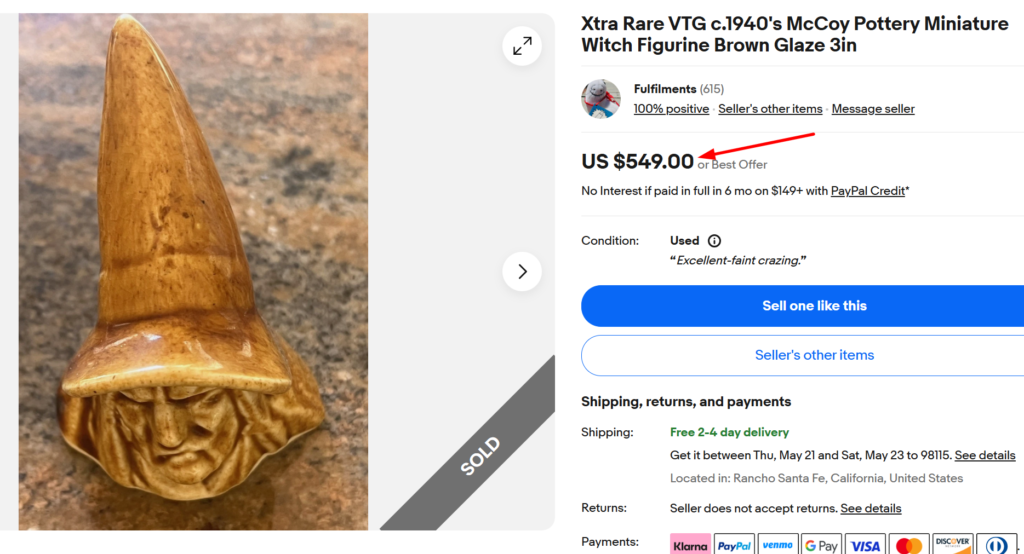
Sold for $550
This is one of the rarest items ever made by McCoy. It’s a miniature 3-inch-tall witch figurine with a glazed finish in a beautiful honey brown dripped glaze. You’ll see a wrinkled face, wearing a large pointed witch hat, and a “USA” mark near the lower edge.
These small figurines are believed to have been made during the 1940s, and only a few quantities were made, making them quite rare today. The value of this example reflects the value and collectibility of authentic pieces.
- Estimated Value: $300–$600+ (mint condition)
- Production Year: c. 1940s
- Line: Miniatures (Halloween/Novelty)
- Characteristics: 3″ tall, brown glaze, detailed witch face, a pointed hat
- Quick Notes: Check for the USA mark & verify against reference books.
2. Black Mammy Cookie Jar
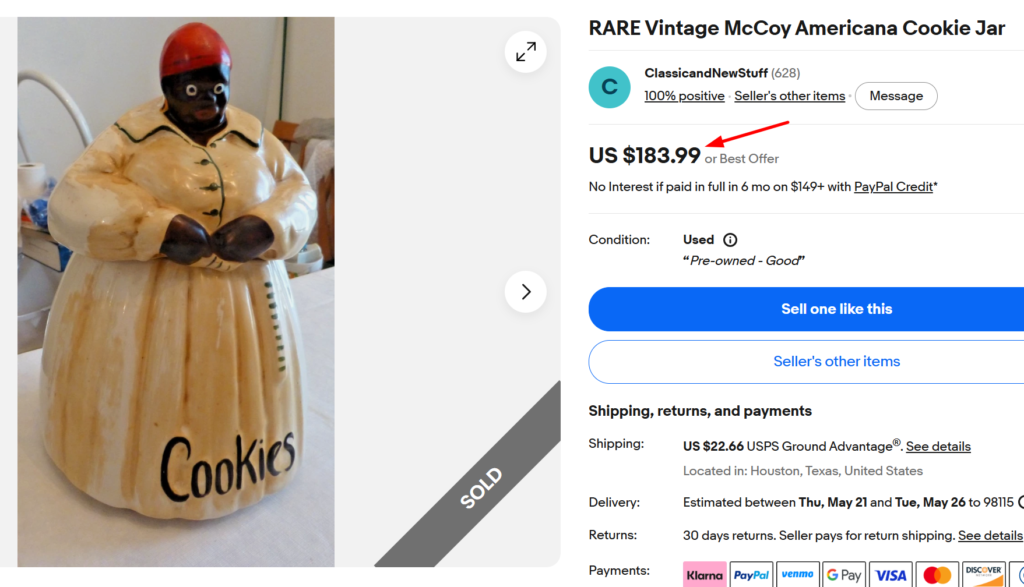
Sold for $185 (single)
This is the holy grail of McCoy cookie jars, and also the most faked. The original was made from the 1940s through the late 1950s in white, yellow, and aqua, with a cold-painted red bandana, green dress trim, and an apron. The authentic jar stands a full 11 inches tall.
McCoy only made two Black Mammy designs. One is the basic Mammy, and the rarer “Mammy with Cauliflowers” (also called Cauliflower Mammy) is the more valuable mold. Original cold paint in good shape pushes the value way up since most surviving examples have worn or faded paintwork.
- Estimated Value: $150–$1,200+ (authentic); $1.500+ (rare versions)
- Production Year: 1940s–late 1950s
- Line: Cookie Jars (figural)
- Characteristics: 11″ tall, glazed bottom with dry ring foot, cold-painted details
- Quick Notes: Heavily reproduced; check height carefully: fakes run 10¼”–10½”
3. “Coalby” Black Cat Cookie Jar
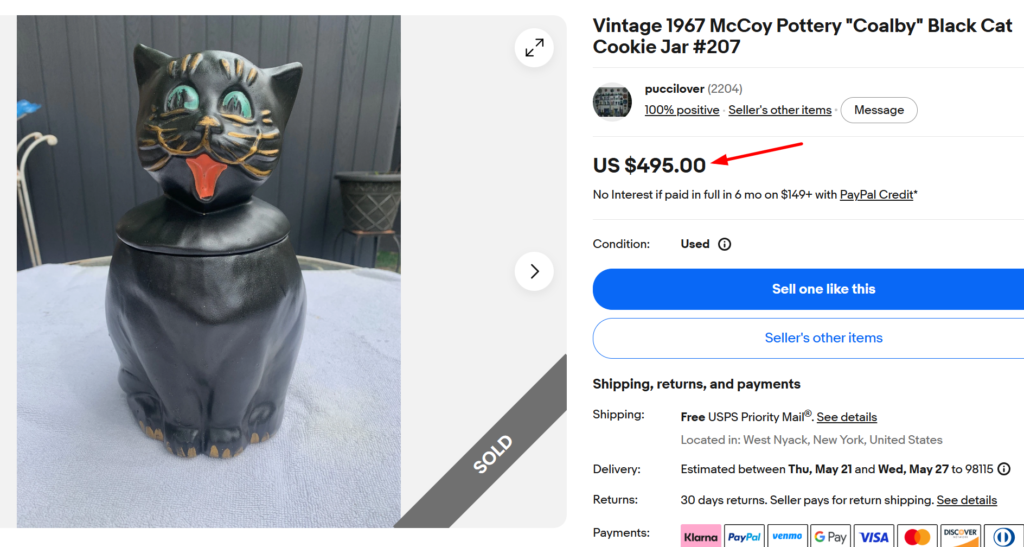
Sold for $495
The Coalby cat is one of McCoy’s most distinctive cookie jars. It’s an all-black matte cat sitting upright with its tongue sticking out. Authentic pieces are marked USA 207 on the base.
You’ll see cold-painted whiskers and paws that add to its personality. The jar stands 11 inches tall, which is a reliable identification parameter.
Very few of these jars were made before the design was discontinued forever, making complete pieces rare. Mint examples can sell for $300-$700 today.
- Estimated Value: $300–$700 (mint condition)
- Production Year: 1967
- Line: Figural Cookie Jars (mold #207)
- Characteristics: 11″ tall, matte black glaze, cold-painted gold details
- Quick Notes: Verify the 207 mark and matte finish.
4. Poppy Planter
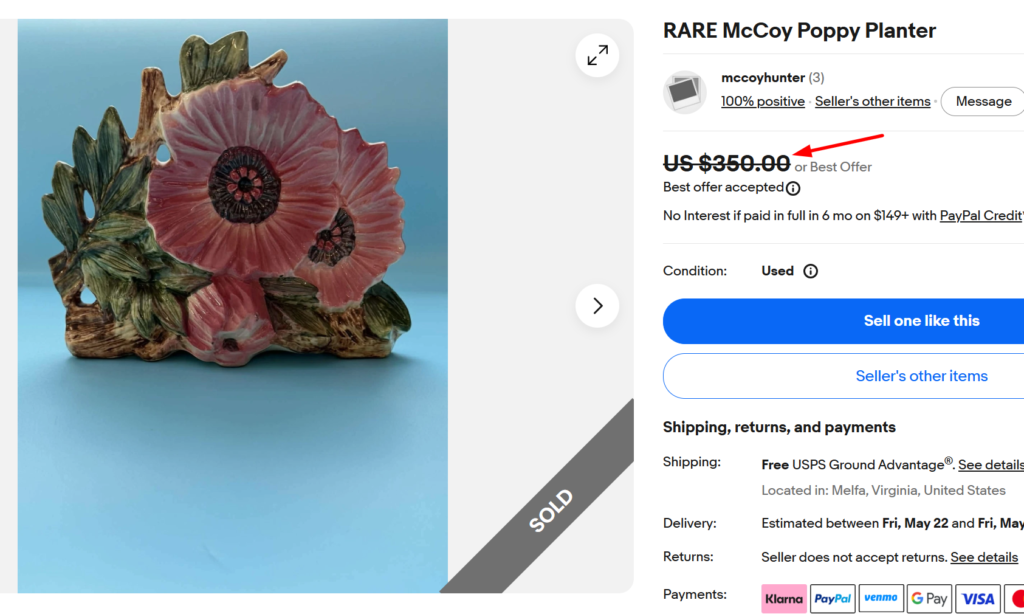
Sold for $350
This is one of McCoy’s most intricately crafted flower pots. It features a fully blossomed pink poppy in a 3-D form rising out of an embossed backdrop of green leaves, along with a miniature poppy and stems encircling the body. The petals show excellent hand-painting.
Released in 1955 during McCoy’s peak novelty era, the Poppy planter is rarer to find. So, earlier examples in vibrant condition can easily fetch $400–$450.
- Estimated Value: $200–$450 (based on color, condition)
- Production Year: 1955
- Line: Floral Novelty Planters
- Characteristics: Sculpted pink poppy, embossed leaves, hand-shaded petals
- Quick Notes: Petal edges chip easily; mint pieces command the top values
5. Iris Jardinière
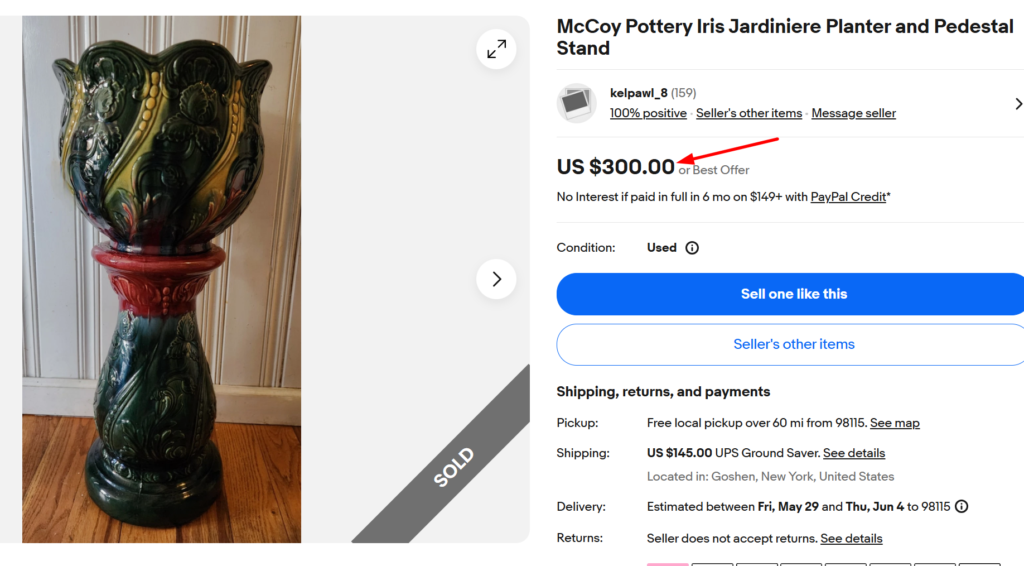
Sold for $300
This is a jardinière and pedestal set in the Iris pattern, with deeply embossed leaves and floral motifs on a dramatic dark green glaze with red and yellow highlights.
Stands roughly two and a half feet tall as a complete set. Made during the J.W. McCoy or early Brush-McCoy era, these large Majolica-style sets are rare because the pedestal base often broke or got separated from the jardiniere. Completeness is the biggest value driver.
- Estimated Value: $300–$800+ (complete sets)
- Production Year: Early 1900s–1920s
- Line: Iris / Majolica Art Pottery (J.W. McCoy / Brush-McCoy era)
- Characteristics: Embossed iris and leaf design, multi-color blended glaze
- Quick Notes: Single pieces are worth far less than sets
6. Kookaburra Pitcher
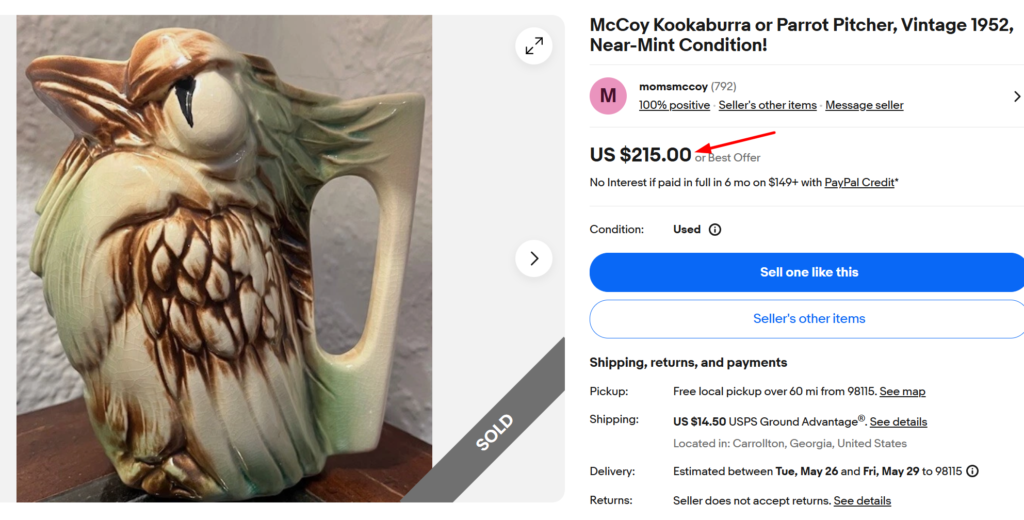
Sold for $215
This McCoy pottery pitcher resembles a kookaburra with feathers made of cream, brown, and green colors, all embossed. The bird’s tail acts as the handle, while its beak acts as the pour spout.
It stands roughly 7″ tall and showcases the brand’s signature crazing on the glaze surface.
The 1952 production date and figural styling make it rare compared to common mid-century pitchers. Also, the beak or spout is highly prone to chips, which impacts value.
- Estimated Value: $100–$250 (mint condition)
- Production Year: 1952
- Line: Figural / Bird Pitchers
- Characteristics: 7″ tall, embossed feather detail, multicolor glaze
- Quick Notes: Check the beak tip and tail handle for damage.
7. Strawberry Cookie Jar
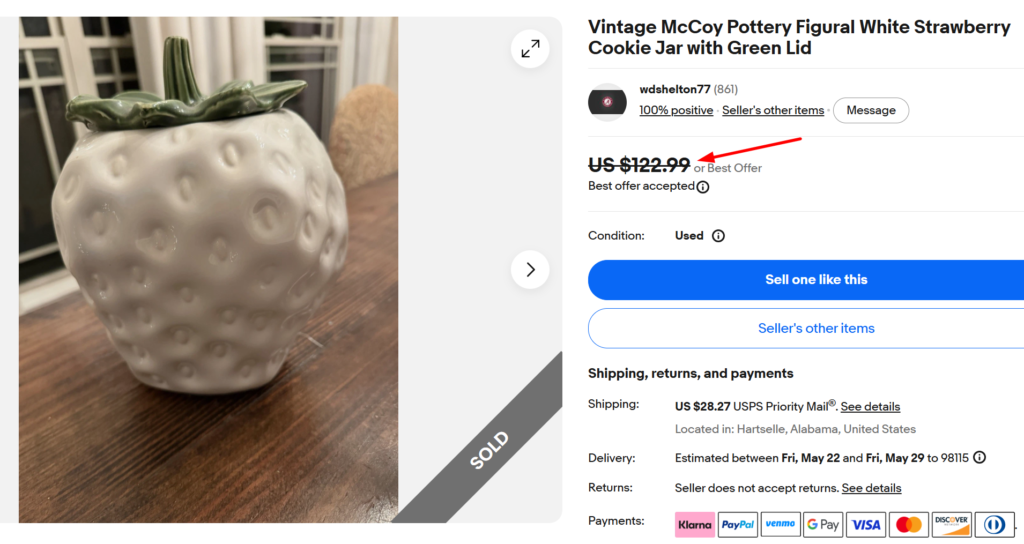
Sold for over $120 (single)
This sweet little fruit-shaped jar comes in two main styles. The classic red strawberry with green leaf lid was made starting in 1971 (mold #263), and there’s also a “Strawberry Country” tilted canister version from the same period. Both are collectible.
The mauve and white color variations are scarcer than the standard red. You’ll also see canister sets that match the cookie jar. Complete sets in matching condition pull the highest prices for any McCoy pottery strawberry cookie jar.
- Estimated Value: $30–$170 (complete with lid)
- Production Year: 1971 onward
- Line: Fruit / Strawberry Country
- Characteristics: Marked #263 USA on most examples
- Quick Notes: Condition and matching lid drive the value.
8. Brown Drip Glaze Jardiniere
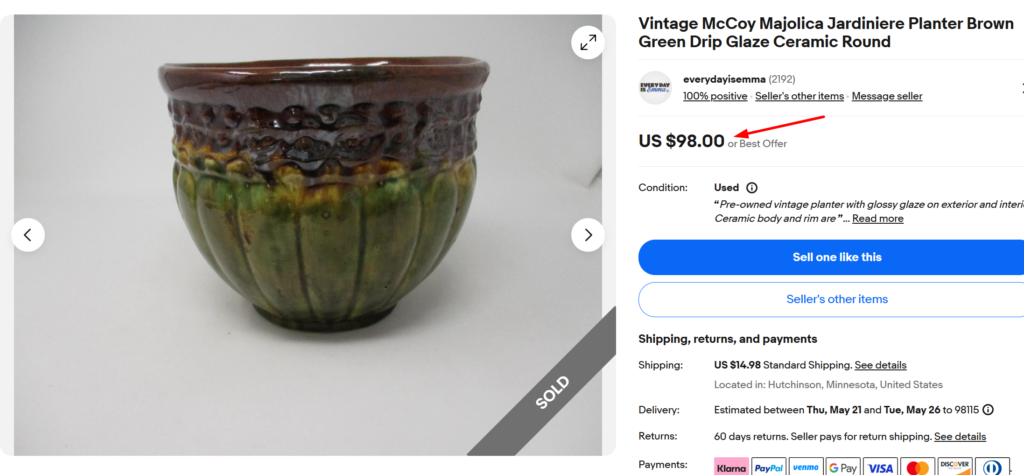
Sold for almost $100
This one is a classic example of early McCoy decorative work in the Majolica style. The body of this jard is made in the form of a ribbed melon, glazed with bright green on the base.
The rim band is glazed in brown mottled drip style, going into the green glaze. This piece has been made in accordance with the Old Ivory Ware and Blended Ware traditions of the J.W. McCoy period.
Also, these early pieces are often unmarked or carry only a mold number. As for value, larger or pristine jardinières regularly hit $150–$250.
- Estimated Value: $75–$250 (based on size/glaze)
- Production Year: Early 1900s–1920s
- Line: Majolica / Blended Ware (J.W. McCoy / Brush-McCoy era)
- Characteristics: Ribbed melon body, brown-on-green drip glaze
- Quick Notes: Authenticate the shape using early catalogs.
9. Covered “Cookie Wagon” Jar
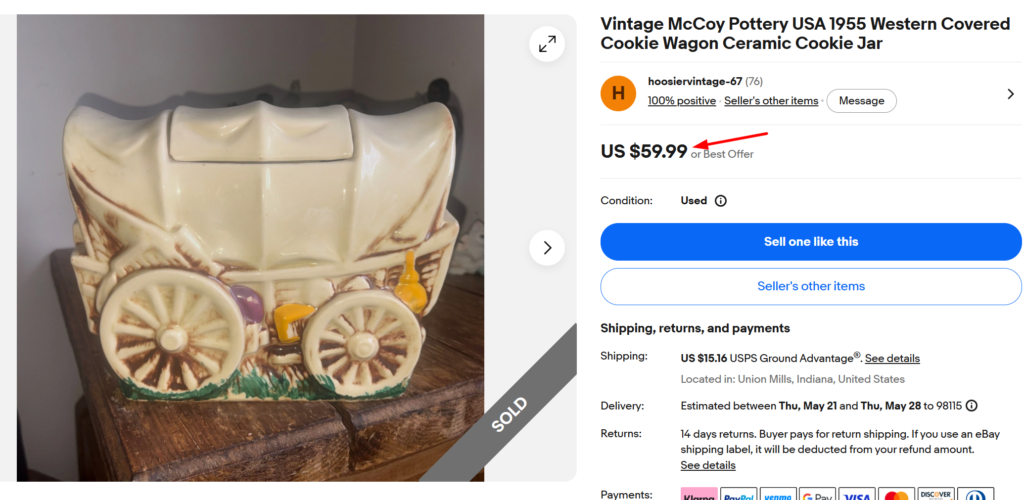
Sold for $60 (single)
This piece from the mid-century looks like a Conestoga wagon with the cover on canvas and the wheels made out of wood and decorated on the molding. The piece was made back in the 1950s when the Wild West was all the rage after Davy Crockett TV shows.
The brown and tan glaze combinations are most common. Look for the original lid (the wagon canvas) since these often get damaged or replaced.
- Estimated Value: $50–$200 (good condition)
- Production Year: 1950s
- Line: Cookie Jars (figural)
- Characteristics: Brown/tan glaze with detailed molding
- Quick Notes: Broken or missing lids reduce value significantly.
10. Yellow Umbrella Stand
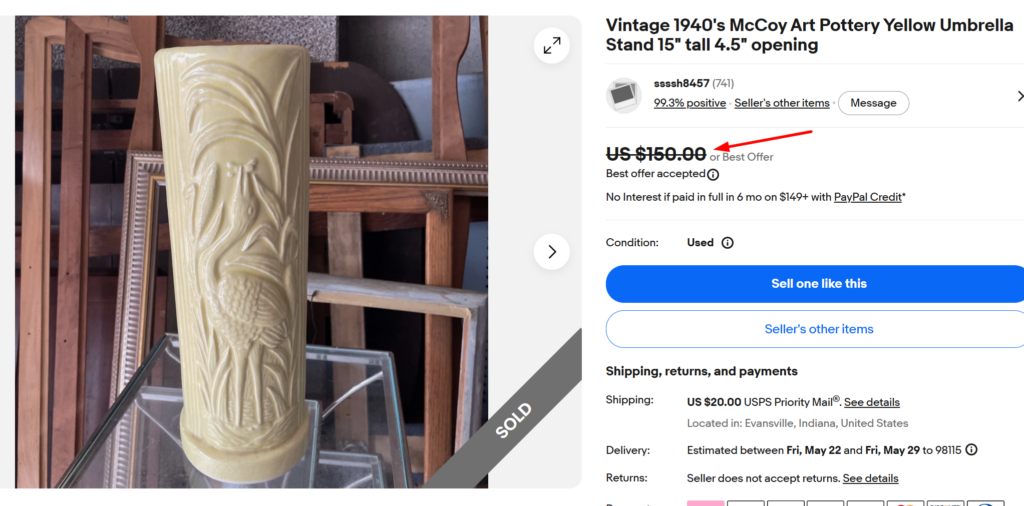
Sold for $150 (single)
McCoy umbrella stands have been in production since the early 1900s, usually as large cylindrical designs with embossed leaves, panels, and spirals. The white glazed versions are particularly striking.
Because of their size and weight, umbrella stands tend to stay in homes for decades. So, they’re not common at online sales, but when one shows up in good condition, it can pull $100–$400+. Brush-McCoy umbrella stands are older and even more sought after.
- Estimated Value: $150–$500+ (vintage examples)
- Production Year: Early 1900s–1950s
- Line: Decorative / Brush-McCoy
- Characteristics: Tall cylindrical form, 18″+ height, embossed details
- Quick Notes: Condition is everything for top value.
11. Stonecraft Pink Blue Stripes Mixing Bowls
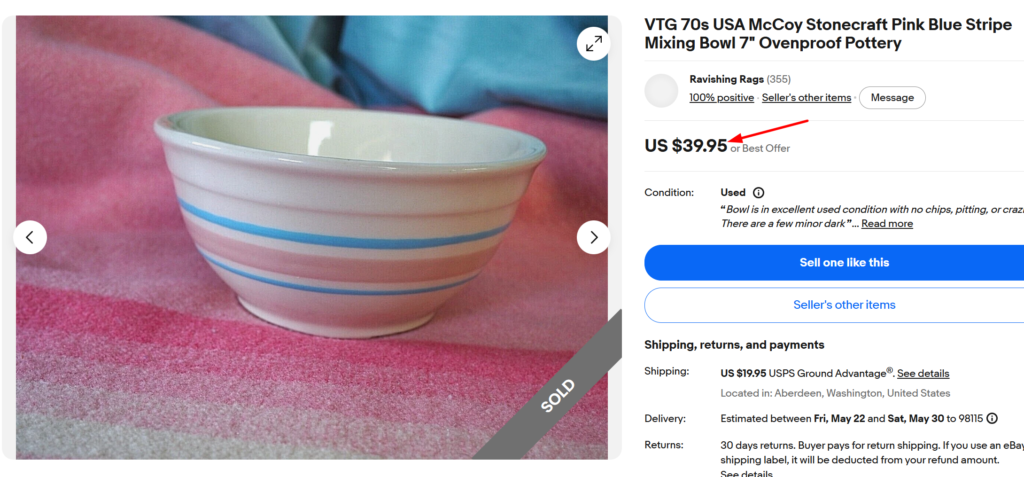
Sold for $40 (single)
McCoy’s Stonecraft line is popular among farmhouse-style collectors. The nesting bowl set includes four nesting bowls made from cream stoneware, marked with very thin pink and blue horizontal stripes on the rim.
These pieces were created in the 1970s for practical use in the kitchen. There is also a matching pitcher, canister set, mugs, and a covered casserole. Complete nested bowl sets bring far more than singles.
Watch for clean stripe bands without dishwasher fade, and intact rims. Mismatched “near sets” pulled from multiple homes don’t bring the same money as a true matched original set.
- Estimated Value: $60–$180 (nested sets); $12–$25 (singles)
- Production Year: 1970s
- Line: Stonecraft (Pink and Blue)
- Characteristics: Cream stoneware, thin pink and blue stripe bands
- Quick Notes: Faded stripes can reduce value significantly.
12. Blossom Time Vase
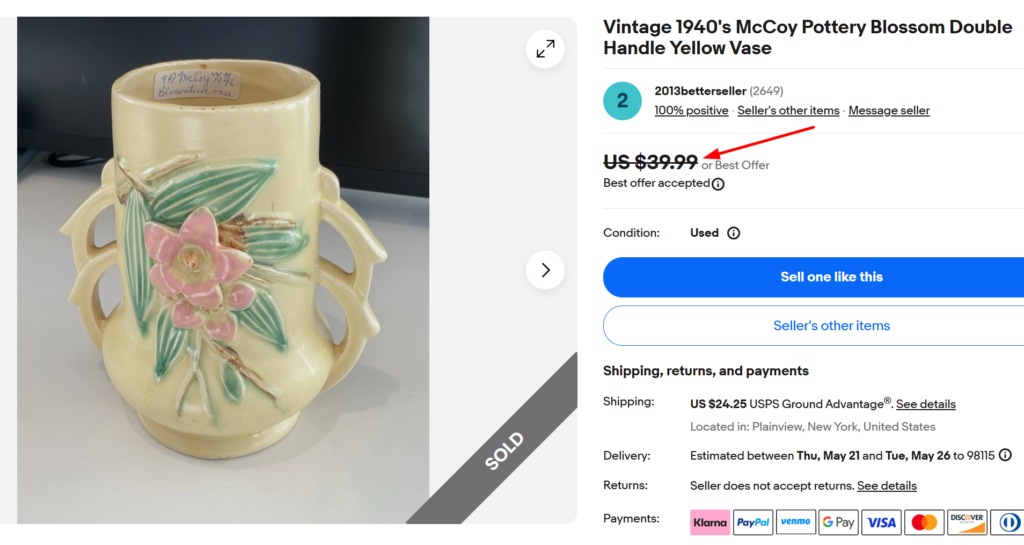
Sold for $40
This vase comes from the McCoy Blossom Time line. It features hand-applied pink pastel flowers and green leaves on a soft yellow matte body and two open looped handles.
The applied 3D floral decoration is what separates Blossom Time from cheaper embossed lines. Each flower was hand-shaped and attached before glazing. Check this precisely to spot any fakes or repros.
Blossom Time vases are usually common, but rare color variations in large sizes can push values significantly higher.
- Estimated Value: $40–$150 (yellow examples); $200+ (rarer colors)
- Production Year: 1946–early 1950s
- Line: Blossom Time
- Characteristics: Yellow matte body, applied pink flowers, double looped handles
- Quick Notes: Hand-applied flowers chip easily; check petal tips closely
13. Bird Bath Wall Pocket
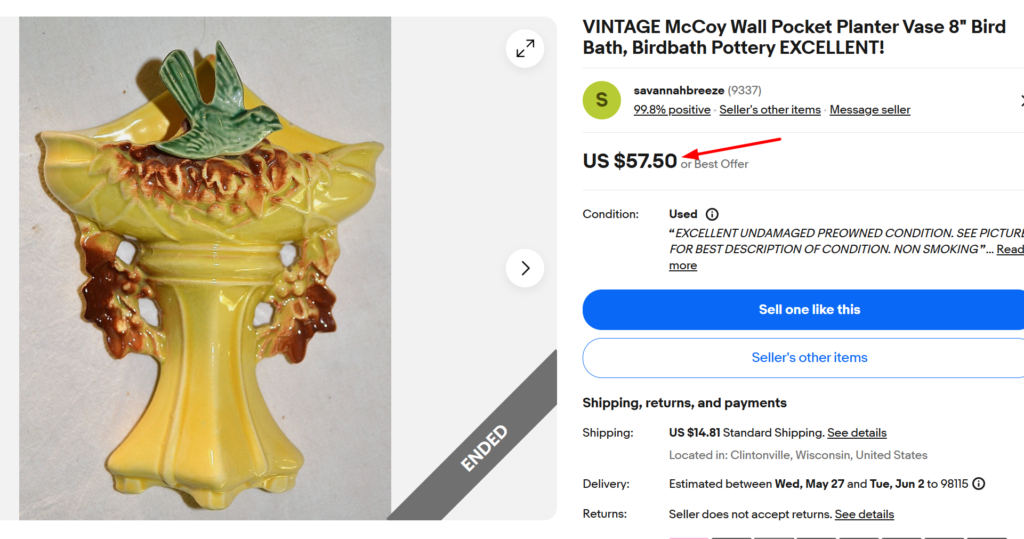
Sold for almost $60
McCoy made over 100 wall pocket designs, but the Bird Bath wall pocket from the 1950s is one of the most loved. It features one or two small birds perched on the rim of a shallow bath, with the pocket forming the bath bowl, and hand-painted details.
Other top-shelf McCoy wall pockets include the Apple wall pocket (1953 Fruit line), the Lily wall pocket, the Bellows, the Umbrella, and the Lovebirds-on-Trivet.
The Mailbox wall pocket marked “LETTERS” is a quirky favorite. Watch for original hanging holes intact, since damage there ruins display value.
- Estimated Value: $40–$175 (based on design, condition)
- Production Year: 1940s–1950s
- Line: Wall Pockets (Fruit, Lily, Bird Bath, Mailbox sub-lines)
- Characteristics: Decorative front, flat back, intact hanging hole
- Quick Notes: Apple, Lily, and Mailbox designs have been reproduced
14. Wishing Well Planter
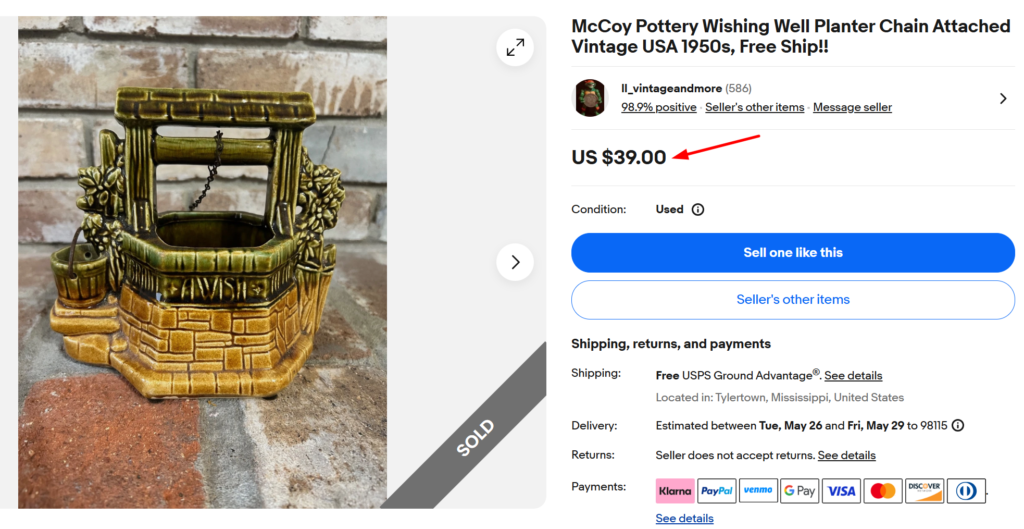
Sold for $40
This planter is shaped like a small wooden-style well with a peaked roof on posts, a tiny bucket hanging from a chain, and the planter cavity in the well’s body.
Released in 1950 and marked McCoy USA #214, it’s one of the most photographed McCoy designs.
Two main glaze versions exist: brown roof with green well, and the rarer yellow combination. The hanging bucket and chain are nearly always missing or broken on used examples. So, a complete one with an intact bucket is the most valuable.
- Estimated Value: $30–$100 (complete with bucket)
- Production Year: 1950
- Line: Novelty Planters (mold #214)
- Characteristics: Peaked roof, hanging bucket detail, brown/green glaze
- Quick Notes: The bucket and chain are important for top value.
What Makes McCoy Pottery Valuable?
It’s true that some of the McCoy’s pottery has significant value, but not all. The company created millions of such products between 1910 and 1990; thus, ordinary planter pots, as well as bean pots, are priced at $10-$30.
The real value lives in specific, rare jars, early art pottery, and pristine condition mid-century pieces. Below are the key determinants of vintage McCoy pottery value:
- Rarity: Specific designs like the Mammy Cookie Jar, Freddy the Gleep, Squirrel Fox, and certain Loy-Nel-Art pieces are scarce because they were made for short windows or in limited colors. Rare McCoy pottery from the 1930s art pottery period and unusual cookie jar designs always lead the pack.
- Condition: This is the most crucial value factor. It’s the mint examples with original paint and intact lids that command top dollar. Chips, hairline cracks, glaze flakes, missing lids, repaired sections, or worn cold paint can cut value by 50–90%. Even rare jars lose serious money when damaged.
- Marks & Age: Pieces from McCoy’s “golden era” (1940s–1960s) generally bring the strongest prices. Early NM marks (1929–1938) and Brush McCoy pieces are even more sought after. Anything made after 1990 is usually worthless since it’s not genuine vintage.
- Demand: Collectors’ taste plays an important role in valuation. Cookie jars exploded in value during the 1990s after Andy Warhol’s collection sold at auction. White Floraline jumped after Martha Stewart featured it. Right now, mid-century planters, Brown Drip, and Stonecraft are trendy.
- Color and Glaze: Rare colors can increase the worth of an item substantially. A normal item in the typical green glaze may only be worth about $40, but that same form in an unusual color like a bright cobalt blue or matte aqua may easily be valued at $400.
- Line/Pattern: Some lines are more collectible than others. Loy-Nel-Art, Onyx, Brush McCoy art pottery, Blossom Time, and Jeweled command higher prices. Common utility lines like Brown Drip and basic Floraline stay affordable unless the piece is unusual.
- Size & Form: Large pieces usually hold more value than smaller pieces from the same series. Huge floor vases, jardiniere with pedestals, and umbrella stands are the most valuable pieces. Tiny novelty planters are affordable unless they’re rare designs.
- Provenance & Documentation: Pieces that have their original tags or dated receipts are more valuable. A piece pictured in a published McCoy reference book, like the Huxford or Hanson guides, carries built-in credibility that drives value.
So before you sell or buy a McCoy piece, check the marks, research the pattern, color, and line, and assess the condition to understand how much it can be worth today.