
Most of us remember seeing Pyrex in our mothers’ or grandmothers’ kitchens, like those turquoise mixing bowls or avocado-green casseroles. What if I told you that the same everyday dishes now sell for hundreds or even thousands?
You read it right! Vintage Pyrex dishes have become highly sought after by collectors. This guide will help you learn how to identify and value vintage Pyrex, and some key patterns and pieces worth knowing!
Brief History of Vintage Pyrex
Back in 1915, Corning Glass Works developed a heat-resistant glass for laboratory beakers. Some engineers at the company figured out this borosilicate glass would be perfect for home cooking, too, and that’s how Pyrex got started.
The first Pyrex pieces were clear and practical. This continued for thirty years until 1945, when Corning introduced their Primary Color series. These bright red, yellow, blue, and green mixing bowls completely changed American kitchens.
The 1950s and 1960s brought the patterns collectors love most, like snowflakes on turquoise casseroles, farm scenes on mixing bowls, and pink daisies on refrigerator dishes.
In 1998, Corning sold the Pyrex brand. The new owners changed from borosilicate glass to a cheaper soda-lime formula. This marks the clear dividing line between vintage collectible Pyrex and modern production pieces.
Identifying Vintage Pyrex Dishes: Key Signs
Authenticating vintage Pyrex is easy once you know the key signs to look for. The backstamp and model numbers, combined with patterns and glass type, provide you with the most reliable information about age and authenticity.
The Backstamp:
The backstamp on the bottom of your Pyrex tells you when and where it was made. Nearly every genuine piece has an embossed marking. These stamps changed over the decades, serving as a clue to age.
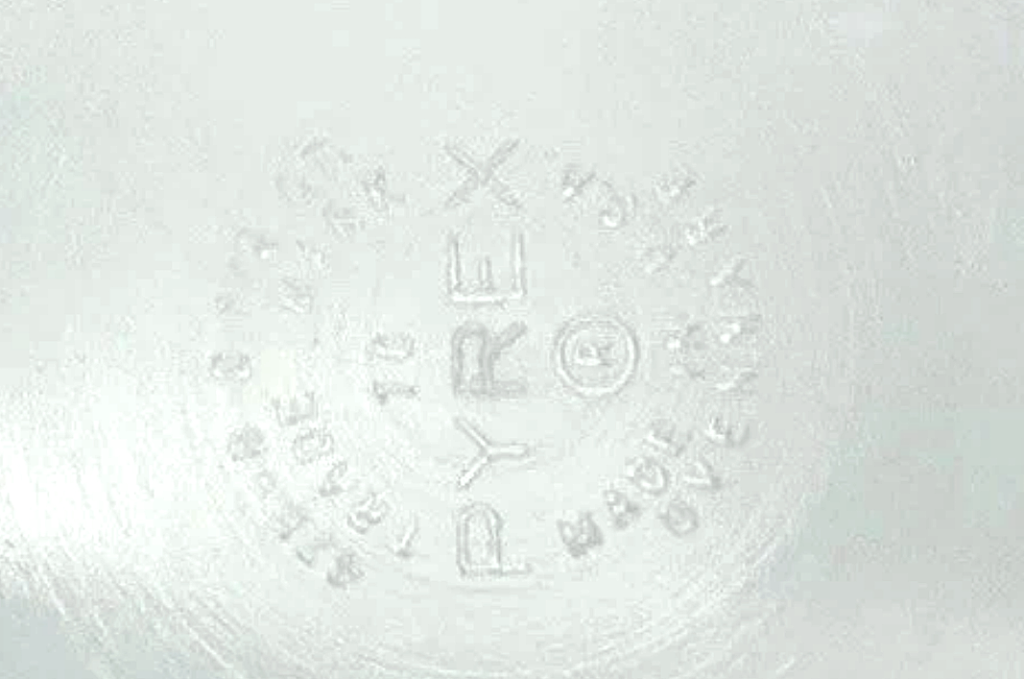
1940s to Early 1950s:
- “PYREX” in capital letters inside a circular stamp
- “CG” marking for Corning Glassworks
- Some early pieces show a small figure blowing glass
- Simple circle format with minimal additional text
Mid-1950s:
- Circular stamp with “MADE IN U.S.A.” added
- Trademark symbols (® or TM) appear
- “TRADE MARK” text may be included
1960s:
- Change from circular to straight-line format
- “PYREX” in block capital letters
- Model number and capacity clearly marked
- “MADE IN U.S.A.” in straight text
1970s to 1980s:
- Usage instructions added, like “NO BROILER OR STOVETOP”
- Metric measurements appear alongside pints and quarts
- Some pieces include “by CORNING, Corning, NY, USA.”
- More detailed safety information on certain items
Important Note: Lowercase “pyrex” indicates a modern piece made after 1998. All vintage Corning-era pieces use capital letters: PYREX.
The Model Numbers:
The numbers stamped on Pyrex pieces identify the type and size. Understanding this numbering system helps you date pieces and identify specific items.
Here are some of the most common series numbers:
- 400 Series (Mixing Bowls) – 401, 402, 403, 404
- 440 Series (Cinderella Bowls) – 441, 442, 443, 444
- 470 Series (Round Casseroles) – 471, 472, 473, 474
- 500 Series (Refrigerator Dishes) – 501, 502, 503
How to Read the Numbers?
- Numbers starting with “0” can be ignored (such as 0401 or 0502)
- The last digit often indicates capacity (a “5” usually means 2.5 quarts)
- Lids match their base number but add “-C” or “-CU” at the end. For example, a 502 dish will have a lid marked 502-C or 502-CU
- Sometimes bowls are marked with “-B” and lids with “-C.”
Note: Some promotional items and early pieces use different numbering systems. This is normal and adds to the challenge of identification.
The Glass Type
The type of glass used in manufacturing changed in 1998, providing a reliable way to date Pyrex. For example:
Vintage Pyrex used borosilicate glass from 1915 to the 1940s. This glass is completely clear, with no color tint, when viewed along the edge or side of the piece. And, it’s heavy.
From the 1940s to 1998, the company switched to soda-lime opal glass, which is a milky white glass. This glass also has a substantial weight.
Modern Pyrex (Post-1998) is made of soda-lime glass. This glass has a noticeable bluish-green tint, especially visible along the edges. Place a modern piece next to a vintage one, and the color difference is noticeable.
Collector’s Tip: Do the black light test for authenticity. Some white opalware pieces glow greenish-yellow under ultraviolet light. This occurs because of manganese in the glass mixture. Although this test doesn’t work on all authentic pieces, if it works, it confirms genuine vintage Pyrex.
The Pattern & Color Combinations
The colors and patterns on Pyrex changed with each decade. This makes dating pieces relatively simple once you learn the timeline.
1945 to 1950:
Primary colors dominated this period. Bold reds, bright yellows, sky blues, and grass greens were standard. These solid-color mixing bowls launched the colored Pyrex line.
1950s:
Pastels became popular during this decade. Soft pinks, turquoise, and pale yellows appeared. The first printed patterns also emerged, including Pink Daisy and Snowflake. These patterns marked a major shift toward decorative kitchenware.
1960s:
This decade saw warmer tones and bolder designs. Town and Country featured atomic-age starburst patterns in black and white. Earth tones started appearing alongside brighter colors.
1970s to 1980s:
Harvest gold became ubiquitous. Avocado green appeared in countless kitchens. Brown tones ranged from caramel to chocolate. Popular patterns from this era include Butterfly Gold and Spring Blossom Green.
If you find pieces with primary colors or pink and turquoise patterns, you likely have items from the most collectible period of the 1950s and early 1960s.
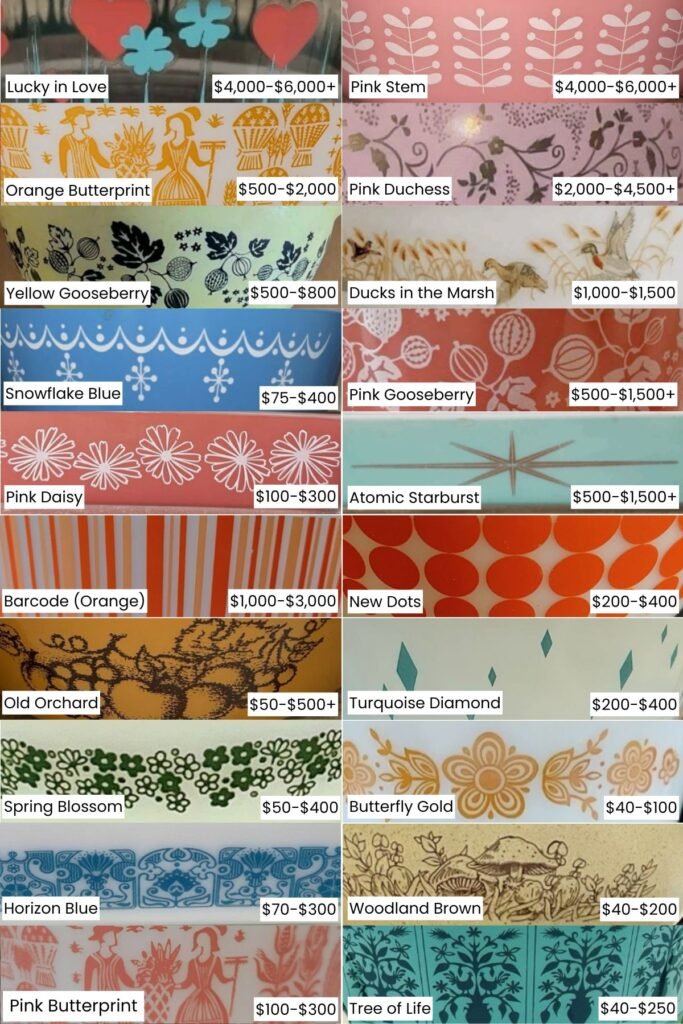
20+ Most Valuable Pyrex Patterns Worth Knowing!
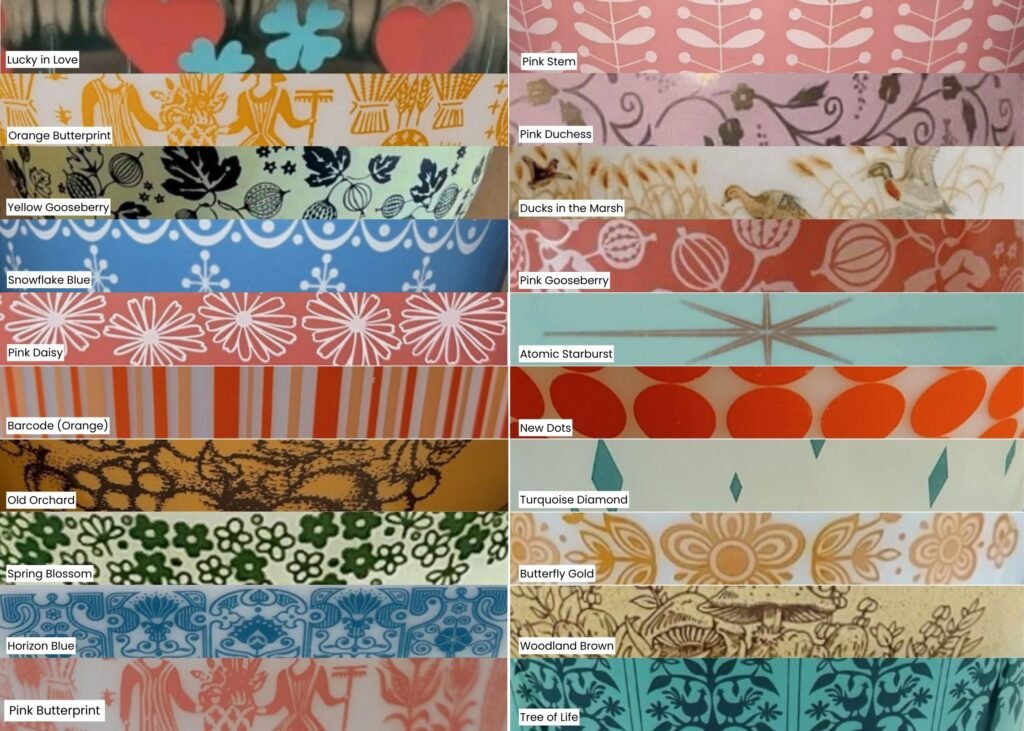
Below are some of the most popular and valuable Pyrex patterns, along with their real-time estimated values.
What Determines the Value of Old Pyrex Dishes?
In general, several factors influence the value of vintage Pyrex. A bowl might sell for $5 at a thrift store while another similar piece brings $500 at auction. The difference comes down to specific characteristics.
Rarity and Production History:
The scarcest pyrex patterns command the highest prices. For example, “Lucky in Love” was probably a test pattern from 1959. Only a handful of these pieces exist, making them super valuable.
What Makes Pyrex Rare?
- Short Production Runs: Patterns manufactured for only one or two years are harder to find. The Blue Stripe (Barcode) pattern was produced for just one year in 1966.
- Limited Distribution Channels: Some patterns were only available through S&H Green Stamps or other trading programs. Orange Butterprint could only be obtained this way, making it much rarer than the standard turquoise version sold in stores.
- Employee Gifts: Corning gave certain patterns to employees as gifts. These pieces never reached retail stores. Golden Gooseberry on a beige background was an employee-only pattern.
- Test Patterns: Some pieces were prototypes that never went into full production. These test pieces sometimes ended up in employee homes.
- Third-Party Promotional Items: Pyrex partnered with companies like Stanley Home Products and Dainty Maids to create special items. These were not sold through regular stores, and very few survived.
Pattern Popularity and Demand
Rarity alone does not determine value. Collector interest plays an equally important role. Some rare patterns generate little interest, while certain common patterns sell for premium prices because everyone wants them.
Some of the highly sought patterns are: Pink Gooseberry, Turquoise Butterprint, Snowflake Blue, and Atomic Eyes/Starburst. These patterns consistently sell for high prices.
Condition
The condition is critical because a Pyrex piece in excellent condition can be worth three to five times more than the same pattern with damage.
Below are the main value reducers:
- Dishwasher Damage: Repeated dishwasher use fades colors and removes the glossy finish from Pyrex. Even minor fading can reduce value by 50%.
- Chips and Cracks: A chipped rim drops the value to about 20% of perfect condition. Cracks are worse. Even hairline cracks make pieces nearly worthless to collectors.
- Surface Scratches: Minor scratches from normal use are acceptable on common patterns. Deep scratches that damage the design reduce value significantly. For rare patterns like Lucky in Love or Orange Butterprint, collectors expect near-perfect condition.
Completeness and Original Sets
Complete Pyrex sets usually sell for more than individual pieces. A full set of four Cinderella mixing bowls in excellent condition brings a higher total price than selling each bowl separately.
Besides, original lids add substantial value. A casserole with its matching lid might sell for $150 while the same dish without a lid brings only $40. And remember, generic replacement lids do not count; it must be the original lid!
Original packaging is also rare. Most buyers discarded boxes and instructions after purchase. So, when you find a piece still in its original box with paperwork, it automatically adds 20-30% to its value.
Examples of the 5 Most Valuable Vintage Pyrex Dishes Ever Sold!
1. Pink Duchess Pyrex Casserole with Cradle
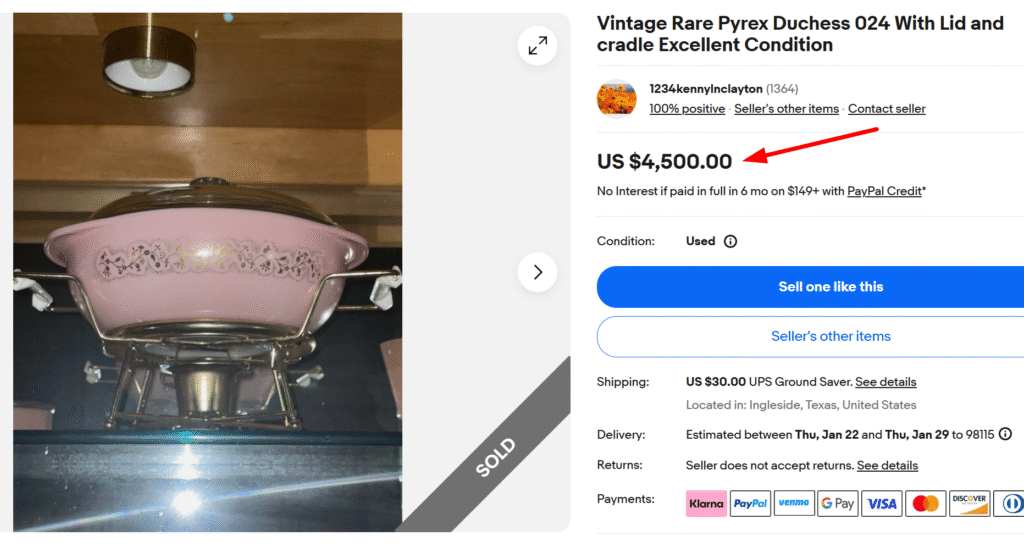
SOLD FOR $4,500
The “Pink Duchess” pattern is extremely rare and was never widely distributed. A complete set of a lidded casserole with the original cradle can be super valuable, more if found with the box!
2. Orange Barcode Stripe Pyrex Dish
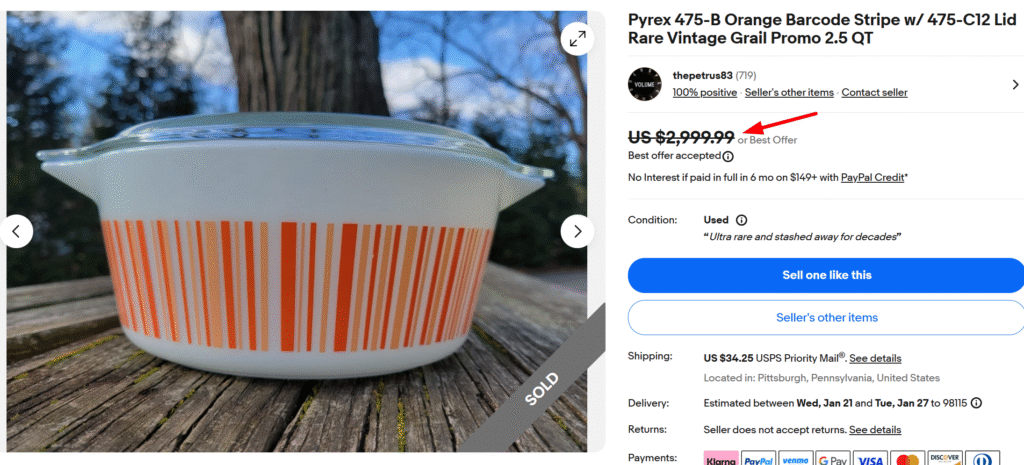
SOLD FOR ALMOST $3,000
The Orange Barcode pattern is a rare color variation of the Blue Stripe design. Many records hint that this was a test pattern released in 1966, but it never reached mass production. Finding a complete casserole set with a matching lid is valuable.
3. Pyrex Delphite Bluebell (401-404) Mixing Bowl Set
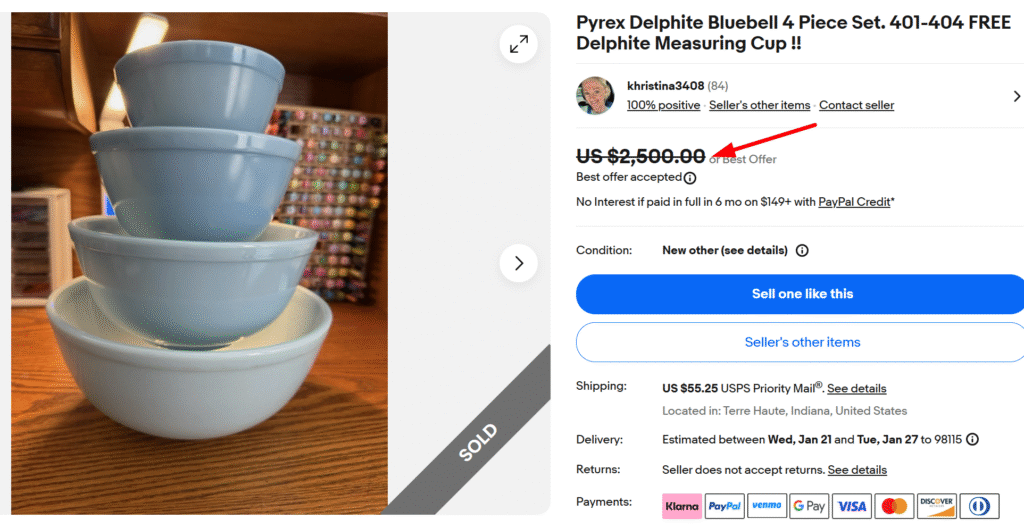
SOLD FOR $2,500
The Delphite Bluebell cookware was a limited edition released for the Canadian market; it is rare to find in the USA. The nesting mixing bowl set (401-404) in this pattern and color is particularly rare!
4. Orange Butterprint Cinderella Bowls
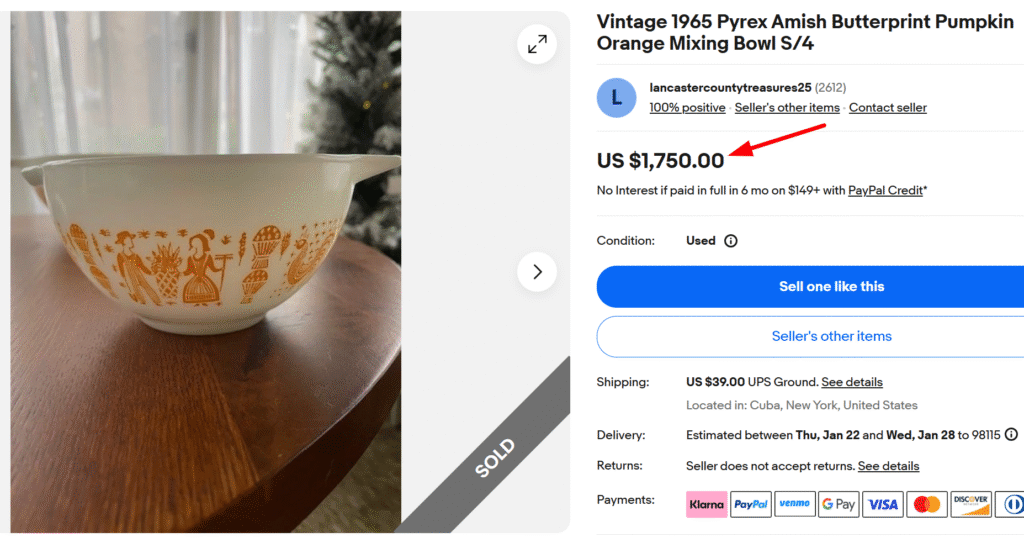
SOLD FOR $1,750
Orange Butterprint was only available through S&H Green Stamps redemption programs, never sold in retail stores. The farm scene pattern in orange on white is much rarer than the standard turquoise version. A complete Cinderella bowl set is extremely hard to find!
5. Atomic Eye/Starburst Casserole Dish with Cradle
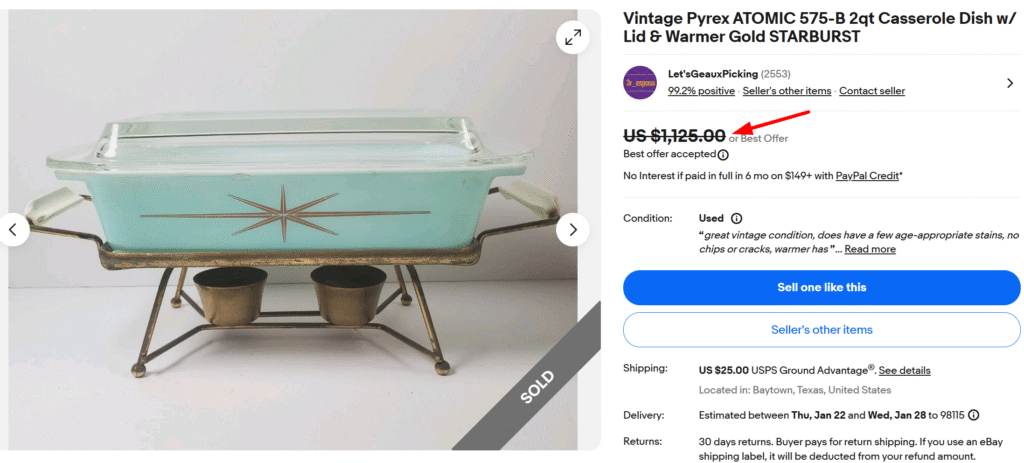
SOLD FOR $1,125
The Atomic Eyes pattern in turquoise features the unique mid-century golden starburst design. This 2-quart casserole includes both the original lid and the metal warming cradle stand. Complete sets, like with all three components, are rare and valuable!