
Fiestaware looks like common, brightly glazed pottery. But did you know that rare vintage Fiestaware pieces from the 1936–1973 era can sell for over $1,000 today? If you didn’t, this guide is for you.
Spotting valuable Fiestaware needs you to check many things, including the color, the shape, and the marks. This guide walks through how to spot original Fiestaware, what drives the value, and 15 specific pieces collectors hunt for today.
What Counts as “Vintage” Fiestaware?
Vintage Fiestaware is the original line made by the Homer Laughlin China Company. It was designed by English potter Frederick Hurten Rhead. The line launched in January 1936 with five solid colors and added turquoise in 1937.
The original series lasted until 1972 before ending completely in 1973. The set was reintroduced in 1986 with its name now shortened to “Fiesta,” but came with new colors and molds after a 13-year hiatus.
The current series of Fiesta produced post-1986 is still being manufactured; however, it is only those made before 1973 that have attained the status of highly valuable collectibles. Rainbow settings, concentric rings design, and vibrant colors attract many new collectors each year.
How to Identify Vintage Fiestaware (5 Quick Checks)
Modern Fiesta and vintage Fiesta look almost similar at a glance. Reproductions exist in the original molds, making identification difficult. So, you have to check more than one thing. Use these five checks together, not separately.
1. Check the Bottom Mark
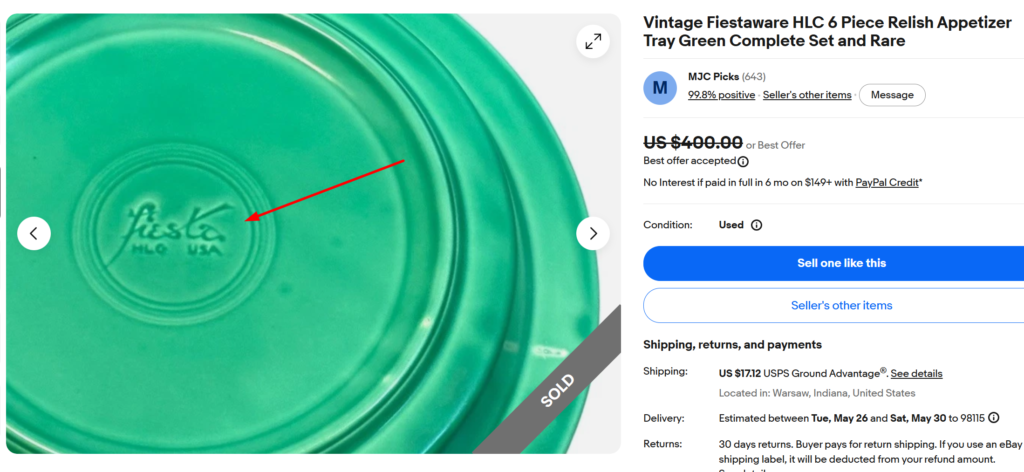
Turn the piece around. Old Fiesta will bear the name “Fiesta” spelled in all lowercase, scripted style. That’s the single biggest clue. Modern Fiesta (post-1986) uses “FIESTA” in all caps almost everywhere.
Besides, there are two types of vintage marks. The ink stamp is a black logo printed under the glaze, usually reading “GENUINE fiesta HLC USA” or “fiesta HLC USA.” This was used mainly on cups, bowls, and saucers.
Incised marks, also referred to as in-mold marks, were made by impressing them on the clay prior to glazing. It is possible to distinguish the letters via the indentations in the glaze. Run your fingertip over it; incised marks have texture, while modern stamps sit flat on the surface.
Some pieces have no mark at all. Some salt and pepper shakers, demitasse cups, and a couple of other small shapes were not marked. Unmarked does not necessarily mean fake. We’ll cover unmarked authentication below.
2. Look at the Rings
Vintage Fiesta is famous for concentric rings. These are bands radiating out from the center of plates and around the bodies of pitchers, cups, and bowls. The ring design was Rhead’s signature element.
On vintage pieces, the rings stop short of the rim, leaving a smooth band of about an inch at the edge. The bottoms (the underside) often have a series of rings, too. Modern Fiesta’s rings are spaced differently, and the rim band is narrower.
Look at the inside bottom of cups, sugar bowls, and creamers, too. Early vintage cups (pre-1937) had a flat inside bottom. Later ones have a slightly domed center. The flat-bottom version is rarer and brings a small premium.
3. Check the Glaze
Older Fiesta glaze tends to be thicker and somewhat uneven. This is because the pieces were dipped by hand. Plus, light spots near the foot, the occasional drip, and color pooling in the rings are all normal.
Secondly, vintage glaze looks dense, almost like enamel, but modern glaze is thinner and more uniform. Hold a piece up and tilt it to check this.
The post-86 colors also tend to look brighter and more “candy-like.” Vintage colors are earthier and more saturated. Original red (1936–1944) especially used uranium oxide in the formula, which gave it that distinctive red-orange color. Production was halted in 1944 when the government took the uranium for the war effort. Red came back in 1959 with depleted uranium and ran until 1972.
4. Check the Foot Ring
Flip over the piece to see the foot, which is the little ring underneath the piece where it sits. Vintage Fiesta will generally have a dry foot with three small stilt marks. This means there are three little chips or bumps from where the piece was held in the kiln.
Such stilt marks are typical on vintage pieces. Modern Fiesta is generally glazed all around with no stilt marks as a result of changes in the firing process.
One exception would be the tripod candle holders and a couple of other art-pottery shapes that were glazed all around. They have a wet foot with stilt marks inside the candle hole instead.
Note: Knowing which forms had which finish takes practice, so check reference photos for the specific shape you’re looking at.
5. Identifying Unmarked Fiestaware
There is a lot of vintage FiestaWare without any marking on it, particularly salt & pepper sets, ashtrays, candle holders, and demitasse cups. In this case, you need to use color, glaze, and shape together.
If the item comes in a recognized vintage color, features the dry foot with stilt marks and proportions, and rings correspond with the recognized vintage shape, one can say that it is vintage indeed. If not, then consider it suspicious.
Color is the most reliable sign for an unmarked piece. The color palette from the ’50s (chartreuse, forest green, rose, gray) was never used after 86 in the same hues.
How Much Is Your Vintage Fiestaware Worth?
Most vintage Fiesta sells in the $10–$50 range per piece. That’s the honest baseline. A common dinner plate in yellow, turquoise, or light green typically goes for $12–$25 on eBay. Where things get interesting is when color, form, and condition stack up.
Five things drive the price. Here’s how each one works in practice.
- Color – Color is the biggest value driver. Common colors (yellow, turquoise, light green) are worth less. Rare colors that were made in small quantities, like medium green, original red, and cobalt blue, sell for 2–3 times higher.
- Piece Type – Form matters as much as color. Flat pieces like plates and saucers are common. Lidded items, pitchers, and discontinued shapes are valuable. The covered onion soup bowl, the carafe, the disk water pitcher, and the tripod candleholders were all short-production items.
- Condition – Vintage Fiesta is pottery, so it chips. A single rim chip can drop a piece’s value by 50–80%. Crazing, a fine pattern of cracks in the glaze, reduces its value by 20-40%. Cracks and “fleabites,” which are small chips smaller than a rice grain, also significantly affect the value. Perfect pieces fetch full premiums.
- Markings – Clearly marked vintage Fiesta pieces sell for more than unmarked ones, even when both are authentic. Because the stamp adds confidence. Faded or smudged stamps are fine, but bring slightly less. Unmarked pieces usually sell at a discount unless the form is known to be unmarked.
- Completeness – Sets are way more valuable than single pieces of the same color and type. For pieces with lids, original lids can be triple the value of lidless ones. Original boxes are rare for vintage Fiesta, but they add real money when present.
Vintage Fiestaware Color Chart by Year (1936–1973)
Knowing the production years for each color tells you immediately whether a piece is vintage and how rare it should be. Here’s the full vintage color timeline.
| Color | Years Produced | Rarity | Notes |
| Red (radioactive) | 1936–1944, 1959–1972 | High | Uranium oxide glaze |
| Cobalt Blue | 1936–1951 | Medium | Original “Big Six” color |
| Light Green | 1936–1951 | Medium | Often confused with later greens |
| Yellow | 1936–1969 | Low | Longest-running original color |
| Old Ivory | 1936–1951 | Medium | n/a |
| Turquoise | 1937–1969 | Low–Medium | n/a |
| Forest Green | 1951–1959 | High | n/a |
| Chartreuse | 1951–1959 | High | High collector demand |
| Rose | 1951–1959 | High | n/a |
| Gray | 1951–1959 | High | n/a |
| Medium Green | 1959–1969 | Highest | The “holy grail” color |
The 1950s colors (chartreuse, forest green, rose, gray) were retired in 1959. That’s important because a piece in any of these colors is automatically dated to an 8-year window, which tightens the dating considerably.
15 Most Valuable Fiestaware Pieces by Colors & Shapes
Let’s take a look at 15 valuable and collectible Fiestaware pieces. The value of these pieces lies in their color and form.
1. Vintage Yellow Covered Onion Soup Bowl
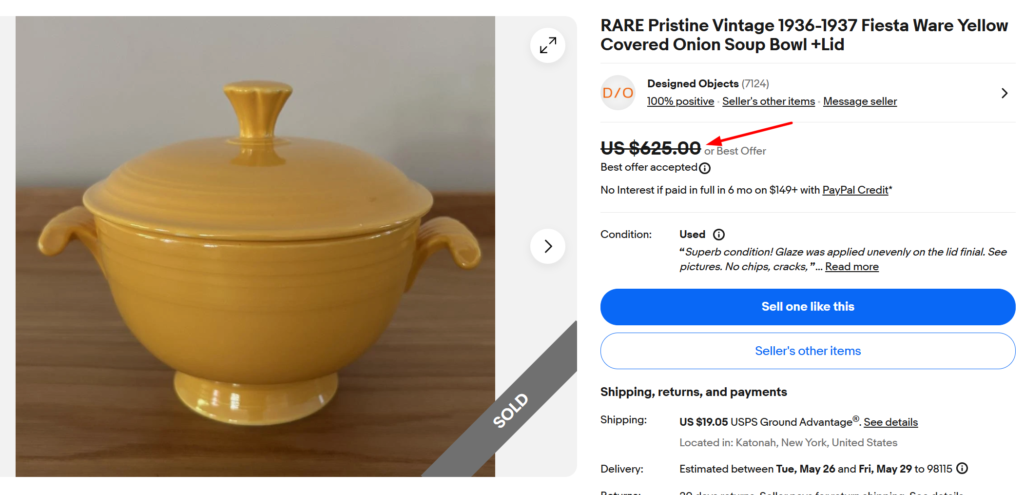
Sold for $625
The covered onion soup bowl is one of the rarest Fiesta pieces. It was only made for less than two years before being retired in the fall of 1937, and never appeared on a Fiesta price list.
Early versions (1936) have a flat interior bottom with the “fiesta” mold mark; later 1937 versions have a rounded bottom and are unmarked.
The bowl was made in five colors plus a tiny number in turquoise. Yellow, ivory, and light green examples with original lids are strong mid-range pieces. Cobalt and red push significantly higher, while the turquoise is the rarest, with fewer than 75 examples known.
- Estimated Value: $400–$900 (yellow, ivory, light green); $1,000–$3,000+ (cobalt or red); $5,000+ (turquoise)
- Production Year: 1936–1937
- What to Check: Lid present; finial intact; no chips on the curved scroll handles.
- Quick Notes: Uneven glaze on the lid finial is common.
2. Fiestaware Yellow Syrup Dispenser
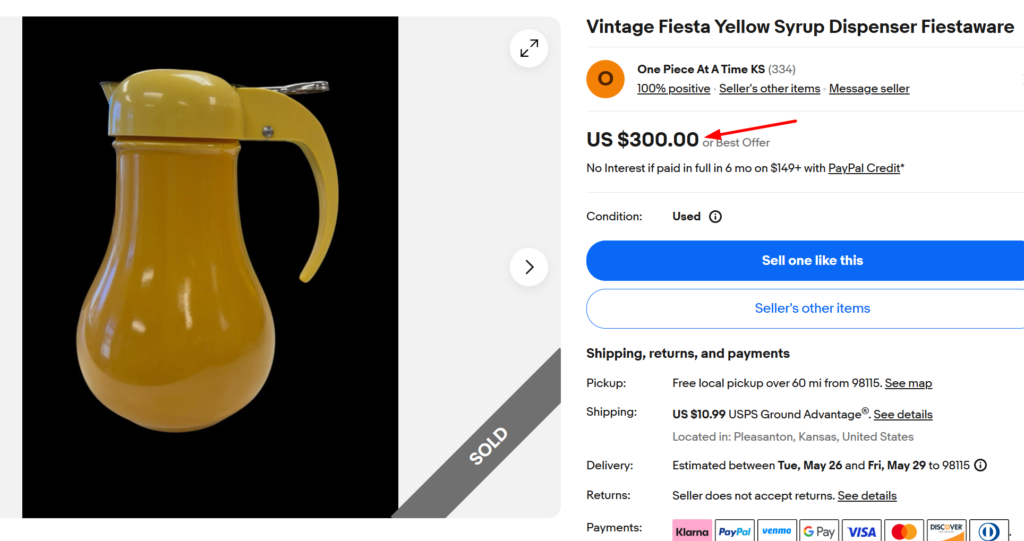
Sold for $300
The Fiesta syrup pitcher is one of the shortest-production items in the vintage line. It was only made for about two years (1938–1940) in all six original colors. The ceramic base was paired with a spring-loaded “Dripcut” metal lid by the Dripcut Corporation of Southern California.
The base is unmarked or has an impressed “fiesta MADE IN USA” mold mark. The Dripcut lid is often engraved “Dripcut,” and the marked versions are more desirable.
The lids are major value drivers. The plastic cracks, melts, or discolors over time. An intact lid is the hard part.
- Estimated Value: $200–$400+ (yellow with intact lid); $400–$800+ (red, cobalt, or ivory)
- Production Year: 1938–1940
- What to Check: Lid present and uncracked; “Dripcut” engraving on lid; impressed “fiesta MADE IN USA” base mark
- Quick Notes: Ivory, red, and cobalt pieces command the highest prices.
3. Original Red Disk Water Pitcher
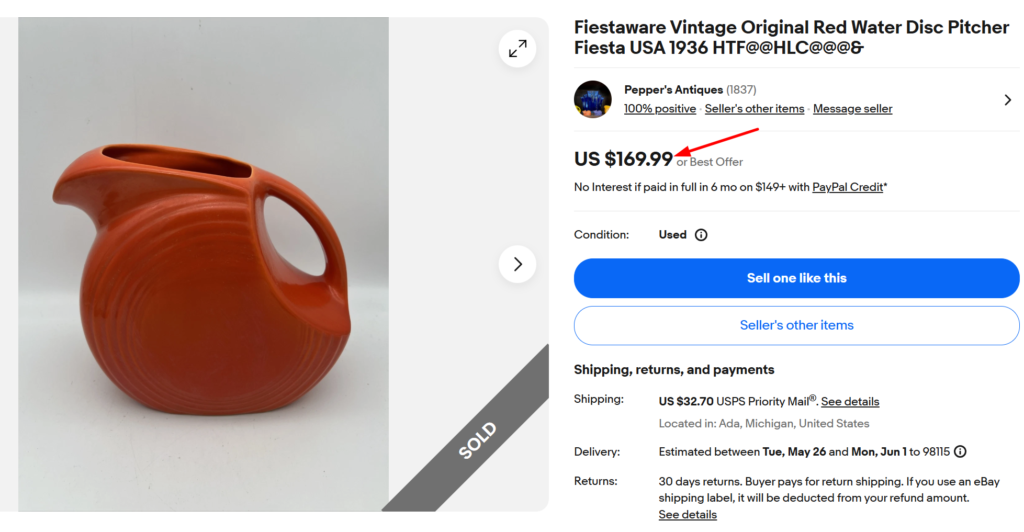
Sold for $170
The disk water pitcher is by far the most distinctive form in the entire Fiesta Line. The pitcher was released two and a half years after its introduction in 1936. It is 7.5 inches high and can hold 71 ounces of liquid, and it even appeared on a 2011 U.S. postage stamp.
Original Red pitchers are the most sought after today because of their color rarity. Even post-1959 Red examples of depleted uranium are valuable. Both eras command a premium over yellow or turquoise versions.
- Estimated Value: $150–$350+
- Production Year: 1938–1944, 1959–1972
- What to Check: “fiesta MADE IN U.S.A.” mold mark; no chips on spout or handle; deep red-orange tone
- Quick Notes: Yellow examples of the same pitcher are common.
4. Fiesta Kitchen Kraft Orange Pitcher
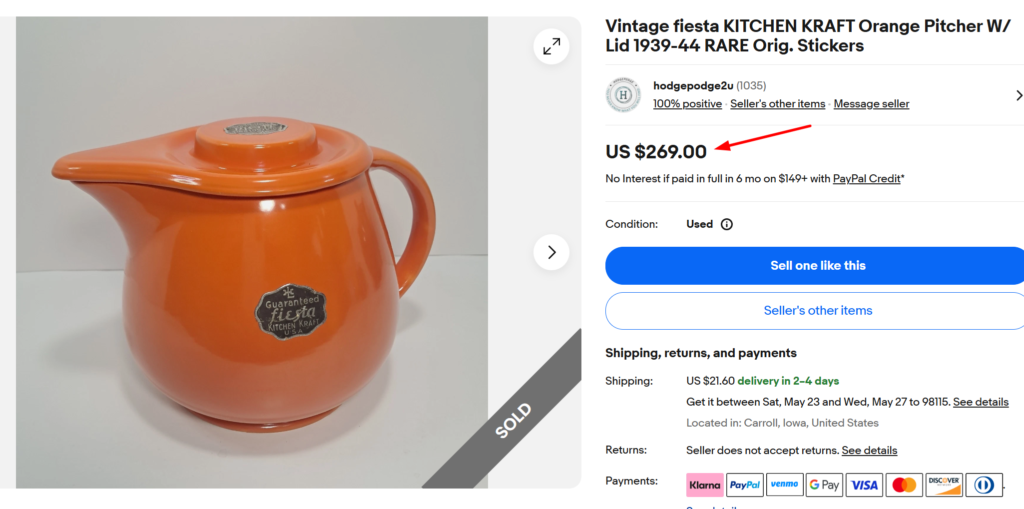
Sold for $270
The Fiesta Kitchen Kraft line was a sister collection of oven-to-table pieces, produced from 1937 to 1944. The covered jug is one of only four lidded items in the line.
It came in two sizes: a 6-inch large version (1937–early 1938) and a 5.5-inch medium version (1938 onward) with a two-step lid flange. Both sizes are hard to find in any color.
The jug is marked with an in-mold “HL fiesta KITCHEN KRAFT U.S.A.” stamp. Many surviving examples still carry their original foil sticker, which adds meaningful value because it rarely survives. The lid is required for the top collector value.
- Estimated Value: $200–$350+ (with lid and original sticker)
- Production Year: 1937–1944
- What to Check: Original lid; “HL fiesta KITCHEN KRAFT U.S.A.” mold mark; intact foil sticker (bonus)
- Quick Notes: The original lid & sticker add a lot of value.
5. Ivory Carafe with Lid
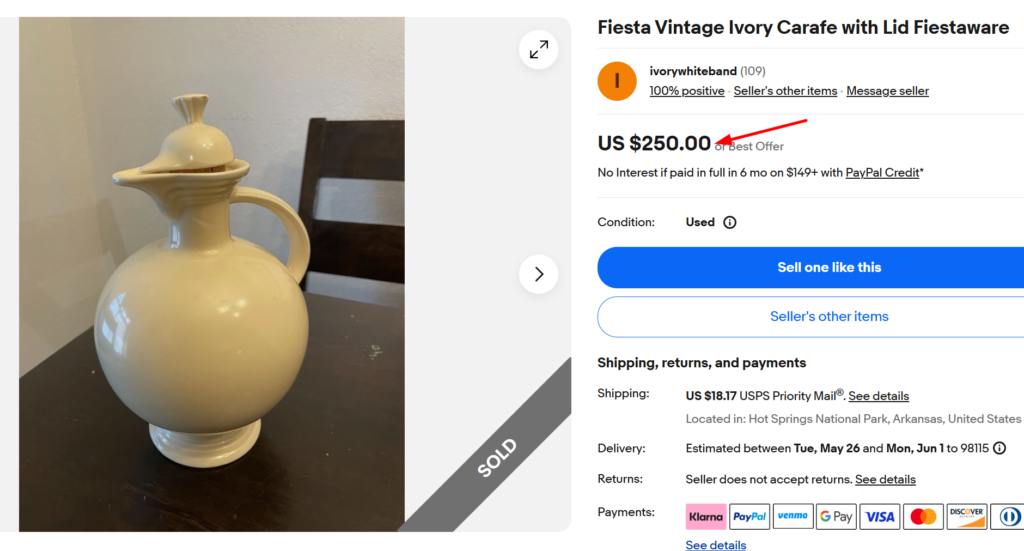
Sold for $250
Carafe is one of the most distinctive pieces produced within the Fiesta range. It is a three-pint pitcher made with a hand-applied finial and cork-lined ceramic lid, measuring around 9.5 inches high.
The carafe was only manufactured for a period of ten years, between 1936 and 1946, in its original six colors and never reissued after that period. That short window makes the carafe scarce in any color.
A complete piece with the original lid is essential for full value, and ivory examples with the lid are a strong mid-range collector buy. Cobalt and red varieties fetch the highest premiums.
- Estimated Value: $200–$300 (ivory); $300–$500+ (cobalt or red)
- Production Year: 1936–1946
- What to Check: Original lid present; cork intact (replaceable but original adds value); finial straight and unchipped
- Quick Notes: Look for the impressed “fiesta HLCo USA” mark on the base.
6. Red Relish Tray (Multicolor Inserts)
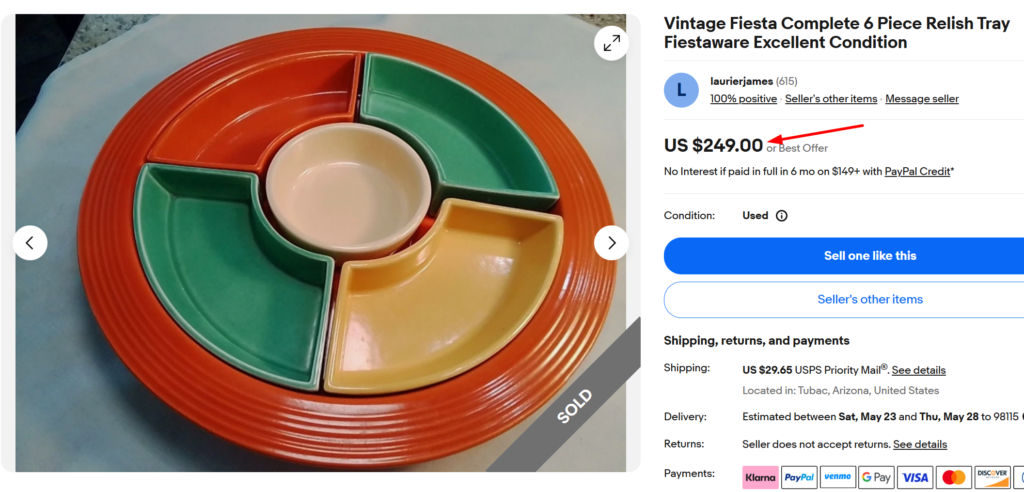
Sold for $250 (complete with inserts)
The relish tray is a six-piece serving set: a round base about 11 inches wide, four wedge-shaped side inserts, and one round center insert. Rhead reportedly borrowed the design from a Japanese import.
These were originally sold as sets in single colors, but collectors quickly started mixing and matching. Today, complete sets with mixed-color inserts are among the most collectible Fiesta configurations.
A red base with assorted color inserts (green, yellow, ivory, turquoise) is one of the most desirable combinations. The base is usually marked “Fiesta HLC USA,” but the inserts vary in marking.
- Estimated Value: $200–$400+ (mixed-color set); $400–$600+ (rare combinations like red base with full original-color inserts)
- Production Year: 1936–1946
- What to Check: All six pieces present; original six colors only (no 1950s colors); inserts fit snugly into the base
- Quick Notes: The backstamp on each piece must match.
7. Cobalt Ice Lip Pitcher
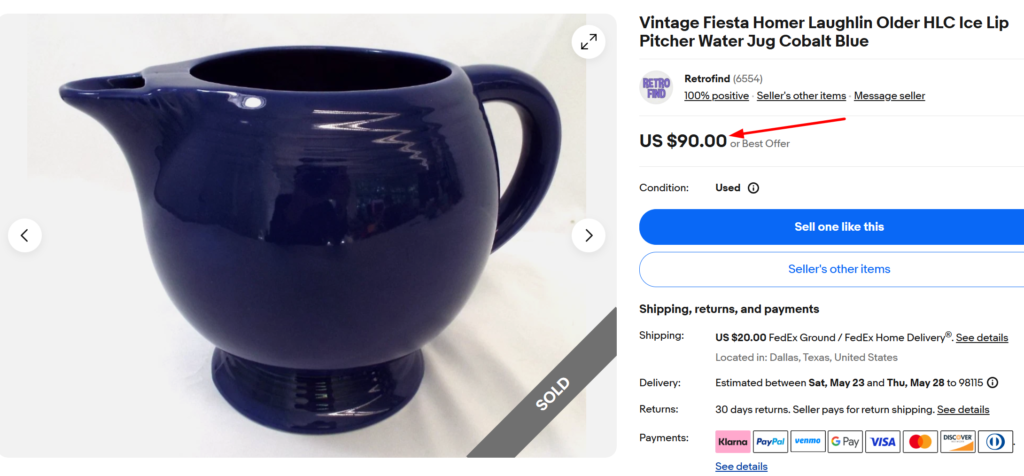
Sold for $90
The ice lip pitcher gets its name from the spout bridge that keeps ice from falling into your glass. It was only made for ten years (1936–1946) in the six original colors, with red discontinued in 1942.
The handle was attached separately by hand, and the foot was flared on a jiggering machine. The body carries Rhead’s signature bands of concentric rings.
Cobalt pitchers in clean condition are mid-range pieces. Ivory is hardest to find clean because the vellum glaze chips more easily than the others.
- Estimated Value: $80–$200 (cobalt, light green, yellow); $300–$500+ (red)
- Production Year: 1936–1946
- What to Check: Bridge across spout intact; handle securely attached; “fiesta HLC USA” mold mark on bottom.
- Quick Notes: The ice lip pitcher never had a lid.
8. Yellow Bud Vase
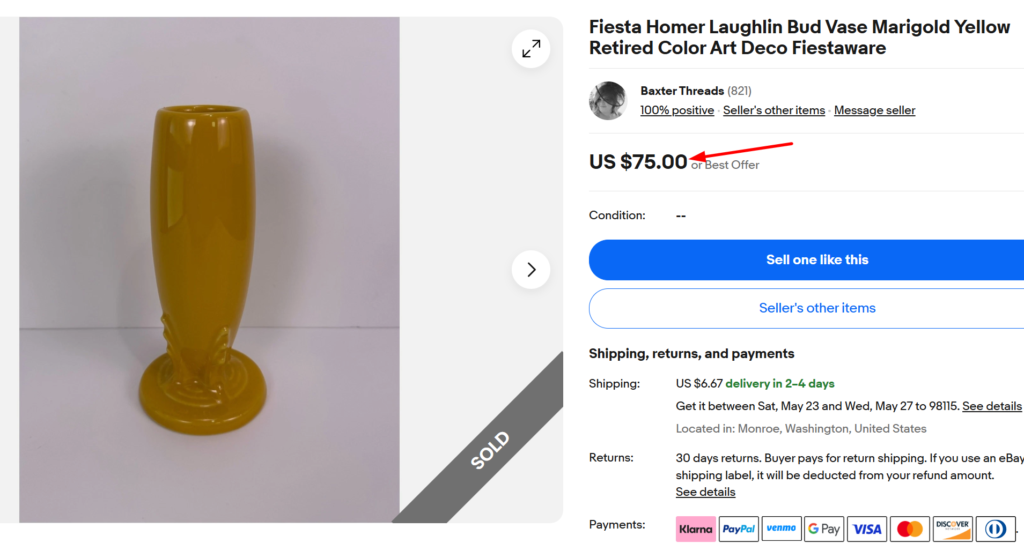
Sold for $75
The bud vase was part of the original 1936 release and was only made for about 10 years in the first six colors. It’s a small and slim vase, which is easier to find than the 8-, 10-, and 12-inch flower vases that came after it.
Although yellow is the most common color for the bud vase, even those pieces are valuable because the shape is so widely copied today. But authentication matters more here than on most pieces.
Check for the dry foot with stilt marks, the lowercase “fiesta MADE IN U.S.A.” mold mark, and a warm vintage yellow tone (more saturated than modern). A raised “H” on the bottom is post-86.
- Estimated Value: $50–$100 (yellow); $300–$800+ (10″ and 12″)
- Production Year: 1936–1946
- What to Check: Dry foot with stilt marks; lowercase “fiesta” mold mark; warm vintage yellow tone
- Quick Notes: A raised “H” on the base indicates modern reproductions.
9. Medium Green Tripod Candleholders
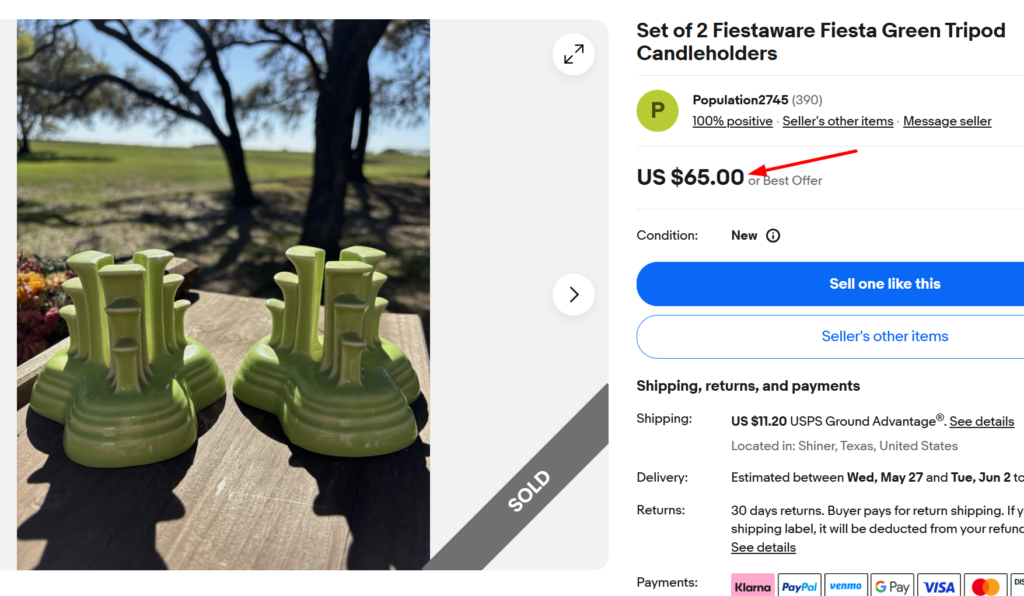
Sold for $65 (pair of two)
The tripod candleholders are widely considered the most architecturally complex shape in the entire vintage line. Rhead labeled them in his sketchbook as “candlestick, three supports.”
They were slip-cast in a four-part mold and hand-assembled. They were only produced for about six years before being discontinued in 1942. Tripod candleholders were ONLY made in the original six colors: red, cobalt, ivory, yellow, light green, and turquoise.
Light green and yellow pairs are mid-range buys, while red and cobalt pairs command the highest prices. A “medium green” or “chartreuse” tripod is always a reproduction or a misidentified piece.
- Estimated Value: $60–$200 (light green, yellow); $700–$1,000+ (red or cobalt pair)
- Production Year: 1936–1942
- What to Check: Fully glazed (wet) foot with stilt marks; no chips on the 27+ edges along the pillars; “fiesta HLCo USA” in-mold mark
- Quick Notes: Repros have sprayed-on glaze visible inside the candle hole; originals are dipped
10. Chartreuse Teapot
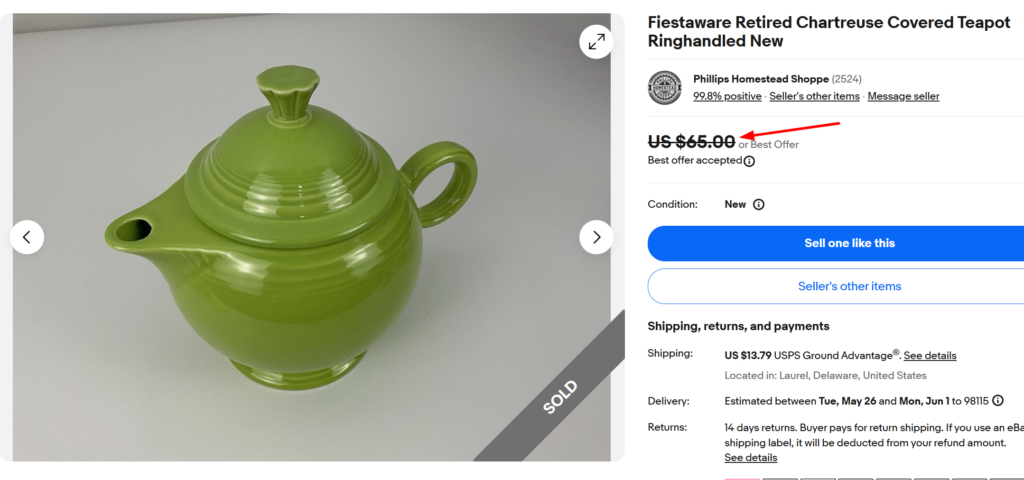
Sold for $65
Chartreuse is the most popular of the four 1950s colors, used for only 8 years. And, the medium teapot is one of the most desirable lidded forms in this color. It comes with a domed lid, hand-applied finial, ring handle, and concentric rings around the body.
Vintage chartreuse teapots in clean condition with original lids are valuable. But note that Chartreuse was also reintroduced as a post-86 color in 1996-97, so check for the lowercase “fiesta” mark and the dry foot to spot a vintage piece.
- Estimated Value: $250–$500+ (with lid, good condition)
- Production Year: 1951–1959
- What to Check: Original lid present; lowercase “fiesta” mold mark; finial intact; no chips on spout tip
- Quick Notes: Check against a known reference to spot post-86 pieces.
11. Gray Sugar & Creamer Set
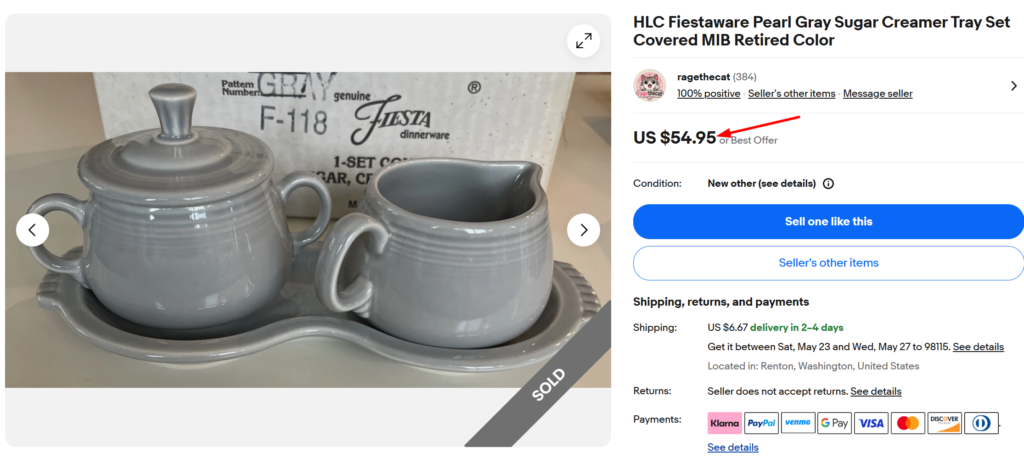
Sold for $55 (set)
The Fiesta sugar and creamer is a classic three-piece set. The sugar bowl has a hand-applied finial top and curved scroll handles, while the creamer carries the iconic ring handle. Both pieces show concentric rings across the body.
Vintage 1950s gray was produced in much smaller quantities than the original six colors. A complete set in vintage gray with the original lid trades well above what the same set brings in yellow. But the pieces should match in glaze tone.
Be aware that Homer Laughlin also released a post-86 “Pearl Gray” color (1999–2001). It uses different molds, looks slightly cooler-toned, and sells for a fraction of vintage gray. So, verify the glaze against a known vintage reference to confirm.
- Estimated Value: $100–$180 (vintage 1950s gray, complete with lid)
- Production Year: 1951–1959 (vintage gray)
- What to Check: Matching glaze on both pieces; lowercase “fiesta” mold mark; finial intact; lid sits flush
- Quick Notes: Missing lids or chipped finials drop the price by 40–60%.
12. Medium Green Chop Plate
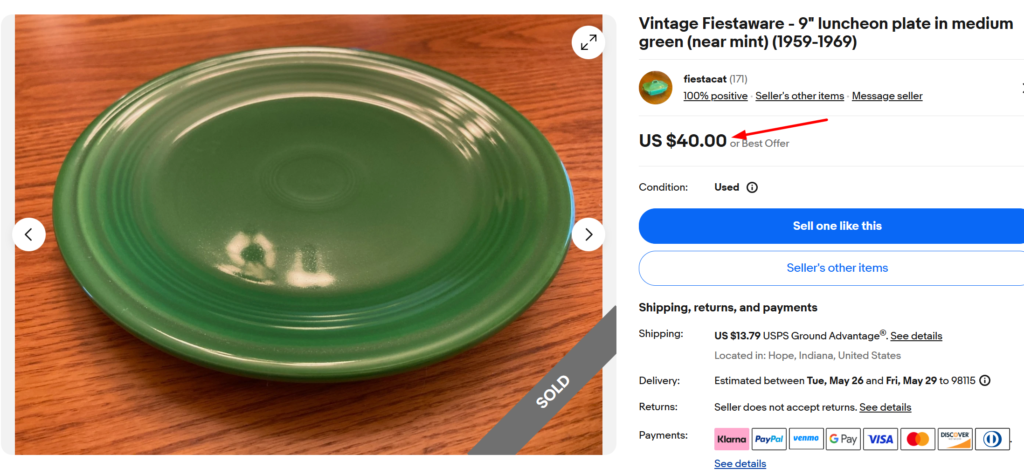
Sold for $40
Any flatware in medium green is valuable because the color was only produced from 1959 to 1969, near the end of the original line. The chop plate (serving plate in either 13-inch or 15-inch diameter) is certainly one of the most desirable shapes.
For example, even the 9-inch luncheon plate in medium green goes for significantly more than it costs in yellow or turquoise. The chop plate pushes higher still. Look for the in-mold “fiesta HLC USA” mark on the back.
- Estimated Value: $40–$80 (luncheon plate); $200–$500+ (13″–15″ chop plate)
- Production Year: 1959–1969
- What to Check: Medium green glaze; intact rim; clear bottom mark.
- Quick Notes: Compare against a known medium green for authenticity.
13. Forest Green Mixing Bowl
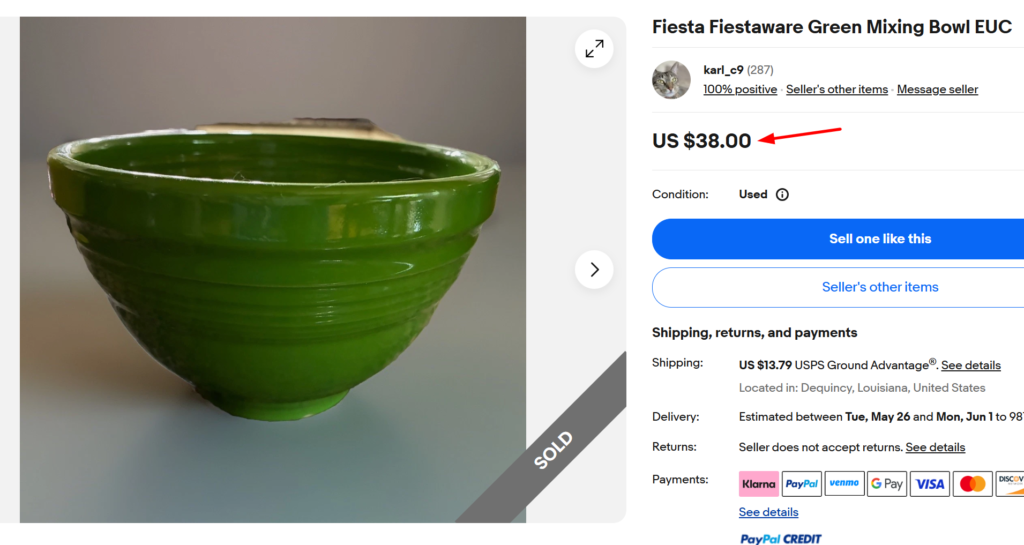
Sold for $38 (single)
The Fiesta nesting mixing bowls were numbered 1 through 7, ranging from a 5-inch #1 up to an 11-inch #7. The complete series was produced only between 1936 and 1944 in the six original colors.
However, between Fall 1942 and Spring 1944, each size was produced in a single color. The #3 was only produced in original green during that window, which makes green #3 examples easier to date but tougher to find in other colors.
Early bowls (1936–1938) have additional rings on the inside bottom and bring 25% more than plain-bottom versions.
- Estimated Value: $35–$60 (#3); $80–$200+ (#7 or early examples); $1,200–$2,500+ (full set)
- Production Year: 1936–1944
- What to Check: Inside bottom rings; in-mold “MADE IN U.S.A.” mark; tap test.
- Quick Notes: Numbered mixing bowls were never made in 1950s colors.
14. Rose Salt & Pepper Shakers
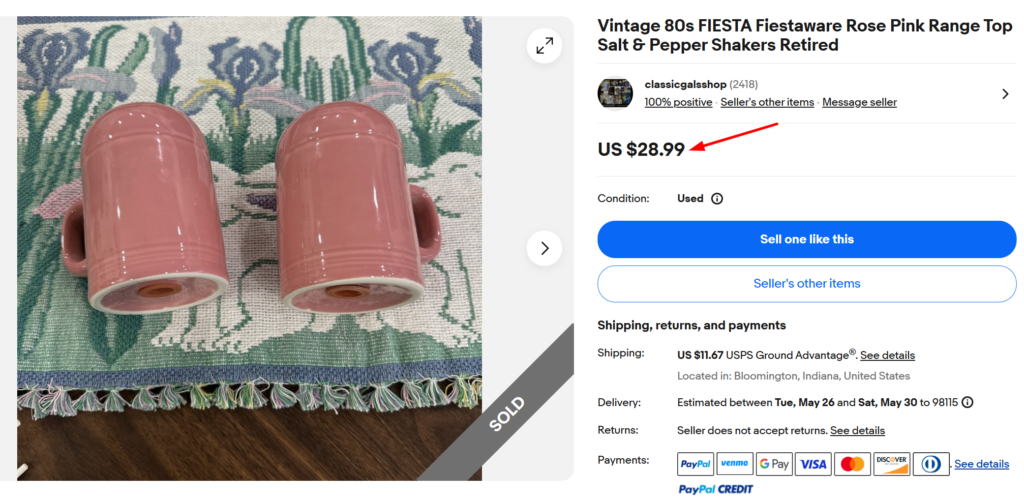
Sold for almost $30 (pair)
The vintage Fiesta salt and pepper shakers ran the entire 33-year production. Both shakers have seven holes, but the salt has larger holes than the pepper, so true pairs will have different hole sizes. They have cork closures at the bottom, which are mostly missing.
This shaker set is in Rose color, one of the colors from the 1950s that was discontinued in 1959, making it rarer than yellow or turquoise.
The shakers are usually unmarked, so check the color and the dry foot for authentication. The post-86 “Rose” reissue (1986–2005) uses different molds and modern markings.
- Estimated Value: $40–$90 (vintage pair)
- Production Year: 1951–1959 (vintage rose)
- What to Check: Both pieces same color; different hole sizes (true pair); unglazed dry foot; original corks (bonus)
- Quick Notes: Confirm vintage pieces by color, foot, and glaze.
15. Turquoise Tom & Jerry Mug
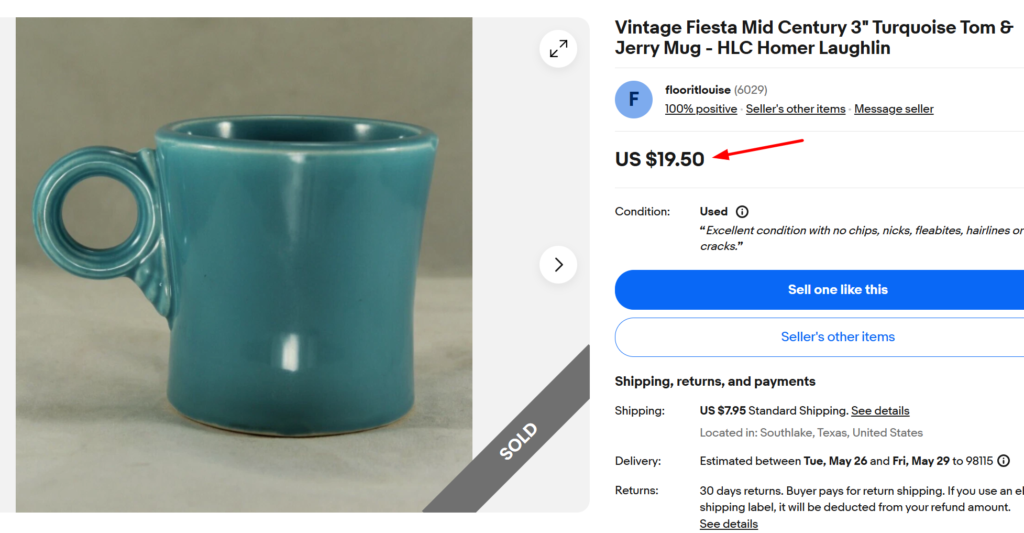
Sold for $20 (single)
The Tom & Jerry mug is the only mug in the original lineup, while everything else is a teacup. This is named after the Tom and Jerry cocktail, which is made by mixing eggs and milk to create a hot beverage.
This features the trademark ring-handle design and an hourglass-shaped body, molded and later polished with metal tools.
The turquoise mugs were made for a long time, from 1937 to 1969, so they are common and moderately priced today. Red or ivory pieces can be worth more.
- Estimated Value: $15–$25 (turquoise); $100+ (red or ivory)
- Production Year: 1937–1969 (turquoise)
- What to Check: Hourglass body shape; ring handle smooth; no chips on the rim; thick walls
- Quick Notes: Red and ivory Tom and Jerry mugs are the rarest.
Fiestaware plates and bowls are fun to use and easy to find. But the real value sits in specific color-and-form combinations. So, always check the mark, compare the color, assess the condition, and crazing before selling or buying.