
Old vintage glass bottles have become popular collectibles, and in some cases, rare glass bottles can sell for huge sums in auctions. The trick is knowing what to look for.
In this guide, I’ll walk you through everything you need to identify valuable bottles, understand what makes them worth money, and show you some real examples that collectors can pay big money for.
Identifying Vintage Glass Bottles (What to Look for)
When it comes to glass bottles, there are numerous types, from early medicine and wine bottles to later milk bottles, perfume bottles, and others!
Figuring out if a vintage glass bottle is valuable needs attention to detail. Once you know what things to look for, it gets easier. Let’s understand all the key signs that help you identify and date old glass bottles.
1. Age Indicators and Manufacturing Methods
Try to understand the way a bottle was made; it can tell you a lot about when it was produced. Here’s what to examine:
Seam Lines:
- Hand-blown bottles (pre-1860s) – No seams at all, or very faint pontil marks on the bottom.
- Mold-blown bottles (1860s-1900s) – Seams run partway up the neck but stop before the lip.
- Machine-made bottles (1900s+) – Seams run all the way to the top of the lip.
Pontil Marks
Look at the bottom for a pontil. If there is an open pontil, which appears as a jagged scar, or an iron pontil, which appears as a circular mark, then you know your bottle was made before 1860. The pontil marks were caused by an iron rod used to hold the bottle.
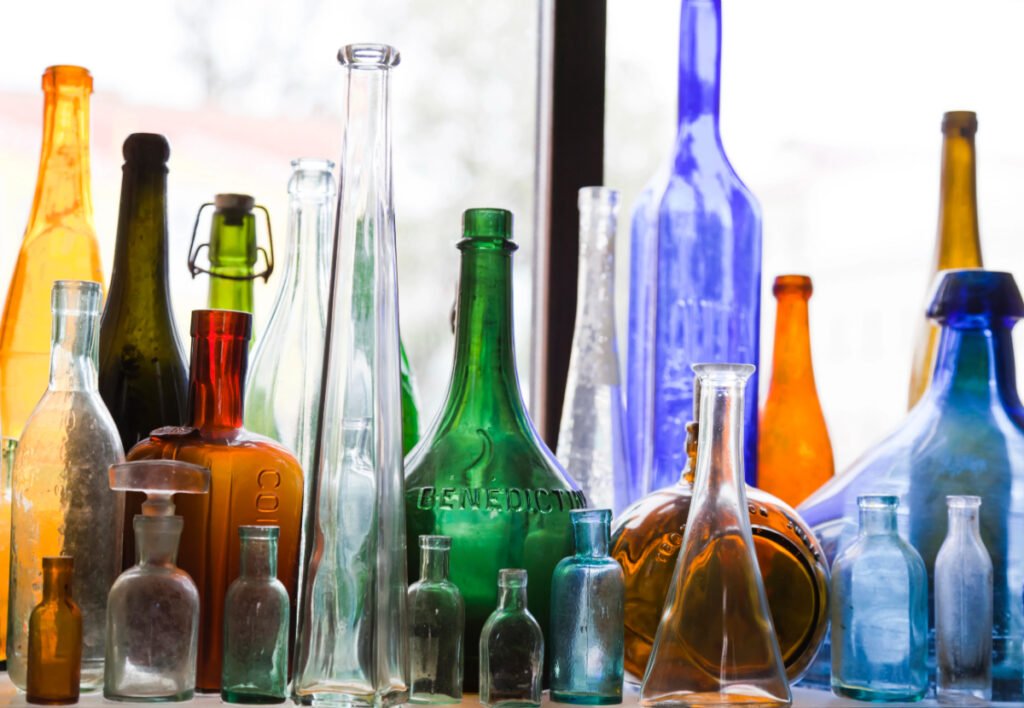
2. Lip and Closure Types
With time, new bottle closure systems and shapes emerged, which are the most reliable signs to date old bottles. Use the table below to determine the age of your bottle by its closure.
| Closure Type | Time Period | What It Looks Like |
|---|---|---|
| Cork top | Pre-1900 | Uneven, hand-tooled lip designed for cork |
| Crown cap | 1892-present | The crimped metal cap groove |
| Screw top | 1910s-present | Threaded finish for screw-on caps |
| Hutchinson stopper | 1880s-1915 | Internal wire loop closure system |
| Lightning closure | 1875-1925 | Wire bail with ceramic or rubber stopper |
3. Embossing, Labels & Maker’s Marks
From the start, different companies have used different ways to mark their bottles. You can identify them by the following types of markings:
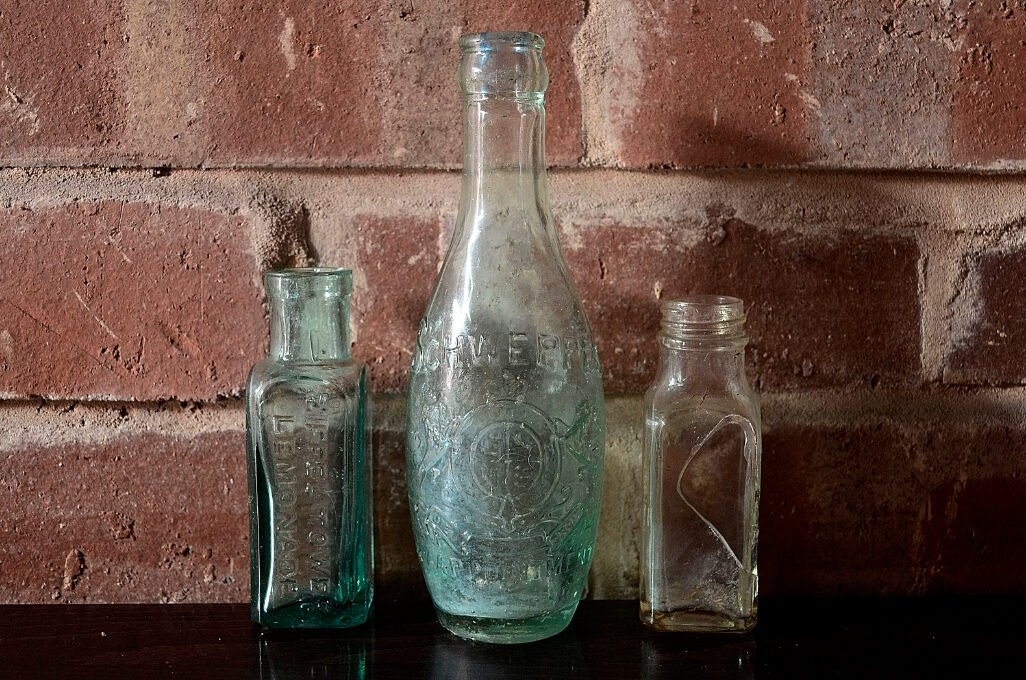
Embossed Text:
This is raised lettering or designs molded into the glass bottle. This can tell you about the company name and location, product information, and date codes or patent information.
Quick Tip: Bottles with crisp, clear embossing from rare or closed companies are generally more collectible. Likewise, those for local bottlers and small-town drugstores are prized, too.
Original Paper Labels
Many vintage bottles had paper labels glued to them instead of embossing. Finding an intact original label is very difficult today, since they are easily lost over time.
Maker’s Marks
You usually find these marks on the base of old bottles. These can tell you about:
- Maker’s marks – Symbols or initials identifying the glass manufacturer (like Owens-Illinois or Whitall Tatum)
- Mold numbers – Help identify production specifics
- Date codes – Some manufacturers included year codes
You can cross-reference these marks with bottle identification guides to pinpoint the exact maker and production period. Some popular vintage bottle makers to know:
- Owens-Illinois (O-I) – Diamond with “I” inside, used from 1929-present
- Whitall Tatum – “W” or “WT” mark, major medicine and poison bottle maker
- Hazel-Atlas – “H” over “A” symbol, common on food and beverage bottles
- Ball Brothers – Made mason jars and commercial bottles, various “Ball” marks
- Anchor Hocking – Anchor symbol, produced from 1938-present
- Brockway Glass – “B” in circle or square, active 1907-1988
4. Shape and Design Features
The shape or design of an old bottle is another great clue to date it, because certain shapes are directly associated with specific eras and uses. Below are some popular designs:
- Blob tops (1840s-1890s) – Thick, rounded lips on soda and beer bottles.
- Hutchinson bottles – Bulbous body with a distinctive closure system.
- Figurals – Bottles shaped like people, animals, or objects.
- Bitters bottles – Often cabin-shaped, barrel-shaped, or had unique, ornate designs.
- Poison bottles – Deliberately made with unusual shapes, ridges, or rough textures so people could identify them by touch in the dark.
How to Value Old Glass Bottles?
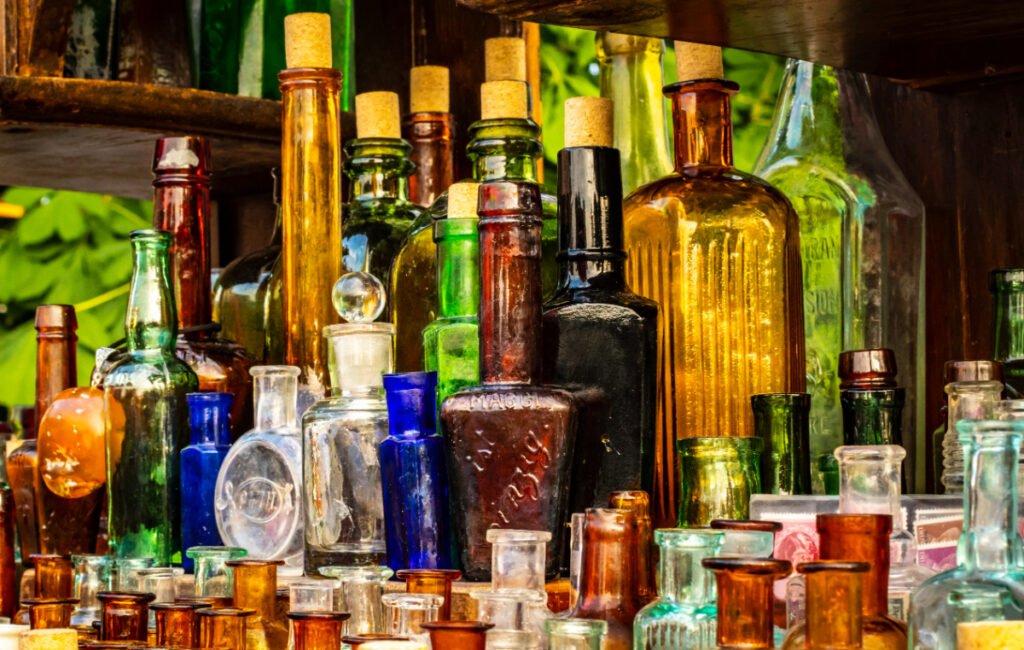
So you’ve identified your bottle, now you might ask, “What’s it actually worth?” The valuation of old glass bottles comes down to a few factors working together.
- Rarity – Rarity is about how many bottles (of a certain type) were made or how many survived? Bottles from small local bottlers, limited production runs, or companies that closed too soon are naturally scarcer.
- Age – Generally, older is better, but not always. A common bottle from the 1700s might be worth less than a rare bottle from the 1920s. Age matters most when combined with other crucial factors.
- Color – Color largely affects the value of a glass bottle. Unusual colors like cobalt blue, purple/amethyst, milk glass, black glass, red, yellow, or other vivid tints are more valuable than common clear, aqua, brow, and green bottles.
- Condition – Even a rare bottle can sell for just a few bucks if it’s damaged. So, check your bottle for cracks, even hairline cracks. Also, look for any chips, especially at the lip or bottom, cloudiness or stains, and serious scratches.
- History – If a bottle is linked to some major historical event, brand, or cultural milestone, it will be more valuable. For example, a prototype bottle for a Coca-Cola bottle or a bottle from a Wild West saloon! Also, documentation, boxes, photographs (if owned by a famous person), and paperwork add value.
- Design & Aesthetics – Bottles with beautiful, ornate, or unusual designs are usually worth more than plain bottles. Figural bottles, fine embossing, and unique shapes are value-boosting features.
- Demand – Like all vintage items, some bottle styles are just more popular than others, namely Bitters bottles, poison bottles, and early soda bottles. You can research current auction results and online sales to get an idea.
7 Most Valuable Vintage Glass Bottles to Know!
Below are some vintage bottles that have all sold for impressive money. Each one has something special that pushed its price sky high!
1. Vintage Gatorade Glass Bottle 1969 Stockley Van Camp
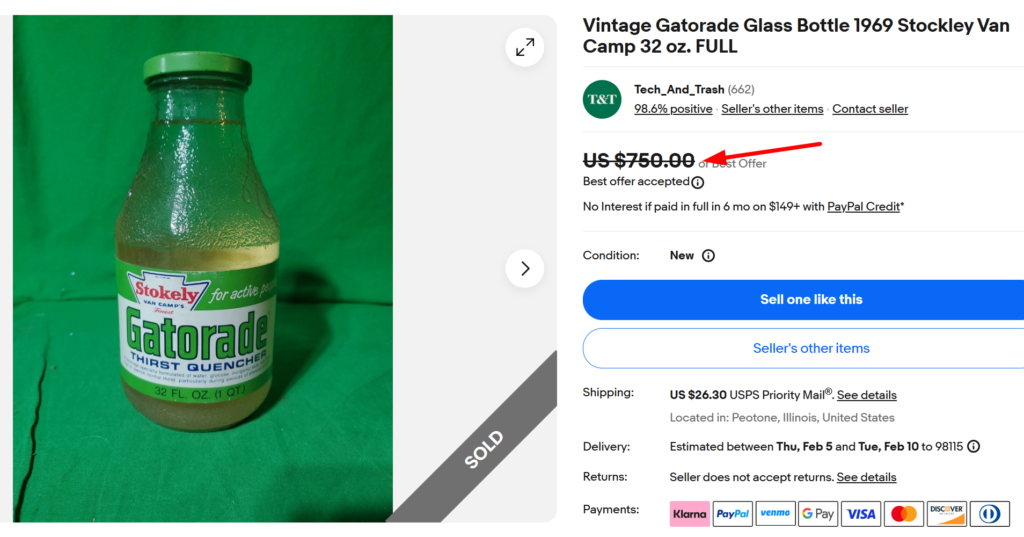
SOLD FOR 750
Early Gatorade came in glass before switching to plastic in the 1970s. This 1969 Stokely Van Camp version with original contents and label was an early commercial production. The textured glass, sealed liquid, and intact “Thirst Quencher” label set these bottles apart!
- Estimated Value: $400-$900
- Brand: Gatorade (Stokely Van Camp)
- Production Year: 1969
- Pattern: 32 oz textured glass with original label
2. Dr. Townsend’s Sarsaparilla Green Bottle
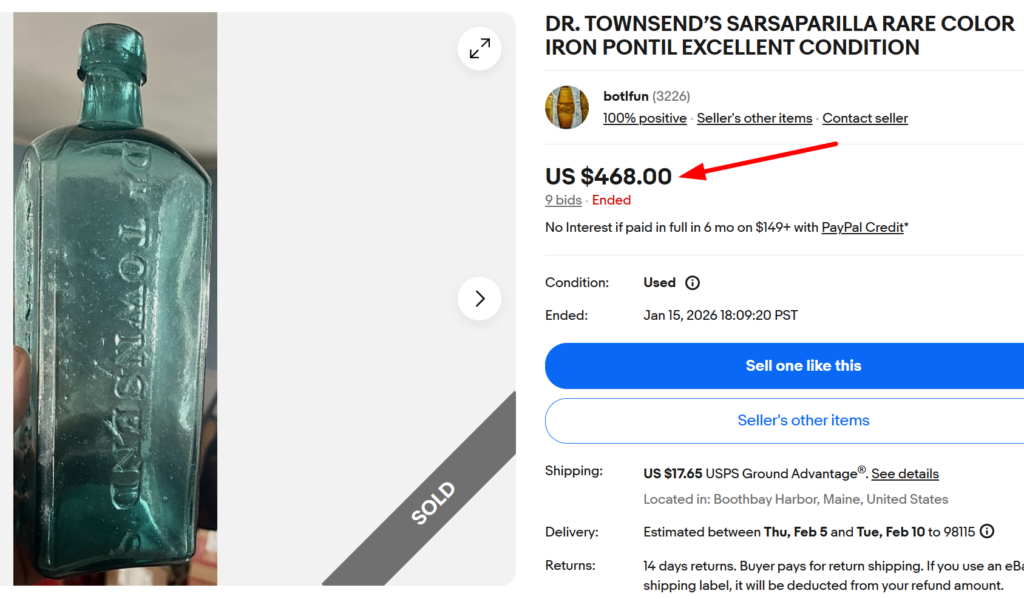
SOLD FOR OVER $465
This rectangular bottle with a pontil mark and applied top was made for one of the most famous patent medicine companies of the era. The green color happened due to specific glass-batch chemistry that wasn’t consistently replicated. Green examples of this 1840s-1850s medicine bottle are rare!
3. Davis Dairy Lockhart Quart Milk Bottle
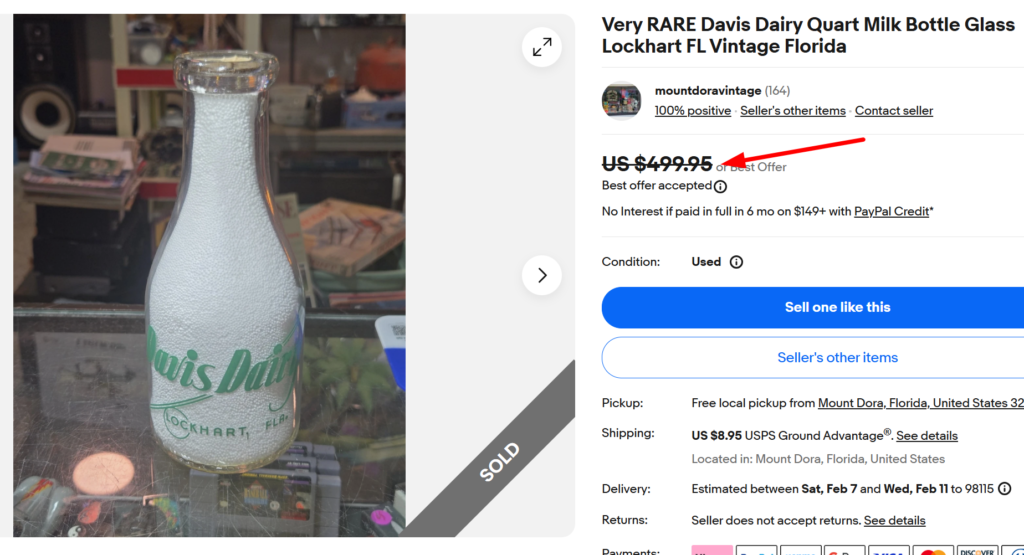
SOLD FOR ALMOST $500
As we learned earlier, embossed quart milk bottles from small local dairies are rare. This Davis Dairy bottle from Lockhart, Florida, has raised lettering and the classic cream-top neck. The regional appeal makes such old milk bottles collectible.
- Estimated Value: $200-$500
- Brand: Davis Dairy
- Production Year: 1940s-1950s
- Pattern: Embossed quart milk bottle
4. Bols Ballerine Bottle
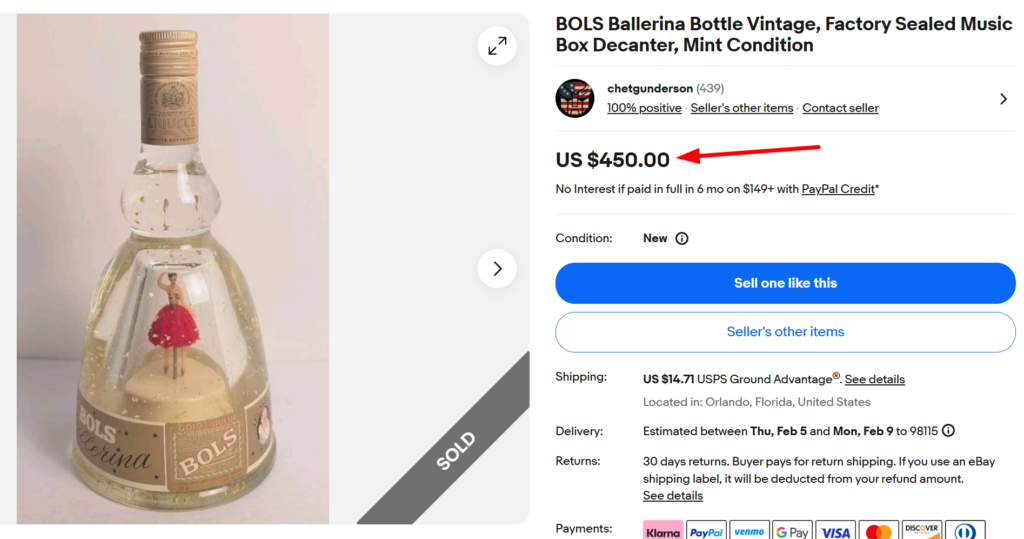
SOLD FOR $450
This Dutch liqueur bottle comes with a tiny ballerina that works as a wind-up music box. Such items were produced in the 1950s-1960s as costly promotional items or decorations.
Factory-sealed examples like this, especially with working music mechanisms and unfaded ballerinas, are worth the most!
- Estimated Value: $450-$650
- Brand: Bols
- Production Year: 1950s-1960s
- Pattern: Ballerina figural music box decanter
5. Straight-Sided Coke Bottle Hamlet
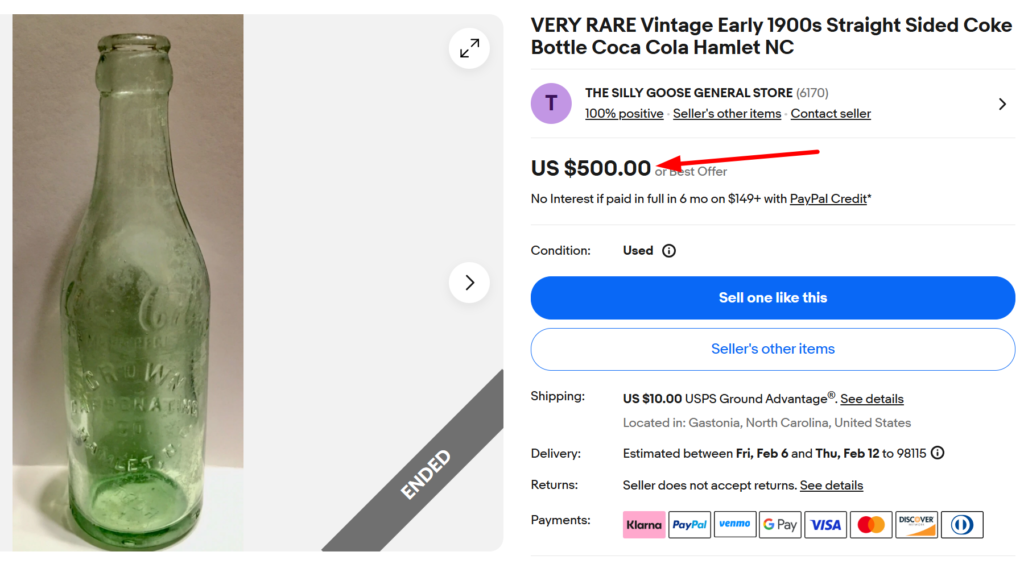
SOLD FOR $500
Before the famous 1915 contour bottle, Coca-Cola used straight-sided bottles embossed with bottler locations. This early-1900s example from Hamlet, North Carolina, shows a crown cap closure and raised “Coca-Cola” script. Such small-town bottlers had brief and limited production, making them rare and valuable.
- Estimated Value: $300-$700
- Brand: Coca-Cola (Hamlet, NC bottler)
- Production Year: Early 1900s (pre-1915)
- Pattern: Straight-sided with crown top
6. Signed R Lalique French Glass Perfume Bottle
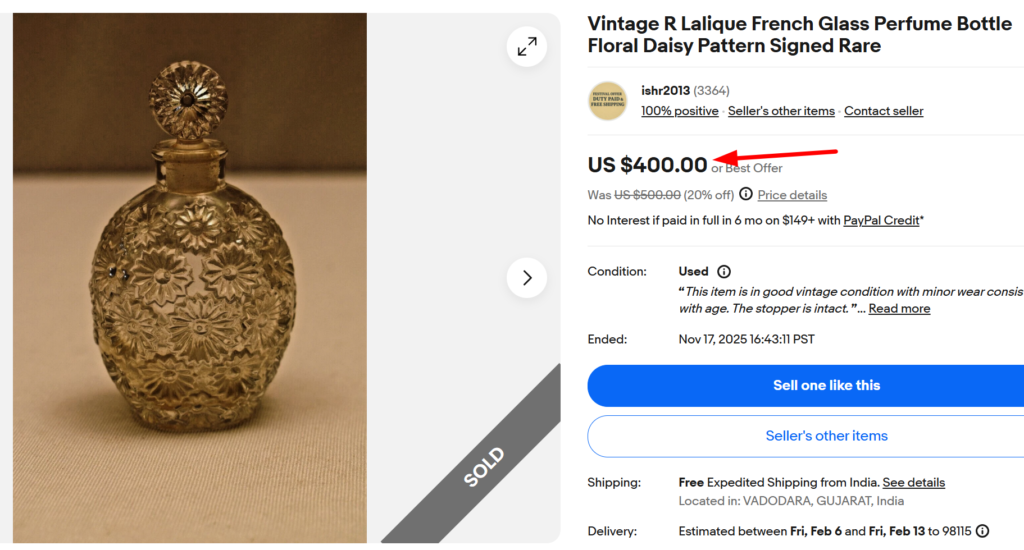
SOLD FOR $400
René Lalique perfume bottles from the 1920s-1930s are super valuable. This signed bottle has daisy/floral relief molded into amber-tinted glass with an ornate stopper. Lalique produced such bottles for specific perfume companies for limited periods, making them rare!
- Estimated Value: $300-$800
- Brand: R. Lalique (René Lalique)
- Production Year: 1920s-1930s
- Pattern: Floral/Daisy relief with ornate stopper
7. J.J. Melchers Flesje Gin Bottle
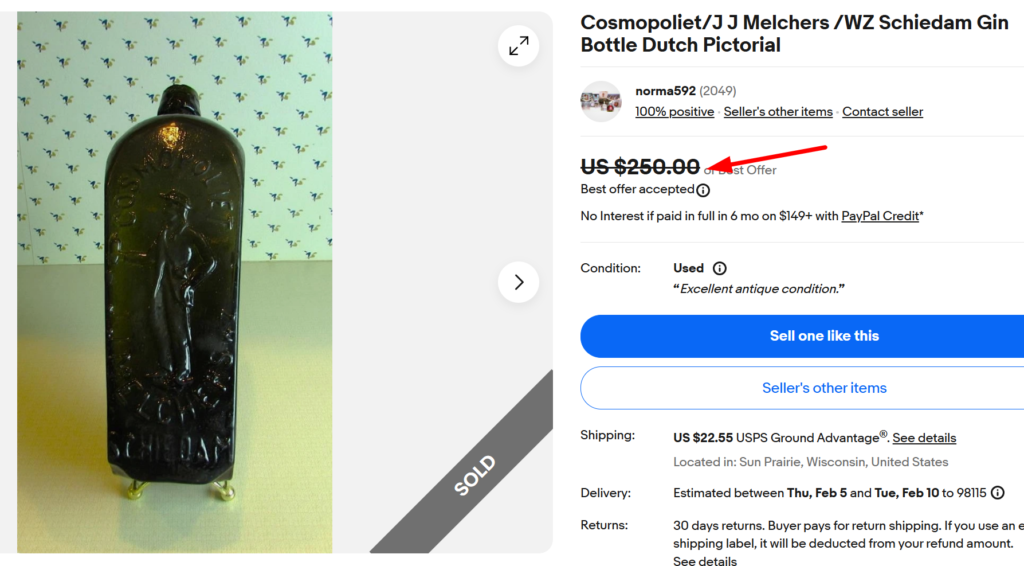
SOLD FOR $250
J.J. Melchers produced these dark olive-black glass Dutch gin bottles in the traditional square-case gin shape. The embossing shows imagery of a man in a hat, which must have needed expensive molds and skilled production. Finding this 150+-year-old bottle in good condition today can be a big deal!
- Estimated Value: $100-$300
- Brand: J.J. Melchers
- Production Year: 1800s
- Pattern: Square case gin with pictorial embossing
Exploring flea markets or digging your own attic, knowing what to look for can save you from passing on a valuable old bottle! So, save this guide before you begin your hunt!